Evergreen Foliage For Christmas Decor

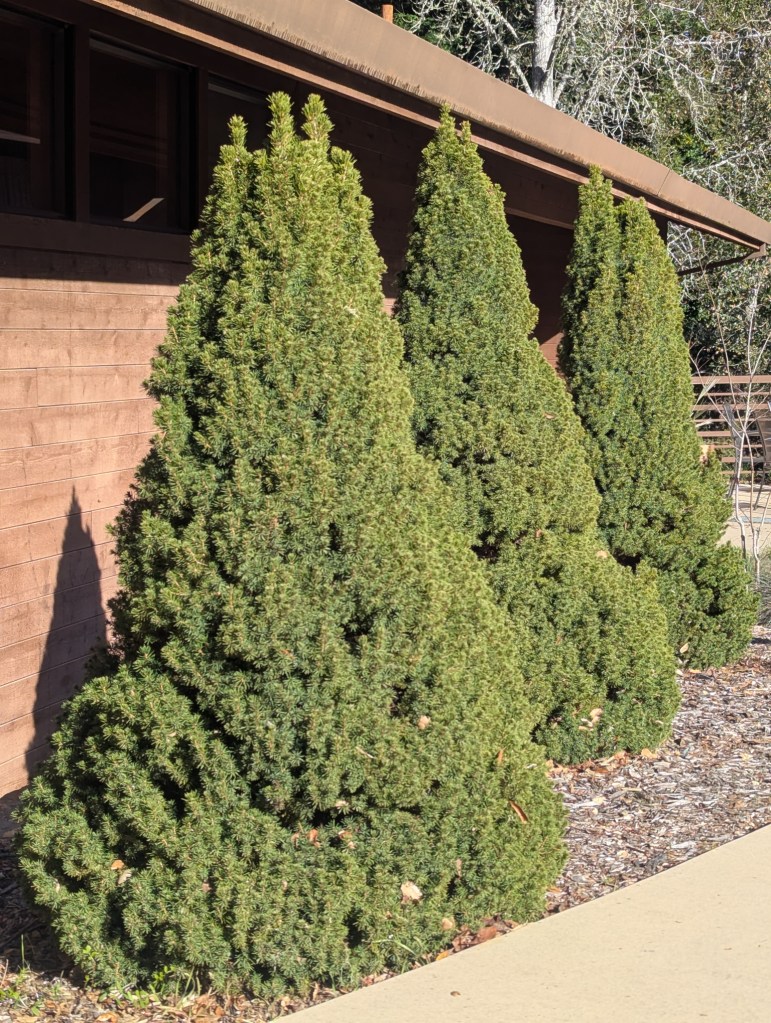
Pines provide delightful cut evergreen foliage.

Berries such as firethorn might be the most colorful features of some home gardens now. Flowers can be scarce for late autumn and winter. Yet, people still enjoy decorating their homes with vegetation from their gardens. Cut evergreen foliage actually becomes more popular than cut flowers had been. It is a basic component of traditional Christmas decor.

Christmas trees are the most extreme form of cut evergreen foliage. With few exceptions, though, they do not grow within home gardens. Instead, they grow on farms and become available for sale before Christmas. Availability from such sources is remarkably diverse. Not many home gardens have adequate space for cut Christmas tree cultivation anyway.

Wreaths and garlands are the second most extreme forms of cut evergreen foliage. Many are available for sale like cut Christmas trees are. However, many people create wreaths and garlands from what inhabits their gardens. After all, wreaths and garlands are merely stylized floral design which lack containers. Most, but not all, lack anything floral as well.

Because wreaths and garlands lack containers, their components must not wilt too soon. The best evergreen foliage is coniferous. However, some broadleaf foliage works nicely. Even defoliated deciduous twigs can be intriguing. Pine cones can substitute for flowers. There are not many rules to floral design, or for the composition of wreaths and garlands.

Collection of evergreen foliage for wreaths and garlands should not disrupt a landscape. Ideally, such foliage should be in need of removal anyway. For example, stems that need pruning can provide significant material. Pruning cuts from source material must be done properly, without stubs or disfigurement. The many rules of responsible gardening apply.

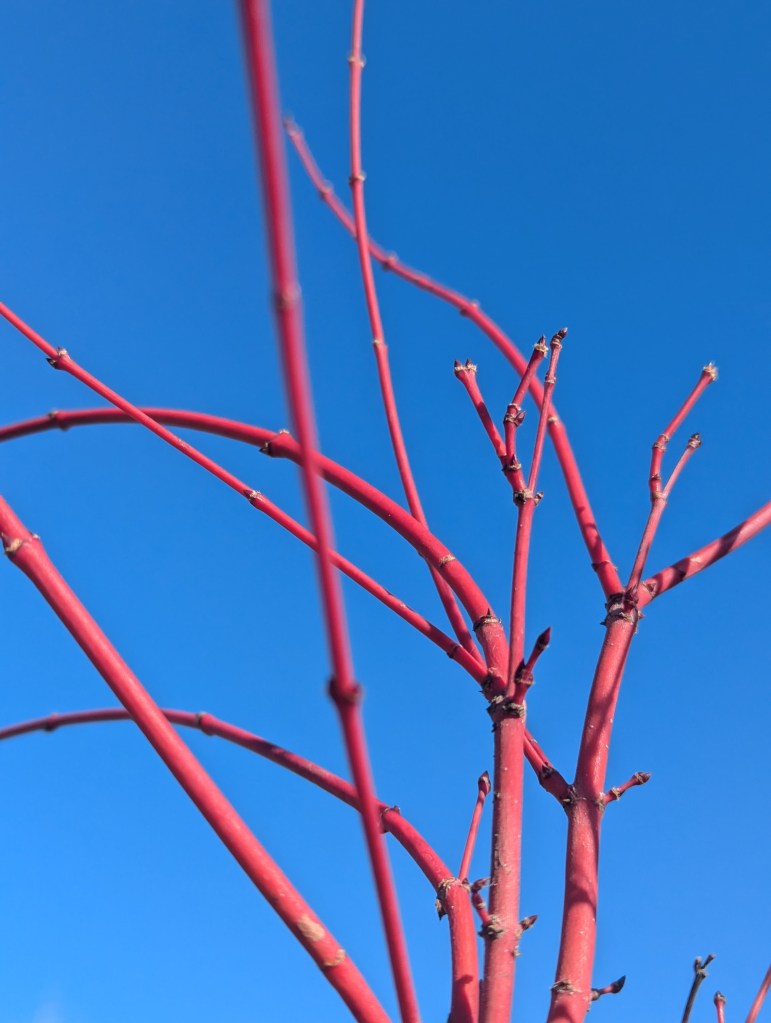
Fir, spruce, pine and cedar are some of the better evergreen foliage for Christmas decor. They are uncommon, though, within local home gardens. Italian cypress, arborvitae and juniper are more common. Boxwood, various hollies and various pittosporums are some broadleaf alternatives. Southern magnolia and New Zealand flax may add bold contrast. So do coral bark Japanese maple twigs or tufts of ornamental grass.

Six on Saturday: More Unseasonal Azaleas

Half of these blooms are right on time. The other half are azaleas that really should wait until spring to bloom. I hope that some refrain from blooming now to bloom in season.

1. Osmanthus fragrans, sweet osmanthus may not be much to look at, but is exquisitely fragrant. I believe that the current cool and humid weather enhances its floral fragrance.

2. Viburnum tinus, laurustinus, which is not typically very fragrant, likewise seems to be more fragrant with cool and humid weather. This one blooms white without pink blush.

3. Osteospermum ecklonis, African daisy blooms significantly less while weather is cool, but seems to never be completely without bloom. This one blooms with a billowy center.

4. Rhododendron spp., azalea should not be blooming now. Flowers that bloom now will be finished and unavailable to bloom in spring. I believe that this cultivar is ‘Coral Bells’.

5. Rhododendron spp., azalea, which is likely ‘Fielder’s White’, is blooming prematurely also. If I remember correctly, it typically does this, but somehow blooms for spring also.

6. Rhododendron spp., azalea with double bloom is probably a recycled florist specimen. I have no idea what cultivar it is. It certainly is colorful. I hope it saves bloom for spring.

This is the link for Six on Saturday, for anyone else who would like to participate: https://thepropagatorblog.wordpress.com/2017/09/18/six-on-saturday-a-participant-guide/

Norfolk Island Pine

Norfolk Island pine seems to have been built rather than grown.

            In coastal areas of Southern California, the Norfolk Island pines, Araucaria heterophylla, are among the most distinctive large trees. Perhaps they are better described as ‘unusual’ . . . , or even ‘strange’. They are so symmetrical that they seem to have been assembled from prefabricated kits than to have grown as natural trees. Their strictly organized conical branch structures and remarkably straight central trunks are always visible through their uniformly open canopies. In such mild climates, they can get nearly a hundred feet tall and half as wide, so are not easy to hide. In Hawaii, their symmetry has actually made them popular as Christmas trees. Their finely textured juvenile foliage is comprised of narrow, half inch long pine-needle like leaves, which are wider among adult growth.

            Locally though, Norfolk Island pines are primarily enjoyed as houseplants, particularly since they can grow slowly and live in pots for many years. The climate is just a bit too cool in winter for them to be very happy in the garden. However, as they eventually get too large for their homes, many end up in the garden anyway. They stay much smaller and are not nearly as symmetrical as they are in milder climates, and may be damaged by the more severe frosts every few years, but they have a certain appeal and distinction regardless. Those that get planted in the garden while young seem to be more symmetrical than those that get disfigured by living as houseplants longer. For some reason, trees that develop weak or curved trunks as houseplants tend to continue to grow with interestingly irregular trunks and branch structure.

Frost Protection

For many species, frost damage is not as bad as it looks.

            My colleague in the Los Angeles area still sends me seeds for all sorts of strange plants that I probably should not be growing in my less climactically temperate garden, making it difficult to conform to the primary rule of frost protection: ‘Select plants that are appropriate to the particular climate.’ No matter how often I remind my clients of this rule, I really do not want to abide by it. There are just too many interesting but inappropriate plants.

            So the next option is to grow frost sensitive plants in containers that can be moved to sheltered areas prior to frost. That worked while I had an extra parking space in the carport and some room under the porch for giant bird-of-Paradise, plumeria, philodendrons and such. Eventually though, some of these plants get too large to be contained; and I really do not want to keep pruning them back. Besides, I prefer to grow things in the ground.

            The third option is to put sensitive plants in spots that are naturally warmer, or where they are sheltered below the canopies of large evergreen trees, lath or wide eaves. Just remember that plants under eaves are also sheltered from rain, so may need to be watered occasionally through winter. Steep slopes are not quite as cold because cold air drains off. However, flat areas below slopes get colder as they catch cold air that drains from uphill. South facing exposures are of course warmer than northern exposures.

            I know probably better than most that there are always some plants that are not ‘appropriate to the particular climate’, that I do not want to grow in pots, and that prefer to be out in exposed parts of the garden. For example, bougainvilleas are somewhat tender, have sensitive roots that do not like to be confined, and really want to be out in the open to take advantage of warming sunshine during summer. Such plants in colder areas will either need to be protected, or will get damaged by frost.

            Burlap suspended above the foliage by stakes is typically enough to protect sensitive plants from frost. I have used old towels and linens where my neighbors can not see. Plastic sheeting is also effective, but should be removed before sunlight warms the air too much underneath. Paper grocery bags or cardboard boxes are enough for small plants.

            I actually allow some of my larger plants that would be difficult to cover to get damaged by frost, and then prune out the damage later. If they are too big to cover easily, they are probably big enough to survive frost. Damaged stems should be left until the end of winter both to insulate stems below, and also because early pruning stimulates new growth that is even more sensitive to frost. 

Pollinator

A pollinator is a vector of pollen, besides wind. Most are insects. Some are animals. Their only qualification is that they collect and deliver pollen between flowers. Almost all are unaware that they do it as they visit flowers for nectar, which the flowers produce to attract pollinators. Bees, which are probably the most common pollinators, visit flowers to collect pollen with which to make their honey, and pollinate in the process.

So, what about the flowers that provide pollen for pollination, particularly for dioecious species such as hollies, date palms and kiwi vines? (Dioecious plants are either male or female.) ‘Bing’ cherry is not dioecious, but is not self pollinating either, so needs another cultivar of sweet cherry for cross pollination. Such a cultivar is known as a pollinator.

My female kiwi vine just recently acquired a male pollinator. It does not look like much yet, but will grow up to bloom with male flowers to provide pollen for the female flowers of the vemale vine. Because kiwi vines are dioecious, the female vine would be fruitless without pollination from the male vine. Perhaps the male pollinator will need a pollinator to deliver its pollen to the female vine.

Atlas Mountain Palm

Atlas Mountain palm resists frost damage.

Mediterranean fan palm is a shrubby palm, with a few small trunks. Atlas Mountain palm, Chamaerops humilis var. argentea, is an even shrubbier variety. Mediterranean fan palm can grow slowly to about twenty feet tall. Atlas Mountain palm grows even slower to only about eight feet tall. Its several trunks become strikingly sculptural only after many years.

The primary allure of Atlas Mountain palm, though, is its distinctly silvery gray foliar color. Individual fan shaped leaves may be nearly two feet broad, with deep and narrow clefts. Petioles are so nastily thorny that grooming and pruning can be painfully difficult. Mature trunks can be six inches wide with dense coats of petiole bases. Bloom is not prominent.

Atlas Mountain palm is notably undemanding. Once established, it does not crave much water or fertilizer. Nor is it finicky in regard to soil quality. It is resilient to both extremes of heat and cold. After several years, it might benefit from thinning of superfluous trunks and pups. Like many palms, Atlas Mountain palm should perform well within big pots or tubs.

Frost Is Not An Enemy

Among canna, frost damage is harmless.

Rain was one clue. Cooler weather is another. It is now so late into autumn that it will be winter soon. Every regional climate experiences some degree of chill. Some, particularly to the north, experience frost. This limits gardening in two ways. Several species prefer a bit less cool weather. Several prefer a bit more. Every species prefers a particular range.

Apple trees, for example, require vernalization, which is a specific duration of chill. Some cultivars require more than others. Without it, they can not distinguish seasons, so do not know when to bloom for spring. Consequently, few cultivars of apple perform adequately within Los Angeles. However, many perform very well in the cooler climates of San Jose.

Banana trees, conversely, need no chill, and are instead set back by frost. Some tolerate a bit more chill than others; but ultimately, they are all tropical species. They produce fruit only within the months between frosts. Consequently, not many banana trees are notably productive within San Jose. However, they perform better in the climates of Los Angeles.

Banana trees stop growing when the weather is cooler than fifty degrees or so. That is a bit too much chill for them. However, frost does not occur until the weather is cooler than thirty-two degrees. Banana foliage can therefore be safely dormant during chilly weather. That is a range of twenty-two degrees. Different tropical species survive different ranges.

The simplest form of frost protection is to not cultivate species that are vulnerable to frost. This is, of course, a bit too restrictive for many who enjoy gardening. Instead, some grow vulnerable species in pots to move to shelter prior to frost. Some simply grow vulnerable species below the shelter of eaves or big trees. Tenting may also be effective protection.

Alternatively, some species can endure frost damage to recover during warmer weather. If possible, outer foliage that succumbs to frost should remain through winter. It insulates inner growth from subsequent damage. Besides, premature grooming can stimulate new growth that is more vulnerable. Many perennials prefer cutting back after winter anyway.

Six on Saturday: Ferns

After the warm and arid summers here, ferns enjoy the beginning of the rainy season in late autumn or early winter, which is about now.

1. Adiantum capillusveneris, Southern maidenhair fern replaces all its tired old foliage for autumn. It resembles native species of maidenhair fern, but with distinct foliar form.

2. Nephrolepis cordifolia, sword fern remains within a big pot because it can be invasive in the ground. It is directly related to Boston fern, but is not quite as soft and pendulous.

3. Dryopteris erythrosora, autumn fern is the only fern here that exhibits autumn foliar color. It is pretty, but quite diminutive. It is no bigger now than it was several years ago.

4. Polystichum munitum, Western sword fern and the next two ferns are native here. All three grow wild within some of our landscapes; and all are remarkably tolerant of shade.

5. Athyrium filixfemina, lady fern is also known locally as ostrich plume fern, but is not related. It has tender leaves with almost succulent rachises that break easily if disturbed.

6. Woodwardia fimbriata, giant chain fern has a similar foliar texture, but is bigger and more resilient than lady fern. We sometimes need to remove big superfluous specimens.

This is the link for Six on Saturday, for anyone else who would like to participate: https://thepropagatorblog.wordpress.com/2017/09/18/six-on-saturday-a-participant-guide/