 They are not a myth. They are quite real. So are the related and similar deciduous azaleas. There are certainly not as popular or as diverse as the familiar evergreen cultivars, but they have their place.
Like the popular evergreen cultivars, deciduous rhododendrons and azaleas have been extensively bred so that they are more spectacular than their ancestors in the wild. They lack the purples and blues of the evergreens, but they compensate with bright oranges and yellows that are uncommon among the evergreen cultivars, as well as reds, pinks and whites. Some of their colors are bright and fiery, while some are more relaxed. Compared to evergreen rhododendrons, the flowers of the deciduous rhododendrons are smaller, thinner, and suspended in smaller trusses. However, these smaller trusses are often significantly more abundant, and are flashier as they bloom before new foliage develops in spring.
Deciduous rhododendrons and azaleas are not grown for the foliar color in autumn, but where autumn weather is cold enough, their foliage can color somewhat well. It is mostly clear yellow, but can sometimes turn orange before falling away cleanly, leaving neatly bare stems through winter.
What deciduous rhododendrons and azaleas excel at that their evergreen counterparts can not compete with is their fragrance. Many are moderately fragrant. Some are VERY fragrant. It is rare that such showy flowers are also so fragrant. (Most flowers rely on one technique or another to attract pollinators.)
Now that the evergreen rhododendrons are blooming, our few deciduous rhododendrons are just about finishing. Visitors often ask about the fragrance, since they do not expect fragrance from rhododendron or azalea flowers, even though they can see little else blooming in same area. These flowers are so popular that we would like to plant more near windows of meeting rooms.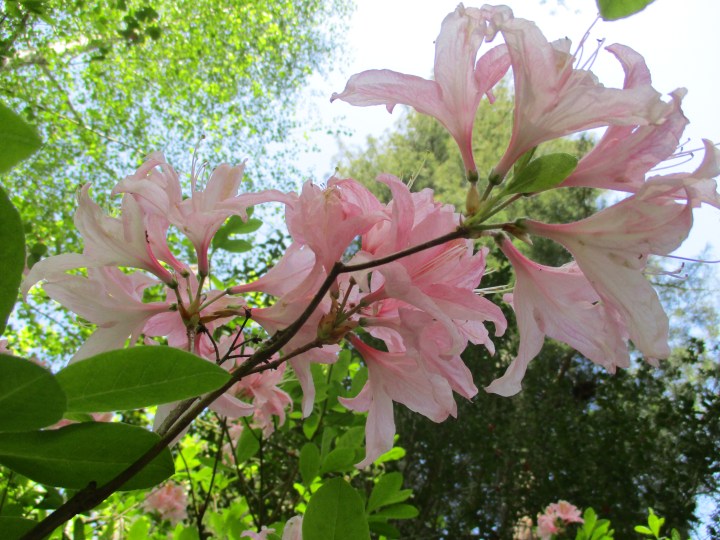 (The article from my weekly gardening column that is typically posted on Thursday was posted yesterday, which is why this article, which is more appropriate for Wednesday is posted today.)
 Tony Tomeo
I don’t think I have come across these. Would they be related to the Verayas. (Not sure of the spelling of this)
LikeLiked by 1 person
Yes; that is name I do not commonly year. Vireyas are tropical rhododendrons of Southeast Asia. They would be more popular in your region than they are here. They are sensitive to frost. The deciduous types are from climates with cooler winters.
LikeLiked by 1 person
They have quite lovely flowers.
LikeLiked by 1 person
It is only unfortunate that you can not see the fragrance!
LikeLike
For your more northerly readers the Northern Lights series of deciduous azaleas are quite spectacular.
LikeLiked by 1 person
Thank you for saying so. We grew only a few varieties. Our clients were more inclined to purchase the plain (unimproved) native than a prettier cultivar.
LikeLiked by 1 person
Captain Richard Steele of Bayport, Nova Scotia was a premier breeder of rhododendrons and magnolias in Nova Scotia for decades until his death in 2010. His hybrids are renowned throughout North America for withstanding the harsh growing climate of Atlantic Canada.
LikeLiked by 1 person
We happened to grow some of the magnolias as well back in the 1990s. I really did not like the magnolias because the market for them was so limited. We grew more than we could sell, and they were quite perishable after getting to their prime. That is one genera that I prefer in the landscape than in the nursery.
LikeLike
Where I grew up in New York I think all the Rhododendrons were deciduous, but maybe I’m just confused. There were lots in my parents’ garden, and they seemed quite large to me.
LikeLiked by 1 person
They look so different from the evergreens that if you knew the deciduous ones as rhododendrons, you might not have recognized the others.
LikeLiked by 1 person
Reblogged this on Tony Tomeo and commented:
These are already finished blooming here. This recycled article was more timely when it posted three years ago. So was the last paragraph, . . . which is useless now.
LikeLike