Cool Season Annuals Are Next

81017thumbGardening is not always fun. After diligently tending to warm season vegetables through spring and summer, it eventually becomes necessary to pull them up to relinquish space for cool season vegetables that grow through autumn and winter. It likely would be less unpleasant to wait for them to succumb to frost, but by that time, it would be getting late for the incoming vegetable plants.

Removing warm season annuals and bedding plants is just as necessary, and might be just as unpleasant. The only consolation is that the incoming cool season annuals and bedding plants are likely to be blooming well as they get installed. Even though they take a while to mature, there is no time without at least some degree of color. Warm season annuals may be tired by now anyway.

Just like cool season vegetable plants, the various cool season annuals and bedding plants appreciate an early start so that they can begin to disperse roots while the soil is still somewhat warm. Only those that dislike warmth should wait. Cyclamen and flowering cabbage and kale can be planted as late as winter. Flowering cabbage and kale might even bolt if they get too warm too soon.

Pansy, viola, sweet William, stock, Iceland poppy, calendula and various primroses are all seasonable now. They should be happy to bloom until they too need to be replaced by annuals for the following season, several months later. Chrysanthemum, marigold and a few other autumn annuals are short term annuals that bloom excellently through autumn, but are not likely to bloom later.

Just like most of the cool season vegetables, most of the cool season annuals should be planted as small seedlings in cell pack. Chrysanthemum and many of the primroses, as well as cyclamen and flowering cabbage and kale that come later, should actually be planted as four inch potted plants. Needless to say, some of these are expensive relative to their respectively limited bloom seasons. Seed for nasturtium and alyssum can be sown directly into the garden. Nasturtiums seedlings in cell packs are expensive and do not transplant well.
Cabbage

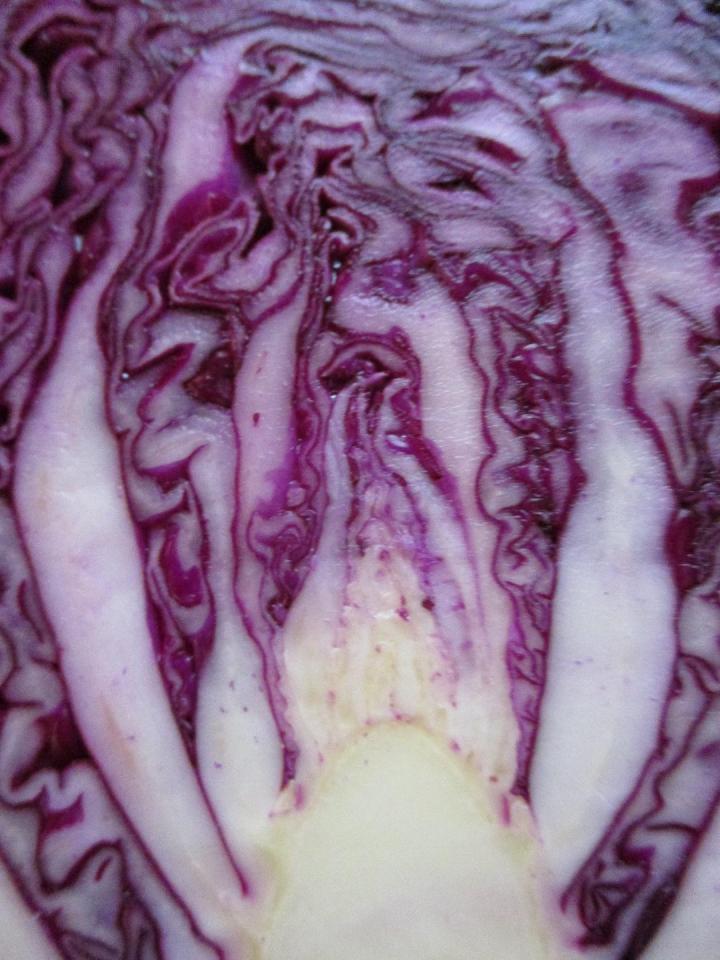
61012There are those of us who can grow cabbage well, and there are the majority of us who wish we could. Mild winters allow cabbage to be grown in autumn as well as in spring; but warm weather can also compromise flavor and promote premature bolting (blooming), which ruins the heads. Cabbage demands rich soil and regular watering. If the weather is evenly mild, they dig that too.
Spring grown cabbage was planted last winter, about a month prior to the last frost. Now it is time for autumn cabbage, about a month or two before frost. New plants can be planted a bit deeper than they were originally grown, so that the wiry and fragile sections of stem below the lowest leaves can be buried. Plants should be at least a foot apart and might get larger with more space. It takes at least two months for dense round heads of common green or red cabbage to mature. Slower varieties are worth growing for their unique flavors.

The Great Pumpkin

P81007The Third Day of Creation was when it all started. Plant life was created just two days after Heaven and Earth, and Night and Day. It must have been a pretty big deal. Humans were not created until three whole days later!
After all this time since Creation, the flora of the World is still just as important as it has always been. Vegans can survive without the consumption of animal products, but no one can survive without the consumption of plants, or the consumption of animals who were sustained by plants. We breath oxygen generated by plants. We live in homes made of wood. We wear clothes made of cotton. Until relatively recent history, wood was the primary fuel for cooking and warmth through winter. Even modern fossil fuels that have replaced wood are derived partly from fossilized plants. There seems to be no end to the long list of what plants do for us.
As if all that were not enough, plants provide pleasure. Some are dazzling desert wildflowers. Some are majestic forest trees. Most are something in between. Many are invited to inhabit our gardens, landscapes and even our homes and offices. Some are bred to do what they do even better than they did originally.
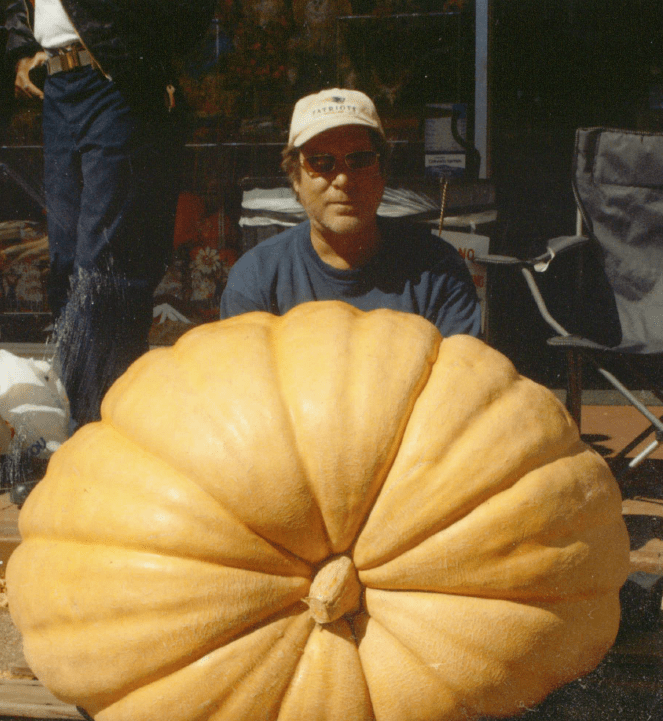
David Paul, in the picture above, made a career of cabinetry, which involved all sorts of fancy and exotic woods. Most of these woods were derived from genetically unimproved trees that would have been found growing in the wild. Most were from eastern North America. Some were from other continents. Some of the favorite maple burls were specifically from New England and the Pacific Northwest. David Paul was no horticulturist, but he knew quite a bit about the flora that produced the fancy woods that he worked with.
The pumpkin is another story. David Paul grew giant pumpkins for several years in Colorado Springs merely because he enjoyed doing so. It required serious dedication throughout the entire long growing season. Yet, the pumpkins were grown only for the fun of competition. As huge as they were, they were not to be eaten. That is the epitome of growing something merely for the fun of it. This is such an excellent picture of that epic pumpkin that it was the illustration for the obituary of David Paul.

Vegetables Come And Vegetables Go

61012thumbVegetables are annuals too, just like the flowering bedding plants that get replaced seasonally. Some are technically biennials, and a few might even have the potential to be short term perennials if they ever got the chance. Yet, for the purposes of home vegetable gardens, the warm season vegetables that produced through summer should now get replaced with cool season vegetables.

Yes, pulling up tomato plants to make room for cabbage is the same dilemma as pulling up petunias to make room for pansies. No one wants to do it while the plants are still productive. Tomato plants might continue to make a few more tomatoes until frost. Yet, planting cool season vegetables should not be delayed for too long. They want to disperse their roots while the soil is still warm.

Just like warm season vegetables, many of the cool season vegetables are more efficiently grown from seed sown directly into the garden. Root vegetables like beet, carrot, radish and turnip do not recover well from transplanting. Besides, cell packs do not contain many seedlings, even if multiple seedlings within individual cells are divided. It is more practical to sow seed evenly in rows.

Baby greens can also be grown from seed because so many small plants are wanted. Unlike heading lettuce that get harvested as individual mature plants, baby greens get plucked as they develop, from plants that may never reach maturity. Chard, kale and collard greens grow well from seed, or can optionally be grown from cell pack seedlings if fewer larger leaves are preferred.

Broccoli, cauliflower, cabbage and Brussels sprout are more typically grown from cell pack seedlings because only a few individual plants are desired. One or two six packs of cabbage might be more than one garden needs, and do not cost much more than a packet of seed. They mature at different rates, so larger ones can be harvested first, while smaller ones get more time to mature.

The root vegetables work the same way, maturing somewhat variably through a few weeks. However, secondary phases planted a few weeks after primary phases can start to mature as the primary phases get depleted. ‘Cole’ crops such as broccoli, cauliflower, cabbage and Brussels sprouts, consume the same resources, so perform best in small groups with a bit of separation.

No Rain

P81006KFor the first time since last winter, a few raindrops were heard on the roof early last Monday morning. It was over by the time I realized that the odd and unfamiliar noise really was that of raindrops. By the time the sun came up, everything was dry. I do not even know if these few raindrops could be considered to be the first rain of the season. There were a few similar raindrops on my windshield a while back, but they were dismissed as such; merely a few random raindrops rather than a confirmed rain shower.
That is how our climate works here. The Santa Clara Valley is in a chaparral climate. Much of Southern California is in a desert climate. We do not get much rain, and it is almost exclusive to a limited rainy season that is centered around winter.
Dust and crud that accumulates on foliage through the long dry season tends to stay there until the rain rinses it away. Oddly, many native plants do not mind, and a few seem to appreciate it. Some have tomentum (fuzz) on their leaves that collects dust, particularly during the warmest and driest summer weather when foliage is most sensitive to desiccation and scorch. Others have sticky foliage that does the same. However, such foliage is remarkably efficient at allowing such crud to rinse away in the first rain. Both deciduous foliage that will be shed shortly after the rainy season starts, and evergreen foliage that will be replaced through winter, seem to prefer to start the rainy season clean. Is this just coincidental, or do the plants intentionally collect dust and crud to shade and insulate their foliage through the harshest summer weather, and then wash up for a good sunning at the last minute?

Six on Saturday: Zoning Out


Zonal geraniums, Pelargonium hortorum, can bloom anytime it wants to here, but really does tend to slow down somewhat through autumn and winter. As growth slows, older foliage will deteriorate and become more susceptible to rust and decay. Where exposed, older grown might succumb to frost over winter. Zonal geraniums will soon be zoning out.

Such deterioration and winter frost damage is not as bad as it looks, unless of course, frost is severe enough to kill the entire affected plants. By the time old growth looks shabby enough to be removed, new growth is probably already starting to develop down near the roots. After the last frost date (when no more frost is likely), old growth can be cut back to expose new growth that will soon replace it. Even if new growth is very minimal, growth will accelerate once exposed by the removal of old foliage, and as weather warms into spring.

That is still a few months away. For now, zonal geraniums are just beginning the process of zoning out, which is why their floral trusses are neither as big nor as abundant as they had been through summer. While they are busy with that, autumn flowers are beginning to bloom, and some of the winter flowers are getting ready for their season. Winter flowers get started in autumn because growth is slower in cooler weather, even for plants that prefer cool weather.

1. Chrysanthemum is ‘the’ classic autumn flower. These are blooming well enough in the infirmary that they will soon be relocated out into prominent spots or pots out in landscaped areas.P81006

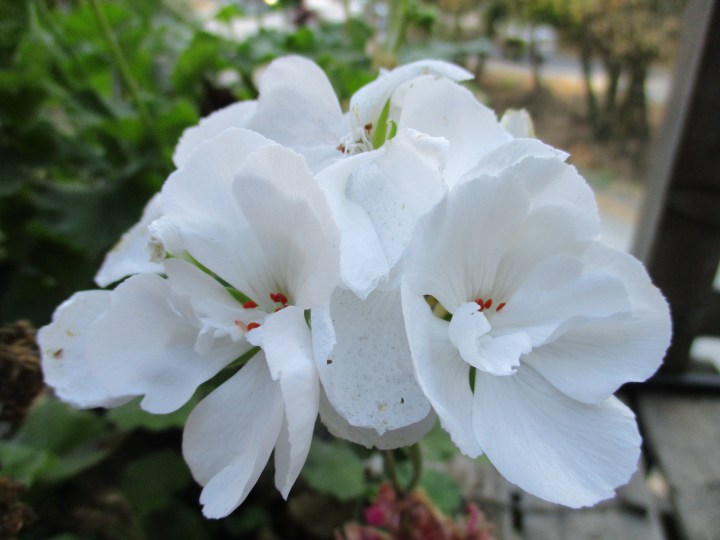
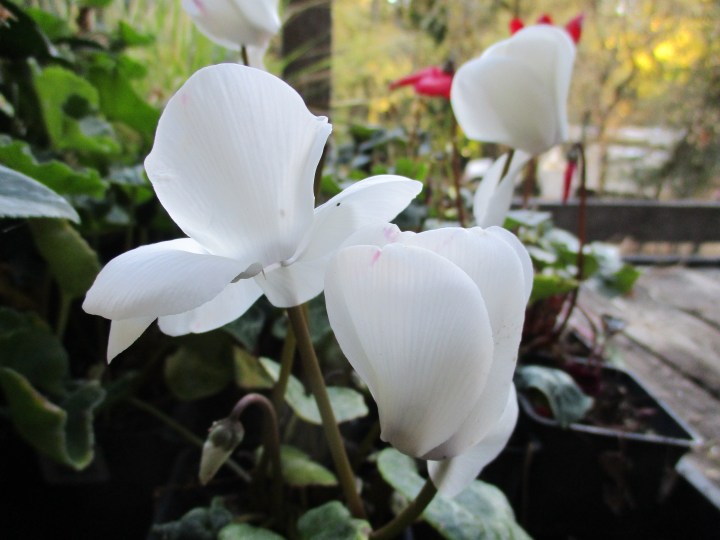
2. Cyclamen is a winter flower that is just now starting to grow after its long summer dormancy. These rudimentary first blooms are not much to brag about, but will likely be followed by enough for these plants to also be recycled back into the landscape from which they came last spring. These white flowers really are the best of the cyclamen for now. (I did not take this picture just because white is my favorite color.)P81006+

3. Reddish orange zonal geranium, and the magenta zonal geranium below, exhibit two more of those colors that I can not identify. I will just say that it is reddish orange. I happen to like it because the color resembles that of one of my two first zonal geraniums. Mine is not so well bred, so exhibits weedier growth and less prominent bloom. Nonetheless, I like mine because it is so resilient and predictable. I cut it to the ground at the end of winter, before new growth develops, and it grows right back. This prettier garden variety would probably prefer a gentler process.P81006++

4. Red zonal geranium seems to me to be the most elegant of those blooming here presently. Of course, I do not know for certain if it is. I do not know much about color. It just seems to me that this color is not as garish as the magenta sort of color below, or as unrefined as the common reddish orange above.P81006+++

5. Magenta zonal geranium, like the reddish orange zonal geranium above, is another color that I can not identify. It is a bit too flashy for my taste. However, the other one of my two first zonal geraniums blooms with a softer hue of a similar color. As much as I prefer to not admit it, my two first zonal geraniums are still my favorites, even though they bloom in colors that I am none too keen on.P81006++++

6. White zonal geranium happens to contrast well with the dark greens of landscapes in the redwood forests. Although it is my favorite of the four zonal geraniums that are blooming here now, my first two weedy zonal geraniums that bloom with unrefined reddish orange and garish magenta are still my two favorites.P81006+++++

This is the link for Six on Saturday, for anyone else who would like to participate:

https://thepropagatorblog.wordpress.com/2017/09/18/six-on-saturday-a-participant-guide/

Fringe Flower

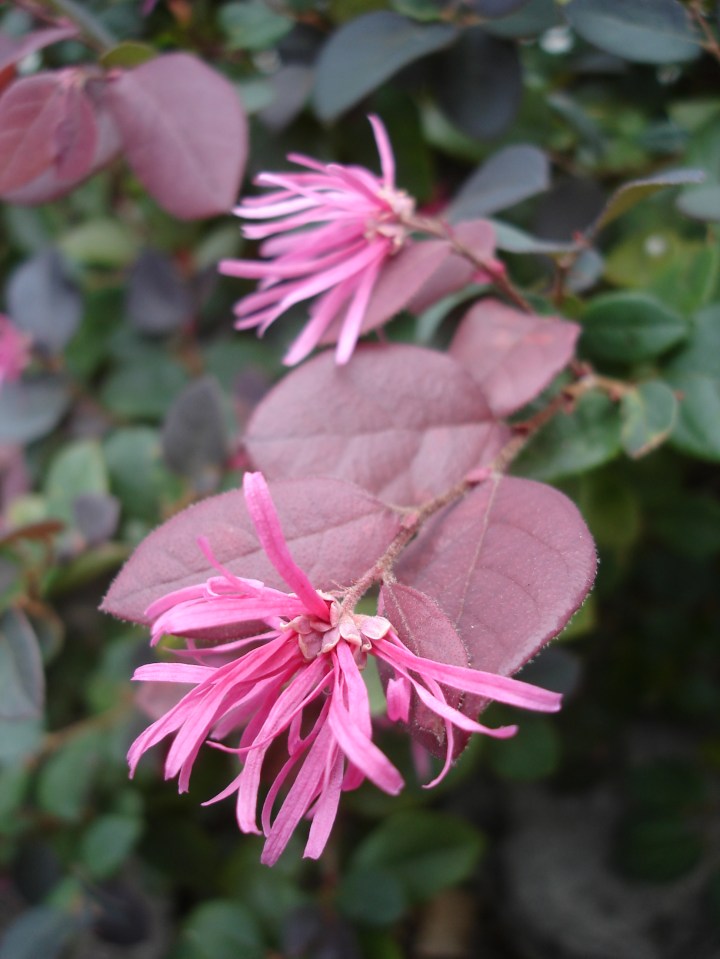
51007Since modern cultivars became trendy several years ago, the old fashioned ‘common’ fringe flower, Loropetalum chinense, has become even more uncommon than it already was. It does not grow fast enough to function as large scale shrubbery, but slowly gets too big to work as small shrubbery. Without pruning, old plants take many years to get to fifteen feet tall.

The gracefully arching stems are outfitted with light green evergreen foliage. The simple leaves are about an inch or two long. The small white blooms have very narrow petals that hang downward like limp bits of ramen. Each bloom is actually a tuft of a few individual flowers. Bloom is most abundant in spring, and then continues sporadically through most of the year.

Modern cultivars of fringe flower are more compact, so rarely get more than five feet tall. Flowers can be white, pink, red or rosy pink. The most popular cultivars have purplish bronze foliage. Fringe flower does well as an understory plant, in the partial shade of trees. It should not be shorn, so should instead be pruned selectively to maintain its natural form.

Winter Dormancy Begins In Autumn

50923thumbAutumn is for planting . . . but not much else. While it is important to get certain new plants into the garden before cool and rainy weather, other gardening chores will not be necessary while plants are becoming less active before winter dormancy. Raking falling leaves is probably the biggest of the new chores that are specific to autumn.
Formal hedges that have been getting shorn regularly since spring may not need to be shorn again until next spring. They simply will not grow much between now and then. If possible, pittosporum and photinia should not be shorn once the weather gets rainy. Their freshly cut stems are more susceptible to certain diseases while wet than during dry weather.

Citrus and tropical plants should not be pruned late because pruning stimulates fresh new growth that will be susceptible to frost later in winter. Even if tender new foliage does not get frozen, it can get discolored and disfigured by cold weather. Cool weather inhibits vascular activity necessary to sustain the development of healthy new foliage anyway.

For the same few reasons, fertilizer will not be necessary later in autumn. Fertilizer can potentially stimulate new growth when it is not necessarily wanted. Also, some nutrients in fertilizer are less soluble (or chemically unavailable) while the weather is cool. Only plants that grow through winter, like cool season annuals, vegetables and grasses, will want fertilizer.

Planting is done in autumn because plants are either dormant or less active than they had been during warmer weather. They can take their time to disperse their roots into comfortably cool and damp soil. Evergreen plants do not draw as much moisture from their roots while foliage is cool and damp. Deciduous plants draw even less moisture without foliage.

Spring blooming bulbs get planted in autumn not only so that they can disperse their roots leisurely, but also because they need to get chilled to bloom well. Bulbs can be phased, so that those planted earlier will bloom before those of the same kind planted later. However, if planted too late, they may not get sufficient chill.

Horridculture – Ignoring Arboriculture

P81003There are too many different types of horticultural professionals to count. There are nurserymen who grow horticultural commodities. There are landscape architects and landscape designers who design the landscapes into which some of these horticultural commodities will go. There are landscapers who install such landscapes. Of course, there are gardeners who maintain the landscapes after they are installed. These are just a few of the more familiar horticultural professionals.
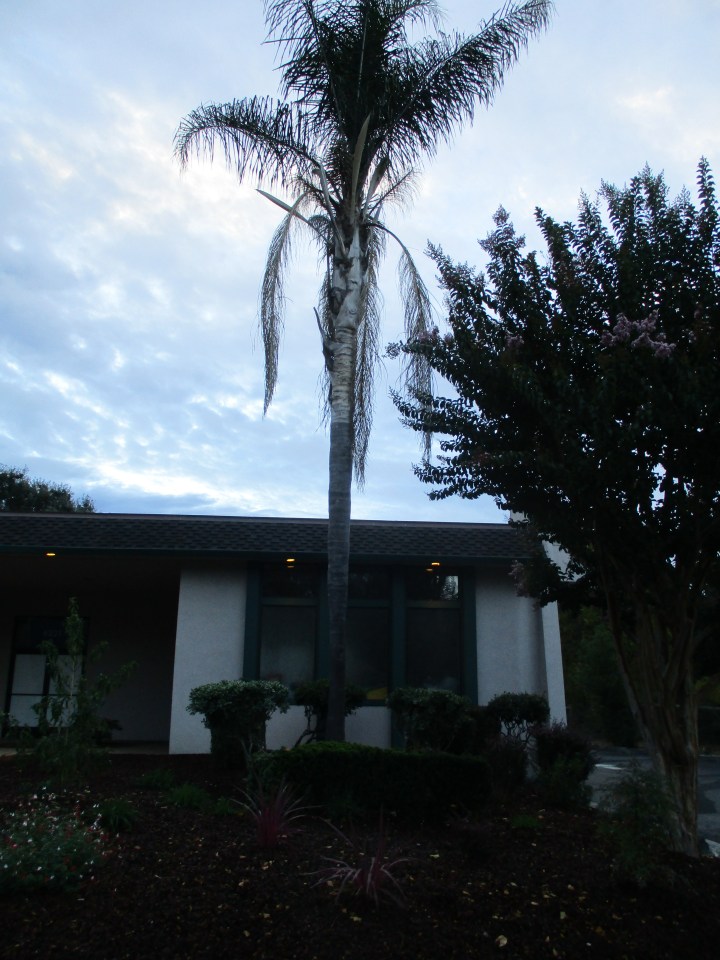
I will refrain from my typical ranting about the extreme lack of professionalism among almost all horticultural professionals who are not nurserymen or arborists (okay, and one landscape designer), but must point out something in the picture above. Do you see it?
It is not the fact that this once very well designed landscape was dismantled and mostly replaced with a cheap slapped together assemblage of cliché plants by someone who just needed work.
Nor is it the pointlessly disfigured shrubbery from the original landscape that was salvaged while the best features that could have been salvaged were removed.
Nor is it the fact that this process has been repeated a few times since the building was originally landscaped back in the 1980s, leaving a nicely maturing but weirdly non conforming crape myrtle in front of the queen palm that should be the focal point, as well as a new dogwood that will compete with both focal points.
It is the fact that despite all the effort that went into the installation of this garage sale style landscape, no one bothered to procure the services of an arborist to groom the queen palm. Do you see it now; all those dead fronds hanging from the canopy of the queen palm? It is like taking a pick up through a car wash while it is loaded with garbage.

Mulla Mulla

81010The common name sounds funny, but it is easier to pronounce then than the Latin name. Mulla mulla, Ptilotus exaltus, is an Australian species that has been locally available longer than its limited popularity suggests. It may seem to be more peculiar than it is because it is grown primarily by specialty growers, who happen to grow many cool plants that should be more popular than they are.

Like many species that are grown as annuals, the mulla mulla is really a short term perennial that can perform for a few years, but is unfortunately more often grown as a warm season annual. It will finish blooming soon, but if left in the garden through winter dormancy, young plants should resume in about April or May. It can succumb to frost if the weather gets cold enough through winter.

Although it can survive with less, mulla mulla prefers somewhat regular watering, and good sun exposure. New spring growth develops rather vigorously without getting much more than half a foot high and wide. Fuzzy cylindrical blooms that stand above the foliage are about three inches long. Floral color is pinkish mauve, with a silvery sheen. Deadheading promotes subsequent bloom.