Aesculus is not native to Arizona. Buckeye is merely where I vacationed after leaving the Los Angeles region. It is northwest of Phoenix, which is also a genus that is not native to Arizona. It was a hundred degrees daily while I was there, but oddly, never to a hundred and one. My Six are from residential gardens. #2 is of the Plantaginaceae family. #1 and #6 are of the Fabaceae family. The three others are of the Bignoniaceae family. Fabaceae and Bignoniaceae seem to be popular there. #1, #4 and #5 are native species. Carnegiea gigantea, saguaro, which is the State Flower of Arizona, grows wild there. I should have taken pictures of it. The base of a minor specimen is visible to the far right of picture #1.
1. Prosopis glandulosa, honey mesquite was in need of clearance pruning. I brought the bigger stems from the pruning debris back for a colleague who will use it to smoke meat.

2. Russelia equisetiformis, firecracker plant, as the specific epithet describes, resembles equisetum, but with these red and narrowly tubular flowers that exclude interested bees.

3. Jacaranda mimosifolia, jacaranda is one of a few familiar species that I encountered. I am impressed that it is popular and seems to perform well within such an arid climate.
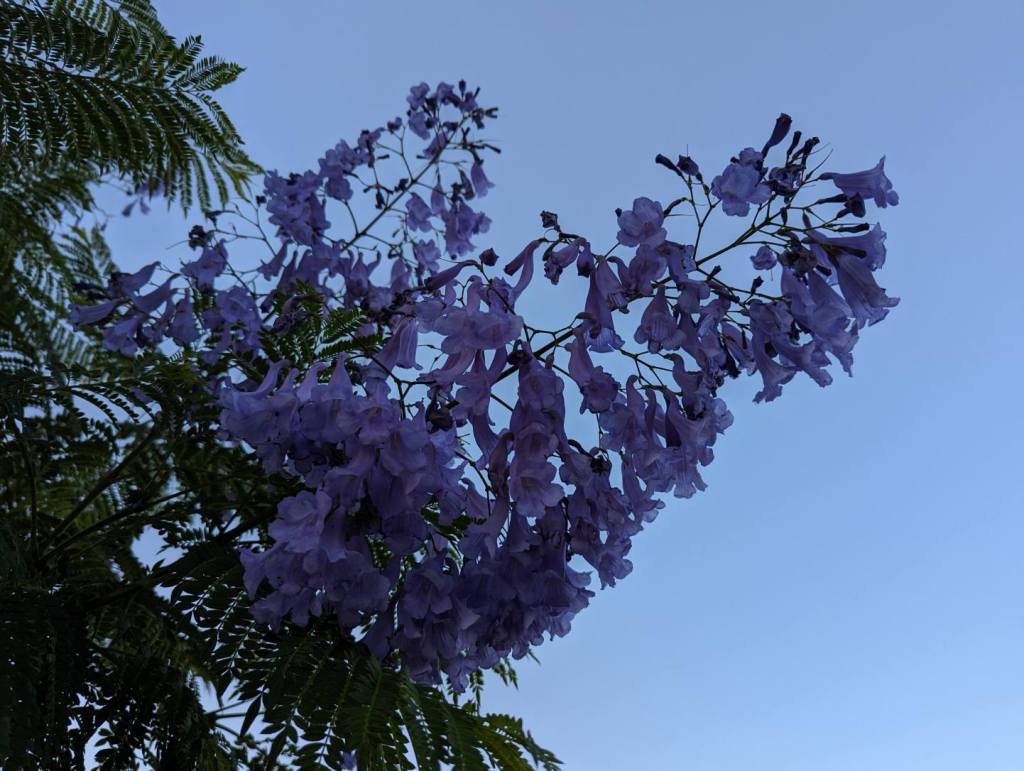
4. Chilopsis linearis, desert willow got my attention because of this floral color that is so unusual for trees. I had previously only encountered it while it was defoliated for winter.

5. Tecoma stans, esperanza, as well as poinciana #6 below, should bloom like this in my garden. Crazy Green Thumbs sent me seed for both last year. Both were terrible failures.

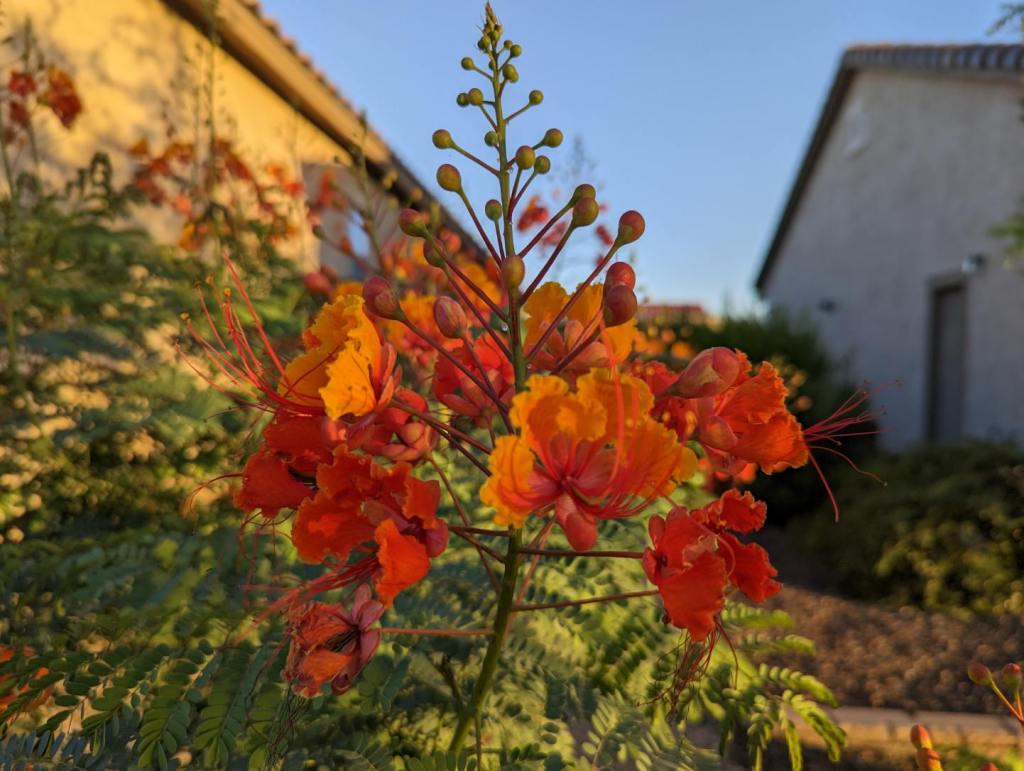
6. Caesalpinia pulcherrima, poinciana, as well as esperanza #5 above, remind me that I should have been more diligent and protective with the seed from Crazy Green Thumbs.
This is the link for Six on Saturday, for anyone else who would like to participate: https://thepropagatorblog.wordpress.com/2017/09/18/six-on-saturday-a-participant-guide/
 Tony Tomeo
Lovely six this week Tony, all beauties. I have grown a jacaranda from seed that we collected on holiday (bit naughty). I doubt whether it will get to flowering size as I have to keep it in a pot and take it inside in winter.
LikeLiked by 2 people
This morning I read a post on Instagram from a French woman from the south of France, who has one potted that is 15 yo and is 2.50 m tall (overwintered frost free). It has been blooming for 2 years! I’m going to try sowing again
LikeLiked by 1 person
Didn’t yours make it?
LikeLiked by 1 person
It died during a cold winter….My son on vacation in Barcelona brings me fresh seeds tomorrow for a new try 😁
LikeLiked by 2 people
Why not grow something that is more appropriate to the particular climate?
LikeLiked by 1 person
Jacaranda behaves very differently in the Los Angeles region, in the Phoenix region, and here. It is grandest and most floriferous in the Los Angeles Region. In the Phoenix region, it is more upright and perhaps a bit sparser, with patchy bloom that may not last for long if the weather is too arid. In Los Gatos, it gets frosted every few years or so. By the time it recovers enough to bloom sporadically, it is likely to get frosted back again. Because of the harsh corrective pruning, it can not support much weight or get too big. Consequently, if it grows too much between frosts, it drops limbs. It is more of a fluffy foliar tree that sometimes blooms sporadically.
LikeLiked by 1 person
I just read that the Caesalpinia pulcherrima is also called a Peacock Flower – I can see why!
LikeLiked by 1 person
It has a few common names. In San Diego, it is known as the dwarf poinciana to distinguish it from the real poinciana, which is a small tree. I know it as the poinciana only because the real poinciana does not live here.
LikeLiked by 1 person
Lovely photos of the flowers, Tony. They all look odd, but beautiful to my East Coast eye. The landscapes are so neat and streamlined there. Hope you had fun and came home with more cuttings or seed!
LikeLiked by 1 person
Actually, I brought back only bits of mesquite for smoking and some rooted bits of Campsis radicans (I believe) from the Phoenix region. A colleague wants me to procure a mesquite seedling or seed now. I really should have brought back more. I got more than I can accommodate from the Los Angeles region.
LikeLiked by 1 person
Lots of pretty flowers this week. We can grow firecracker plants here and they will stay green if there are no freezes. Landscapers have started using it in public areas.
LikeLiked by 1 person
It might be available here, but if what looks like firecracker plant actually is firecracker plant, it does not look good. I suspect that it prefers more arid warmth.
LikeLiked by 1 person
Thanks Tony a nice mix of interesting and new to me, plants.
LikeLiked by 1 person
You are welcome. I enjoyed getting pictures of some of them performing as well as they were. Only the jacaranda was less than exemplary.
LikeLike
All gorgeous and lovely to look at, and impossible to grow outside here. I did try Caesalpinia in the greenhouse a few years ago but it never bloomed.
LikeLiked by 1 person
It is odd that so many plants prefer arid warmth. Such weather seems to be so uncomfortable, like humid warmth. Many of such plants do not mind wintry weather as long as they get arid warmth through summer.
LikeLike
Almost all of that grows here. Except Desert Willow and Mesquite. Strange.
LikeLiked by 1 person
I sort of wonder why desert willow is not more popular in other regions. The Chitalpa, which is a hybrid between a Chilopsis and a Catalpa, is a very resilient street tree for chaparral climates, such as the Santa Clara Valley, but is not as colorful as the Chilopsis. I suspect that the Chilopsis prefers more warmth. The mesquite may be unpopular merely because there are so many better trees to grow.
LikeLiked by 1 person
no clue, I like the desert willow, it is probably too humid here.
LikeLiked by 1 person
It is weird that humidity can be a problem for vegetation, but I know that it is for many desert species, just as a lack of humidity is a problem for non desert species. That is why the California fan palm does not like to be close to the coast.
LikeLiked by 1 person
It is weird to me what will grow here vs LA and San Diego..
LikeLiked by 1 person
All three places are very different from each other. San Diego is the part of California that is likely most similar to there, but is really not all that similar. It is relatively arid.
LikeLiked by 1 person
I was talking to a lady from San Diego..they can’t grow mangoes there. But most other fruits, humidity?
LikeLiked by 1 person
I would have guessed that some sort of mangoes could grow in San Diego. At least one sort grows near the Leimert Park district of Los Angeles. What about humidity?
LikeLike
I love Jacaranda – not usually in San Diego when it is in bloom there, but it is very popular. Lots of reptiles!
LikeLiked by 1 person
Reptiles?! Jacaranda is somewhat adaptable to a few climates. It is likely grandest in regions such as San Diego. It is more of a fluffy foliar tree that sometimes blooms sporadically. It gets frosted every few years, so can not grow too large, and if it does, it drops limbs that it can not support. I suspect that in Arizona, the bloom succumbs to aridity sooner.
LikeLike