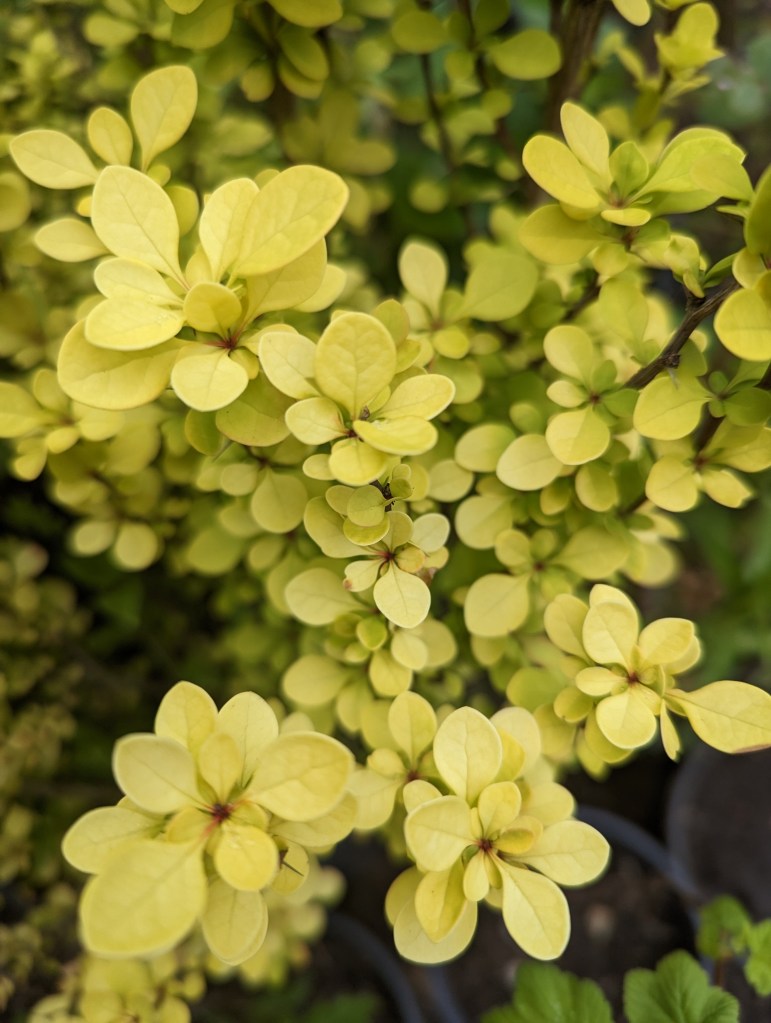
Its abundance of small but very sharp spines are both a blessing and a curse. Barberry, Berberis thunbergii, can work like vegetative barbed wire. An intruder might get through its thicket growth of limber stems once. Its unavoidable thorny nastiness will dissuade a second attempt. Unfortunately though, the same thorny nastiness is unpleasant to prune.
Ironically, most barberry is aesthetic rather than utilitarian. Popular modern cultivars are bright yellow or dark purplish red. Variegation is still rare. Most cultivars are less than six feet tall. Some are very dense and less than two feet tall. Old fashioned green barberry that gets ten feet tall is now uncommon. Autumn foliar color is exquisitely red or orange.
Barberry works splendidly as a low shorn hedge, although it defoliates through winter. Its naturally billowy, flaring or upright form is even more splendid unshorn. Congested older specimens regenerate vigorously after winter coppicing. Small ovate leaves constitute a refined foliar texture. Tiny bright red berries are rarely observable before birds find them.
 Tony Tomeo