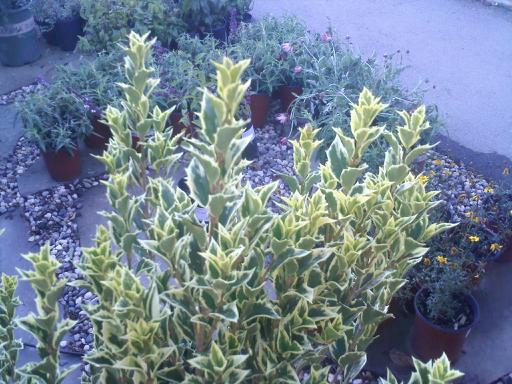
English holly happens to be one of my all time favorite plants, even though it rarely produces the abundant berries that are expected of hollies. Its deep rich green foliage is so glossy and distinctively textured. Because English holly does not mind partial shade, the variegated varieties can add a bit of color where it is too dark for most other plants to bloom. I really do not mind that it is so prickly.
For those who do mind, the holly-leaf osmanthus, Osmanthus heterophyllus (or ilicifolius) is a worthy substitute for English holly that is just as happy with partial shade. The foliage is very similar in appearance, but a bit less glossy, and much less irritating. Holly-leaf osmanthus is sometimes mistaken for English holly, but can be distinguished by its opposite leaves. English holly has alternate leaf arrangement.
Mature holly-leaf osmanthus can get as large as English holly, but rarely does. It is more often less than 10 feet tall and wide, and is somewhat more adaptable to shearing into hedges. ‘Variegatus’, the most popular variety with pale white leaf margins, grows a bit slower and stays more compact, and actually looks better in partial shade than out where it is too exposed. Holly-leaf osmanthus flowers that bloom about now are not much to look at, but produce a delicate fragrance if the weather gets warm.
 Tony Tomeo