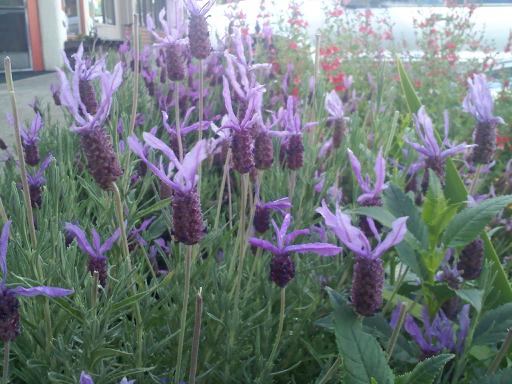
While waiting for my white mocha at the White Raven coffee shop, I noticed white sage smudge sticks (incense) for sale. I also noticed that white sage is a component of at least one of the many herbal teas available. Although white is my favorite color, I am doubtful that it would be one of my favorite flavors. White sage seems to me to be much too pungent. I suppose that I should at least try it to satisfy my curiosity. Otherwise, the many other herbal teas included more docile but equally compelling herbs like sunflower petals, cactus flowers, chamomile, lavender, mint, catnip and various geraniums.
My mocha was ready too quickly, before I could investigate all of the herbal teas. Since I needed to get out of the way at the counter, I went to peruse the incense, where I again noticed some familiar herbs, like various sages, lavender, rosemary and bay laurel. A few plants that I do not commonly think of as herbs are common components of incense as well, such as juniper, cedar and pine. This was all too baffling; so I took my mocha to a table out front by a roadside garden, where I noticed some of the exact same herbs that I came outside to get away from!
All these fancy herbs and incenses and girly boutique beverages are simply not my cup of tea. Although at the White Raven, I know better than to be surprised by what might be in an excellent tea. Regardless, the garden out front is still more my style, and reminds me of how so many utilitarian herbs can also be very appealing ornamentals.
Rosemary, lavender and several of the sages are actually quite common in ordinary landscapes, whether or not anyone even notices that they have herbal merit. Some types of creeping thyme are sometimes used as ground cover in small areas, particularly around pavers or stepping stones where they release their fragrance if lightly trampled. Santolina and various yarrows and scented geraniums are less ordinary, but are similarly grown more often for their aesthetic value than as herbs. In my own garden, I really do not know what yarrow is good for. I like to add geranium leaves to sun tea, even if it makes it a girly boutique beverage.
Some herbs are almost too happy in my garden. The feverfew, chamomile and nasturtiums (my favorites!) that grew from seed from Renee’s Garden two years ago have spread outside of their area. I actually gave my mints away before they could escape. The catnip is confined to a hanging pot by the neighbor’s cat who gets sufficiently overindulgent to eradicate any self sown seedlings below. I never would have guessed that an inebriated cat could be so useful! Calendula, chive and oregano have all been grown from seed and become happily naturalized.
 Tony Tomeo
Your use of girly is sexist and derogatory.
LikeLike
No, it is not; but saying that it is derogatory is sexist.
LikeLike
I grow herbs for their looks as well as their scent, but I do not like the smell of yarrow – my Mum says her grandmother treated every single ailment with a dose of yarrow, which I assume was made into a tincture or tea. And she hated the taste of it! Sage in tea is quite pleasant – refreshing. You should try it.
LikeLiked by 1 person
Sage is an uncommon herb here. It used to be available from nurseries, but is rare now. Many other species of Salvia are very popular though, and some of them are useful herbaly. Actually, I sort of prefer some of the native Salvia to more familiar culinary sorts. Some are a bit strong, so should be used in minor quantities.
LikeLiked by 1 person