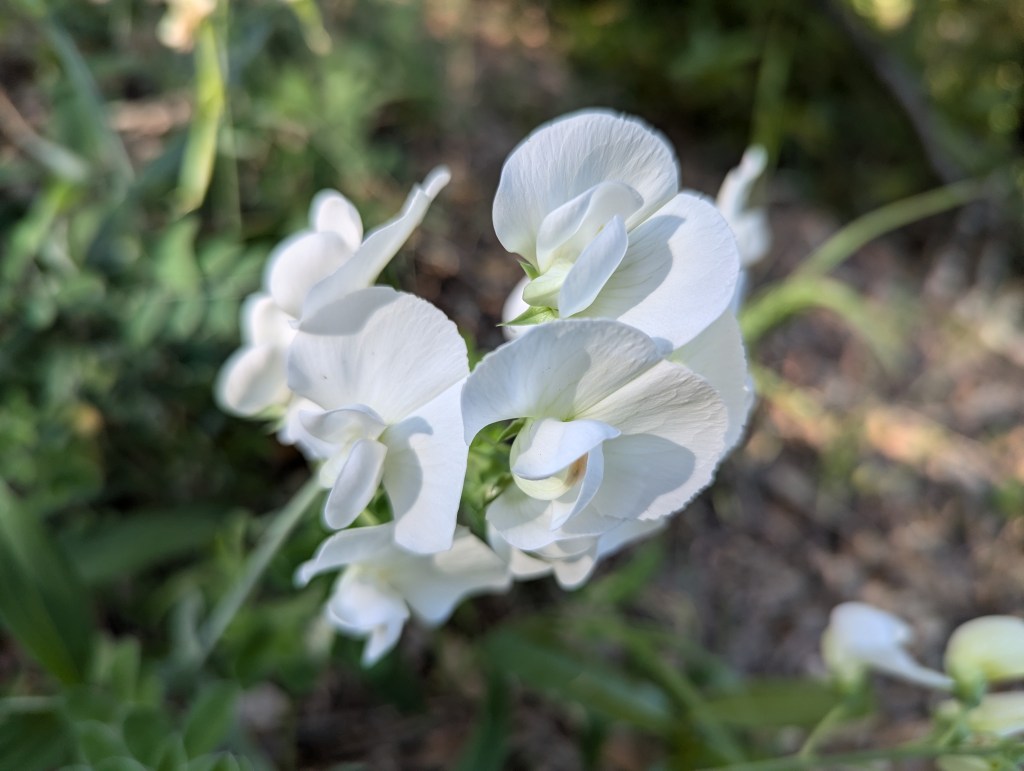
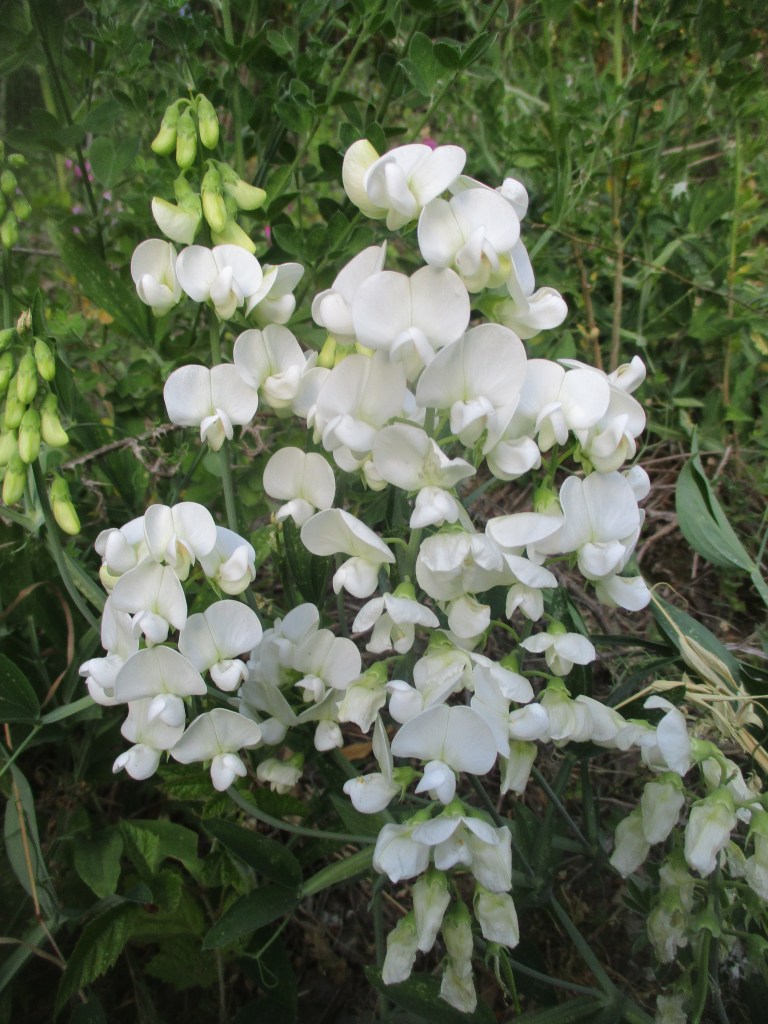
P is for pea, or more specifically, perennial pea, or Lathyrus latifolius, which does not begin with P, but that is not the point. Perennial pea is a naturalized exotic species here. Within our landscapes, it is difficult to kill. I suspect that it is just as difficult to kill outside of the landscapes, although I have not tried. After all, it is quite pretty, and does not seem to be too invasive beyond situations that it finds to be favorable. Trying to kill what grows beyond the landscapes here would be futile anyway, since there is so much more of it beyond the boundaries of what we have access to. However, I would not want to add any to areas where it is not already established and interfering with local ecosystems. That leaves me with a dilemma. I just acquired a perennial pea that I want to grow more of, but there is no place to grow it. Almost all of the perennial pea here blooms obnoxiously bright purplish pink. Very few bloom lighter pink with a swirly pattern. About as few bloom white. I am told that perennial pea can bloom red, but I am getting to suspect that such red is what I consider to be obnoxiously bright purplish pink. Anyway, I found a perennial pea that blooms white a several years ago, and grew several copies of it. I shared all the copies until none were left. I thought that I could always return to the original source for more. Unfortunately, the source was buried under debris that was removed from a mudslide two winters ago. What a bummer! I had been watching for white perennial pea since then. Then, last Wednesday, I saw it! It was not much, since only one floral stalk was beginning to bloom, but it was enough for identification. I got a good bit of its upper taproot and stems for many cuttings. The base of the taproot remains as a more permanent source if I need it, and if nothing happens to it. I am so pleased with this acquisition, even though I have no idea of what to do with it, like so much of what grows out there.
 Tony Tomeo
Utterly gorgeous! I’ve never before seen a white pea like this. I’m so pleased you ‘refound’ it!
LikeLiked by 1 person
White and lighter pink are rare. Seed for each or a mix of all three is available online, but I will not purchase a weed. I really want to find out what the red blooming pea is. Some pictures show it as the same as what grows wild here while others show that it is actually red. Either way, I am pleased with what I got.
LikeLiked by 1 person
This white perennial pea is gorgeous. Here it has been named ‘White Pearl’ and has been awarded the RHS award of garden merit so it must be good.
LikeLiked by 1 person
The Royal Horticultural Society does not impress me. I experience more climate zones between her and San Jose than they contend with in all of Britain (the primary Islands). It is nice that they enjoy it, but I am more impressed that it grows wild on roadsides here. ‘White Pearl’ may have a very slight blush to it. I do not know. I still do not know what ‘Red Pearl’ is. I believe that this natural variant is known as ‘Alba’, but again, I do not know. I am growing a lot of it now, and I have no idea what to do with it!
LikeLike
It is remarkably white and very pretty. Glad you could find a wild one and hope you find one that really is red one day too. I have never seen a red one.
LikeLiked by 1 person
I am very pleased with this white variety. Realistically, if I never determine the identity of the red variety, I will not worry about it. Red, if it exists, would be interesting, but is unnecessary. What I got is more than enough.
LikeLiked by 1 person