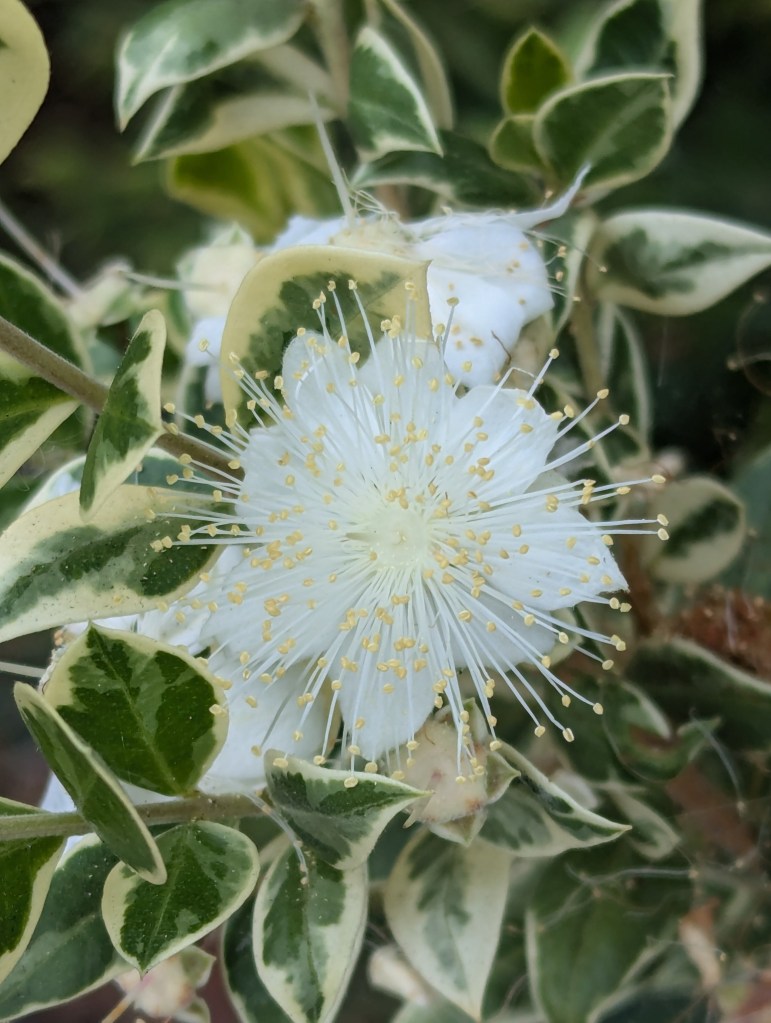
Old landscapes of the Victorian Era may still include myrtle, Myrtus communis. It is quite a survivor. It had been popular for centuries because of its resiliency. It is very conducive to the sort of formal hedging that was popular during that time. As formal hedges became old fashioned, so did myrtle. Yet, it is still more sustainable than more popular shrubbery.
Besides, myrtle is not limited to refined shorn hedges. It can just as efficiently become an unshorn and informal hedge or screen. It can grow as tall as fifteen feet, but rarely grows higher than first floor eaves. Without pruning, it typically grows about half as wide as it is high. Selective pruning rather than shearing limits its size without ruining its natural form.
Myrtle foliage is densely evergreen and pungently aromatic. Individual leaves are merely an inch or two long. Small white flowers with prominent stamens may not be very showy. Small and darkly bluish black berries are sparse. ‘Compacta’ grows only about three feet high and wide. ‘Compacta Variegata’ is slightly more compact and variegated with white.
 Tony Tomeo