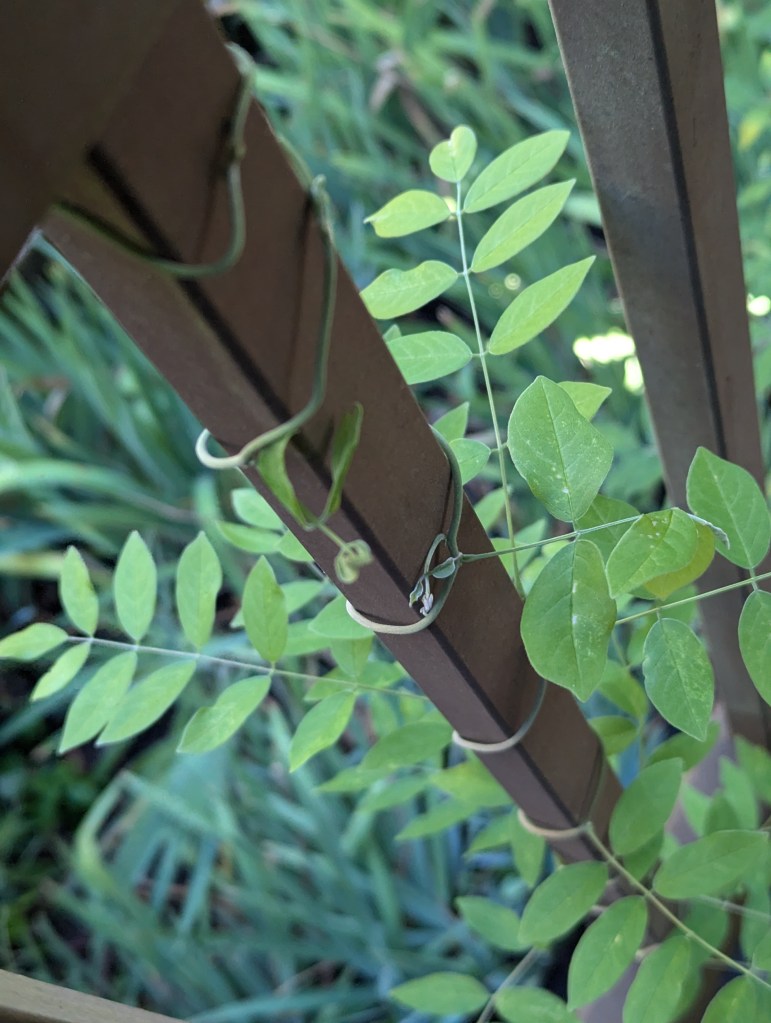
Chinese wisteria is an aggressive vine! A few that have gone wild near here have climbed high into redwoods, or spread over large areas of forest, or both. Some may have been planted intentionally, and then been abandoned. Some may be feral. Japanese wisteria may have potential to do the same, and perhaps some have already done so without being recognized as a different species from more common Chinese wisteria. Both species are spectacular while blooming within refined landscapes, but can be difficult to accommodate within the often neglected or partially forested landscapes here. That is why I am so pleased to try the much more docile American wisteria, Wisteria frutescens. I do not remember the name of this particular cultivar, but it blooms with bluish lavender floral color that is comparable to that of the more traditional Chinese wisteria. Like Chinese wisteria, other cultivars can bloom white or more purplish, and supposedly even pink, although I have yet to see even pictures of it blooming pink. It is not as spectacular, primarily because it is so much more docile, so does not grow nearly as large. Also, the floral trusses are relatively short, stout, and cylindrical in form, so protrude more rigidly outward like bottlebrush bloom, rather than more pendulously like the familiarly elongated and conical floral trusses of Chinese wisteria, or the more elegantly elongated floral trusses of Japanese wisteria. Kentucky wisteria, Wisteria macrostachya, is supposedly quite similar, but blooms later with more bluish color, rather than lavender. ‘Clara Mack’ is a cultivar that blooms white. After I see how American wisteria performs here, with its traditional wisteria colored bloom, I would also like to see how ‘Clara Mack’ Kentucky wisteria performs here. It could be a delightfully docile alternative to traditional Chinese wisteria for the White Garden.
 Tony Tomeo
I used to love wisteria. I bought one, not sure what other than not native, at a local nursery. Took over. I cut it down, as far into the soil as I could, and put a huge filled planter on top. A year later it’s back as big as before. I wish they wouldn’t sell them at all. I’m in Oregon, and we can’t buy, or transport, English ivy. It’s choking the trees in Portland.
LikeLiked by 1 person
Wisteria is a splendid vine for those who maintain it. The problem is that people move away, leaving their vines with those who are unfamiliar with them, or do not know how to take care of them. Also, some people plant wisteria without knowing how aggressive they can be. Vegetation really should come with warnings. Several other species can be overly aggressive, invasive, toxic and so on. Labels describe only attributes, but not the liabilities.
LikeLike