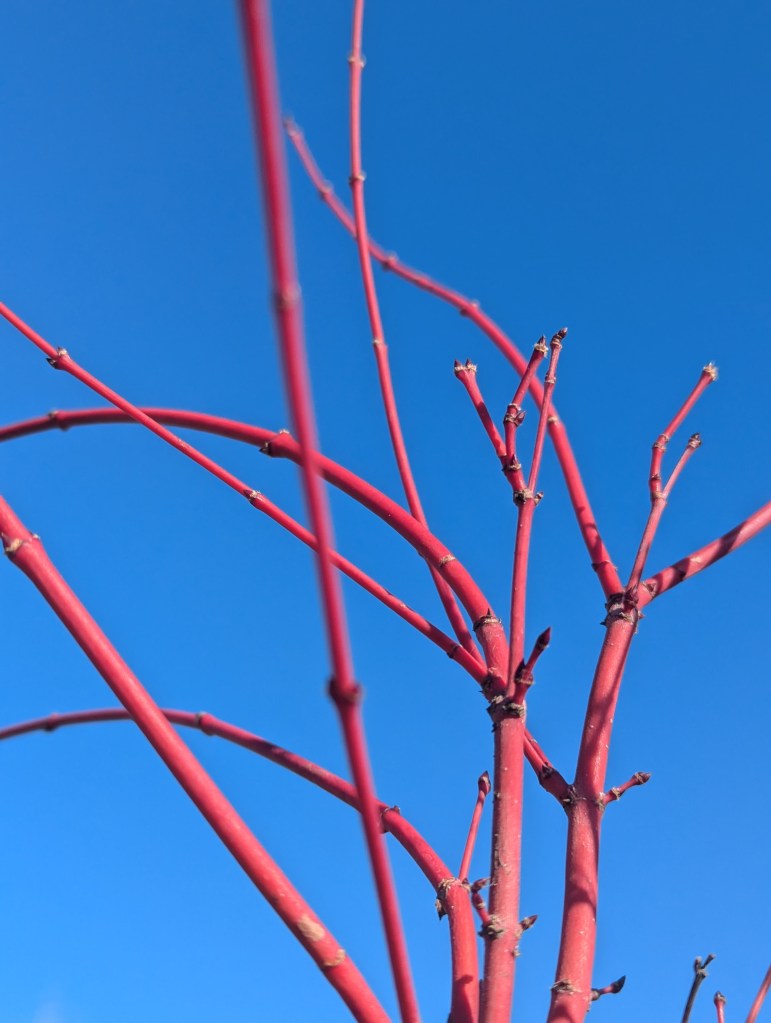
Bloom is probably the favorite component of home gardens. Foliage is likely the second favorite component. Japanese maples are popular as much for their form as for any other characteristic. The intricate textures and autumn color of their foliage is likely secondary. Coral bark Japanese maple, Acer palmatum ‘Sango Kaku’, is even a bit more distinctive.
Relative to other cultivars of Japanese maples, its foliage is not remarkable. Actually, it is more vulnerable to foliar scorch with arid warmth. Its form is not overly remarkable either. For coral bark Japanese maple, the bright red bark of its young twigs is its primary allure. It is obscured by foliage for most of the year, to be revealed by defoliation through winter.
Coral bark Japanese maple is an understory tree, so can tolerate partial shade. With full sun exposure, it particularly dislikes arid wind. It can grow as tall as twenty feet, or might stay as short as ten feet. It naturally produces many long and limber stems with shiny red bark. Severe pruning to promote growth of such stems is likely to ruin its sculptural form.
 Tony Tomeo
Thank you for the learning moment. I was not aware of this beautiful tree.
LikeLiked by 1 person
You are welcome. I only wrote about this for the gardening column, so it is gratifying that others appreciate it. I am actually not so keen on Japanese maples, although this cultivar has been fun, and is striking against the dark green foliage of the redwoods at this time of year.
LikeLiked by 1 person