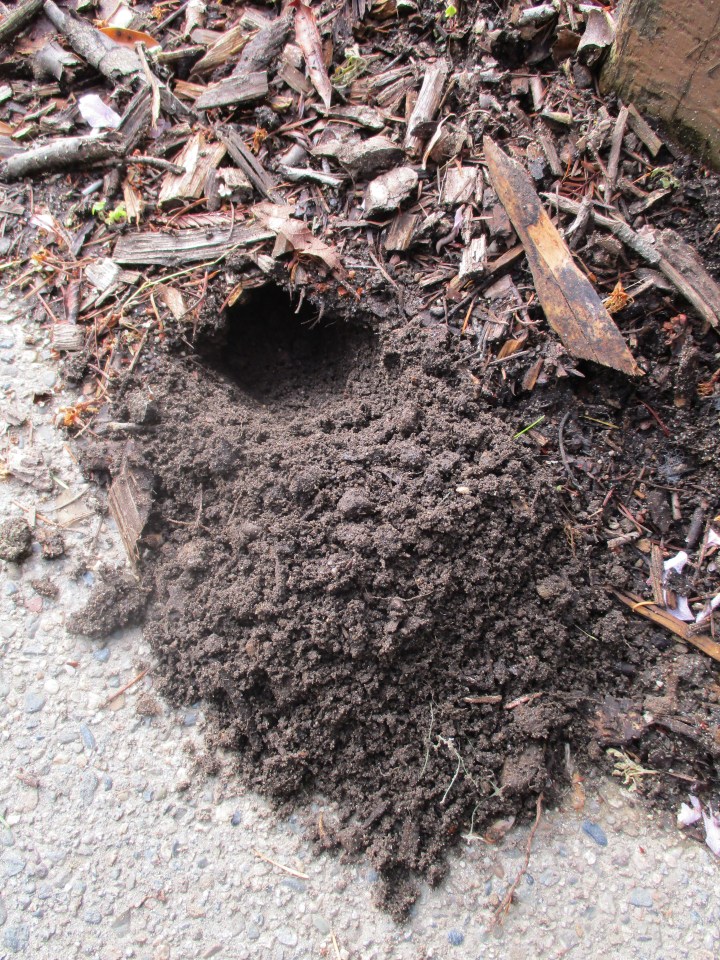
Many of the yuccas that naturally live in deserts where forage may be scarce are equipped with an efficient defense system. Each leaf terminates with a nasty spine. Leaves are so abundant that the spines are impossible to avoid. It is amazing that these yuccas are as vulnerable as they are to gophers, who simple burrow below all the advanced defense technology to eat the starchy roots and any subterranean portions of stems.
Some of the techniques sometimes used to get rid of gophers are too dangerous to even discuss. Rodent poison (for rats and mice for example) is not only dangerous to other animals that may dig it up, but not often effective since gophers prefer to eat fleshy roots and stems. The only practical poisons can only be applied by licensed pesticide applicators.
New plants can be installed within ‘gopher cages’ that should exclude gophers from the root system at least long enough for the plants to get established. Gopher cages can be purchased ready-made, or can be constructed easily from chicken wire. They only need to be as deep as the planting hole, but can be wider for perennials that spread.
Gopher cages do not protect all roots, since some extend through the cage to disperse; but should protect enough roots to keep plants alive if outer roots get damaged. By the time the cages deteriorate, the plants within should be established enough to survive gopher infestation for a while; although even large plants can be killed by unrestrained gophers.
Properly used traps are the most practical means of controlling gophers. Traps should be installed in pairs, even though each pair typically catches only a single gopher. If possible, traps should be installed away from any gopher cages that may be present, since cages are difficult to work around, and nearly impossible to release from a sprung trap.
Once the entrance to a gopher run is found under a mound of freshly excavated soil, the entrance, which is typically filled with loose soil, should be excavated back as far as the main run, which extends perpendicularly to the right and left. The main run should be cleared of loose soil.
Each of the two traps can then be set and gently placed within the main run in each direction. A trap should be held by the spring end so that the claws and lever extend into the run. Wires attached to the spring end of the traps are easier and safer to pull the traps out with later, instead of digging the traps out. These wires can be attached to a stake to make them easy to find later.
The entrance hole should then be buried. Air circulation from outside will prompt the gopher to collect loose soil to plug the hole, and push the loose soil ahead, springing the trap prematurely.
The gopher within may not be interested in using the same entrance to expel soil, but will likely use the same run. Two traps are used because there is no way of knowing which direction the gopher will approach from. The unfortunate gopher can be removed in a day or so; so that the traps can be set into another run where fresh excavation has been observed.
 Tony Tomeo