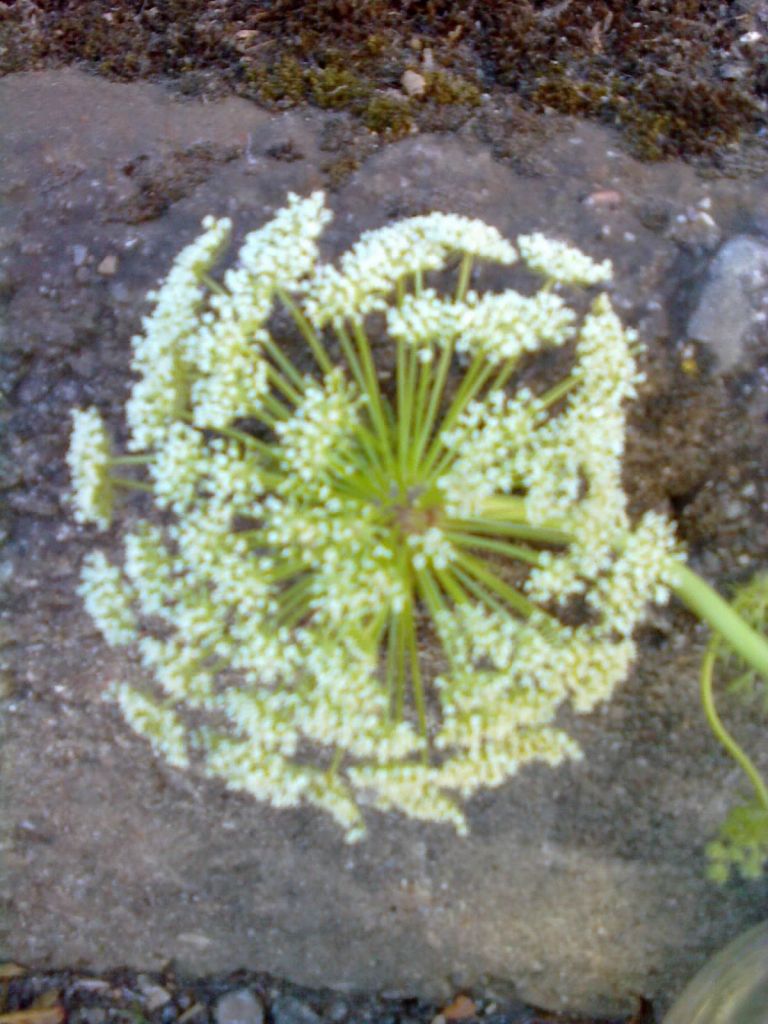
There are actually a few different flowers known as Queen Anne’s lace. The most common species, Daucus carota, that has naturalized and even become somewhat of a weed in some areas, has two and a half inch broad, flat-topped trusses of delicately minute but abundant flowers, with a single red flower at the center of each truss. Apparently, Queen Anne pricked a finger with a needle while making the lace, leaving a drop of blood. Modern varieties have broader and fluffier trusses, often lacking central red flowers. They are a popular ingredient or fill for mixed bouquets with more colorful flowers.
The biennial foliage of Queen Anne’s lace grows to about three feet tall in the first year, with weedy but intricately lacy leaves. It blooms in summer of the second year. It is very similar to poison hemlock, which is poisonous enough to kill Nero, so should not be allowed to grow in vegetable gardens or where toxicity might be a problem; just in case.
 Tony Tomeo
It is a thing of beauty and one of my favorites.
LikeLiked by 1 person
I forgot how out of focus that old picture is, but it really was pretty with other flowers at the time.
LikeLiked by 1 person
I keep trying to grow it from seed – that’s the purple-flowered one that we kave over here as ‘Purple kisses’
LikeLiked by 1 person
Purple?! It is so perfect in white. Purple sounds . . . unique.
LikeLike