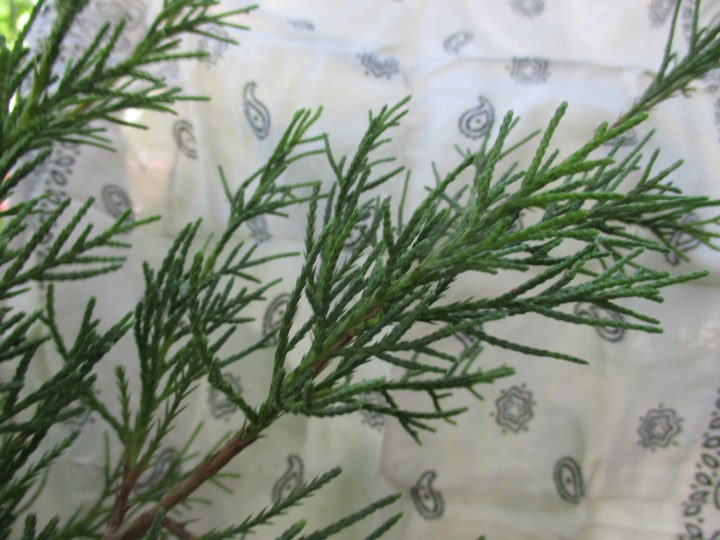
One of the less common and certainly least familiar of junipers happens to be the most culturally and environmental significant juniper in North America, even though it is not even known as a juniper. Juniperus virginiana is instead known as the Eastern red cedar. It has a vast range, including every state east of Colorado, as well as Quebec, Ontario and even Oregon to the west. In some areas within and near the natural range, fire suppression has allowed Eastern red cedar to become invasive.
Mature trees are mostly less than fifty feet tall, but are the biggest evergreen trees in Kansas nonetheless. The largest Eastern red cedars can get almost ninety feet tall. Most are well branched from top to bottom unless pruned for clearance. The fibrous bark is ruddy brown, but not often seed from the outside.
Foliage and fruit are rather variable. The prickly juvenile leaves of young plants and interior stems of mature plants can be rather annoying. The scale-like adult leaves are more typical of junipers. Male trees produce pollen that can be a significant allergen. Female trees produce sporadic, small berries in blue or purplish black, that are quite popular with certain birds through winter.
Prior to the discovery of the incense cedar in the west, Eastern red cedar was the common aromatic cedar that was used to make pencils and to laminate cedar chests and closets to protect woolens and natural fibers from moths. Since it is so repellent to insects and decay, it is commonly used as fence posts. Native American Indians also used posts of Eastern red cedar, painted red with blood of the animals they hunted, to mark the boundaries of their hunting ranges. The name of Baton Rouge, which means ‘red stick’, was actually derived from such marking posts.
During the Dust Bowl drought of the 1930s, and before becoming known as a potentially invasive species, Eastern red cedar was promoted by the Prairie States Forest Project as a resilient wind break. They tolerate drought, harsh exposure and inferior soil. They can be planted close together to fill out and gain height more efficiently. More information about Eastern red cedar can be found where I got much of this information, at the Great Plains Nature Center.
 Tony Tomeo