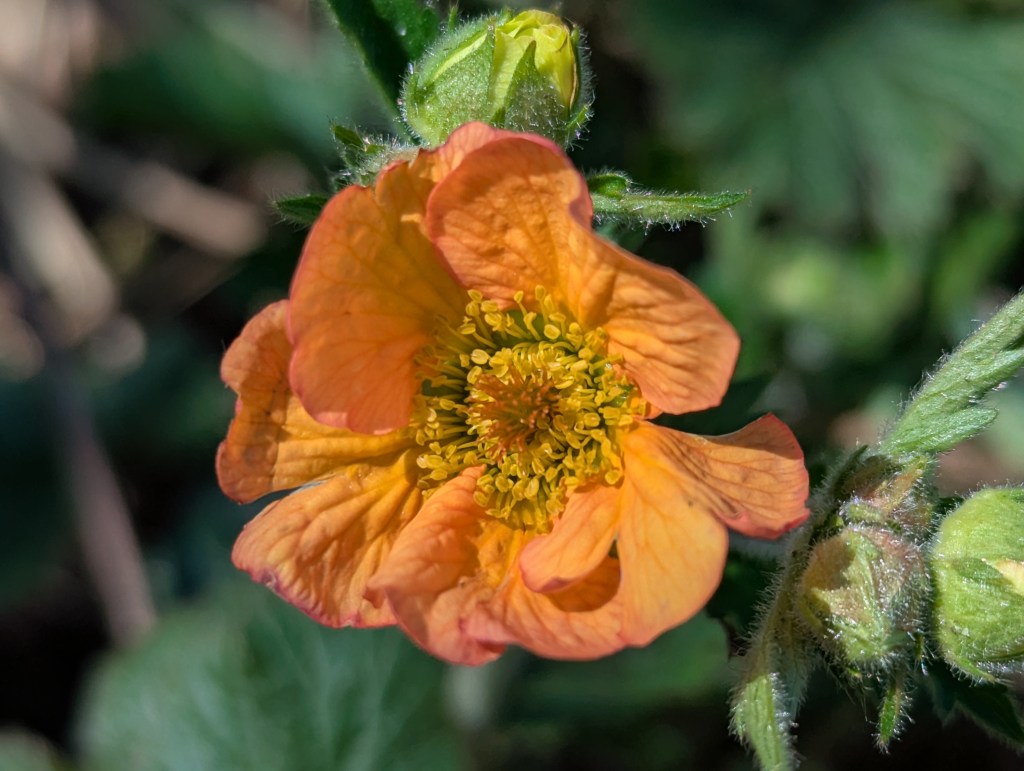
Sunday Best – Geum
Rhody and I are still not taking many pictures while on vacation. I realize that I said that I should be more diligent about doing so, but we have been so busy vacationing. Perhaps I will do somewhat better next Saturday.
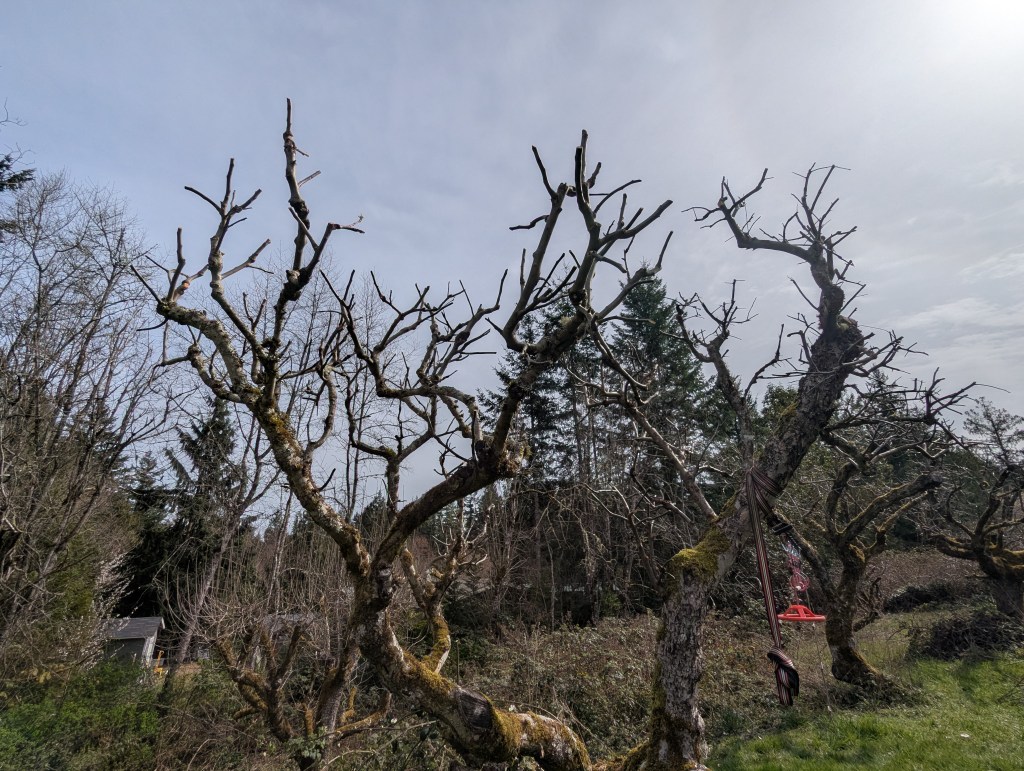
1. Apple trees before pruning look like a hot mess, particularly with the thicket of willow and other vegetation in their background, but are actually quite healthy and cooperative.
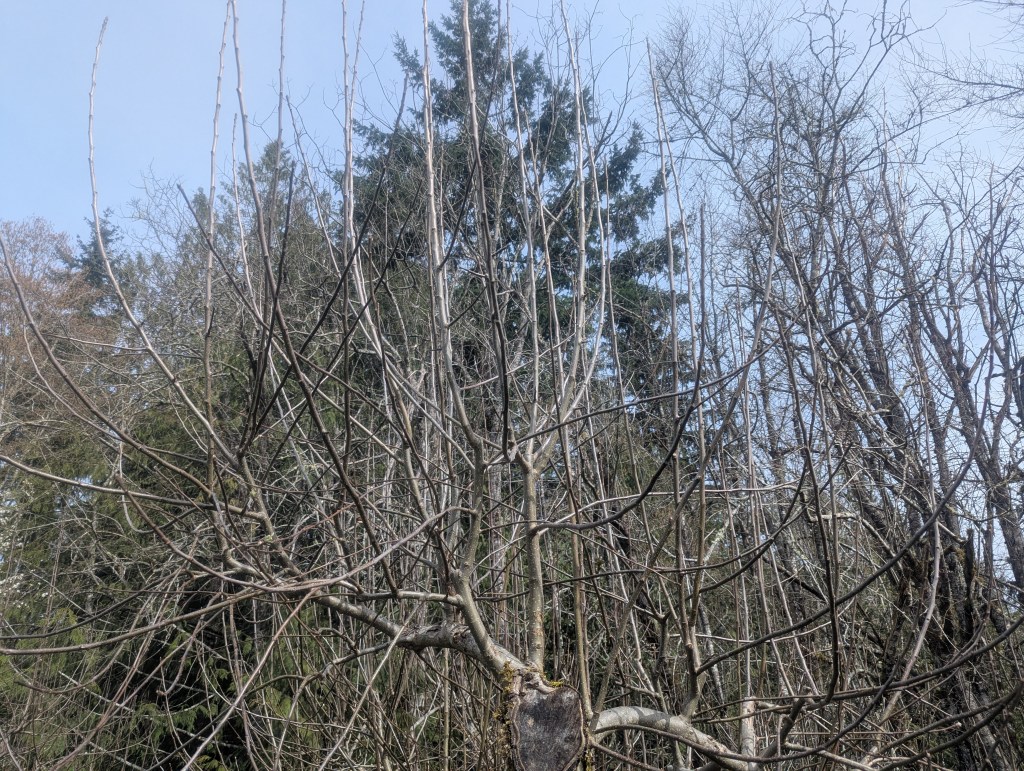
2. Apple trees after pruning still look questionable and disfigured, but really are healthy. I probably should not have thinned them so much. It will compromise their production.
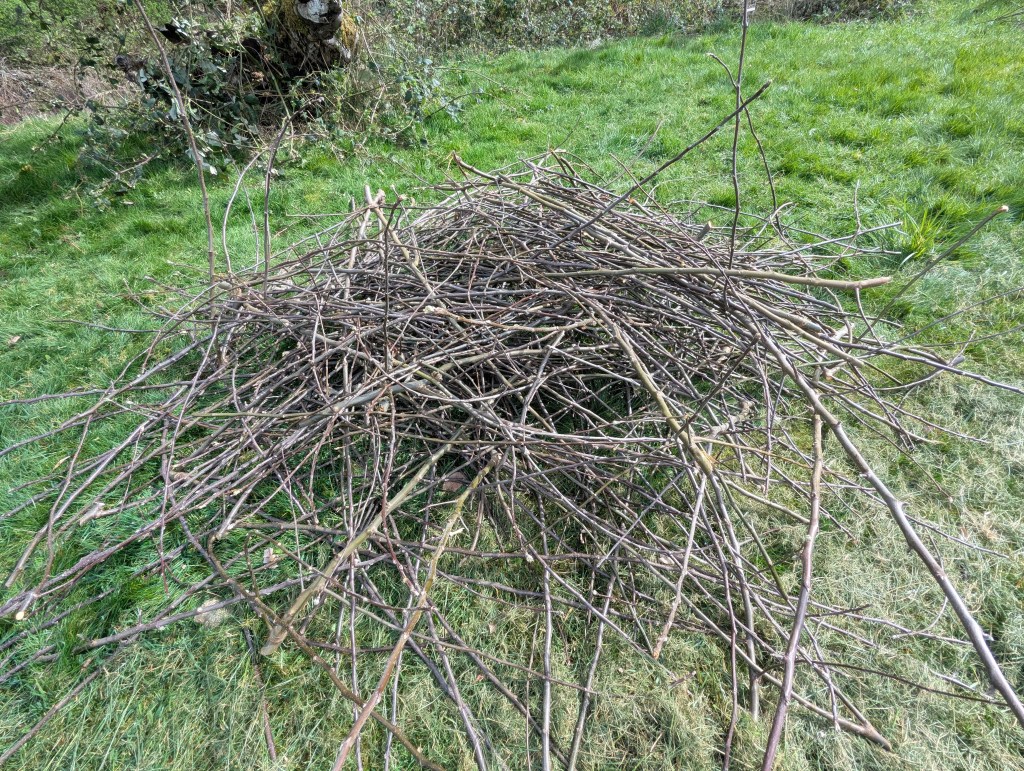
3. Apple debris was not so abundant this year, since all the major cuts were made in past seasons. Almost all of this debris is one or two year old growth. Now, it must be burned.
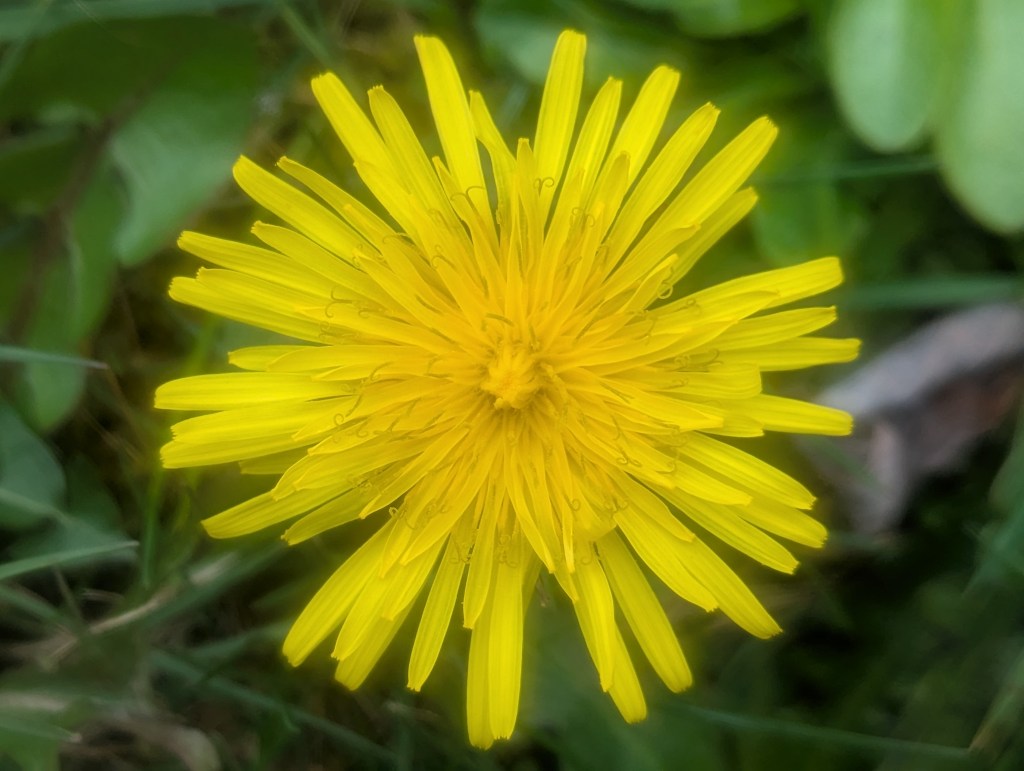
4. Dandelion was one of the only flowers besides cherry trees that I noticed blooming in the vicinity of the apple trees. A cherry tree that I got pictures of last week is about done.
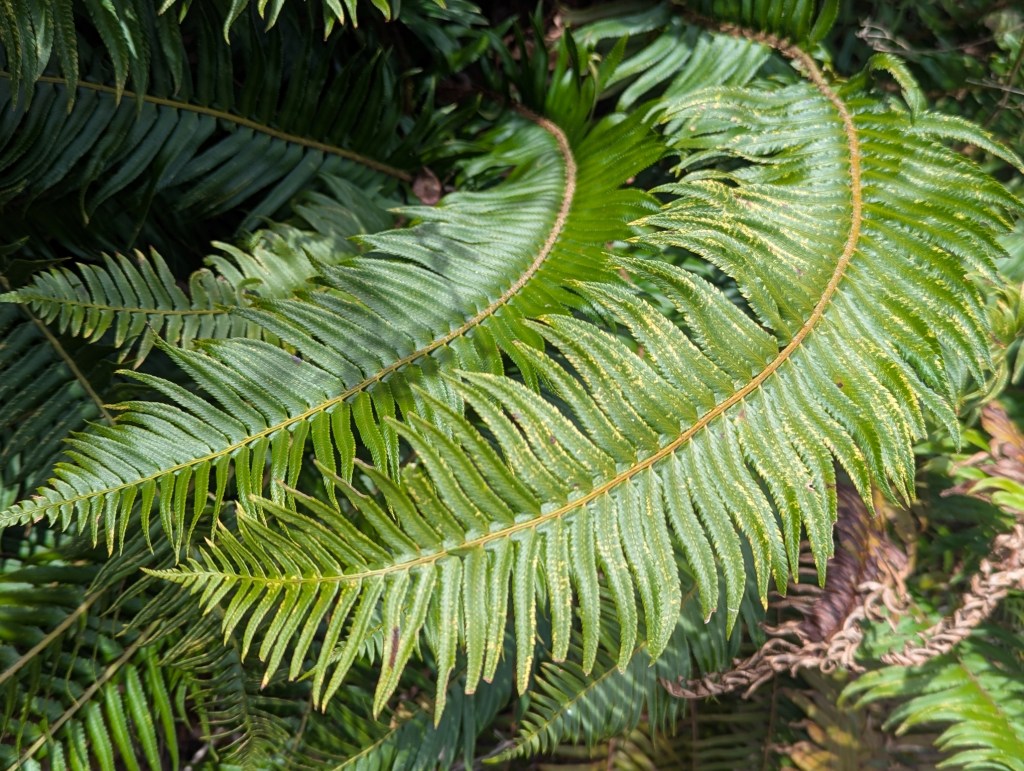
5. Western sword fern was featured in an upcoming gardening article. This picture is the same as the illustration but sideways. This fern is very common in the Pacific Northwest.
6. Rhody really knows how to relax on our vacation. He is very fond of my Pa, and enjoys lounging on his lap for as long as he can, typically with an inane movie on the television.

This is the link for Six on Saturday, for anyone else who would like to participate: https://thepropagatorblog.wordpress.com/2017/09/18/six-on-saturday-a-participant-guide/
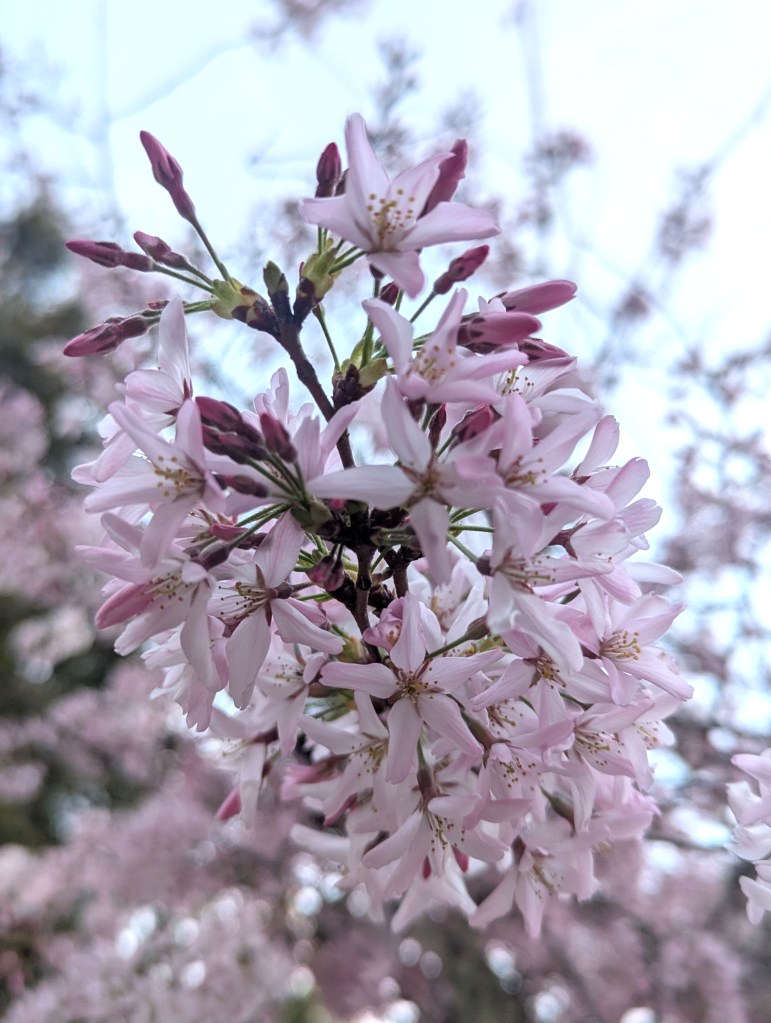
Flowering cherries are a complicated group of many distinct hybrids, of several species. Japanese cherry, Prunus serrulata, is the most common ancestor of almost all of them. It is a relatively small deciduous tree that does not get much more than twenty five feet tall. The wild species produces unpalatable fruit, but its many hybrids are generally fruitless.
Most flowering cherries exhibit splendid autumn foliar color, with yellow, orange and red. Weeping cultivars develop strikingly pendulous form. Birch bark cherry exhibits distinctly smooth and chestnut brown bark, with broad lenticels. Weeping cultivars are sometimes grafted onto birch bark cherry trunks. This combines pendulous form with smooth trunks.
The primary allure of flowering cherries, though, is their profusions of early spring bloom. Floral color ranges from bright white to rosy pink, although most cultivars are pastel pink. Flowers can be delicately single or billowy double. Some cultivars bloom slightly earlier or later than others, but all bloom quite early. Their blooming stems are pretty cut flowers.
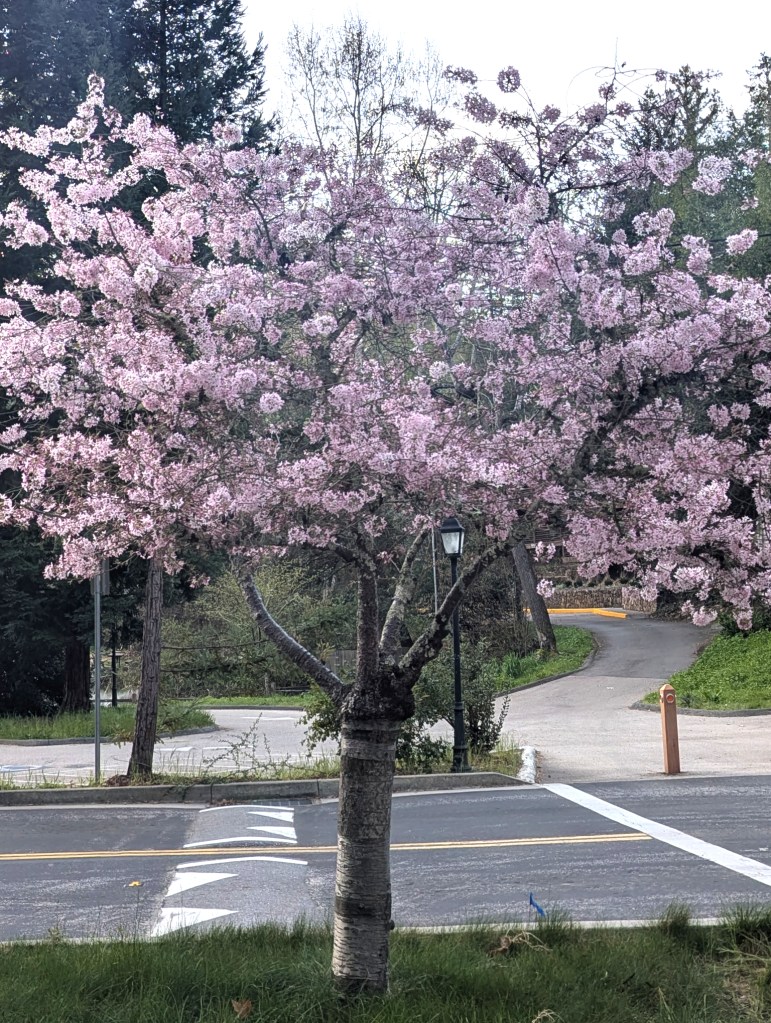
Fruit trees such as apricot, cherry, peach and plum, bloom about now. Some are already finished, while a few are just beginning. Apple and pear trees will bloom somewhat later. More colorfully, flowering or fruitless counterparts of such trees are on similar schedules. Flowering apricot has already finished bloom. Flowering crabapple will likely bloom last.
The difference between fruit trees and their flowering counterparts is not their bloom. It is their fruit or lack thereof. “Flowering” has become a euphemism for “fruitless”. Trees with such designation produce either no fruit or fruit of relatively inferior quality. Wildlife might enjoy some of any inferior fruit. Although, even inferior crabapples might make good jelly.
Purple leaf plums are probably the most popular of this type of flowering or fruitless tree. Flowering cherry is less common. Flowering peach is somewhat rare. Fruitless pear is a popular street tree, but may not bloom as profusely as the others. Also, it does not bloom quite as early. Flowering quince grows as shrubbery rather than trees with upright trunks.
While very closely related, fruiting trees and their fruitless counterparts are very different. Fruiting trees should obviously produce fruit. That is their primary purpose. Their fruitless counterparts are merely ornamental. The truly fruitless types grow and bloom where fruit would be a messy nuisance. For example, some perform well as small scale street trees.
Because they are fruitless, such trees do not require specialized dormant pruning. There is no need to prune to concentrate resources into developing fruit. Nor is there any need to prune to accommodate the weight of fruit. Fruitless trees can assume their natural form and scale instead. Although none are large trees, they can grow taller than fruiting trees.
Also because they are fruitless, their bloom is their priority. They bloom more abundantly than fruiting trees, and some bloom with double flowers. Floral color is more diverse too, ranging from bright white to rich rosy pink. Some flowering crabapple trees bloom nearly red. Since dormant pruning is unnecessary, blooming stems are splendid as cut flowers.
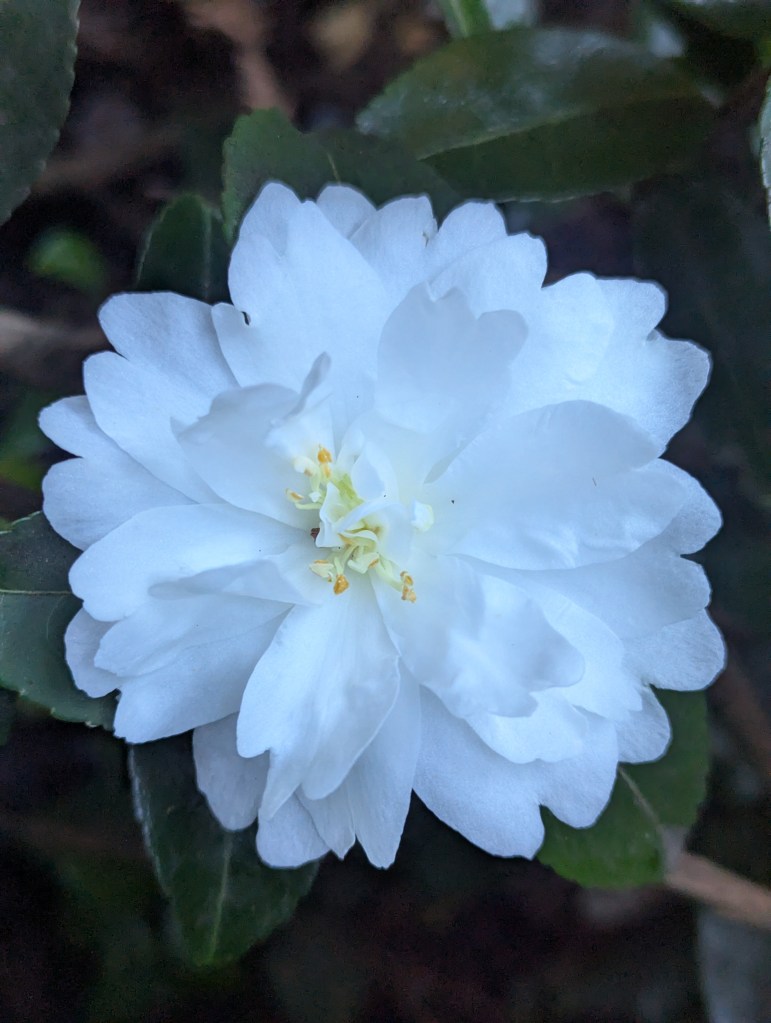
Between leaving on my trip and arriving, I neglected to get many pictures to select from for these Six. Actually, only two pictures are from the trip. I should take more pictures.
1. Prunus serrulata, flowering cherry of unidentified cultivar was featured in the garden column. It was the first to bloom. This picture was a bit too dark to use as an illustration.
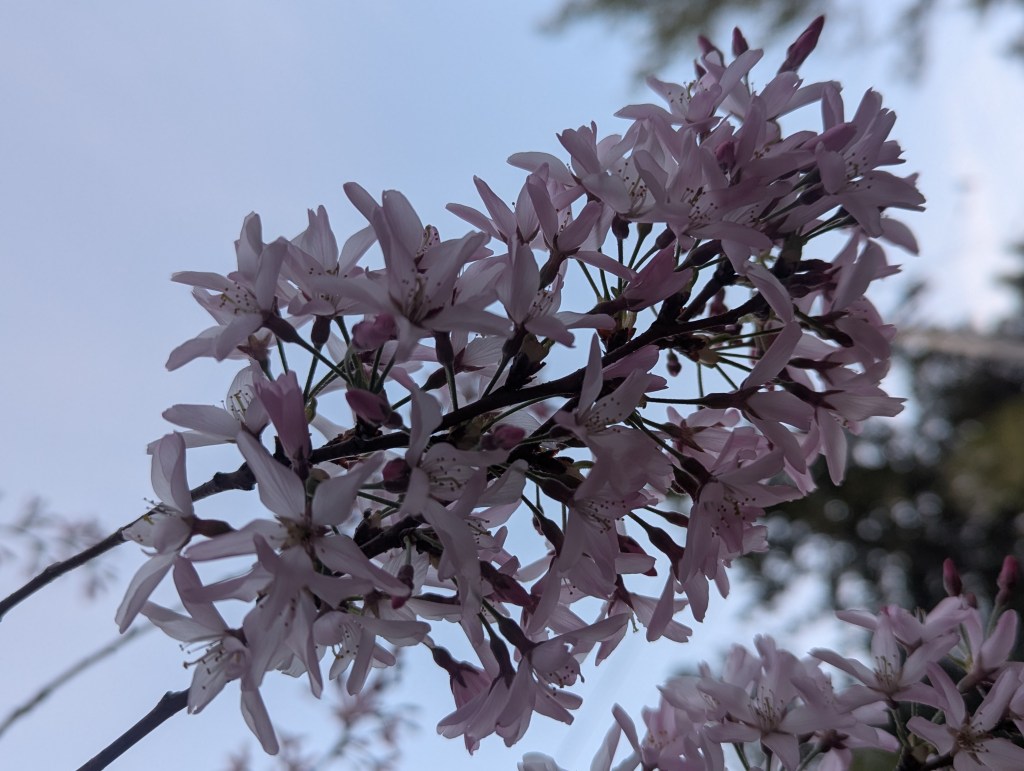
2. Camellia japonica, camellia looks like a fried egg with such a prominent yellow center surrounded by a white corolla. White camellia are prettier with less prominent stamens.
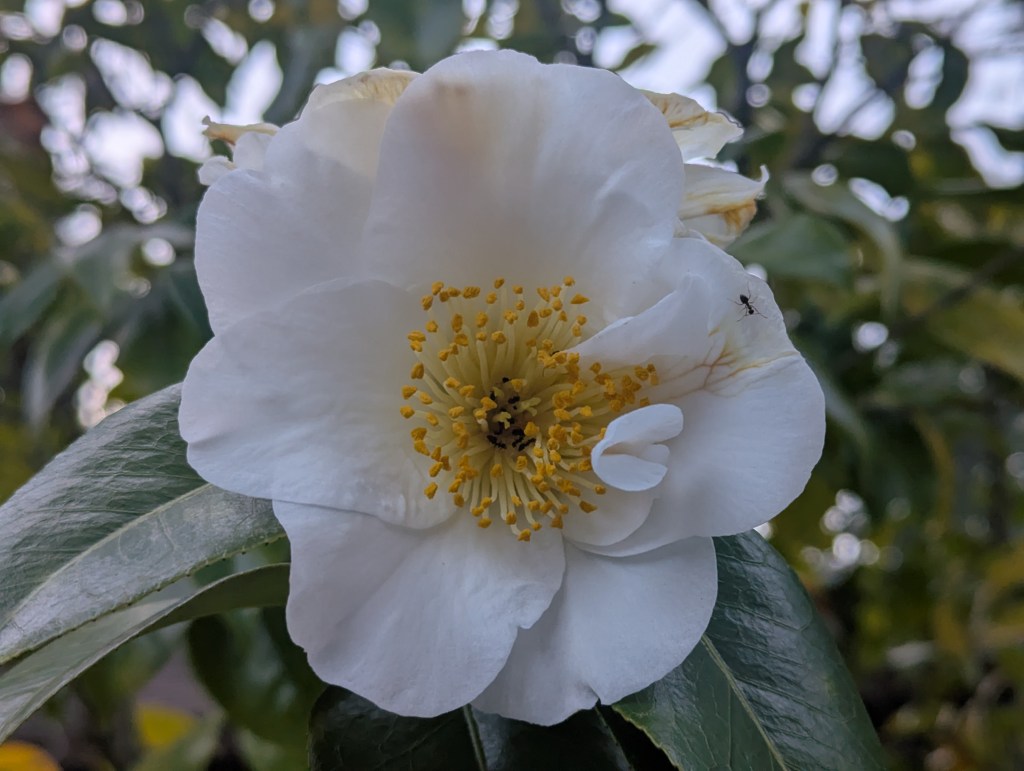
3. Camellia japonica, camellia seemed more red than this when I took its picture. It was still blooming adjacent to the white camellia above. It is as pretty in pink as it was in red.
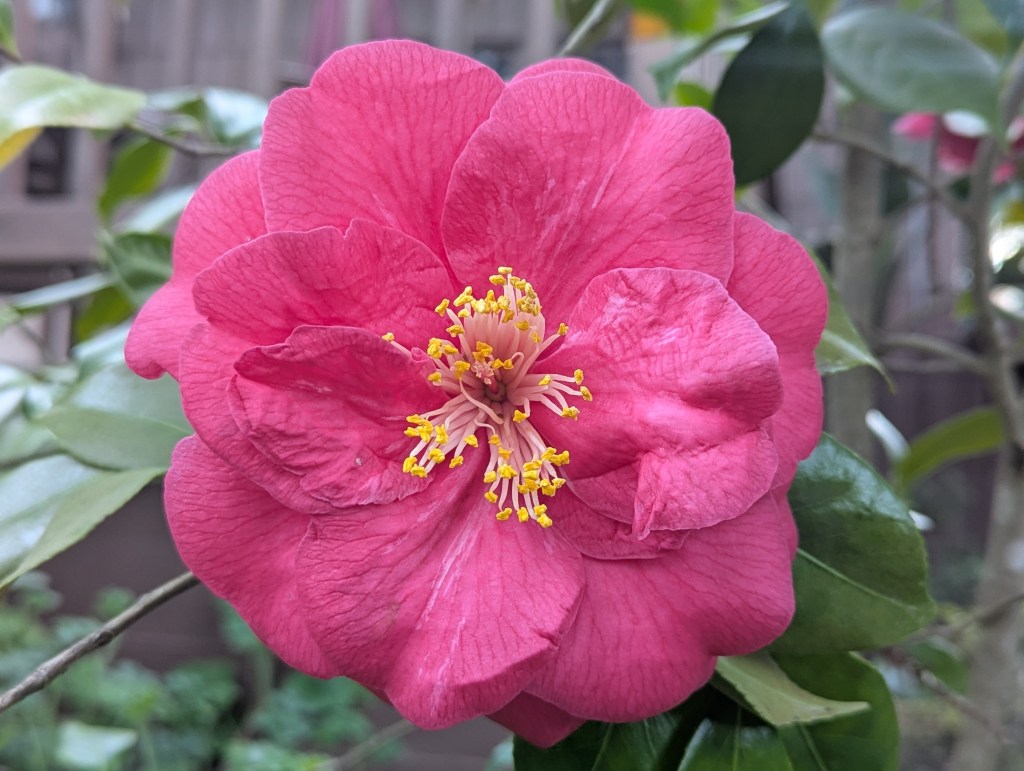
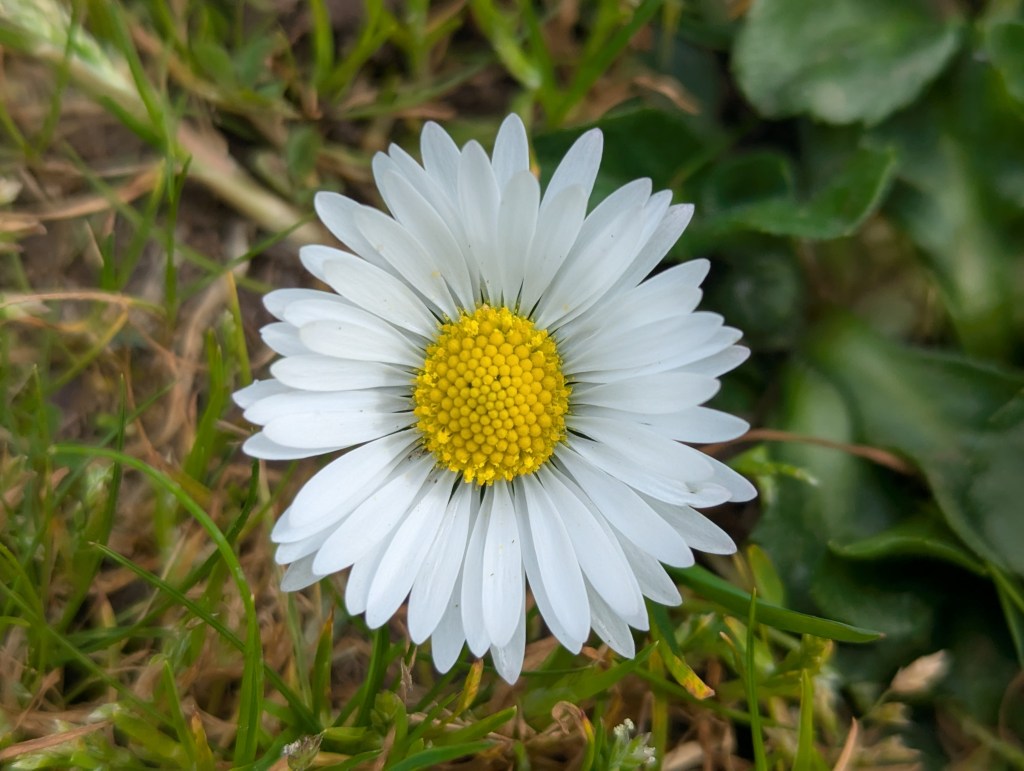
4. Bellis perennis, English daisy is the only picture that I took in Oregon. I must be more diligent about taking pictures on the way back, even if I do not stop in Oregon too much.
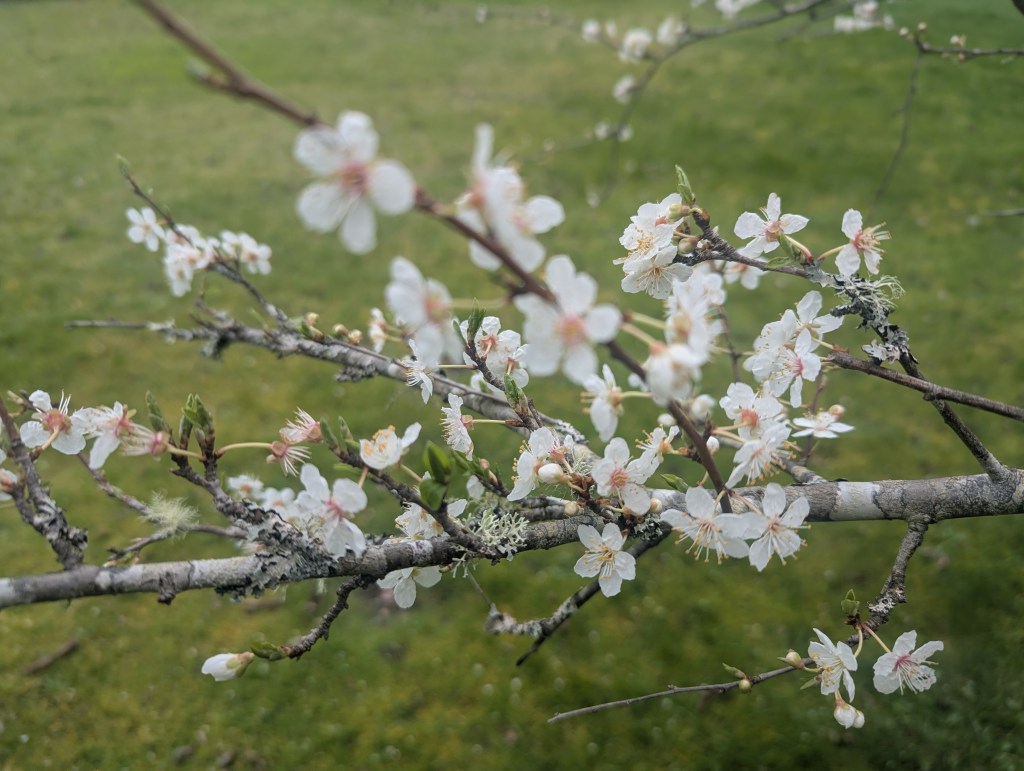
5. Prunus spp., cherry understock is growing from the base of what was formerly a stone fruit tree of some sort on my Pa’s farm. It is cool and rainy here, but is obviously spring.
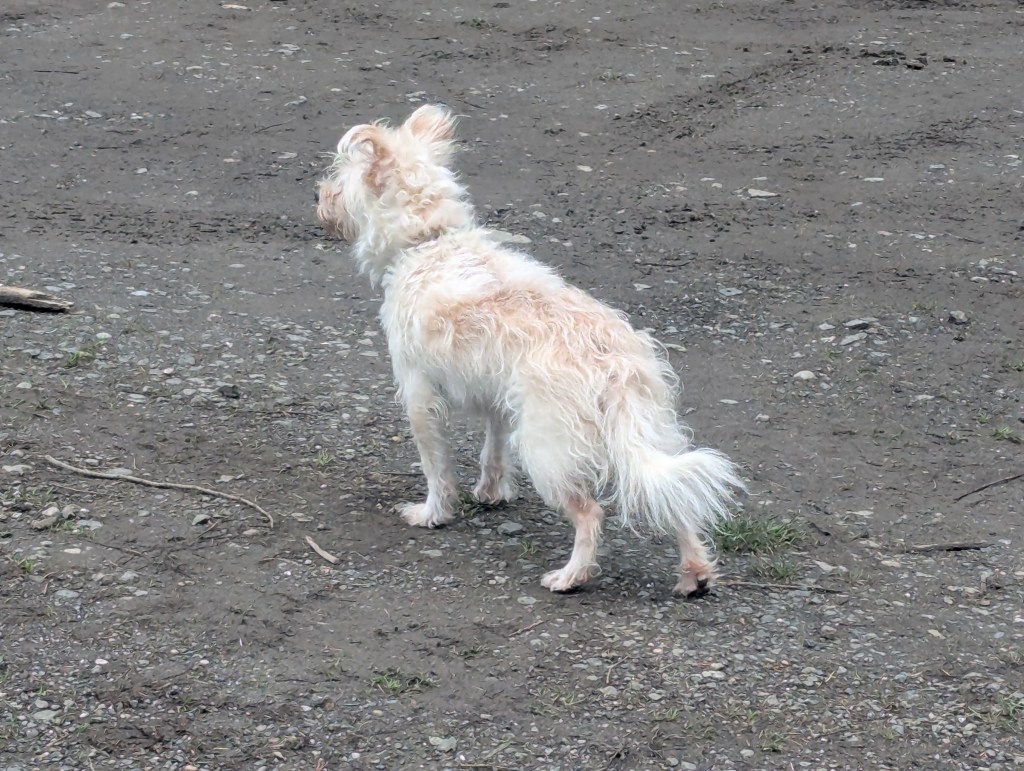
6. Rhody is a good sport on our trip. We left at midnight and, because of a few stops, we arrived after six in the evening. That is an eighteen hours drive, or a 126 dog hours drive.
This is the link for Six on Saturday, for anyone else who would like to participate: https://thepropagatorblog.wordpress.com/2017/09/18/six-on-saturday-a-participant-guide/
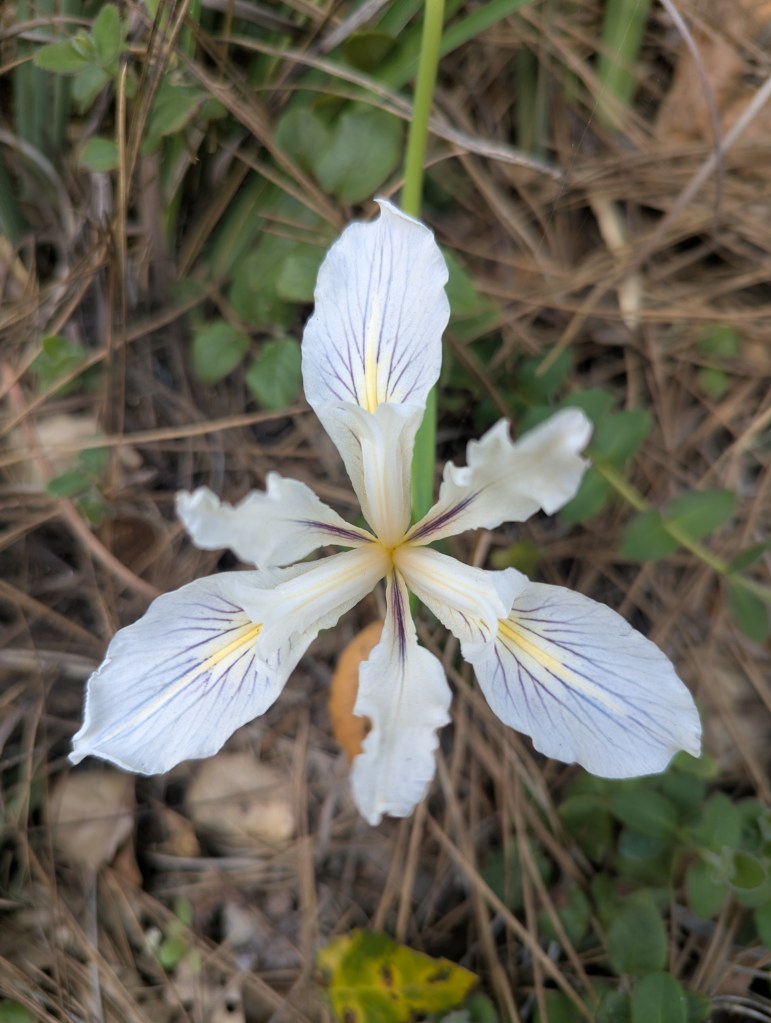
The natural range of Fernald’s iris, Iris fernaldii, is actually rather limited. It is endemic to only the Coast Ranges from Mendocino County to Santa Cruz County. Although it grows well beyond its natural range, it is quite rare in cultivation. Within chaparral climates that are warmer than its range, it prefers afternoon shade. Its foliage is greener with irrigation.
In the wild, Fernald’s iris develops sparse colonies, typically mixed with other vegetation. Colonies are more compact with cultivation and exclusion of other species. Propagation is very easy by division, or simple separation of wayward rhizomes. Fernald’s iris can be satisfied with shallow soil or soil of inferior quality. Too much fertilizer may inhibit bloom.
Fernald’s iris grows only about a foot tall, with slender, grassy and grayish green leaves. Floral stalks stand a bit more vertically and slightly above the foliage. The typically white flowers are paired on each floral stalk. Flowers might be pale or buttery yellow, or, rarely, pale lavender. Roots are thin but tough. Rhizomes, relative to those of other iris, are slim.
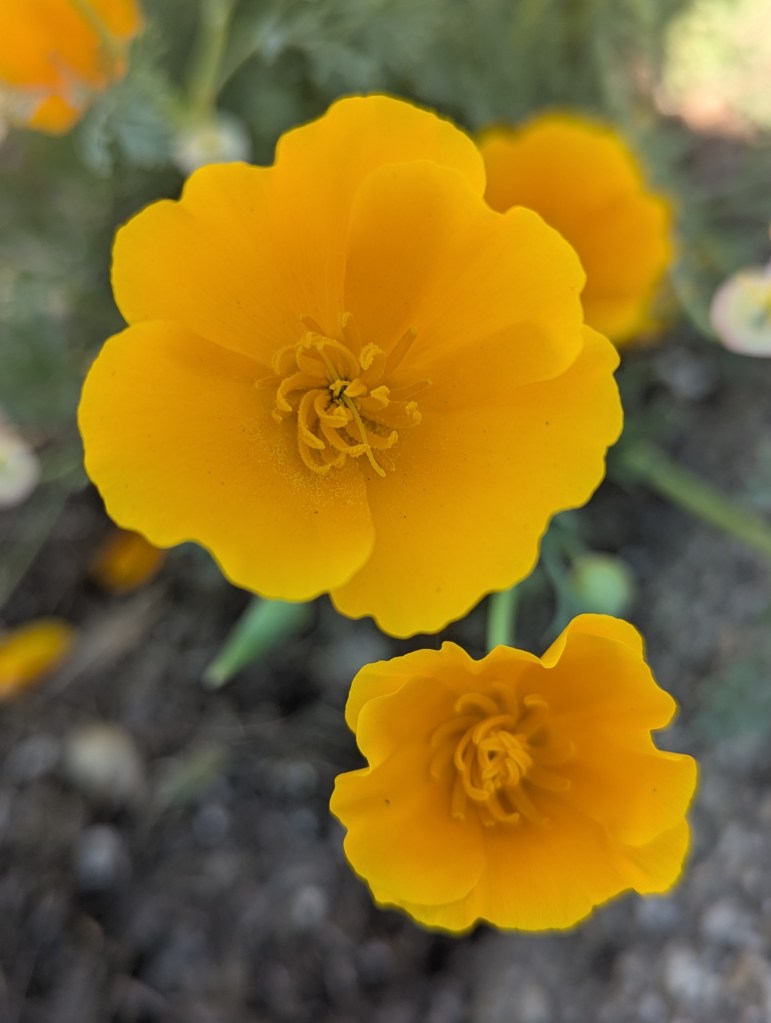
Vegetation has always been here. Wildlands outside of urban development demonstrate that noplace is or was without it. Native species lived here before any home gardens did. Whether intentionally or unintentionally, some of it still does. Some sneaks in like weeds. Some arrives by invitation. A few old trees never left as the area around them developed.
Native species perform well locally because they are adapted to local climates and soils. It is all very natural to them. In fact, many dislike major modifications to their climates and soils. Although most tolerate or even appreciate a bit of supplemental irrigation, some do not. Many rot if irrigation is too generous. Also, many do not want much soil amendment.
Some native species might be a bit too natural, though. Because they are from chaparral climates, they can get somewhat scraggly by summer. It is not because of a lack of water or other environmental deficiency. It is their natural behavior, and how they survive in the wild. Many wildflowers that bloom so well for spring are completely dormant by summer.
The advantage to this is that almost all native species do not demand much water. Many want none at all. Once established, they get all they need from natural rainfall. Therefore, landscapes of mostly or exclusively native species conserve water. Since native species are adapted to endemic soil, they require no fertilizer either. They are quite conservative.
California poppy, which is the State Flower of California, is a very familiar native annual. Unlike other native species, it appreciates supplemental irrigation after the rainy season. It typically blooms only for spring, but may bloom into summer with occasional irrigation. Sky lupine is another native annual that blooms for spring, with contrasting blue flowers.
Various salvias, bush lupines, penstemons, irises and grasses are native perennials. So are sticky monkey flower, Oregon grape, tree anemone and tree poppy. Toyon, silk tassel and various California lilacs are native shrubbery. So are flannel bush, coyote brush and coffeeberry. California sycamore, coast live oak and redwoods are common native trees.
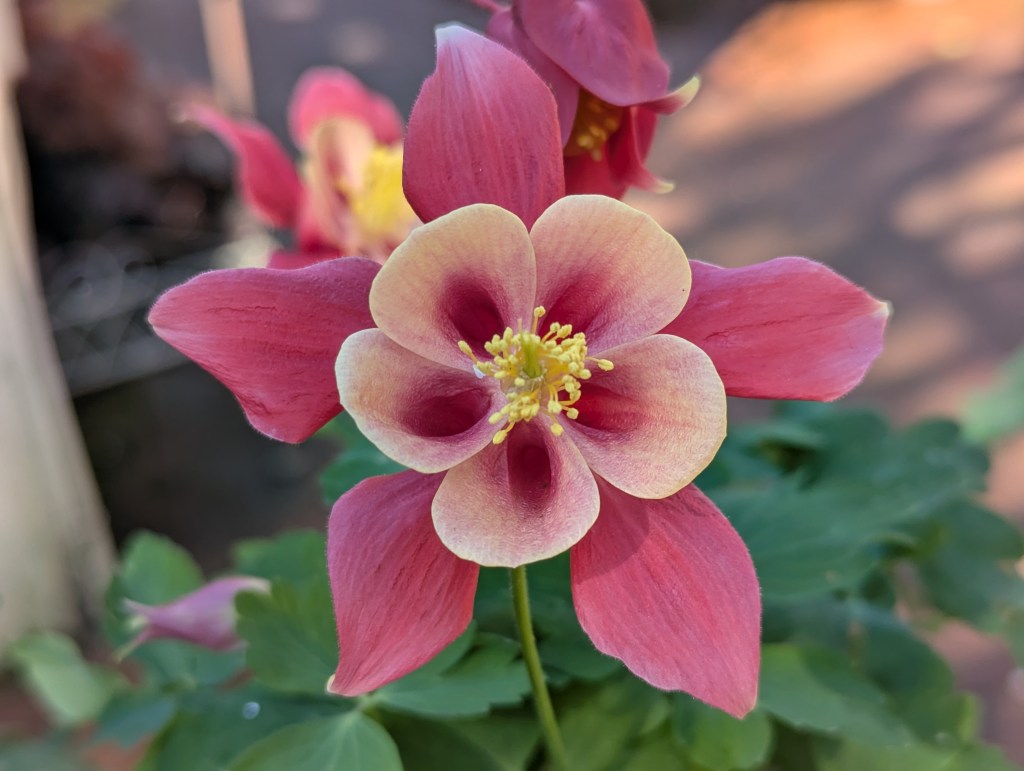
More flowers seem to be in order. The six that I posted pictures of last week got so much extra attention.
1. Gerbera jamesonii, Transvaal daisy, along with the columbine below, was observed in a nursery. It is a long story. To be brief, neither was within the landscapes or my garden.
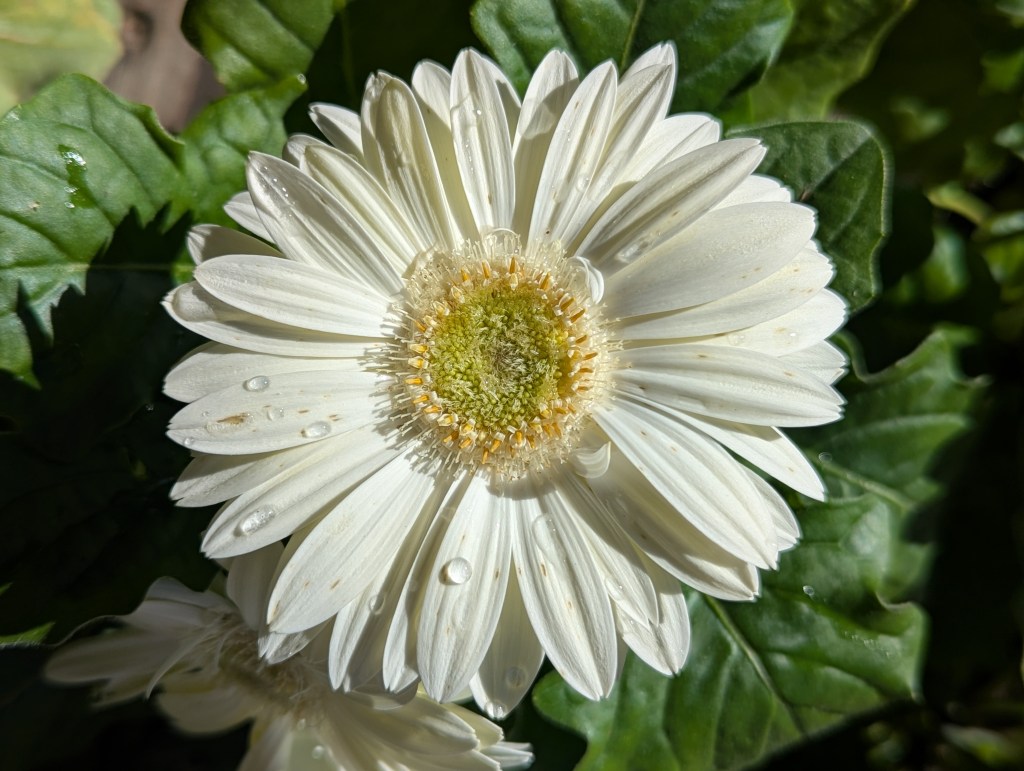
2. Aquilegia X hybrida, columbine is the State Flower of Colorado, but also is the colors of the Flag of Greece. Perhaps that is too much trivia. It is elegant and pretty regardless.
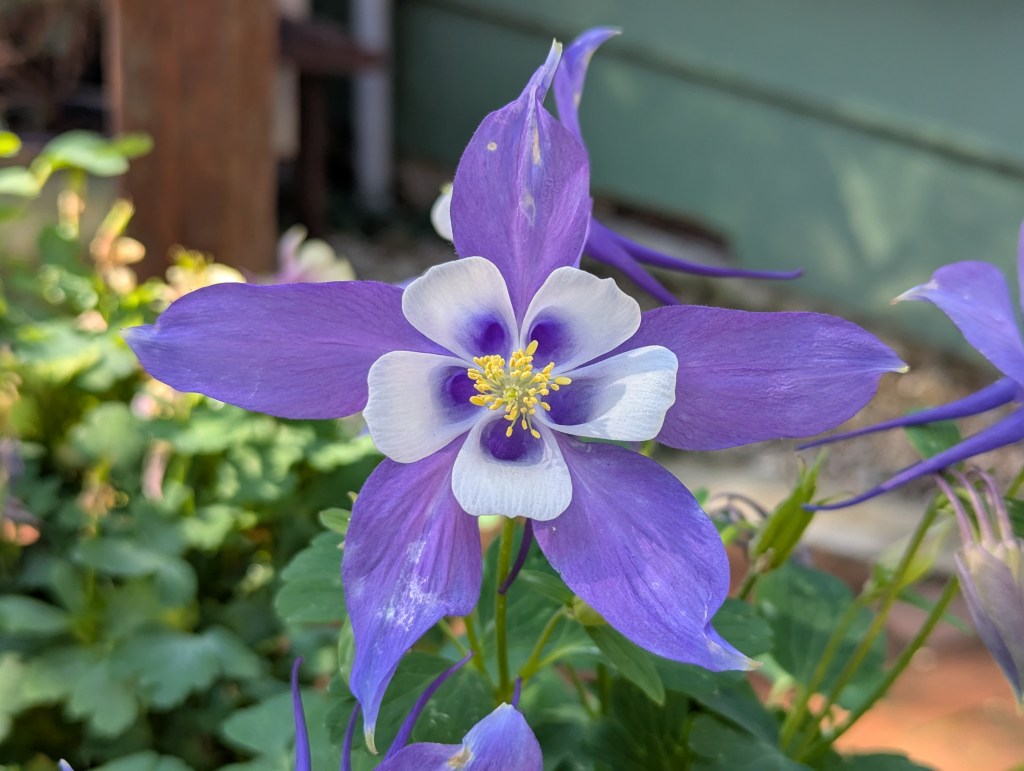
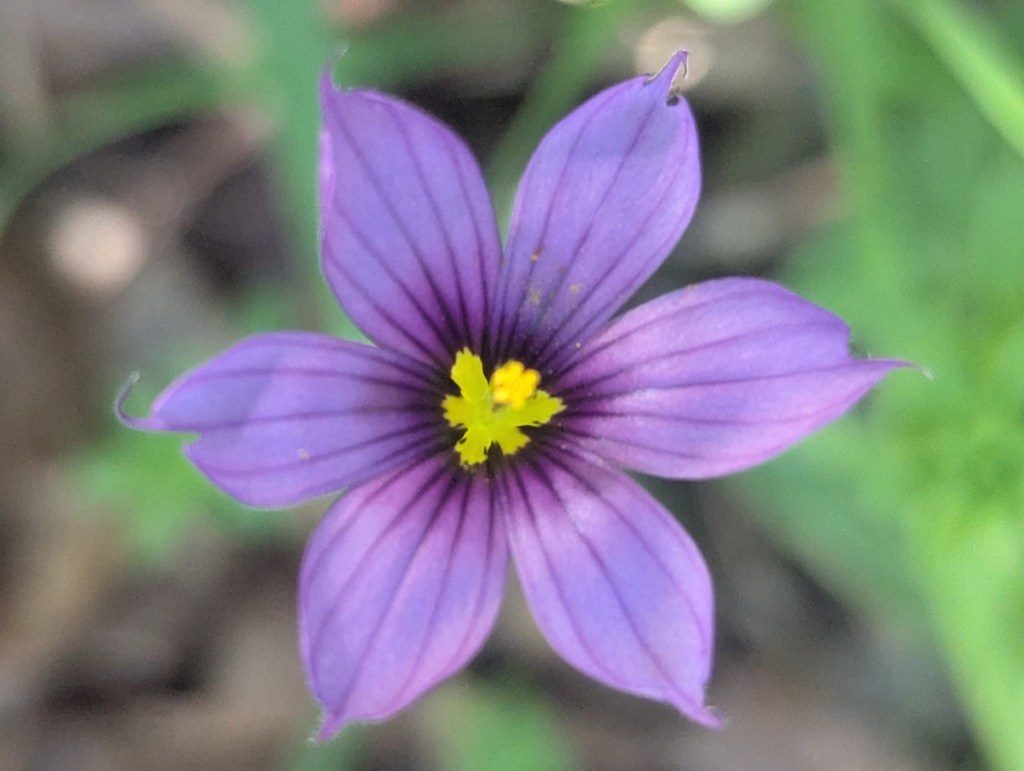
3. Sisyrinchium angustifolium, blue eyed grass grows wild here. This one happens to be in my driveway. Its proliferation exceeds its intellect. It might otherwise soon be extinct.
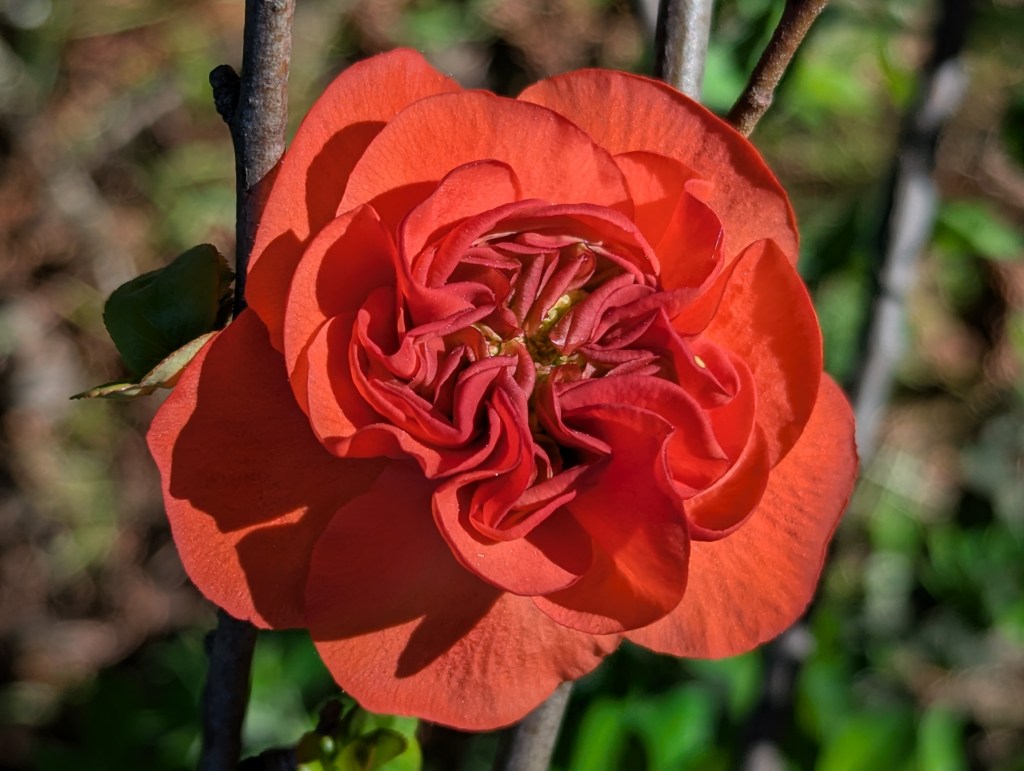
4. Chaenomeles speciosa ‘Orange Storm’ flowering quince is appealing only because it is a flowering quince. I am unimpressed by its fancy breeding and orangish red garishness.
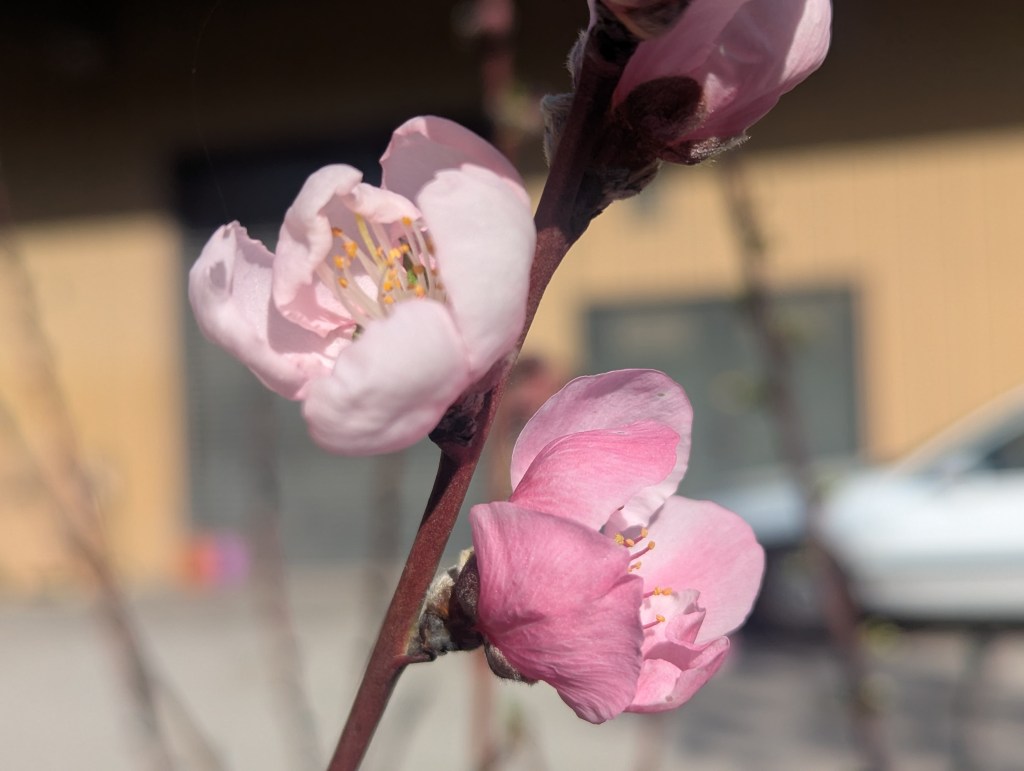
5. Prunus persica var. nucipersica ‘Fantasia’ nectarine is more respectable since it is not fruitless, and also since it is among the most popular cultivars of the Santa Clara Valley.
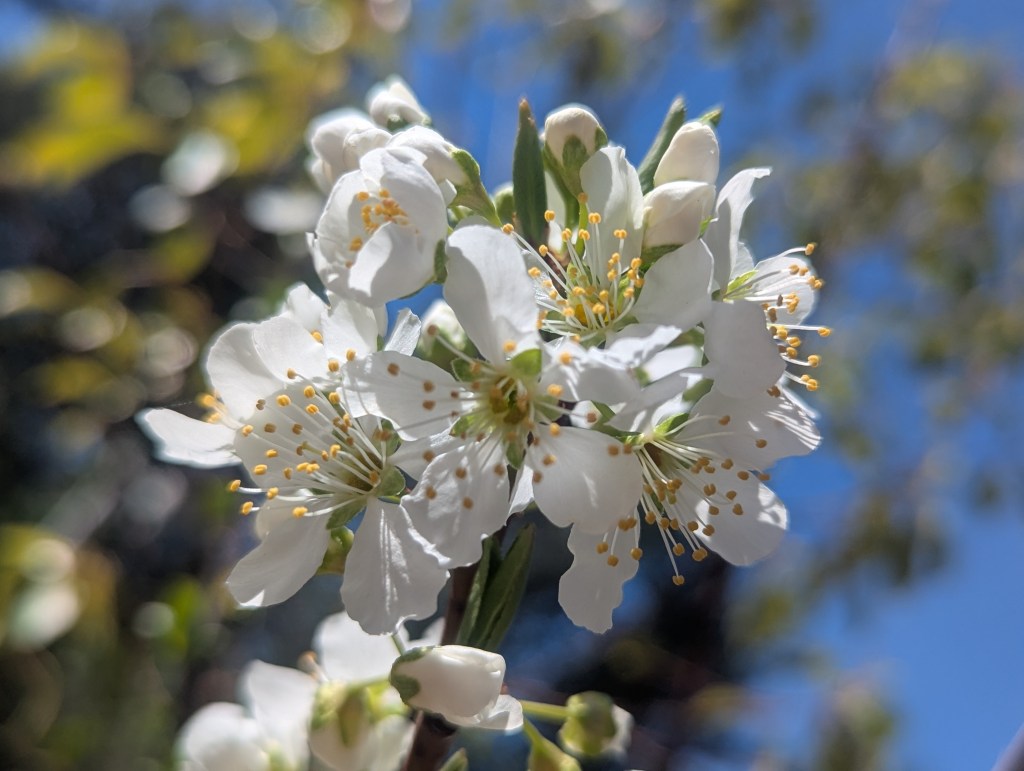
6. Prunus salicina ‘Satsuma’ plum is not as popular as ‘Santa Rosa’ plum is, but it is very traditional among those who are familiar with it. It is not quite as tart as ‘Santa Rosa’ is.
This is the link for Six on Saturday, for anyone else who would like to participate: https://thepropagatorblog.wordpress.com/2017/09/18/six-on-saturday-a-participant-guide/
 Tony Tomeo