Horticulturists are by nature, nonconforming. I happen to find it difficult to conform to what makes us nonconforming. Trends are fleeting. Old technology that has worked for decades or centuries is still best. Although I am not totally against chemicals, I find that almost all are unnecessary for responsible home gardening. Pruning is underappreciated, and fixes many problems.
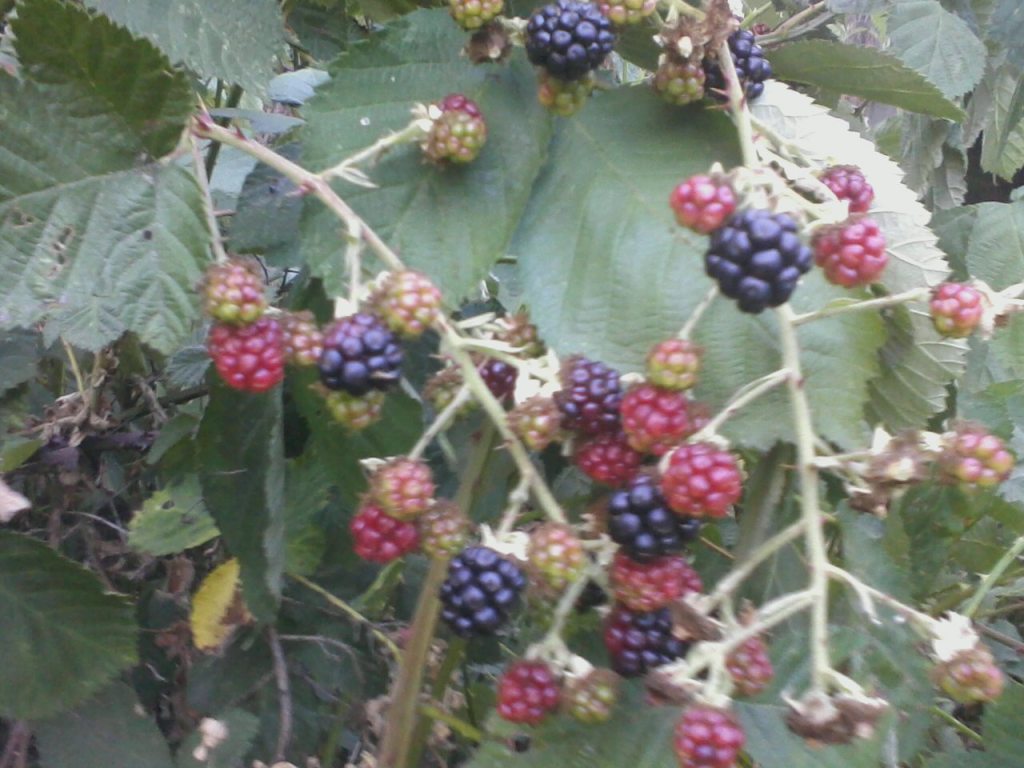
Blackberries are ripening slowly this year because of the mild weather.
Rampant brambles of feral blackberry, Rubus fruticosus, canes are much too common and give blackberries a bad reputation. Yet, with regular selective grooming and pruning, their biennial stems that emerge from woody perennial roots are both more productive and easier to contain than one would guess. ‘Primocanes’ grow rapidly to six to sixteen feet in the first year. In the second year, they become ‘floricanes’, which do not grow longer, but instead develop lateral stems that bloom and fruit. Only a few modern ‘fall bearing’ or ‘everbearing’ cultivars fruit on primocanes.
Canes are trailing, semi-trailing or erect. As the names imply, trailing types like ‘Marion’, ‘Boysen’ and ‘Olallie’, need support. They are the most popular locally because they are more productive. Erect types that need no support, like ‘Navaho’, ‘Choctaw’ and ‘Arapaho’, are less productive, but because they are more tolerant to frost, are more popular where winters are colder. Old classic blackberry varieties are quite prickly. Modern thornless varieties are becoming more popular as more varieties are developed. All have palmately compound leaves with five or seven leaflets. Simple small white or pale pink flowers that bloom late in spring are followed by the familiar blackberries that are ripening now.
Cane berries need aggressive pruning, but are no fun to prune.
All the raspberries and blackberries that are now ripening do not come without a price. The canes that produce them may grow like weeds, and in many gardens really are weeds, but they need quite a bit of work. Like the deciduous fruit trees that need such meticulous pruning while dormant in winter, berry canes need winter pruning while dormant, as well as summer pruning as the berries finish.
Blackberry canes that have produced fruit should be cut at the ground as the fruit gets depleted. Then, for ‘trailing’ varieties, about a dozen of the new canes that grew since spring should be selected, pruned to about six feet long, and trained onto the same supports that the removed canes used. ‘Semi-erect’ varieties need only about half as many canes, and get cut about a foot shorter. (‘Erect’ varieties that get cut even shorter are not common locally.) All other canes should be cut to the ground. Through the rest of summer, the pruned canes develop side branches which should eventually get pruned to about a foot long in winter to bloom and produce fruit next year; but that part must wait.
Summer bearing raspberries, like ‘Willamette’, ‘Tulameen’ and ‘Canby’, do not need to develop side branches to produce fruit next year, so do not necessarily need to be groomed of spent canes and pruned just yet, and can actually wait until winter. Everbearing raspberries like ‘September’, ‘Heritage’ and ‘Fallgold’, are not nearly so simple, although canes that were selected while young last winter and allowed to grow through summer likewise need no pruning just yet. The top portions of these canes will produce fruit later in autumn, and later in winter, get pruned down as low as fruit developed. However, the lower portions of older canes that fruited the previous year and got their tops pruned down last winter are now finishing their second and last phase of fruit production, so should get pruned out as they finish.
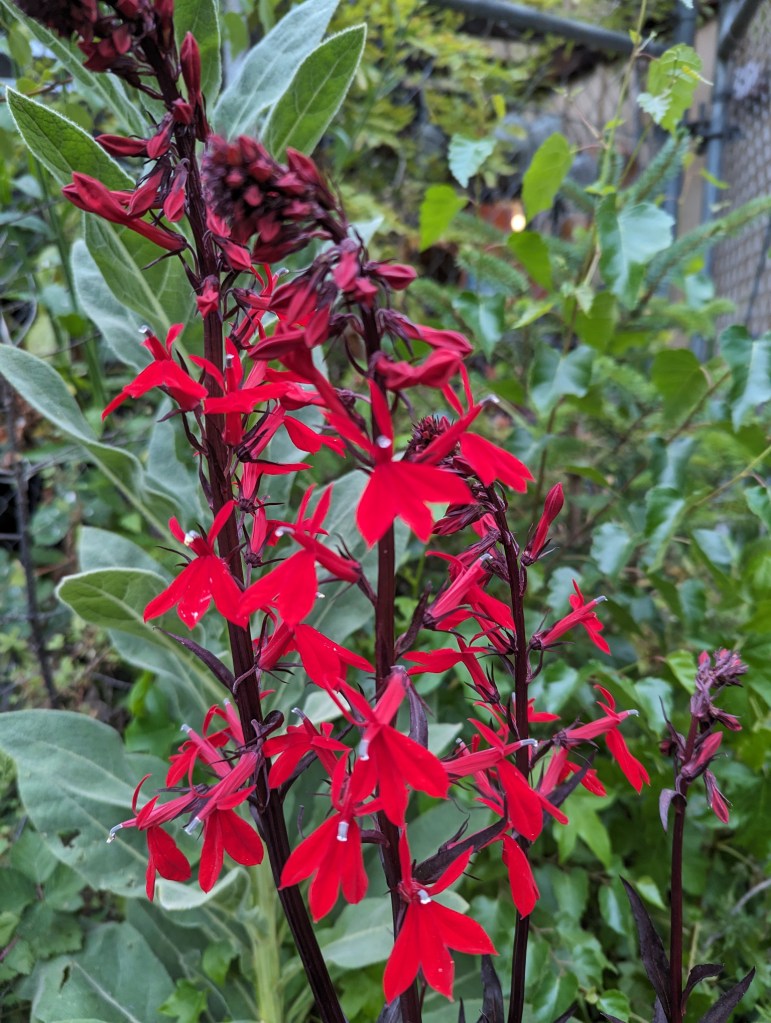
This warm season annual is actually a biennial. Cardinal flower, Lobelia cardinalis, may stay relatively short for its first summer. It might bloom four feet high for its second or third summer. By then, pups are easy to divide as new plants to replace the old. Most cardinal flower plants from nurseries are rather mature. They might grow tall for their first summer.
Common cardinal flower has rich cardinal red bloom and bright green foliage. ‘Alba’ has white bloom. ‘Rosea’ has pink bloom. ‘Queen Victoria’ has familiar rich red bloom above deeply bronzed foliage. Individual flowers are only an inch and a half from top to bottom, but are numerous. Basal leaves can be almost six inches long. Upper leaves are shorter.
Cardinal flower enjoys richly organic soil with regular irrigation. It dislikes getting too dry. It appreciates a bit of partial shade as the weather gets warmest after noon. Seed is easy to collect. However, seed from fancy cultivars is not necessarily true to type. Subsequent generations eventually revert to familiar rich cardinal red bloom and bright green foliage.
There is no doubt about it. Weeds are sustainable. Otherwise, they would not be weeds. By definition, they grow where they are undesirable. Less sustainable vegetation should be less invasive. Also, it should be less resistant to eradication than most familiar weeds are. Unfortunately, also by definition, weeds are undesirable. They can not become fads.
Sustainable horticulture is a fad though. Unlike most fads, it is actually quite sensible. In theory, it is horticulture that requires as minimal intervention as possible. It excludes that which requires intensive or impractical cultivation. For example, native species that grow wild are sustainable. Tropical species that may survive only within greenhouses are not.
A problem with the sustainability fad is its marketability. ‘Sustainable’ and ‘Sustainability’ have become cliche buzzwords. They too often describe merchandise that is contrary to the fad. Realistically, genuine sustainability is unsustainable within profitable marketing. Truly sustainable merchandise would eliminate most of the need to ever purchase more.
Modern cultivars can qualify as ‘new and improved’ as they first become available. They are certainly new. However, their improvements may be questionable. Hybridization and extensive breeding can cause genetic deficiency. Even natural variegation compromises vigor. Seed is not true to type. Most aesthetic improvements are contrary to sustainability.
Native species are technically sustainable. Once established, they might survive without irrigation or other attention. Unfortunately though, some are not very adaptable to refined home gardens. Some are vulnerable to rot if nearby vegetation needs frequent irrigation. Some perform vigorously only for a few years. Several species are innately combustible.
Ironically, several of the most passe and old fashioned species are the most sustainable. That is why some of them became passe. Lily of the Nile can survive indefinitely. If it gets overgrown, it is easy to divide and relocate. It may be available for free from neighbors or friends. African iris, New Zealand flax, bergenia, most aloe and many yucca are similarly sustainable.
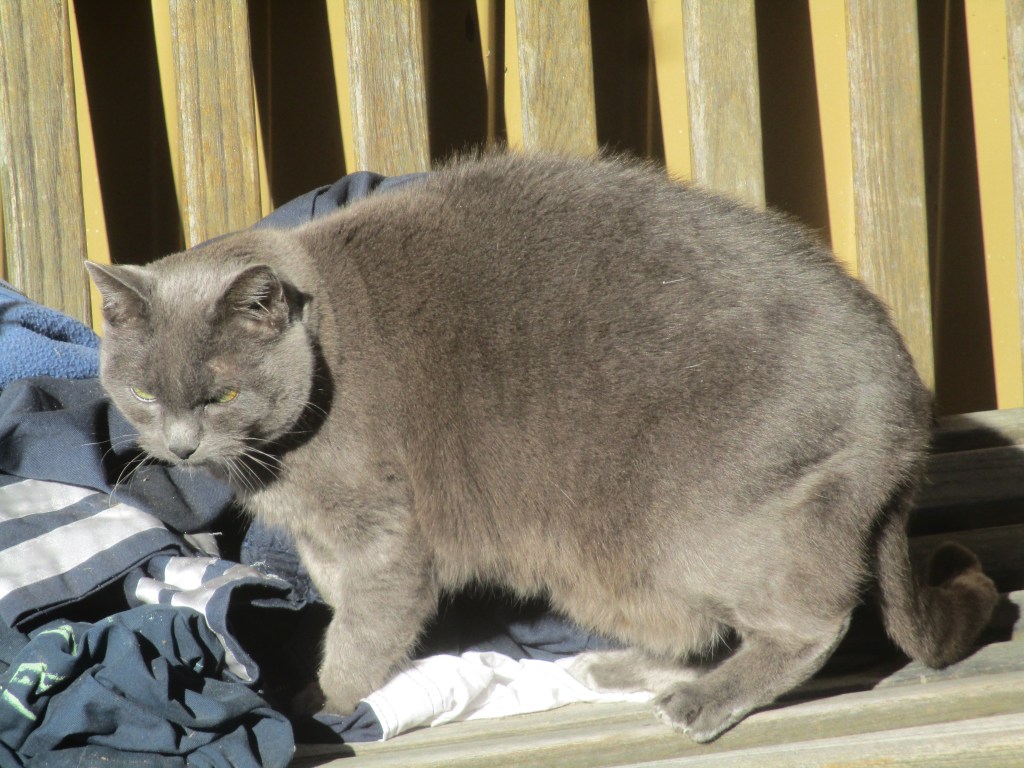
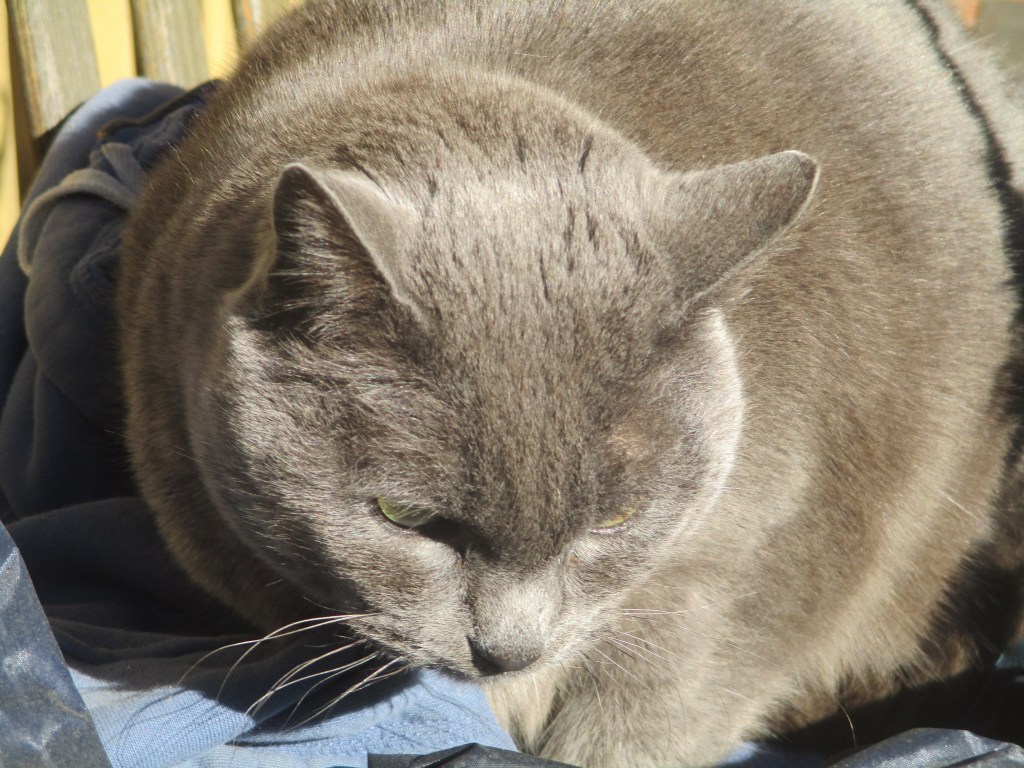
Darla is a feral kitty who used to live here. I believe that she is why no rodents lived here. I never actually saw her do anything to dissuade rodent infestation. Actually, I rarely saw her do anything. She was quite reclusive and disliked almost everyone except Rhody.
Unfortunately, someone else here insisted that fleas were a problem because of Darla. He also insisted that Darla came inside to share her fleas with the carpet and furniture. No one else, including Rhody, ever noticed a flea. Darla never came inside.
While the weather was getting nastier than it had since 1982 last winter, Darla went to live at a home in Santa Clara. After her initial disapproval, she efficiently adapted, and learned to appreciate it. Apparently, she is now happy with her more domestic lifestyle. She is quite elderly, so really deserves safer and more comfortable accommodations.
Rodents are everywhere now! Rats and mice come inside for any scraps of food that the crew leaves out. Ground squirrels have burrowed into much of the exposed soil downstairs. They as well as the rabbits and perhaps tree squirrels eat some of the plant material that is stored in the yard until it goes into the landscapes. The ground squirrels are already digging after the soft buds of the pups my giant bird of Paradise that were heeled in only yesterday! I need to put blood or bone meal out there in an attempt to repel them. I had not considered how horticulturally beneficial a kitty could be.
Of course, with so many rodents here, the fleas have also become a major annoyance, particularly for Rhody!
Now, others at work want me to hire another feral kitty. I do not know how to take care of a kitty, especially a feral kitty!
While the cat is away, the mice and all the other rodents will play.
(This article is copied from my other discontinued blog at Felton League. It is not about horticulture, but links to another article about hedges, and features Brent’s garden.)
This is why I have never stayed at Hotel del Flores.
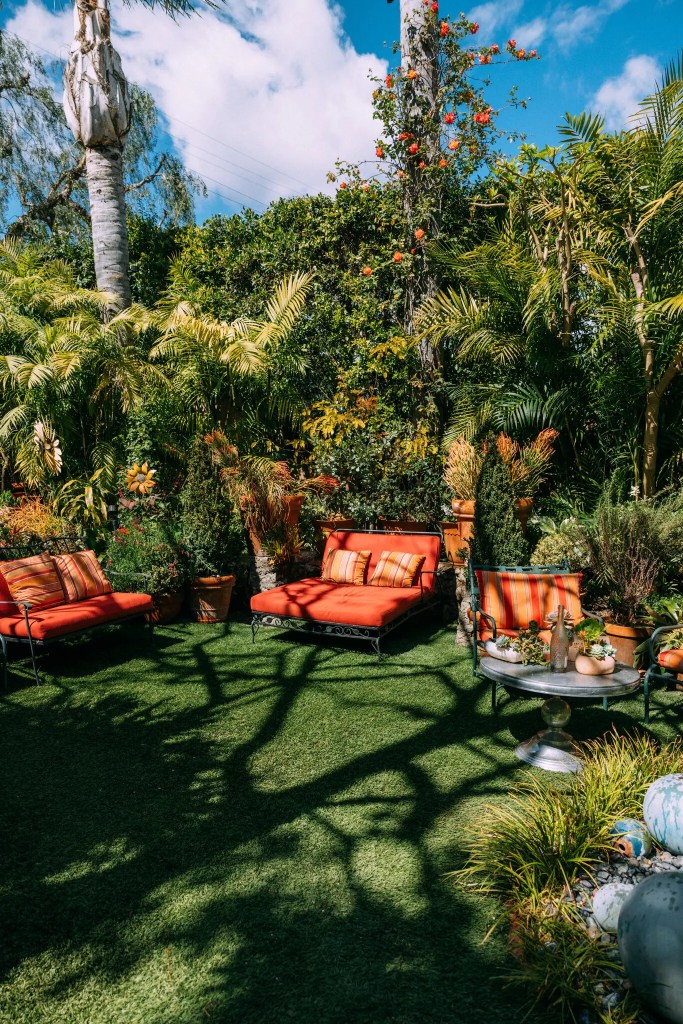
The New York Times featured a picture of my homeless camp! It is the third illustration of this article about landscape hedges. It shows where I camp while in Southern California, including the orange garden daybed where I sleep, and, as the primary topic suggests, a portion of the surrounding hedges.
This illustration should demonstrate why I enjoy being homeless in Southern California. It is quite luxurious. The weather is exemplary for camping. I wake amongst lush tropical foliage and palms, to the gentle sounds of small fountains and wild parrots. It is about as excellent as camping within one of my gardens, but very different, and special because I do it for less than three cumulative weeks annually. For many years, I have been wanting to stay at the famously eccentric Hotel del Flores nearby, but will not do so without inhospitable weather to dissuade homelessness.
Seeing this particular illustration reminds me of why this Felton League blog has been discontinued. For quite a while, there has not been much to write about that would not be intrusive to those involved. Societal difficulties as well as personal difficulties within society certainly remain, but are not as prominent as they had been. My own experience with faux homelessness, albeit within another Community, is strangely appropriate as an illustration for an unrelated article within the New York Times.
Most of those who experienced unemployment, poverty, homelessness or related difficulties here in the past are now enjoying major improvements to their personal situations. Many of those who are not yet benefiting from such improvements appreciate support from this graciously compassionate and generous Community. This has always been a good place to be in a bad situation. Perhaps, now that I no longer blog here, I should write a book about my experiences.
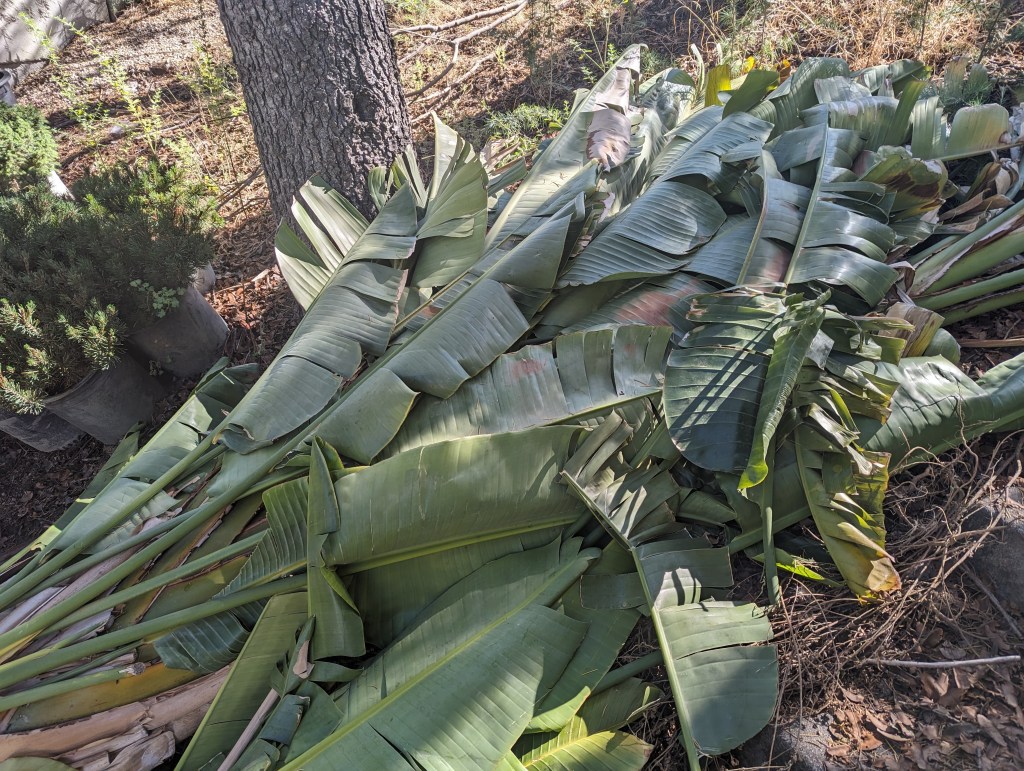
Giant bird of Paradise, Strelitzia nicolai, is a grand perennial. It develops several trunks like those of palms, with lush leaves like those of bananas, and bold white flowers. Their bloom can be messy with its sticky and viscous nectar though. Brent and I refer to them as drooling seagulls. For this reason, these giant bird of Paradise needed to be removed. I was pleased to recycle them. They look pathetic now that most of their foliage has been pruned away to minimize evapotranspiration during their recovery. Most should begin to regenerate roots through summer, and then resume growth for next spring and summer.
1. Giant bird of Paradise does not look so impressive laying on the ground. This is one of two piles of well foliated trunks that must be processed and heeled in until next autumn.
2. ‘A Flock of Seagulls’ demonstrates how abundantly these mature specimens bloomed. They are not just any seagulls, but are dead drooling seagulls. I will glean them for seed.
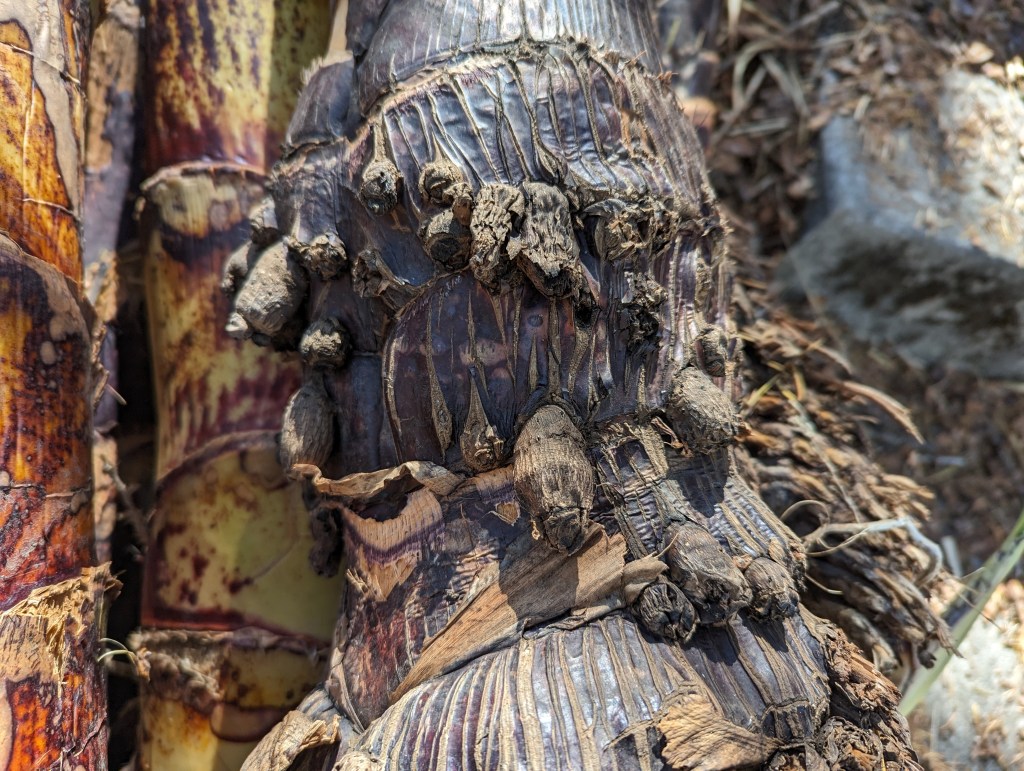
3. Husks make the trunks seem to be bigger than they are. They are the bases of petioles of leaves that were pruned off over the years. Trunks are leaner and tidier without them.
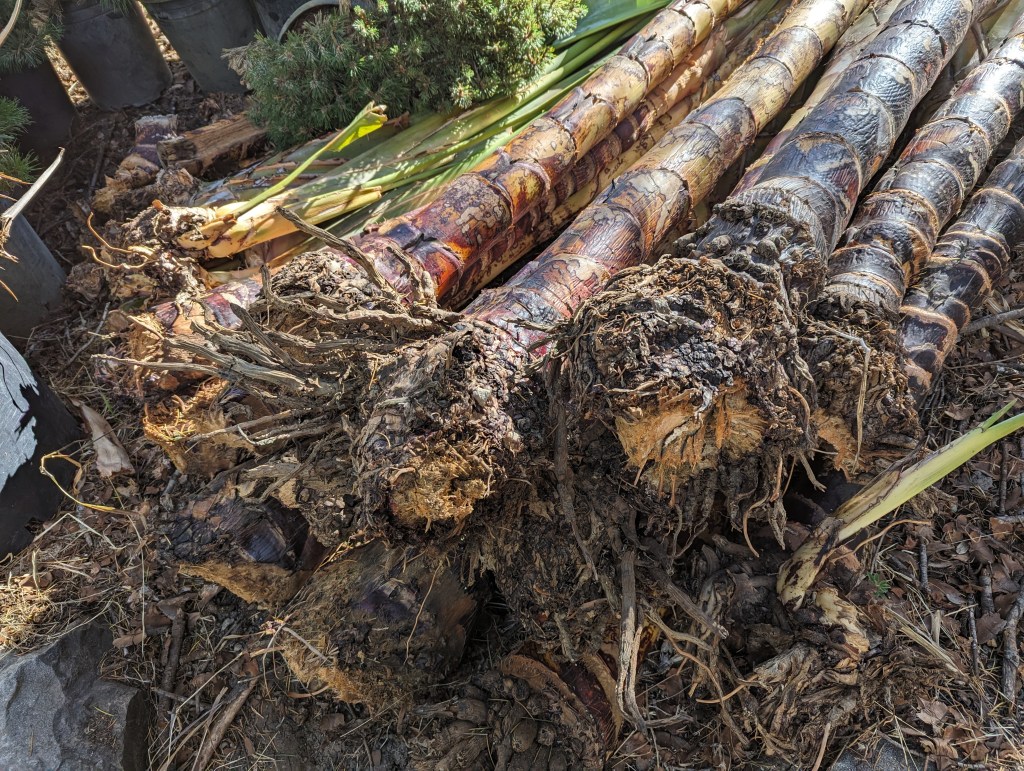
4. Severed roots are unimportant. They merely indicate that a portion of a subterranean rhizome remains attached to the base of a trunk. Trunks are neater without their husks.
5. Adventitious roots grow from portions of rhizome that remain attached to the bases of the trunks, and from the bases of trunks near the rhizomes. These roots are now buried.
6. Lineup shows that there are about a dozen significant trunks, a dozen shorter trunks, and half a dozen pups. They are heeled in here to begin rooting with frequent irrigation. They will be relocated to their permanent landscape after the rain starts during autumn.
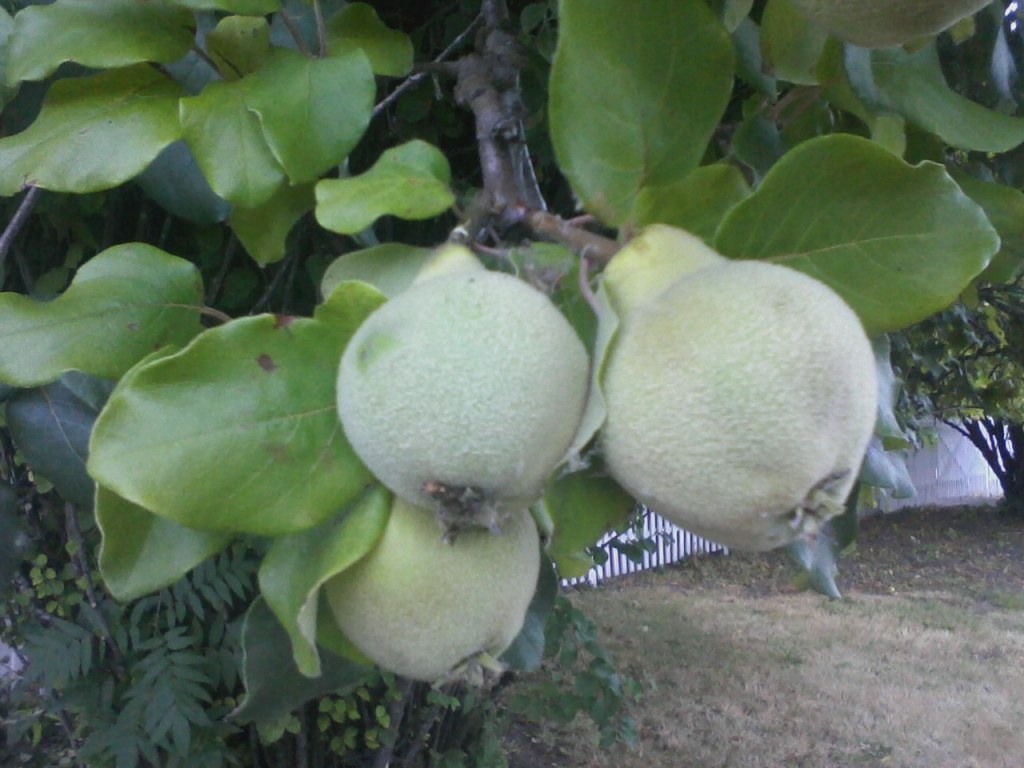
With the many slender arching trunks, quince, Cydonia oblonga, is more like a large deciduous shrub than a fruit tree. Even old trees are not much more than twenty feet tall and broad. Most of the rare trees that can be found are old, because quince is such an old fashioned fruit. The fruit is still immature and covered with white pubescence (fuzz). By late autumn, it will be remarkably aromatic and resemble golden pears, about four inches long and nearly as wide, and so hard that it should be cooked.
Trees of all sorts are among the most important features of most gardens, and are also the most substantial. Yet, in the end, whether they get too big, too crowded, too hazardous or simply succumb to old age, they eventually need to be removed.
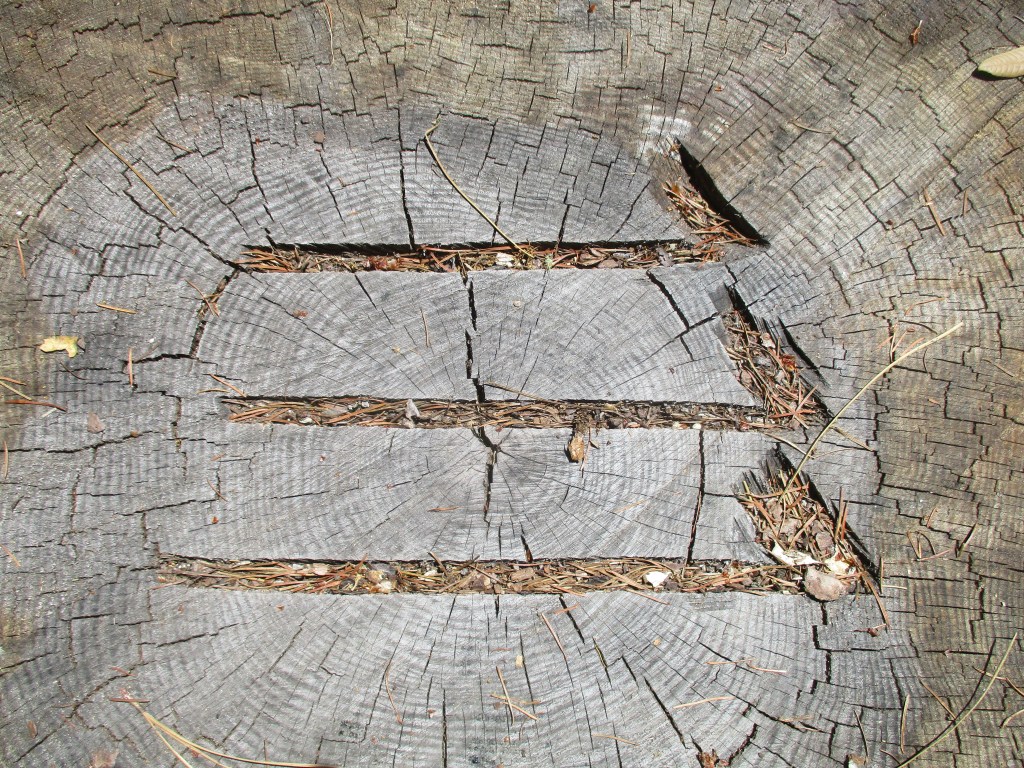
Getting rid of the brush (foliage and smaller limbs) of smaller trees is generally not much of a problem, especially where greenwaste can be left at the curb for recycling. Larger limbs and trunks can be cut and split into firewood. The brush and wood of trees that are so large that they need to be removed by professionals typically gets taken away be the same professionals. The most difficult parts to remove though, are the stumps.
Professional tree services typically offer the option of stump grinding. This works well for the most obtrusive stumps that are accessible. Other stumps get left either because they are inaccessible, or because of the expense of grinding.
Stumps that are within ground cover or shrubbery often get obscured by the surrounding vegetation, and are never seen again. Others are not so easy to hide. Many refuse to die for several years, and may even try to grow back as new trees.
Coastal redwoods (but not giant redwoods), poplars, willows, privets, sycamores and camphors are notoriously difficult to kill. Their stumps can continue to sprout for years. Shoots that emerge away from the stump can certainly be left to grow into new trees if they happen to be where they will not soon become problematic. (Shoots that emerge directly from cut stumps will likely lack structural integrity.)
To kill stubborn stumps, shoots must be removed as they appear. Eventually, the stumps and roots below the ground exhaust all resources and die. Of course this sounds simple, but may take years to kill redwood stumps. Leaving shoots to grow prolongs the process by allowing replenishment of resources. A stump from a camphor tree that I cut down in about 1988 but did not regularly remove the shoots from lingered for about twenty years before finally succumbing in about 2008!
Once stumps die, they rot faster if buried or at least covered with other plant material. Less stubborn stumps that are not likely to sprout again, like those of pines, cypresses, cedars, birches and (solitary trunked) palms, can be buried or concealed immediately. Stumps that are not cut low to the ground are not so easy to conceal, but should still rot faster if covered with ivy. I prefer to plant either freshly divided lily-of-the-Nile shoots or geranium cuttings around the bases of stumps, because they obscure the stumps and also promote rot as they get watered and disperse roots into the decaying wood. They can be removed, if desired, as the stumps deteriorate.
The Post Office in town is where I go to post or collect mail. For the past few years, this small coast live oak has been getting so low that I must duck under it to get onto the sidewalk from the parking spaces, or even to get past it on the sidewalk. It is particularly annoying because it is in such a prominent location where many other people park and enter the Post Office. I have sometimes considered bringing my pole saw and other pruning tools to prune it for clearance, but because I have not driven the pickup into town for a very long time, and do not intend to do so anytime soon, I would have no means with which to dispose of the debris.
Well, someone else pruned it. Well, sort of pruned it. Well, let us just say that I no longer need to duck under it. What a hot mess of stubs, or should I say, ‘posts’. This is after all, the Post Office. How could anyone think that this was acceptable?! How difficult would it have been to cut these lower limbs properly, without leaving these horrid posts?! Even someone who is not at all concerned about the tree or proper arboriculture can see how hideous this is. Seriously, this goes beyond negligence. Someone put considerable effort into doing this so extremely improperly!
I brought my pole saw the following week to remove these posts without doing any more pruning. I figured that without all the foliage, I could fit them into the trunk of the Roadmaster. However, by the time I go there, someone, likely from the Department of Public Works, had already repaired the damage. The tree could be pruned a bit more, but at least it is not so mutilated.





 Tony Tomeo