Horticulturists are by nature, nonconforming. I happen to find it difficult to conform to what makes us nonconforming. Trends are fleeting. Old technology that has worked for decades or centuries is still best. Although I am not totally against chemicals, I find that almost all are unnecessary for responsible home gardening. Pruning is underappreciated, and fixes many problems.
California fan palm is the only palm that is actually native to remote regions of California. However, Mexican fan palm, Washingtonia robusta, is much more common. Technically, its native range is not far away. It had been the most popular of palms prior to the 1990s. It is more adaptable to more populous climates. Also, it naturalizes within some regions.
Mexican fan palms grow vigorously while young. Growth decelerates with maturity. Very old trees can grow very slowly without completely stagnating. Wild specimens may have potential to survive for a few centuries with such slow growth. Cultivation and irrigation of home gardens may limit this potential. Few local specimens are more than a century old.
Mexican fan palms are taller and slimmer than California fan palms. Their trunks lean as prevailing wind blows them. They easily grow fifty feet tall, and eventually get a hundred feet tall. Such tall and leaning trunks can suspend their canopies over adjacent gardens. Their pleated and palmate leaves are about three feet wide, on petioles with nasty teeth.
A tree is a woody perennial plant with a single tall trunk and branches. Banana trees and tree ferns lack both branches and wood. Arboriform yuccas develop branches but are not woody. Palm trees are no better. Some develop a few trunks but without branches. Doum palms that develop branches are extremely rare in California. No palm is actually woody.
Palms are trees only because of their size and form. In other words, most are big and tall. The most compact of palms are no smaller than Japanese maples, which are also trees. Realistically though, palms are merely large to very large perennials. They are monocots like grass, bamboo or cordyline. Some horticulturists classify them as herbaceous trees.
Only California fan palm is native to California, and only to remote desert oases. All other palms are exotic. Spanish Missionaries imported date palms to produce dates within arid regions. Only a few other palms were similarly utilitarian. The majority are desirable only for their distinctive form, texture and evergreen foliage. They are genuinely ornamentals.
All palms are evergreen. Fan palms produce rounded palmate leaves on sturdy petioles. Feather palms produce elongated pinnately compound leaves on sturdy rachises. Many fan palms also produce wicked teeth on their petioles. Many feather palms also produce dangerously sharp spines on the bases of their rachises. Even lush palms can be mean.
Not many palms get big enough to provide much shade. Many types are shady in groups though. Without branches, palms are not conducive to containment or redirection. Some eventually grow tall enough to shade neighboring gardens instead. Unfortunately, palms that encroach too closely to high voltage cables require removal. They do not go around.
Palm trunks do not widen as their canopies grow higher above. Palms with plump trunks grow at ground level for several years before they can launch. Their single terminal buds must first grow as wide as their mature trunks will ever get. Their foliar canopies likewise grow no broader than they were when they launched. They only grow higher. Most large palms develop distended basal adventitious roots that can get quite wide, though.
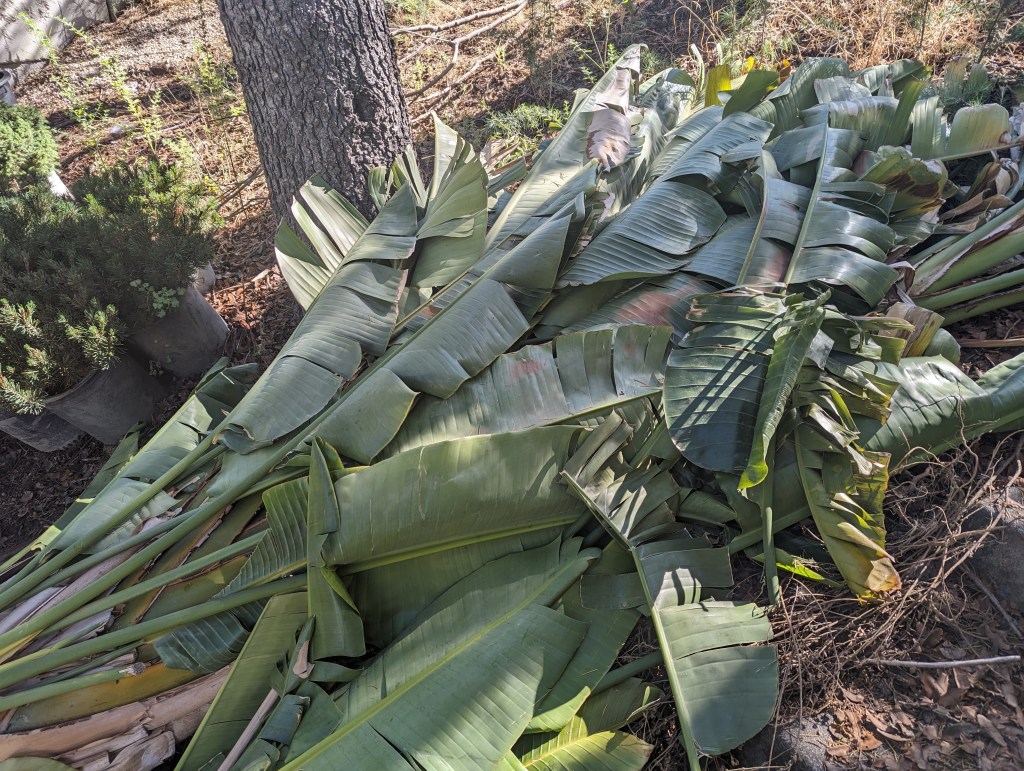
Giant bird of Paradise is not actually from Paradise, and if it were, it would not be the Paradise in Butte County that burned five years ago. This particular species, Strelitzia nicolai, is from South Africa, Mozambique, Botswana and Zimbabwe. These particular specimens are from none of these places though. They came from Morgan Hill. Nor are they actually birds, although they seem to be migratory like so many species of birds that migrate about the southwestern portion of Africa, and apparently Morgan Hill, but not Paradise. Oh, this is getting confusing.
Giant bird of Paradise, which is unrelated to Big Bird of Sesame Street, is a grand perennial that can get twenty feet tall. It resembles the more common bird of Paradise, but with tall trunks that resemble those of small palm trees. Also unlike the common bird of Paradise, their appeal is more foliar than floral. In other words, their primary attribute is their lush foliage, rather than their bloom. Actually, their bloom can be undesirable within some situations.
In fact, that is why these particular specimens needed to be removed. Their bloom was drooling messy nectar onto the pavement below. In horticultural slang, they are known as ‘drooling seagulls’ because of this habit, and also because their bulky white flowers look like seagulls peeking from the lush foliage, and of course, drooling while they do so.
Morgan, the old F250 who coincidentally is named after Morgan Hill, and I brought these giant bird of Paradise here, where they await processing. They are supposed to be left out of the ground for about two weeks anyway, so that they will be less susceptible to rot when planted and irrigated. After their processing, they will get heeled in here so that I can monitor them more directly as they begin their recovery. The best of them will migrate again to their permanent landscape after the rainy season starts. I should get better pictures of them and their processing for Six on Saturday.
My blogging discontinued quite a while ago. Articles from my gardening column still post in two parts on Mondays and Tuesdays, with the primary topics on Mondays, and the featured species on Tuesdays. Older articles still post in the same format on Thursdays and Fridays. These articles are not actually blog posts though. They are gardening column articles.
Originally, my only blogging had been on Saturdays, Sundays and Wednesdays. ‘Horridculture’ topics posted on Wednesdays. ‘Six on Saturday’ contributions posted on Saturday mornings. Random topics posted at noon on Saturdays and on Sunday mornings. Then, with the exception of ‘Six on Saturday’ contributions, all of these blog posts were recycled from earlier posts, so no longer qualified as actual blogging.
Now, as was inevitable, there are no more blog posts to recycle. Articles from my gardening column will continue to post on Mondays and Tuesdays. Older articles from the same column will continue to post on Thursdays and Fridays. I will likely continue to participate in the ‘Six on Saturday’ tradition on Saturday mornings. Otherwise, except for occasional random posts, regularly scheduled but recycled posts for Saturday afternoons, Sundays and Wednesdays will not continue.
In the future, recycled gardening articles may also be omitted, and new gardening articles may not be divided into two sections. If so, intact articles from my gardening column may post only weekly here. After all, the original purpose of this blog was to be another minor venue for the gardening column, . . . and obviously, pictures of Rhody.
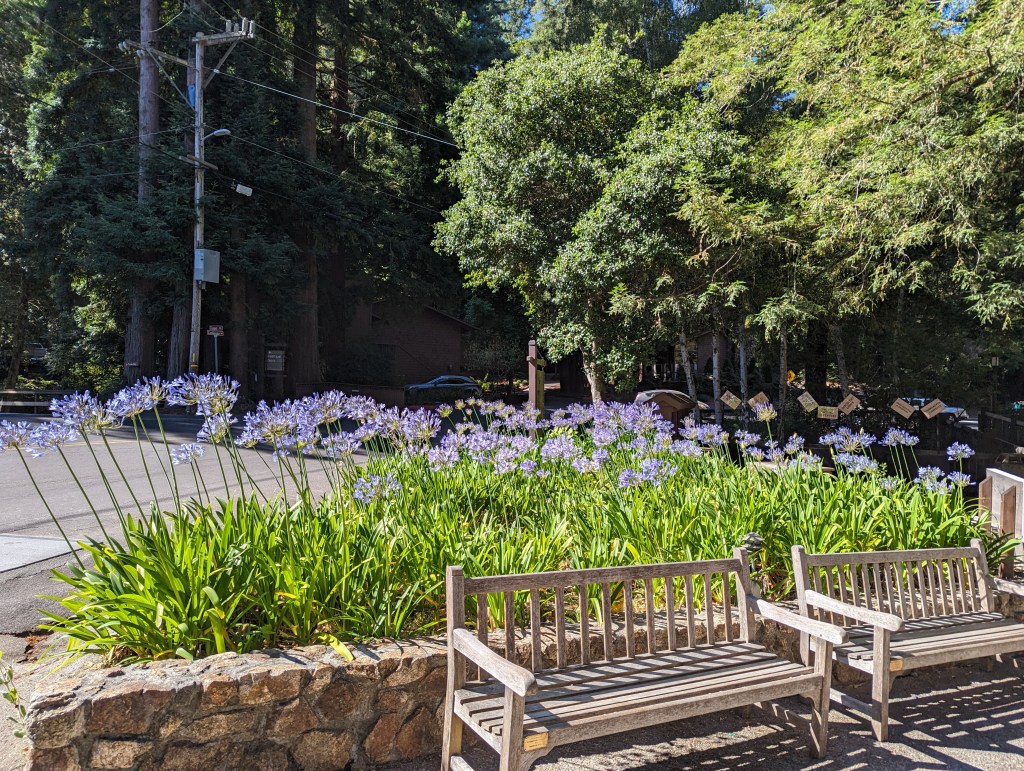
As I explained earlier, unusual weather has interfered with the growth and bloom cycles of many species. Winter weather was exceptionally wintry. Spring and summer weather was exceptionally mild until only recently. Many flowers bloom precisely on schedule, as if oblivious to the unusual weather. Many flowers bloom significantly later than normal. Lily of the Nile seems to be about a month late. So does garden phlox, although I do not remember if it bloomed simultaneously with lily of the Nile last year. Nor do I remember when butterfly gladiolus bloomed. Hybrid gladiolus seemed to bloom right on schedule, so are finished.
1. Agapanthus orientalis, lily of the Nile should have been blooming like this more than a month ago, and at least for Independence Day. Some buds are only beginning to open.
2. Agapanthus orientalis, lily of the Nile does not bloom abundantly in the shade, but it blooms grandly. This picture can not show that this one floral truss is about a foot wide.
3. Agapanthus orientalis, lily of the Nile, although genetically variable, had always been exclusively blue within all of the landscapes here. This is the first of three white blooms! I grew the originals in the early 1990s, but needed to relocate their herd a few years ago.
4. Phlox paniculata, garden phlox seems to be even more delayed than lily of the Nile is. I can not be certain though, since I got acquainted with its seasons only a few years ago.
5. Gladiolus X hortulanus, hybrid gladiolus was not so delayed, so bloomed precisely on schedule, and now needs deadheading. I am pleased by how many are reliably perennial.
6. Gladiolus papilio, butterfly gladiolus is Skooter approved, and is from Tangly Cottage Gardening! I do not know if it was delayed, because I am still getting acquainted with it.
Most black walnuts were not planted intentionally, but grew from the roots of old English walnut trees.
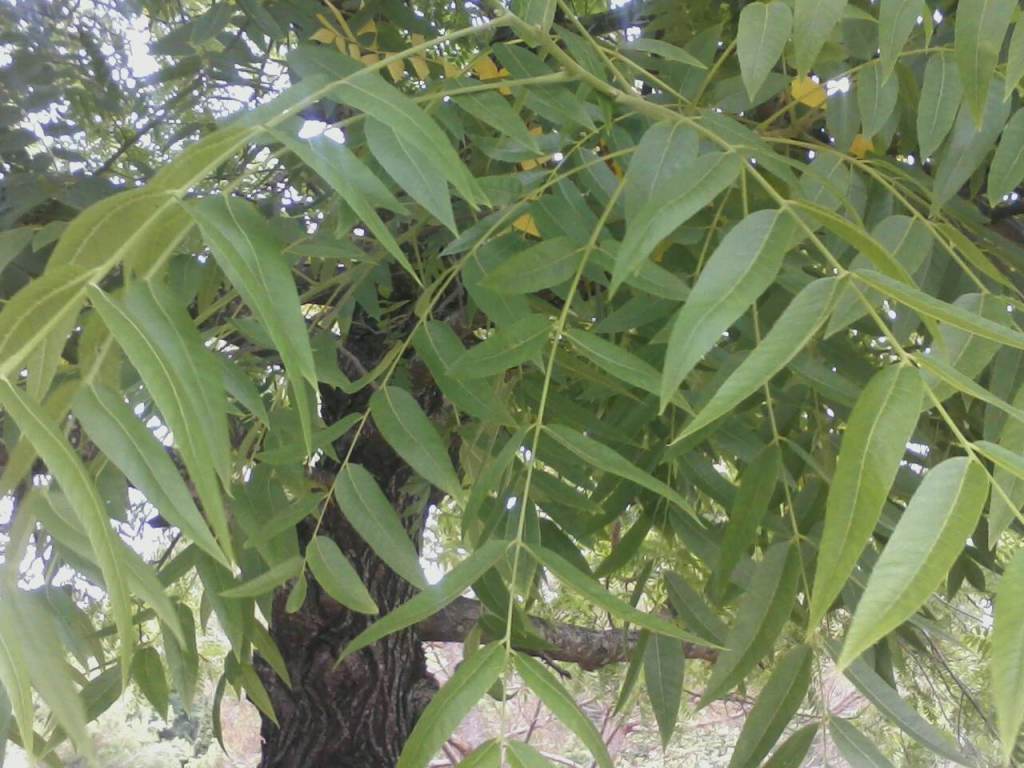
Although native, most local black walnut trees, Juglans hinsdii, are secondary growth from the rootstock of what were once grafted English walnuts, or descendents of such trees. (English walnut trees are grafted onto black walnut understock.) However, the massive old trees that flank the old Monterey Highway south of San Jose were planted as large shade trees nearly a century ago. They are now about sixty feet tall, with lofty broad canopies. Their foot long leaves are pinnately compound, with about eleven to nineteen slightly dentate leaflets that are about three or four inches long. The hard nuts and thick husks are far too messy for refined gardens.
Does anyone really know what roots do? We know that they are important parts of almost all plants, that draw nutrients from soil and water, and that they provide structural support so that plants can stand upright. Yet, we really do not know all of what they they could be doing right now, underground, where no one can see them.
Big roots of big trees unfortunately sometimes cause big problems by displacing pavement and other features. They commonly displace pavement because they naturally disperse laterally just below the surface of the soil, and do the same directly below pavement as if it were the thin layer of soil that they require above. Roots of many trees are actually attracted to pavement because it is better insulated than some types of soil, and may even retain moisture better. As roots grow and expand, they displace the pavement above.
They do not displace retaining walls or foundations as commonly because they are not so tempted to go under them. When they do displace such features, it is usually because they disperse against them and displace them laterally.
Although often blamed for such problems, roots only rarely interfere with subterranean utilities like water pipes and sewer pipes. Most pipes are deep enough to avoid the majority of roots. However, very old sewer pipes of unsealed terracotta segments or unsealed iron can leak slightly but enough to attract and become invaded by roots. Also, some types of trees are notorious for invading septic systems.
Various types of root barriers limit lateral dispersion of roots and promote deeper dispersion to protect pavement and features at the surface of the soil. They are somewhat effective for certain types of trees that innately exhibit aggressive roots. Alternatively, trees that innately exhibit complaisant or deeply dispersed roots may be selected for situations in which aggressive roots would be a problem.
Roots that are already causing problems most often need to be severed. Unfortunately, severing substantial roots is very distressful to the affected trees, and can even be destabilizing. Trees with fibrous roots, like redwoods and crape myrtles, recover from minor root damage somewhat efficiently. Many other trees, like oaks and most maples, are very sensitive to such damage. If it becomes necessary to sever major roots or large portions of a root system, an arborist might determine that it would actually be more practical to remove the affected tree than to allow it to be destabilized or to deteriorate slowly before ultimately succumbing to damage.
Rather than addresses, most of the guest cabins at the conference center where I work for part of the week, have delightfully horticultural names; such as Camellia, Lupine, Holly, Dogwood, Huckleberry, Strawberry and Cottonwood. Others have names that are suggestive of idyllic locations, such as Meadowbrook, Creekwood and Rustic Dell. Then, . . . there is ‘Dumpster View’.
Dumpster View is not actually a guest cabin, or a lodge, or any building that any of the guests would ever see. It is part of our maintenance shops buildings. Although large, these building are outfitted with only a few windows. The largest building has only a single window for an office. The smaller building has only four windows. Two of the windows have a view only of dumpsters.
The picture above shows the view from the window in the galley. It was what I saw as…
Mount Shasta very rarely lacks its snow. Its summit is almost always white. Shasta daisy, Leucanthemum X superbum, strives for the same. Bright white bloom starts in spring and continues into autumn. Primary spring bloom is the most profuse. Sporadic bloom lingers between subsequent minor bloom phases. Only cooling autumn weather inhibits bloom.
Shasta daisy is a resilient perennial. It develops dense colonies of tough basal rhizomes to survive winter dormancy. From spring to autumn, upright blooming stems grow almost three feet high. Individual composite flowers are of classic daisy form with cheery yellow centers. They are excellent as cut flowers, with simple green foliage. Leaves are serrate.
Shasta daisy prefers systematic watering, but can survive with less. It tolerates only a bit of partial shade. Removal of floral stems after bloom or cutting should leave no tall stubs. Removal of all upright growth as it deteriorates into winter promotes tidier spring growth. During winter dormancy, Shasta daisy is very easy to propagate by division of rhizomes.
All weeds are plants. Not all plants are weeds. Weeds are a specifiable subset of plants. Specifically, weeds are plants that grow wildly where they are undesirable. Similarly, dirt is likely soil, although it could be anything that is dirty. Soil is not merely dirt, though. Dirt is soil or a similar matter, where it is undesirable. Plants and weeds know the difference.
Most simply, soil is the loose material on the surfaces of most land. Obviously, looseness is relative. Some is quite dense and hard. It is not solid rock though. All of it consists of a combination of various inorganic aggregates. Most also includes various organic matter. Inorganic aggregates range in size from microscopic clay particles to substantial stones.
Soil provides stability and nutrients for vegetation that inhabits it. Roots disperse through it for structural support of their associated stems and foliage. Roots also absorb nutrients and water, as well as conduct respiration. Soils are naturally quite diverse. Vegetation is naturally more diverse to exploit various soils. Very few soils can not sustain vegetation.
Lawns are the carpets of a garden. Hedges are the walls. Tree canopies are the ceilings. Soils are the foundations. They support all vegetation that is not self-reliant in containers or epiphytically. Some soils are sandy, so drain very efficiently. Some are denser clay, so may drain slowly. Like climate and exposure, soils can limit what grows within a garden.
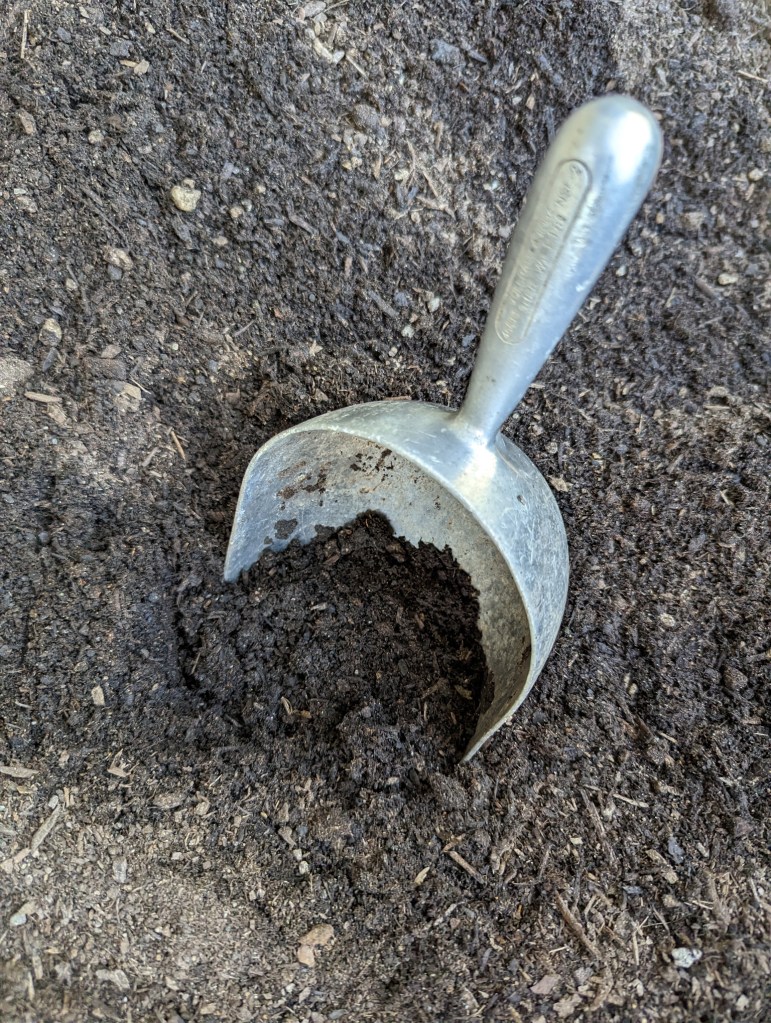
Most common and popular vegetation is satisfied with most common types of soil. Some, particularly vegetables and annuals, are more demanding. Even within good quality soil, they appreciate amendments such as compost. Amendments improve aeration, drainage and moisture retention. Organic amendments also provide nutrients as they decompose.
The most demanding vegetation also appreciates fertilizers. Most fertilizers are chemical or synthetic fertilizers of very precise formulation. Organic fertilizers are only slightly less precise. All allow application of specific amounts of specific nutrients for specific results. For example, nitrogen enhances foliar growth. Also, phosphorus enhances floral growth, and fruit growth.






 Location – Locations – Location
 Tony Tomeo