Horticulturists are by nature, nonconforming. I happen to find it difficult to conform to what makes us nonconforming. Trends are fleeting. Old technology that has worked for decades or centuries is still best. Although I am not totally against chemicals, I find that almost all are unnecessary for responsible home gardening. Pruning is underappreciated, and fixes many problems.
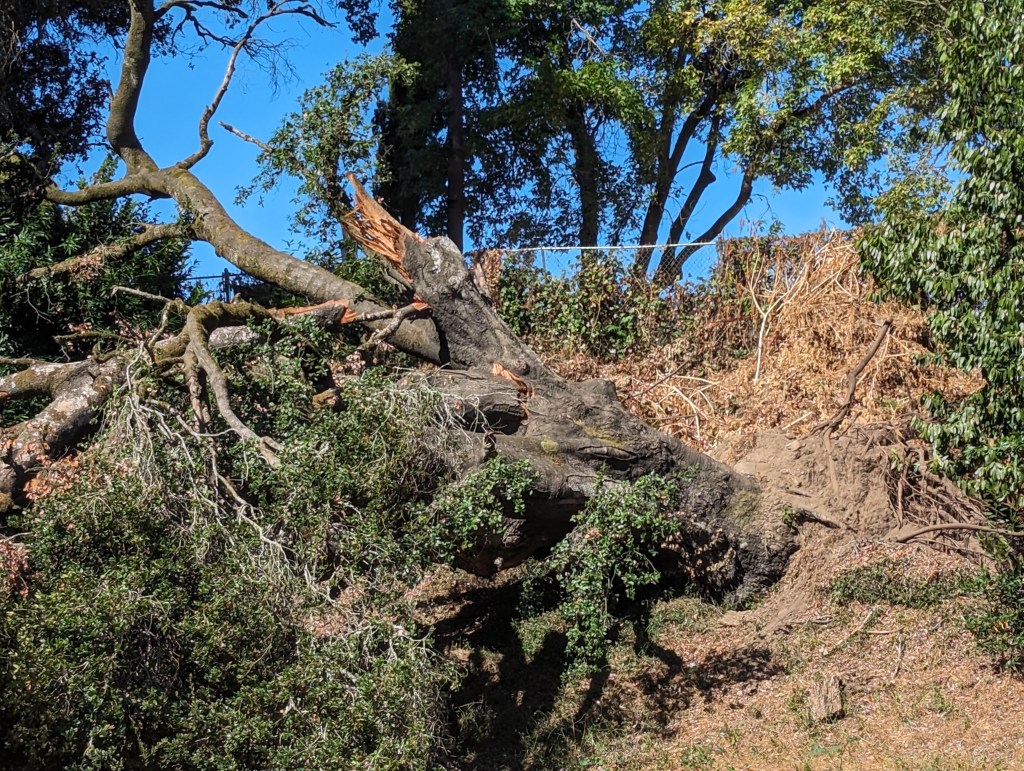
Before: There was not much hope for the Chinese maple underneath this mess.
It will be just fine. The Chinese maple that I mentioned earlier this morning sustained surprisingly minimal damage when part of a bay tree fell onto it. The situation initially seemed hopeless prior to the removal the heavy debris that was pressing the diminutive Chinese maple downward. Yet, the little tree somehow regained its composure, and is expected to recover.
The little Chinese maple was always rather sparse in the shade of the surrounding forest. Also, it exhibited an asymmetrically sculptural form. That is likely normal for the species within its natural environment, where it lives as an understory tree (within the shade or partial shade of larger forest trees). The distinctive form and open canopy were part of its allure.
As the debris was removed, most of the stems of the Chinese maple sprang back into…
Summer was late this year. This is sounding redundant, so I will not mention last winter again. Nor will I mention last spring or early summer. Now that summer is about a third over, it seems as if it is merely beginning. Lily of the Nile, which never fails to bloom for Independence Day, began to bloom only a few days ago. Bloom is catching up though, or at least trying to. These summer flowers are doing well, and were actually doing well last week, when I was unable to post these pictures because of bad reception. Easter lily was done right after I got these pictures. The preponderance of red here is mere coincidence, but summery.
1. Lilium longiflorum, Easter lily was likely left behind after a wedding in the old Chapel. It lives in a garden across the road now. It is the only of these six that finished blooming.
2. Hydrangea macrophylla, hydrangea is pleasantly pink even without the fertilizer that maintains its pink color. Blue hydrangea faded to lavender without their pH adjustment.
3. Pelargonium hortorum, zonal geranium is quite a bit more prolific in bloom than the old fashioned sorts that I am accustomed to growing. The floral color is impressive also.
4. Gerbera jamesonii, Transvaal daisy is as bright and bold as 1984. However, I still fail to be impressed. It is certainly pretty, but looks like a squirting daisy that a clown wears.
5. Papaver rhoeas, poppy grew from seed that got sown prior to the last torrential storm of last winter. I thought that all the seed got washed away. This was a delightful surprise.
6. Hemerocallis fulva, daylily grows like a weed. We move it from one garden to another as it outgrows its space. This double orange cultivar may be ‘Kwanso’, but I do not know.
Many relocated mature date palms were recycled from date orchards.
It seems that recycled large date palms, Phoenix dactylifera, became trendy in the past few decades while vast date orchards around Las Vegas were displaced by urban sprawl. They are stately trees with airy but bold rounded canopies between twenty and thirty feet wide. Mature trees are more than fifty feet tall on single trunks. Varieties with multiple trunks are shorter and rare. The ten to twenty foot long leaves are pinnately compound with folded foot long leaflets, and nasty basal spines.
Each date palm tree is either male or female (dioecious). Orchards are almost exclusive to fruiting female trees with only a few male trees grown separately for their pollen, which gets applied manually. Without male pollinators, recycled formerly productive female trees are fruitless, and therefore not messy.
Date palms may have been in cultivation for nine thousand years! The Judean date palm was grown from seed that was lost in storage for two thousand years, which (until recently) was the oldest known viable seed!
Spring was mild and started late. Summer if now getting started.
Just like the moon is always either waxing or waning, but is really only full or new for the brief moments in between, the seasons are always flowing from one to the next. Even though it is not yet half way through summer, plants in the garden are already planning for autumn. Summer has been mild, but still warm enough for most plants to do what they need to do by this time of year.
If weeds were not pulled when they should have been in early spring, they really should be pulled now. They have already started to sow their seed for the next generation that will grow at the end of next winter. The ground has dried and hardened since early spring, so pulling weeds will take a bit more effort. That is the punishment for procrastinating.
Weeds that are still somewhat fresh and green may not have dispersed all of their seed yet. If pulled soon enough, their next generation may not be so prolific. Those that have dried have likely dispersed their seed already. Their progeny will be back by next spring.
Pulling out the roots of annual grasses is not as important as getting the roots of perennials like thistles. Heck, they are annuals, so will die at the end of the season anyway. Getting their seed in the priority now. Some people are satisfied with simply pulling the seeded tops off of annual weeds, and leaving the lower portions to die out naturally.
Most fruit trees finish their production sometime during summer. Small fruit like cherries finished some time ago. Larger peaches, although related to cherries, may still be ripening into August. They should be picked as they ripen, not only to get the most use out of them, but also to avoid sharing with unwelcome rodents, birds and other annoying wildlife. The ground under fruit trees should be cleaned of any fallen fruit that might otherwise rot and perpetuate disease. Apples and pears ripen later and into autumn.
Warm season vegetables should be picked as they mature to promote continued production. Leaving extra zucchini on the plants inhibits production of new zucchini, while the old zucchini grow into tough and insipid baseball bats. Leaving extra tomatoes both inhibits new tomatoes and also makes a mess of rotting fruit.
Leaves are the original solar panels. They collect solar energy, and convert into useful resources. Some of those resources get converted into other resources that are good for human consumption, such as fruit, vegetables, lumber, firewood and oxygen. However, one resource that leaves do not produce is electricity.
That is why the big solar array pictured above was installed over a big parking lot. There are a few of these arrays in this parking lot, and more in other nearby parking lots. Many trees were cut down to accommodate them. People who work nearby can use the electricity more than they could use vegetation, or anything that vegetation could produce within this area.
Shade trees are nice over parking lots, but are not necessary over a parking lot that is shaded so thoroughly by such big solar arrays. After parking during rainy…
Mrs. George Washington never grew Martha Washington geranium, Pelargonium X domesticum. It was hybridized in Europe from south African species after she passed away. Although classified as a hybrid species, it is actually a group of distinct hybrids. Most are related to the same pair of primary ancestors. A few other species mingled in the process though.
The largest cultivars do not get much taller than three feet. Some develop rather irregular form. A few grow upward only to fall over. Minor tip pruning can improve awkward form. Stems are woodier than those of common zonal geranium. Consequently, cuttings do not develop roots as efficiently. Old specimens are less likely to recover from major pruning.
Martha Washington geranium may not bloom quite as profusely as zonal geraniums. The flowers are more spectacular though. Floral color can include purple, lavender, pink, red, burgundy or white. Billowy flowers are bordered or blotched with alternate colors. A few flowers bloom together on rounded umbels. Evergreen foliage is light green and ruffly.
Elderberries grow efficiently from hardwood cuttings.
Seed is the most familiar source of much of the vegetation that inhabits home gardens. It is the origin of almost all vegetables and most annual flowers. Some seed grows directly into its gardens. Some grows in nurseries to become saleable young plants. Seed is not the only method of propagation though. Cuttings, division and layering are as productive.
Cuttings, as well as divisions and layers, are genetically identical to their single parents. Unlike seed, which are products of two parents, they lack potential for genetic variation. Division is the separation of stems with roots from perennials or clumping woody plants. Layering is the rooting of stems by partially burying them while attached to their parents.
Cuttings grow simply as pieces of stem within moist rooting medium such as potting soil. They initially lack roots and perhaps foliage. They develop new roots and foliage as they grow. Their medium must remain moist throughout the process. For many plants, rooting hormone accelerates root initiation. Some species can grow roots as they soak in water.
Hardwood cuttings are mostly from deciduous species as they defoliate for winter. Those from last winter are developing now. Evergreen hardwood cuttings retain some foliage through their winter dormancy. Softwood cuttings can be either deciduous or evergreen. They involve fresh new growth, so can begin as soon as such growth is mature enough.
The lower cuts of cuttings should be just below a node. Upper cuts should be just above a node. Terminal cuttings are tips of stems without upper cuts. Each cutting must include at least two good nodes. Some species may need cuttings to be several inches long in pots. Most grow better from small cuttings that fit into flats. Some can go directly into a garden. Cuttings should lack leaves below the level of their rooting medium.
Softwood cuttings generally require humidity to help compensate for their lack of roots. Most also appreciate partial shade. Evergreen hardwood cuttings appreciate the same as weather gets warmer and drier. Warmth from a heating mat below pots or flats might accelerate rooting. Many species are difficult or impossible to grow from cuttings though.
Since posting this article three years ago, I noticed that some of the male pollinators from former date orchards were recycled as exclusively male groves for isolated landscapes between Los Angeles and Las Vegas, and between Los Angeles and Phoenix (which, incidentally, is named for the species). Some were installed around highway interchanges. Some are at resorts.
Date orchards that were displaced by the expansion of urban sprawl around Las Vegas in the 1990s were the source of the many recycled mature date palms that briefly became popular for large scale landscapes at the time. Most of the trees within the orchards were female, with only a few male pollinators. (Pollinators can live remotely, where they provide pollen for dusting.)
Male trees were undesirable anyway, at least in conjunction with female trees. They are taller and lankier, with less pendulous foliage, so are less visually appealing. More importantly, they pollinate female flowers so that they make fruit. Of course, in orchards, fruit is very important. In landscapes, it is just a mess. Without male pollinators, female trees produce no messy fruit.
Consequently, most male trees were not recycled. Some were installed singly, or in exclusively male colonies, in landscapes that were…
Although I can not be certain, I believe that this is prickly lettuce.
Pretty weeds do not get my attention like they do for others. They look too much like weeds to me. If I want to appreciate them, I must do so with intention. Sometimes, I do actually try. I did happen to notice these two weeds. However, now that I got their pictures, I have no use for either of them. Neither is readily useful for the gardening column. I will just share them here.
The yellow flower pictured above is most likely prickly lettuce. I really do not know. I know it as yellow chicory; but chicory does not bloom yellow. Some people think of it as dandelion, since the flowers are similar. These flowers stand much higher though, with only minimal foliage below. For the picture, I plucked this flower and stuck it in the ground…
The wrong flowers are nonetheless pretty. Pretty flowers distract from unsightly foliage. Neighborly ground squirrels are people too.
1. ‘Red King Humbert’ Canna was one of only two canna that I ever purchased. I still feel guilty about spending about $6 for ‘Australia’ years ago. This second purchase for thirty rhizomes late last season was not so inexpensive. I was so displeased as virused foliage emerged. I tried to believe that this discoloration was from starting so late in the season.
2. ‘Red King Humbert’ Canna gets about six feet tall, with billowy and bright red bloom. Because it started so late last year, it barely grew, and did not bloom. Now it blooms like this, and is only about two feet tall. It is all virused. It definitely is not what it should be.
3. An assortment of formerly unappreciated canna, Kaffir lily and giant bird of Paradise temporarily inhabit this otherwise uninteresting deck at work. A gardener found them to be too appealing to leave in obscurity within the nursery yard, so brought them here and set their cans into more appealing pots. Only the canna to the right is original to the site.
4. Strelitzia nicolai, giant bird of Paradise is shabby though. The worst of its few roasted leaves is to the upper left. However, only I notice it! Everyone else notices its rad bloom.
5. Alvin, Simon and Theodore are the new neighbors. I yelled at them initially. They just came out to stare at me. More of their friends and family moved in. They do not damage desirable vegetation though. Actually, they are eating undesirable weeds with brambles!
6. After recycling an article about the vandalism of the Memorial Tree in Felton Covered Bridge Park two Wednesdays ago, I should post this new picture of how happy it is now.