Chimney Clearance

Combustible debris accumulates in gutters and behind chimneys.

There are several reasons why fireplaces are not nearly as commonly used as they once were. Modern building regulations have prevented construction of newer fireplaces (except pellet stoves). Many fireplaces that were ruined by the Loma Prieta Earthquake were never replaced; partly because there are other more efficient sources of heat, and partly because of the concern of air quality. The fuel that was once relatively easy to obtain from orchards that were getting removed to relinquish their land for urban development has been exhausted.

Regardless, those of us who use fireplaces need to be certain that they do not become overwhelmed by trees or climbing vines. Cypress, cedars, pines and some fan palms are remarkably combustible and hazardous when they get too close to chimneys, particularly if the roofs below are covered with old fashioned cedar shingles.

All trees and vines should be pruned away from chimneys so that they are out of reach of sparks and heat. The more combustible trees should get more clearance than deciduous trees (that are bare through winter) need. Nearby Monterey pines, Cypress and any trees that tend to accumulate debris should be groomed of debris, even if their limbs are already pruned back for sufficient clearance.

Trees should also be pruned for clearance from roofs and gutters; and any accumulated debris should be removed. Even before the weight becomes sufficient to cause damage, the motion of limbs in the wind is abrasive to roofs. Older roofs, particularly cedar shingles, will deteriorate under any accumulation of organic debris, particularly as it gets wet from rain.

Why Bother?

Nasturtiums were a good choice for my downtown planter box, or so I thought. I know that people pick flowers from such planter boxes. I figured that nasturtiums bloom so abundantly that no one could possibly pick all the flowers from them. Technically, I was correct. Technically, not all of the flowers were picked. However, there were times when only a few of the abundant flowers remained. I replaced them with some sort of compact aeonium like perennial that I can not identify. It forms dense mounds of yellowish green succulent foliage that I figured no one would bother. I do not mind when I notice a few pieces missing. There is enough to share. What I do mind is that someone clear cut harvested enough to leave this bald patch. The left half of the picture demonstrates what it should look like. What is worse is that there is so much of it extending outside of the railing that would not have been missed if it had been taken. Also, as the picture below shows, the more prominent common aeonium is not exempt from such pilferage. So, why do I bother? Well, I still enjoy my downtown planter box.

Norway Maple

Norway maple looks like a sycamore.

It is rare now, but Norway maple, Acer platanoides, was once common as a street tree. A few are prominent within neighborhoods that were developed in the 1950s and 1960s. It resembles the common London plane. In fact, its botanical name translates to ‘maple like a plane tree’. Unfortunately though, the roots are perhaps too aggressive with pavement.

Norway maple defoliates somewhat more efficiently than London plane tree. However, in spring, it refoliates significantly later. Otherwise, it is a splendid shade tree. A few modern cultivars exhibit bronzed foliage that yellows for autumn. One exhibits variegated foliage. Another has chartreuse foliage. ‘Schwedleri’ was once the most common bronze cultivar.

Very few Norway maples are taller than forty feet within the mild climates here. They can grow significantly larger in cooler climates, such as the Pacific Northwest. Their palmate leaves are about five to nine inches wide. New trees are rarely available from nurseries, so require special ordering. Norway maple is not overly discriminating in regard to soils. It prefers regular irrigation through summer warmth.

Gutters Innately Accumulate Falling Leaves

Falling leaves can overwhelm gutters.

Autumn foliar color gets messy. It is spectacular while suspended in deciduous trees and even on the ground. The problem is that it mixes with wind and rain as it deteriorates and gets sloppy. It necessitates raking from lawns, ground covers and hardscapes. It requires removal from gutters, or eavestroughs, and where it accumulates on roofs. It gets messy.

The timing could not be worse. The wind and rain that cause it to be so messy are no fun to work in. Using ladders to clean gutters and roofs is more dangerous in wet conditions. Fallen leaves are messier and heavier while wet. Yet, they are not too heavy for winds to blow green waste piles about after raking. Autumn weather will get progressively worse.

Unfortunately, gutters that accumulate fallen foliage require cleaning to function properly.  Otherwise, foliar debris clogs them and their downspouts when they are most necessary. Rain water then flows over their edges and onto the ground below. It can be more than a minor annoyance. Splattering water can cause rot within adjacent walls that it dampens.

That is why old historic houses originally had ‘foundation plantings’ of dense vegetation. Some lacked gutters because gutters were very expensive. Instead, rain was allowed to flow from eaves and directly onto the ground. Dense vegetation between the dripline and the foundation contained the splattering. Almost all modern homes, though, have gutters.

Gutters may need cleaning more than once before deciduous trees defoliate completely. Evergreen trees necessitate cleaning as well, but do not shed so profusely for autumn. A few, such as redwoods and pines, are exceptionally messy. Because their mess may not coincide with autumn, cleaning it can be a bit earlier. It is easier during pleasant weather.

Cleaning gutters is a gardening task that may be best to leave for professionals. After all, it may involve climbing to unsafe heights on ladders and roofs. Installation of screen like devices over gutters can mitigate the need for future cleaning. Of course, gutters that are not below messy trees might never need cleaning. There are many variables to consider.

Six on Saturday: Pots

Pots are a bit more common within our landscapes than they should be, but they can be justified.

1. Philodendron selloum ‘Lickety Split’ split-leaf philodendron grew efficiently enough to obscure its pretty green pot within a few months, but does not seem to grow much now. It seems to merely replace old foliage with new foliage. The stems do not elongate much.

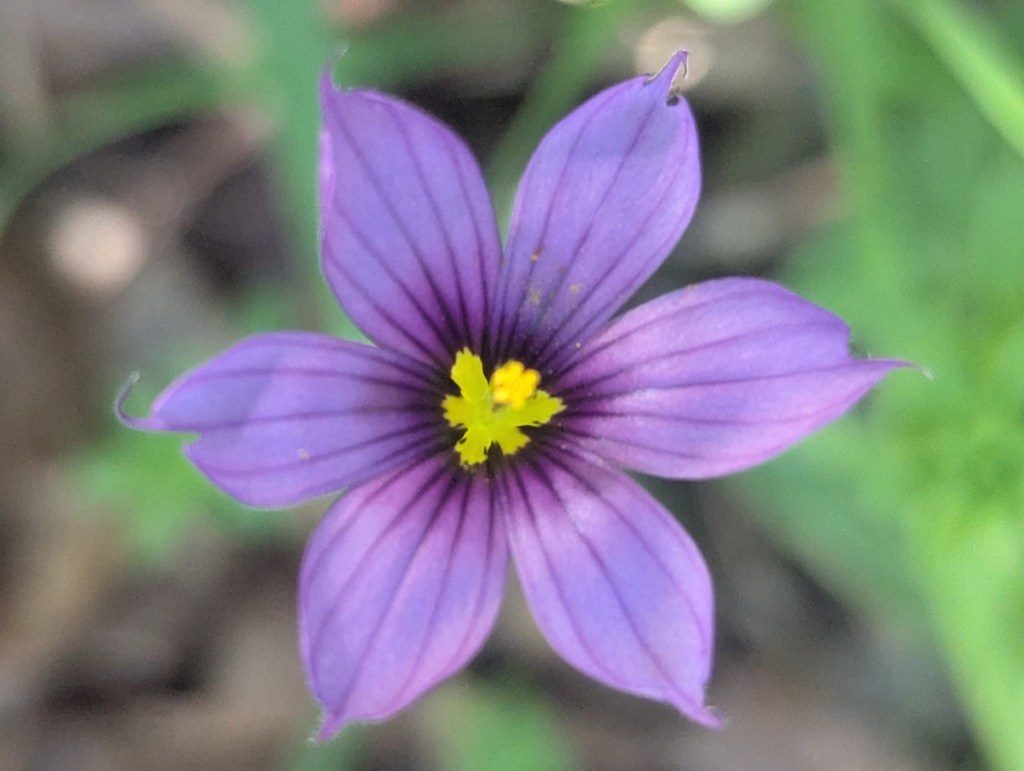
2. Dianella caerulea, blueberry lily is named Sigmund because it looks like a shabby sea monster. It is in a large terracotta pot that it now completely obscures. It visually softens the blunt end of a low stone retaining wall that separates a few stone steps from a ramp.

3. Cymbidium, orchid with a few small bits of Vinca minor ‘Alba Variegata’, small white variegated periwinkle are in a cheap plastic urn, with Sigmund in the background to the left. I know neither the species nor the cultivar of the orchid, but it blooms white nicely.

4. Alocasia odora, taro, or whatever species this is, has grown quite nicely to obscure its pot, just like the split-leaf philodendron and Sigmund. It was taken from a vacated home with an Australian tree fern two years ago. Sadly, the old home will soon be demolished.

5. Brugmansia, angel’s trumpet really is getting to be redundant, but is also really quite pretty. Like the orchid, both its species and cultivar are unknown. I grew it from a scrap from a green waste pile in East San Jose. Its big terracotta urn was a gift a few years ago.

6. Eucalyptus globulus ‘Compacta’, dwarf blue gum is certainly not a typical houseplant. Yet, here it is within an antique coffee shoppe lounge at work. We do not know how long it can survive here without direct sunlight, but will eventually find out. It is quite grand.

This is the link for Six on Saturday, for anyone else who would like to participate: https://thepropagatorblog.wordpress.com/2017/09/18/six-on-saturday-a-participant-guide/

Queen Anne’s Lace

Queen Anne’s lace is pretty but toxic.

There are actually a few different flowers known as Queen Anne’s lace. The most common species, Daucus carota, that has naturalized and even become somewhat of a weed in some areas, has two and a half inch broad, flat-topped trusses of delicately minute but abundant flowers, with a single red flower at the center of each truss. Apparently, Queen Anne pricked a finger with a needle while making the lace, leaving a drop of blood. Modern varieties have broader and fluffier trusses, often lacking central red flowers. They are a popular ingredient or fill for mixed bouquets with more colorful flowers.

The biennial foliage of Queen Anne’s lace grows to about three feet tall in the first year, with weedy but intricately lacy leaves. It blooms in summer of the second year. It is very similar to poison hemlock, which is poisonous enough to kill Nero, so should not be allowed to grow in vegetable gardens or where toxicity might be a problem; just in case.

Cut Flower Alternatives

Lily of the Nile floral trusses are appealing even without bloom.

Most flowers bloom in spring. Many bloom a bit later and though summer. Not nearly so many start to bloom in autumn or though winter. This time of year, there is more to clean up from fading blooms than there are fresh blooms to cut and bring in.

Much of the color in the garden through autumn is provided by colorful foliage or foliage that gets colorful as the weather gets cooler. Later in winter, some plants have colorful bark and stems that gets revealed by winter defoliation. Coral bark Japanese maple, red twig dogwood and some arctic willows have remarkably colorful twigs.

Blooms of a few plants are sometimes cut and recycled after they fade because their dried flowers, flower stems or seed pods are appealing. Hydrangeas are not so attractive as they deteriorate out in the garden, but can be cut and hung upside down to dry to substitute for fresh flowers later. If done quickly, many types hold their color somewhat. Those that do not hold their fresh color may turn an appealing shade of brown.

Queen Anne’s lace can likewise be a nice dried flower, but is not so easy to hide in the garden while it dries. If cut and hung to dry, individual stems should be hung separately, since they bend and are difficult to separate if hung in clusters. Their flat-topped flower trusses curve inward as they dry, so they look nothing like they do fresh.

The rigid flower stems of New Zealand flax are rather sculptural protruding from their softer foliage. These same stems can be cut, plucked of seed pods, and like dried hydrangeas, used as cut flowers when there is not much else to get out of the garden. Ironically, New Zealand flax flowers sometimes get cut before they bloom, since not everyone appreciates their contrast against their own softly textured foliage.

Years ago, New Zealand flax flower stems were actually dried and spray painted! For those daring to try this technique, it also works well with lily -of-the-Nile flowers stems and trusses (plucked of their seed pods), Heavenly bamboo flower stems, and even dried pampas grass blooms. However, pampas grass blooms are deprived of their fluffiness and most appealing quality by spray paint. Bird-of-Paradise leaves twist interestingly as they dry, to provide texture with or without paint.

Fronds (leaves) of some fan palms can provide bold cut foliage. Mediterranean fan palm is difficult to handle because of the nasty teeth on the stalks, but has nice rounded leave that fan out nicely behind other flowers. They can be cut into smaller fans, or even other not so rounded shapes. Windmill palm is much easier to handle, but is a bit larger, so is more likely to need to be trimmed to shape. All are easy to cut with common scissors, and can be dried and spray painted.

There is probably more in the garden to substitute for cut flowers than would be guessed. Useful plant parts can be found in the least expected of places.

KPCR Garden Report

Nothing is official yet. I am hopeful, though. I am currently in training to establish a new Garden Report on Pirate Cat Radio KPCR-LP 92.9 FM in Los Gatos, KMRT-LP 101.9 FM in Santa Cruz, KVBE-LP 91.1 in Portland, and online at KPCR.org. For me, it is daunting. However, those training me are confident of my ability. I have no problem talking about horticulture for an hour. My difficulty is operating the necessary electronics. It is not much, and actually looks quite simple. I am just not comfortable with it. I am intent on doing what I must, though. I miss my former Garden Report gardening shows on KSCO 1080 AM in Santa Cruz and KBCZ 89.3 FM in Boulder Creek. Ultimately, I would like to post recordings of the new Garden Report here on the blog, or at least post links to such recordings. I am told that is not difficult to do, if I record the shows, which is apparently standard procedure. I still need to find “intro” music for the beginning and end of each show, but I believe that I have a source for that. Goodness, although I know this should be easy, I am nervous!

Valley Oak

Valley oak is a stately tree.

Native trees are not necessarily the best options for home gardens. Valley oak, Quercus lobata, for example, grows much too large. Old trees can grow more than a hundred feet tall. Although unpopular for new plantings, it sometimes self sows. Also, new landscapes sometimes develop around old trees. Formerly rural trees therefore become urban trees.

Old trees are unfortunately very sensitive to disruption of their surroundings. Grading can severely damage their shallow feeder roots. Irrigation to sustain new landscapes is likely to promote rot of older and larger roots. Trees that should live for centuries can succumb to such damage within decades. Younger trees are fortunately adaptable to landscapes.

Nonetheless, young valley oaks are trees for future generations. Also, they require plenty of space. Although it may take a few centuries, trunks can eventually grow ten feet wide. As they mature, such big trees can make a big mess. The deciduous foliage can shed for weeks instead of days. The pale yellowish brown autumn foliar color is rather mundane. Without excessive irrigation, roots are remarkably complaisant.