Horticulturists are by nature, nonconforming. I happen to find it difficult to conform to what makes us nonconforming. Trends are fleeting. Old technology that has worked for decades or centuries is still best. Although I am not totally against chemicals, I find that almost all are unnecessary for responsible home gardening. Pruning is underappreciated, and fixes many problems.
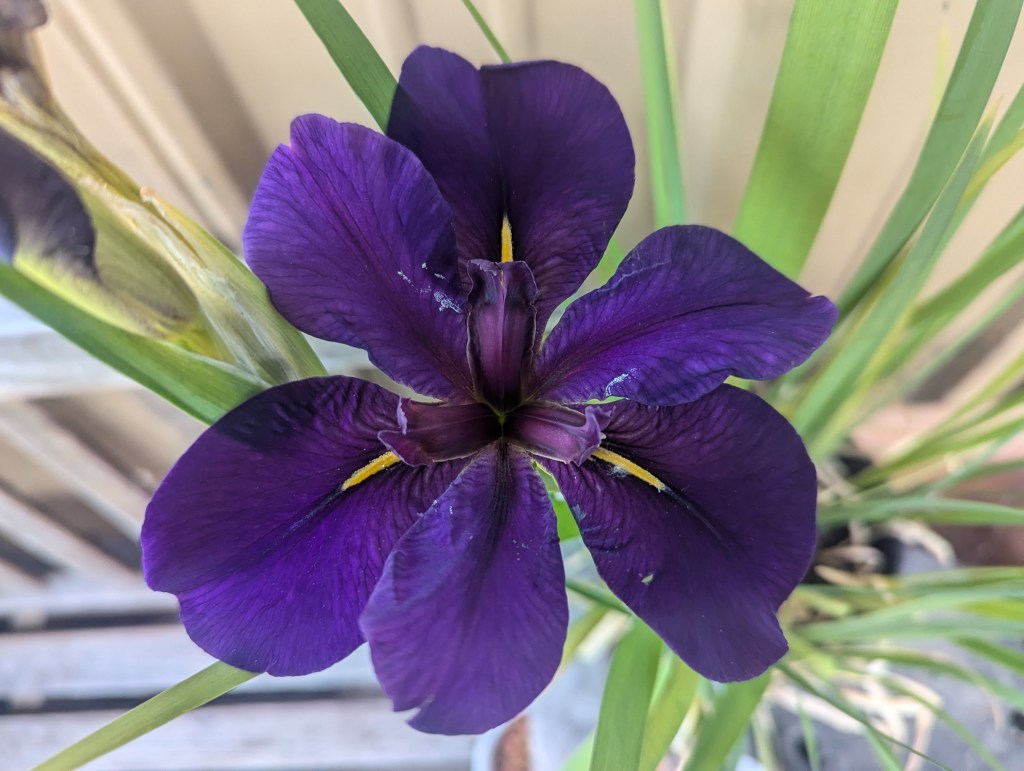
Finally, after two years, ‘Black Gamecock’ Louisiana iris from Tangly Cottage Gardening are blooming! At the end of winter of 2023, I divided a significant clump of them into enough pups for a thirty foot long row on the edge of the irrigation pond. They grew through summer, and should have bloomed for the following spring. Instead, a gopher ate all but a few pups. At the end of winter of 2024, I divided another clump into enough pups for a twenty foot long row in the same location, but closer to the water. Again, they grew through summer, and should have bloomed this spring, but instead, all but a few were eaten by a gopher. These that are now blooming are the survivors from the original batch, which were canned for their safety. They are blooming late, probably because they would rather be in the ground than canned. I will divide these into more cans now so they can proliferate and be divided again later, until there are twice as many as necessary for the edge of the pond. Then, I will plug some at the edge of the pond, into saturated soil that gophers can not dig under.
Like oleander and junipers, lemon bottlebrush, Callistemon citrinus, has become passe. It was a victim of its own practicality. It was so popular that it became overly common. Yet it is just as practical now as it was then. It is resilient enough to survive within medians of freeways with minimal irrigation. In less exposed situations, it might require no irrigation.
As a small tree, lemon bottlebrush can grow more than fifteen feet tall. With pruning from below, some grow about twenty feet tall with sculptural trunks. Their canopies eventually become messy though, and require aggressive pruning. Most lemon bottlebrush grow as big flowering shrubbery or high hedges. Shearing can compromise bloom if too frequent.
Bright red bloom should be most abundant for summer, but may be sporadic at any time. It is very popular with pollinators, including hummingbirds. Many small staminate flowers bloom in compact cylindrical trusses, like bottlebrushes. Each truss is about two or three inches long and nearly as wide. The aromatic and evergreen leaves are almost as long. Dark brown bark is handsomely shaggy and furrowed.
Floral color communicates to pollinators. Pollination is, after all, the priority of all flowers. Those that rely on pollinators more than breezes for pollination must therefore advertise. They effectively customize their bloom for preferable pollinators. Some incorporate floral fragrance if necessary. Most preferable pollinators are insects. Some are hummingbirds.
Seven species of hummingbird inhabit California. Some are always here. Some migrate south for winter. A few are only here while they migrate between farther south and farther north. All eat only small insects and floral nectar. Blooms which rely on hummingbirds for pollination are happy to provide. They have a mutually beneficial symbiotic relationship.
Many plant species have customized their bloom for pollination by hummingbirds. Many of these flowers are elongated, tubular and curved to fit the long beaks of hummingbirds. Most, although not all, are bright and rich colors that hummingbirds prefer. Bright red and orange are probably their favorite colors. Floral fragrances are more for other pollinators.
Many who enjoy gardening enjoy hummingbirds within their gardens. Hummingbirds are as colorful as some small flowers, but are much more dynamic. They enjoy hummingbird feeders and birdbaths or simple saucers of water. They also appreciate the various sorts of flowers that appeal specifically to them. Such flowers can appeal to everyone anyway.
Hummingbirds enjoy too many flowers to list. Those that customize their blooms for them will be expecting them. Many that customize their blooms for other pollinators can attract them anyway. Zinnia, coneflower and most composite flowers are ideal for pollination by bees. Many of their bright floral colors that attract bees entice hummingbirds incidentally.
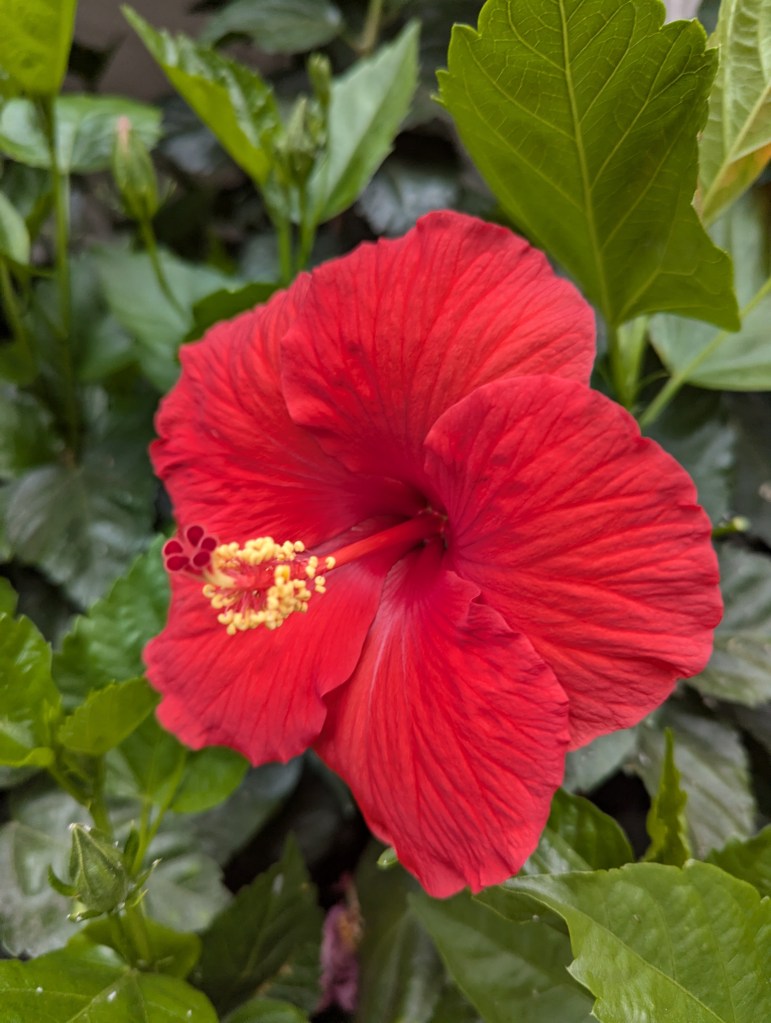
Columbine and nasturtium are more customized for hummingbirds. Penstemon, foxglove and various trumpet vines accommodate a range of pollinators. Honeysuckle, lupine and sages do too, but seem to fit thin hummingbird beaks best. Bright floral color of hibiscus, fuchsia, canna and bottlebrush are impossible to ignore. Indiscriminate taste is an asset.
This is an intentional attempt to eschew the most obvious options.
1. Tanacetum parthenium ‘Aureum’, golden feverfew is the only of these six that I know the cultivar of, but only because it is the only cultivar that I am aware of with such sickly chartreuse foliar color that passes for golden. Its little daisy flowers are splendid though.
2. Dianthus caryophyllus, mini carnation is one of those cool season annuals that never gets removed at the end of its season. It neither flourishes nor dies, so has been here for several years. It will probably die back partially now that the weather is getting warmer.
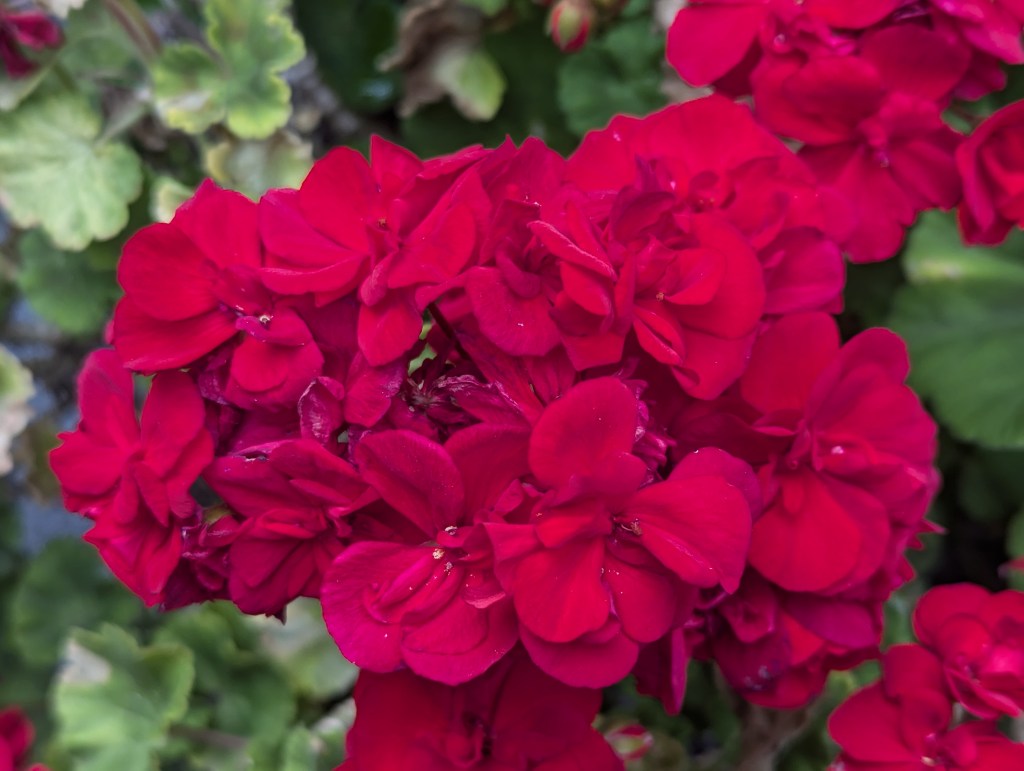
3. Pelargonium X hortorum, zonal geranium may seem to be cheap and common, but it has been very reliable. Besides, I happen to be fond of them. They were some of the first perennials that I grew during my childhood. This and others like it are modern cultivars.
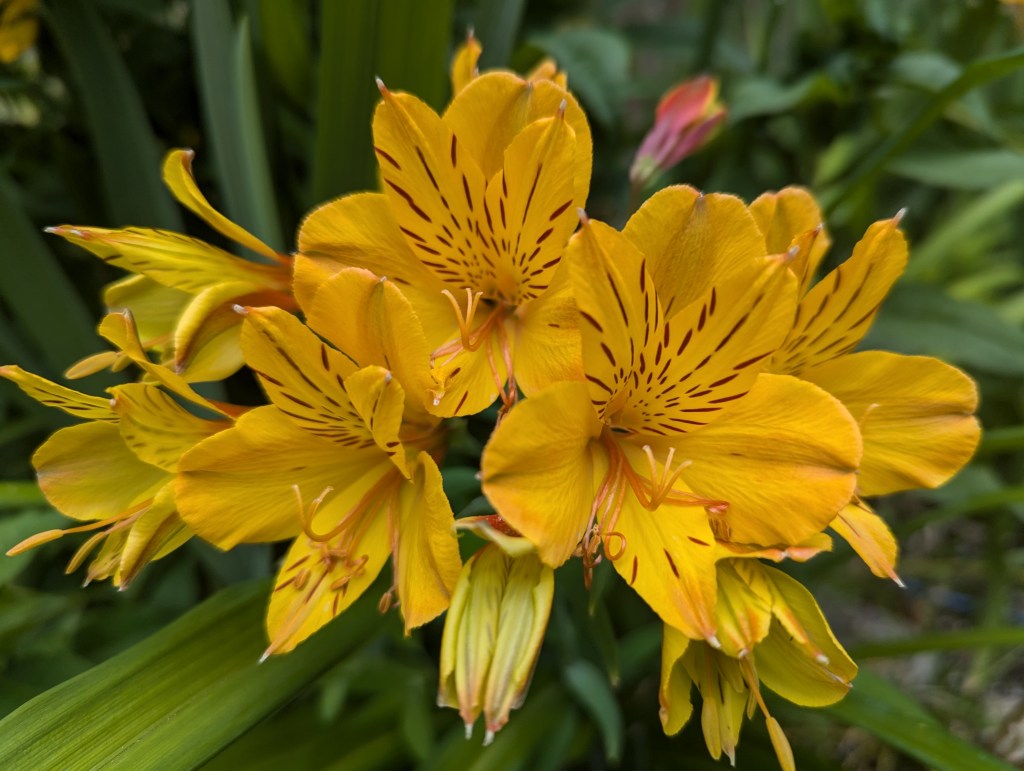
4. Alstroemeria spp., Peruvian lily was the first large scale cut flower crop that I worked with during the summer of 1986, while I was studying horticulture at Cal Poly, San Luis Obispo. This and a few cultivars at work seem to be as old fashioned as those from 1986.
5. Lilium auratum, Asiatic lily was a gift from a neighbor while its bulbs were dormant a few winters ago. It was not expected to perform as well as it has. Not only has it become reliably perennial, but it has multiplied so much that I must eventually dig and divide it.
6. Cornus florida, flowering dogwood is the last dogwood to bloom so late. This could be because of distress associated with its relocation last winter. I do not remember when it bloomed last year, or if it should bloom as late next year. I suppose that we will see then.
Pincushion blooms in pastel blue, lavender pink or white.
The oddly protruding stamens of pincushion flower, Scabiosa columbaria, are ideal for bees collecting pollen. To us, they resemble pins stuck into the somewhat flat surface of the composite (daisy like) flowers. To bees, they are a flea market (or bee market) of pollen. Bees easily stroll the two inch wide flowers to peruse the merchandise on display.
The pale lavender, blue, pink or white flowers on limber stems are good cut flowers. The grayish foliage is deeply lobed and nicely textured. Mature plants can be two feet tall and broad. Bloom begins by summer and continued until frost if fading flowers get plucked. Although perennial in mild climates, pincushion flower is more often grown as an annual.
Flowers are only as colorful or fragrant as they are to attract pollinators.
When the garden is full of bloom, we do not like to think that flowers have an agenda. All their colors and fragrances seem to be displayed merely for our benefit. Who really wants to know that procreation is their real priority; that all their efforts are merely to get pollinated to make seed for the next generation?
Because flowers are not mobile like animals and insects are, they need to rely on wind or pollinators to deliver their pollen to other flowers. Flowers that are more reliant on wind for pollination are not much to look, since they do not need to advertise. The wind needs no incentive to blow. Wind pollinated flowers are instead abundant and productive, to disperse as much of their light pollen as possible.
Flowers that need pollinators need to advertise. They offer all sorts of attractive colors, fragrances, nectar and pollen to attract their particular preferred pollinators. For example, those that exploit the services of hummingbirds appeal to their discriminating taste with sweet nectar in tubular flowers that are mostly in colors that hummingbirds like, orange or red.
All the variety among flowers is designed for the variety of pollinators that they employ. Flowers that rely on nocturnal moths are large and pale, often with infrared patterns (that people do not see) to be visible in moonlight to moths drawn to their sweet fragrance. The offensive fragrances and textures of fly pollinated flowers are delightful to flies. Many flowers appeal to multiple pollinators.
Bees are of course the busiest of pollinators, as they collect nectar and pollen to make honey. They visit any flower they encounter, but prefer those that make abundant and dense pollen that they can carry away. They are very fond of the many different fruit trees; such as apple, pear, apricot, cherry, plum and all their relatives, as well as citrus. They also dig eucalyptus, wild lilac (ceanothus), hebe, firethorn, bottlebrush, honeysuckle and roses.
The difficulty for bees is finding a constant supply of flowers. As apple and pear trees finish blooming, bees want to start visiting other flowers. Bees like a variety of just about any of the annual flowers, particularly pincushion flower, cornflower, snapdragon, foxglove, sunflowers, poppies and lupines. With a good mix, something should always be blooming. Bees are also very fond of catmint, ajuga, thyme, rosemary, penstemon, lavenders and the many salvias and sages.
Those who want to attract bees to the garden should therefore plan for a good mixture of flowers that bees like, so that there is always something to keep the bees happy. Many of their favorite flowers that may not seem very colorful to us use ultraviolet patters that are quite flashy to bees. The choices are not always so obvious.
However, those who do not like bees or are allergic to bee stings, should avoid an abundance of flowers that will attract them. Unfortunately, there are no flowers or plants to repel bees. Also, the coniferous (cone bearing) evergreens and many other wind pollinated plants that are less attractive to bees produce abundant light pollen that is so problematic for allergies.
What makes this particular white bearded iris so special? Well, all three of the bearded iris that bloom white in my gardens are special. Each arrived with history, from other important gardens. I am impressed with this one now because it is so white. I did not know what color it was when I acquired it from its garden in Monterey so many years ago. I just wanted a souvenir from that particular garden after the owner passed away, so grabbed a bit of it during the estate liquidation. It bloomed for its first season, but was a dingy grayish white. I thought it might get whiter for its second season, but continued to bloom annually with the same unimpressive color. I could not eliminate it from my collection because of its historical significance. Because it is so uninteresting, I had not shared it or, until recently, tried growing it anywhere else. Then, because bearded iris grow and proliferate as they do, I brought a small bit of it to the Iris Bed at work, where I got this picture of it. I can not explain why it is so much whiter than it had been, but I am impressed.
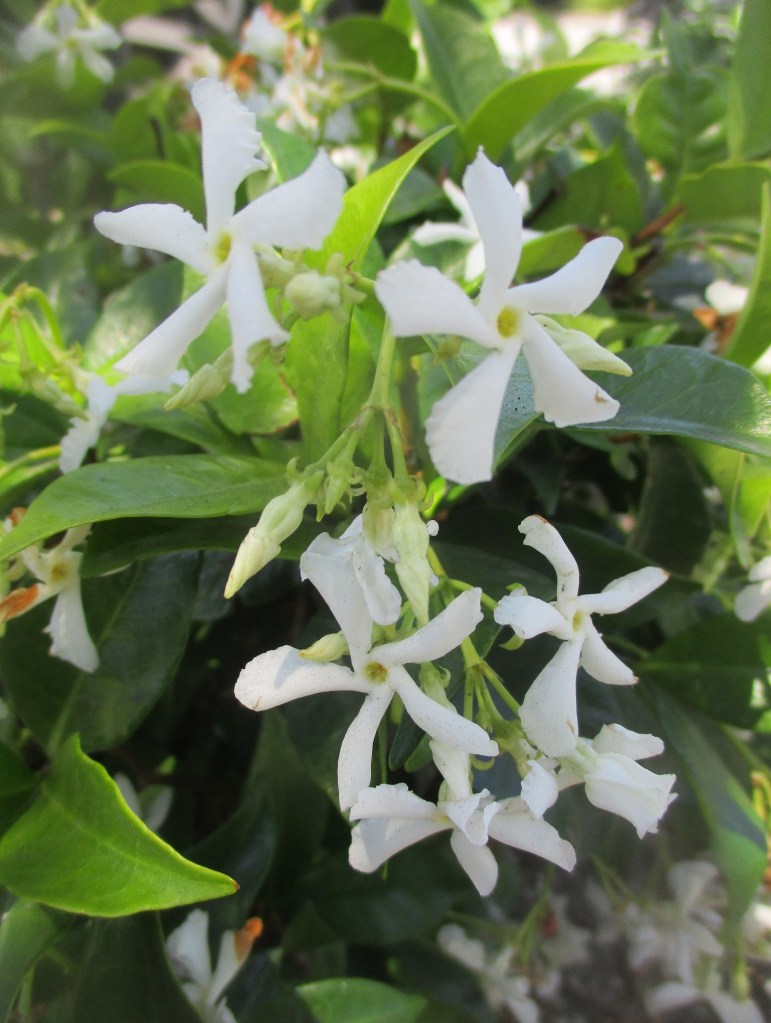
It is certainly a star within many gardens, but it is technically not a jasmine. Star jasmine, Trachelospermum jasminoides, is actually closely related to Plumeria. Its floral fragrance can be comparably rich with copious bloom, but is distinctly vanillish. Bloom is abundant for late spring and early summer. Sporadic bloom can start early and continue to autumn.
Without bloom, the distinctly glossy foliage is handsome alone. Individual leaves are not much longer than two inches, and not much wider than one. Their deep green foliar color and lustrous sheen almost seem artificial. Pruning or any disturbance of foliage or stems releases caustic and toxic sap. Twining vines ascend by wrapping around their supports.
Star jasmine can get two feet deep as a ground cover without support. It requires pruning to prevent it from overwhelming shrubbery or climbing into trees. It also requires frequent pruning around its edges. As a climbing vine, it grows fast to ten feet high, and can grow much higher a bit slower. It can become a neatly shorn faux hedge on a chain link fence.
Dormant pruning last winter did more than concentrate resources for flowers and fruits. It did more than eliminate superfluous growth, which many pathogens overwinter in. It also directed or concentrated resources for stems and foliage. Such growth now grows faster than some types of insect infestation. Aphid, though, are famously prolific and tenacious.
Hybrid tea roses very effectively demonstrate the advantages of dormant pruning. Those that lacked such pruning are more vulnerable to major aphid infestation now. Those that benefit from such pruning are significantly less vulnerable. Even with minor infestations, they may bloom well. Their vigorous stems grow at least as fast as aphid can proliferate.
It is too late for dormant pruning now. Furthermore, this is the beginning of aphid season. It continues until early autumn. Fortunately, aphid are usually not problematic for too long on the same hosts. Their natural predators often find and control them as their infestation culminates. They might continue to be present, but at a tolerable or unnoticeable degree.
Insecticides can be useful for severe infestation, but can interfere with natural processes. Some eliminate predatory insects that can naturally control aphid. If possible, it might be more practical to literally allow nature to take its course. Aphid are prolific, but essentially weak. Mildly soapy water kills them fast without killing many beneficial predatory insects.
Ants symbiotically cultivate aphid in exchange for their honeydew, (which is excrement). They protect their benefactors, and move them to ideal host material. Pruning citrus trees so that they touch nothing else can nearly block access to ants. Application of a barrier to their trunks, such as grease, blocks access more completely. Predatory insects still fly in.
This technique is practical for many small trees, but not low shrubby roses and hibiscus. For them, aphid might be easy to blast off with a spray nozzle on a hose. This procedure neither removes nor kills all aphid, but it can limit their damage. Repetition of the process will likely be needed a few days later, and maybe a few times. Aphid might be persistent, though.




 Tony Tomeo