Horticulturists are by nature, nonconforming. I happen to find it difficult to conform to what makes us nonconforming. Trends are fleeting. Old technology that has worked for decades or centuries is still best. Although I am not totally against chemicals, I find that almost all are unnecessary for responsible home gardening. Pruning is underappreciated, and fixes many problems.
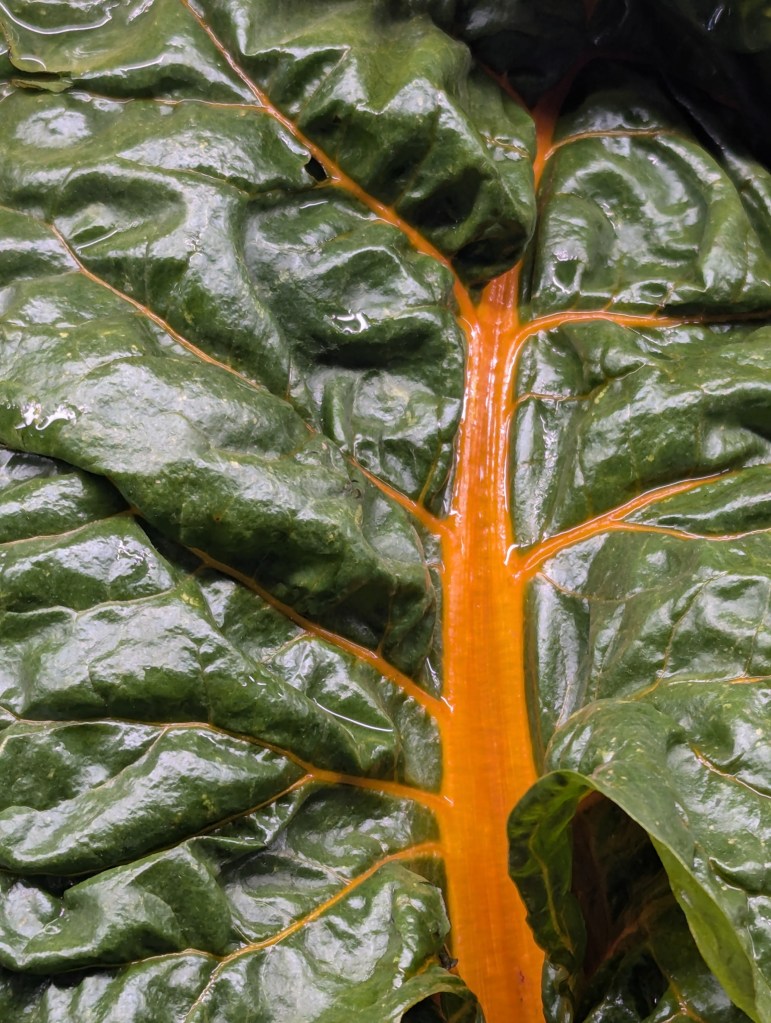
Among the cool season vegetables that are now seasonable, this one is too cool. Swiss chard, Beta vulgaris subsp. vulgaris var. flavescens is as ornamental as edible. Its richly deep or bronzy green foliage is a splendid backdrop for cool season annuals. The same foliage is edible, either fresh or cooked. Yet, even as a vegetable, it is nicely ornamental.
The wide petioles and leaf veins can be white, yellow, orange, pink or maroon. Although varieties with simple green petioles are more productive, they are less popular. ‘Rhubarb Chard’ and ‘Ruby Chard’ develop deep red petioles and veins. ‘Rainbow Chard’ is a mix of varieties with petioles and veins of various colors. Some have darkly bronzed foliage.
Although a cool season vegetable, Swiss card performs very well for spring and autumn. It only succumbs to summer warmth. In cooler climates, it might succumb to severe frost. Since only external leaves are harvested, it retains its ornamental quality for a long time. Swiss chard like sunny exposure and rich soil. It wants water when winter rain is sparse.
Warm season vegetables that started late last winter will be finishing their seasons soon. Cool season vegetables, or winter vegetables, should begin to replace them. This might sound familiar as the same scenario for warm and cool season annuals. After all, almost all vegetable plants are either annuals or biennials. Few perform for more than a season.
Just like annual bedding plants, different vegetable plants perform to different schedules. Some warm season vegetables begin to deteriorate as warm weather ends. Others may continue to produce until frost. Some cool season vegetables need an early start. Others can start late and grow through cool winter weather. Gardens need not transition quickly.
Besides, different phases of some types of vegetables begin and finish at different times. Although late phases of corn continue to grow, early phases are already done and gone. Although late phases of beet might begin months from now, early phases can begin now. Warm season vegetables, ideally, relinquish space as cool season vegetables require it.
Cool season vegetables grow slower than warm season vegetables. Also, more of them are true vegetables rather than fruit that contain seed. Many are distended roots, such as beet and carrot. Many are distended foliage, such as cabbage and chard. A few, such as broccoli and cauliflower, are distended floral bloom. Peas are actually fruiting structures.
All root vegetables should grow directly from seed. They are vulnerable to disfigurement if transplanted. Besides, they typically grow in significant quantities that are not practical for transplant. These include beet, carrot, radish, turnip and parsnip. Cucumber and pea, although conducive to transplanting, also perform better from seed. So do lettuce greens.
Heading lettuce, though, is more like cabbage and larger cool season vegetables. Since only a few are necessary, transplanting them as seedlings is practical. Besides, they are conducive to transplanting. Cell pack seedlings for cool season vegetables are available from nurseries now. Seed is always available. It can go directly into a garden or into cells for transplanting later, as summer becomes autumn, then winter.
1. Rain dampened the landscapes for the first time since last spring. It was not much and did not last for long, but was fun while it lasted. Actually, it was barely more than drizzle and made only a few tiny and grungy puddles. Pavement had not been rinsed in months.
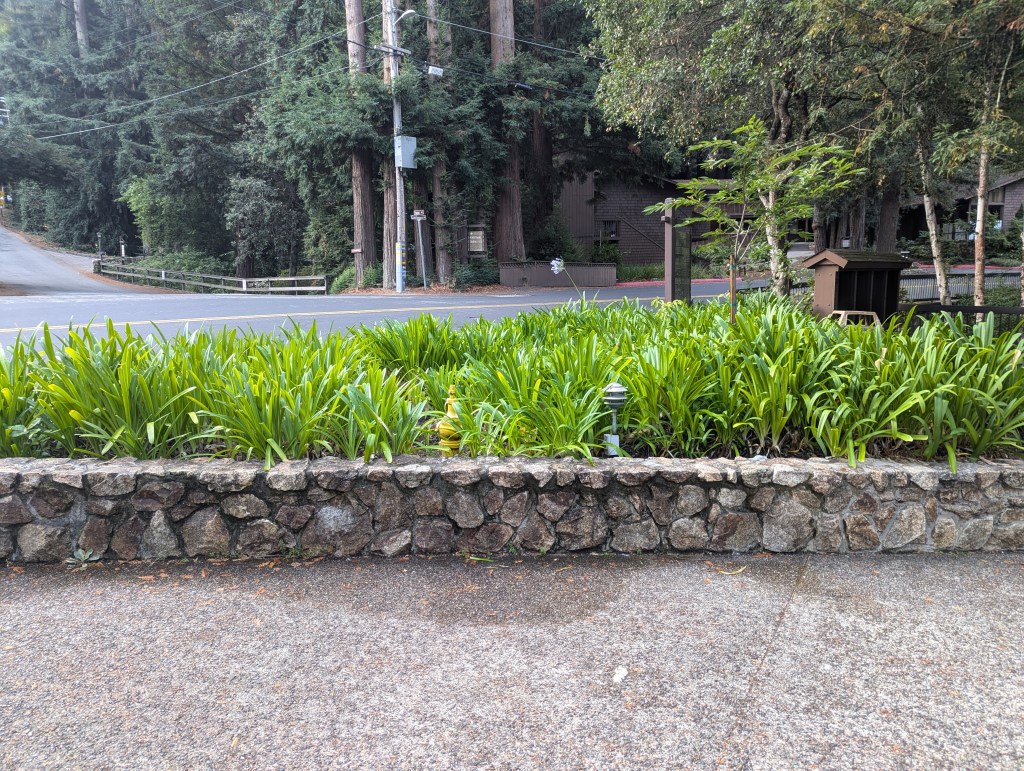
2. Agapanthus orientalis, lily of the Nile confirms the end of summer by finishing bloom and necessitating deadheading. One last bloom looks silly and lonely at the center of this big colony. It may be cheap and common, but lily of the Nile happily blooms for months.
3. Pelargonium X hortorum, zonal geranium has left the building. The Post Office looks better without its shabby planter boxes that were so predictably bashed by parking cars. Some believe that we must replace them with other prominent potted plants. I disagree.
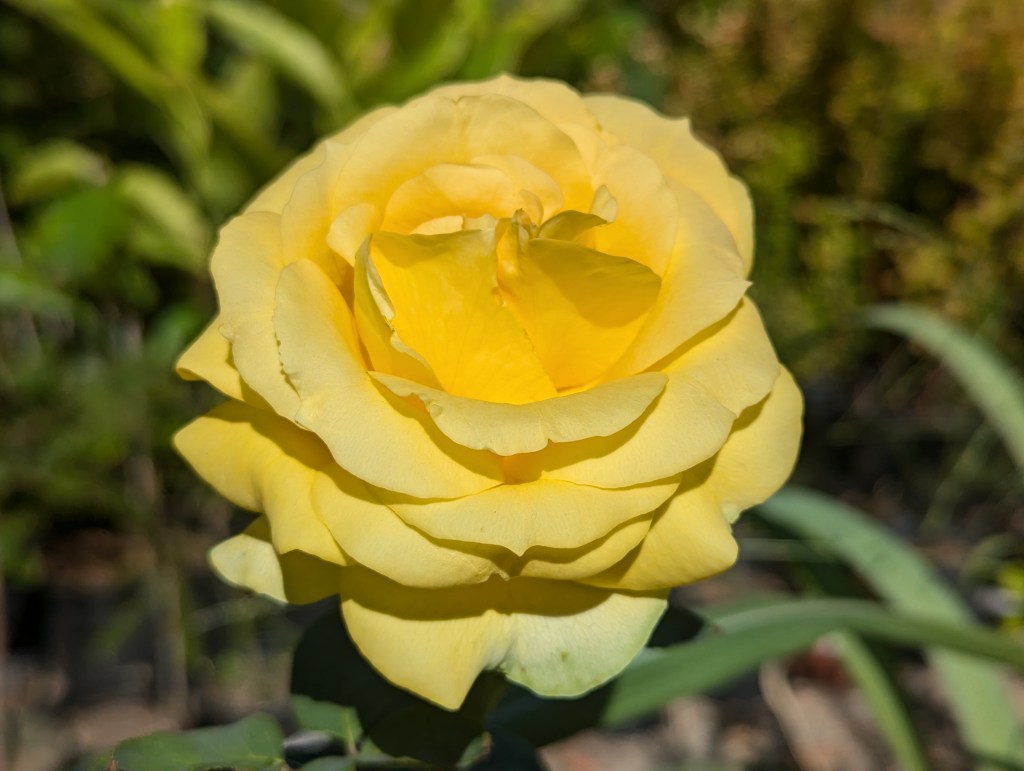
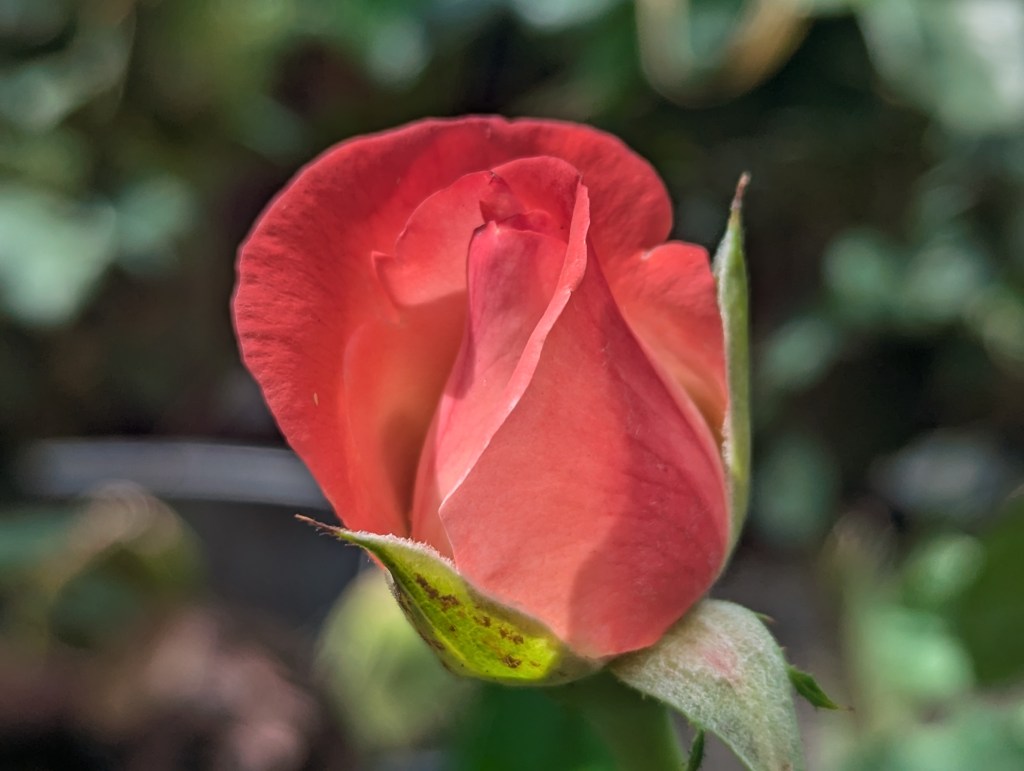
4. Rosa ‘Sheer Magic’ rose was actually labeled as such. I misidentified another rose that was blooming last week as such because I thought that it looked about right. I found the label afterward. This is the only one of four recycled roses that retained its original label.
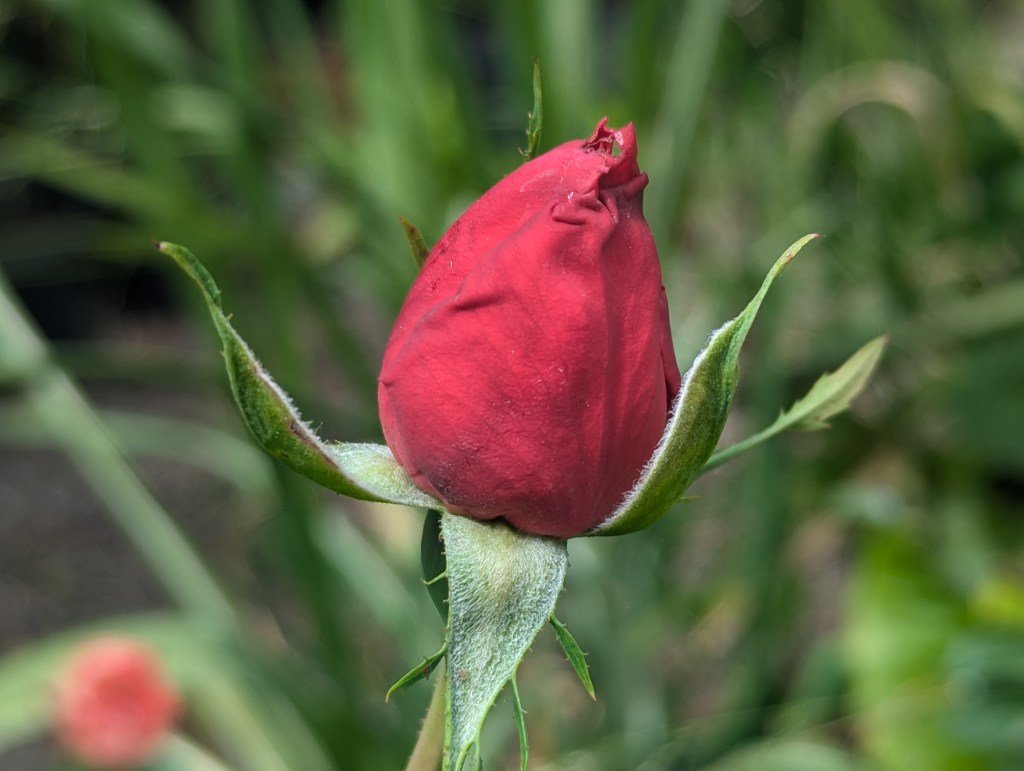
5. Rosa, rose is one of the other three recycled roses that did not retain its original label. It looks as if it is about to bloom red. Perhaps I will get a picture of it for next week. Any color would be nice from roses that were not expected to survive an untimely relocation.
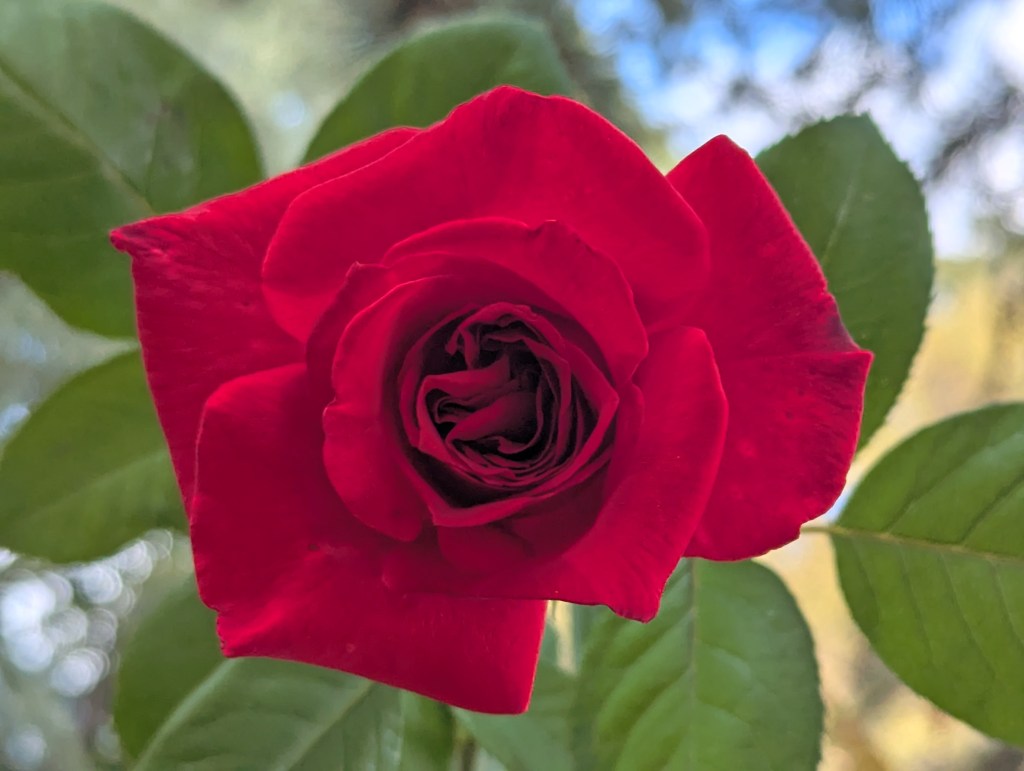
6. Rosa ‘Proud Land’ rose is not one of the four relocated roses, but is from my own rose garden. It was too pretty to not show off. I planted it with two others in about the winter of 1984 or 1985. Although I did not choose it, ‘Proud Land’ is likely my favorite red rose.
Sprawling ground cover forms of rosemary, Rosmarinus officinalis, that get only a foot or so deep are the most familiar. Taller upright types that can get to six feet tall can be quite sculptural. There are several shorter shrubby types in between that can be allowed to grow wild or shorn into tight hedges.
All rosemary is densely foliated with small narrow leaves not much more than an inch long. It is used as an herb because it is so aromatic and flavorful. Tiny flowers bloom in various shades of blue through winter and spring, and sometimes again in autumn. Stems that root where they touch the ground can be dug and moved as new plants.
Rosemary happens to be one of the many plants that is perhaps too versatile to be respected. Low ground cover forms and sculptural upright forms are probably at their best without much attention. Shrubby forms can instead be shorn strictly into neat formal hedges.
The problem is that most rosemary eventually gets shorn and deprived of natural shape and texture, whether it needs it or not. Those that should be upright and sculptural become rounded over like bean bag chairs. Ground cover forms without their naturally soft texture are like flattened hedges. Those that should be shorn are seldom shorn properly for confinement, so become distended and obtrusive.
The many different kinds of juniper are similarly disgraced. Instead of becoming sculptural small trees, Hollywood juniper and Eastern red cedar more commonly get shorn into nondescript shrubs. Shrubby types get shorn so often that their appealing textures are never appreciated. Only a few of the densely foliated and compact junipers are conducive to formal shearing.
Shearing is certainly practical where formal hedges are desired, and for plants that have sufficiently dense and finely textured foliage. Yet, it is still important to shear such plants properly. Hedges should be slightly narrower at the top and wider at the bottom, so that lower foliage gets good sun exposure. Vertical surfaces are acceptable; but hedges should not be wider on top and narrower on the bottom.
Hedged or shorn plants should not be allowed to sneak out of their confinement to become obtrusive to usable space. For example, hedges along a driveway should not become so deep (from front to back) that they occupy usable space where cars could otherwise park. They function just as well if three feet deep as they would if they were eight feet deep!
Most hedged plants that should not have been hedged can be salvaged with a bit or work. Unfortunately, the process can be quite involved and makes the shorn plants unappealing while they recover. Overgrown privet hedges can simply get cut back to bare limbs (late in winter) and allowed to sprout back. They should be cut back farther than they need to so that new growth has room to expand.
Overgrown photinias are not so tolerant to severe pruning, so need to be cut back selectively to allow sunlight into the interior. The largest and most obtrusive growth can be cut out completely at first, as long as some lower growth remains to sustain recovery and shade interior stems. As new growth emerges from within, more of the overgrown outer growth can get removed until it is replaced.
Alternatively, overgrown photinias, as well as oleanders, osmanthus, large junipers and some pittosporums can be allowed to grow wild on top if their obtrusive lower growth gets pruned away. Such overgrown plants often have appealing trunks within. The only problem is that hedges pruned up into rows of small trees do not obstruct lower views as they may have been intended to do, unless they get pruned up only on one side.
Remember that shearing is not the only option. Properly pruned plant are allowed to grow into some spaces, but not where they will get in the way. Natural growth habits should be exploited instead of oppressed.
Yucca whipplei, which is now also known as Hesperoyucca whipplei, was the first species of Yucca that I met in the wild when I relocated to San Luis Obispo in 1985. Although it is too unpleasantly spiny for me to recommend it for home gardens, it is my favorite species of Yucca.
The only specimen of Yucca whipplei that inhabits our landscapes produced a few seed pods two years ago. I dried the seed and sowed them last year. I would have been pleased if a few germinated successfully. Instead, hundreds of them are now growing! Again, I grew too much of a good thing.
I can install several as a deer fence below a portion of my home garden. Although they grow only about three feet tall, deer will not try to jump over them uphill if they can not land beyond their painful foliage on the uphill side. However, if I put them three feet apart, only about twenty seedlings will be needed for approximately sixty linear feet of deer fence. That might be only about a twentieth of the hundreds that are now growing! They are still babies. I can worry about finding homes for them later.
Wax begonia, Begonia X semperflorens–cultorum, exemplifies simplicity. Its floral color is white, pink or red. Its foliage is green, bronze or dark bronze. Each floral color combines with each foliar color for a total of only nine combinations. That must be enough, though. Variants of these nine simple options, including some with fluffier double bloom, are rare.
Wax begonia is most familiar as a common warm season annual. However, it is probably at least as popular as a cool season annual. Actually though, it is a short term perennial. Except for during the coolest winter weather, established specimens may bloom all year. After minor frost damage, most regenerate efficiently. They need only minimal grooming.
Mature wax begonia should not grow any higher or wider than a foot. As bedding plants, they blend together. Individually, they develop densely ovoid form. Flowers are small but abundant. Foliage and stems are succulent, with a waxy sheen. New plants grow easily from cuttings or division. Wax begonia prefers rich medium and very consistent watering. A bit of partial shade should be no problem, but a bit too much can inhibit bloom.
Warm season annuals that started late last winter should be finishing their season soon. It might seem as if they replaced their predecessors, cool season annuals, only recently. This is the nature of annual bedding plants. They perform only for their particular season. It is now about time for cool season annuals, or winter annuals, to begin another season.
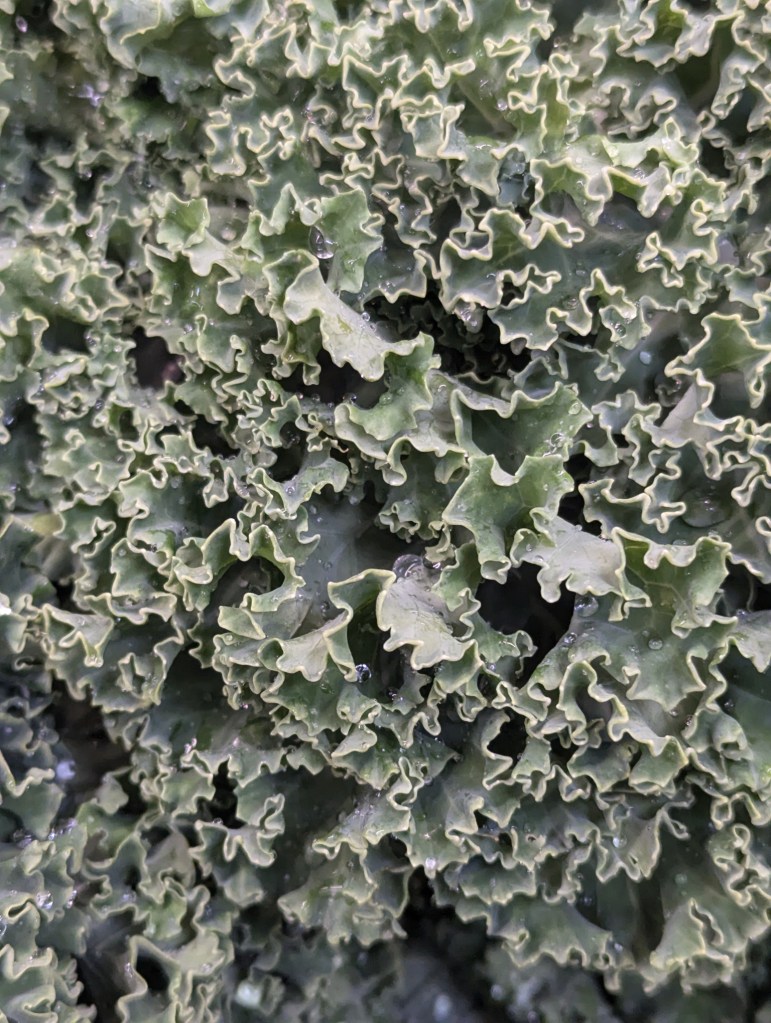
There is no need to hurry, though. The several different cool season annuals operate on different schedules. Only the earliest begin as small plants now, and even they can wait. Some prefer to begin later during autumn. Cyclamen and ornamental kale can even wait until winter. Only annuals that start as seed really must do so while the weather is warm.
Besides, some warm season annuals still perform too nicely for immediate replacement. Ideally, they are only beginning to deteriorate as they relinquish their space. Sometimes, some varieties are already grungy before their replacement. This facilitates their removal without guilt. However, some warm season annuals might continue to perform until frost.
Furthermore, some annuals, both cool season and warm season, are actually perennial. They merely function as annuals because their replacement is easier than their salvage. Busy Lizzie, for example, can remain mostly dormant through winter below new pansies. As the pansies finish in spring, the older busy Lizzie can regenerate for another season.
Sweet William and various primrose are cool season annuals that are actually perennial. Both can bloom until next spring becomes too warm for them. Then, they become mostly dormant until the following autumn. Any that remained dormant through last summer can regenerate and bloom this autumn. Perhaps they take turns performing with busy Lizzie.
Pansy and viola are the most familiar and reliable of cool season annuals. Marigold and snapdragon are popular now, but only as autumn annuals. They may not perform well for winter. Wax begonias might perform almost throughout the year with grooming after frost. Stock is the most fragrant of the cool season annuals. A few short varieties are available.