Horticulturists are by nature, nonconforming. I happen to find it difficult to conform to what makes us nonconforming. Trends are fleeting. Old technology that has worked for decades or centuries is still best. Although I am not totally against chemicals, I find that almost all are unnecessary for responsible home gardening. Pruning is underappreciated, and fixes many problems.
The pinkish magenta of rock purslane bloom is almost obnoxiously bright.
In Santa Cruz and coastal areas down to Los Angeles and San Diego, rock purslane, Calandrinia spectabilis (grandiflora) has been popular for only a few years. It is still somewhat uncommon here in the Santa Clara Valley. Because of the ambiguity of its Latin species name, it is most commonly known simply by its genus name of Calandrinia.
Moderate watering is best. On the coast, rock purslane only needs water occasionally through the driest summer weather. It should recover readily from winter frost damage. Partial shade is not a problem, but may limit profusion of bloom. Harsh exposure or reflected glare can actually roast the tender succulent foliage.
From about now through autumn, limber, two foot tall stems suspend strikingly bright magenta flowers above the low, grayish evergreen foliage. The fragile leaves are neatly arranged in terminal rosettes. Foliage, stems, flower stalks and all parts are sensitive to traffic, and can even get broken by a cat sneaking through the garden. Broken bits and pieces of stem root very easily to make new plants, though.
There are not many colors that bearded iris can not provide.
If I could select my favorite color for the flowers in the garden, they would all bloom white. There is no more perfect color. White may be bright or pale, but lacks the many shades that other colors have. There is no need to select between deep blue or sky blue, bright yellow or pastel yellow, purple or lavender. White is simply white.
The main problem with white, or any other color, is that no color is the right color for every situation. Also, some flowers are simply not at their best in white. Camellias, oleanders and fruit trees look great in white. However, nearly white marigolds, sunflowers and nasturtiums are interesting oddities that are excellent in the right spot, but are not nearly as flashy as the more traditional bright yellow and orange shades are.
My two favorite geraniums are actually reddish orange and fuchsia pink, and really look horrid in bloom together. They are my favorites nonetheless, because I have been growing them since my sophomore year at Prospect High School! I have taken cuttings with me whenever I relocated since then. I enjoy the garden too much to grow things that I do not enjoy.
Flower colors probably should be compatible with the colors and architecture of associated residences and other buildings, as well as the neighborhood. Yet, we all have different tastes. It is more important to grow flowers with the colors that we enjoy, even if they are not exactly perfect for their particular situations. Fortunately, compatible colors are more likely to also be enjoyable.
White happens to be useful in shaded areas, or with an abundance of deep green, such as wax privet hedges. White brightens an area, even in conjunction with other colors. It also softens richer colors like purple or red.
Darker shades of purple, red and blue should be out in the open, since they can make shaded areas seem even darker. Lighter shades, including lavender and pink, can work almost anywhere. True blue happens to be uncommon among flowers, even though the very common lily of the Nile is typically blue.
Yellow and orange seem at home in sunny spots, and also brighten shaded spots if not overdone. Yellow contrasts with purple. Orange contrasts with blue. Orange marigolds and cobalt blue lobelia might look odd in abundance, but can be striking as a border to a perennial or annual bed. Many of us like a random mix of any color; but too much mix over a large area can look like a garage sale of colors. Black, gray and brown flowers are rare and mostly grown by those of us who really appreciate them; since they look quite odd in the wrong situations. Black hollyhock, pansy and bearded iris are perhaps the best blacks, while other black flowers are not so convincing. Gray iris are still quite rare. Brown sunflowers are becoming more popular.
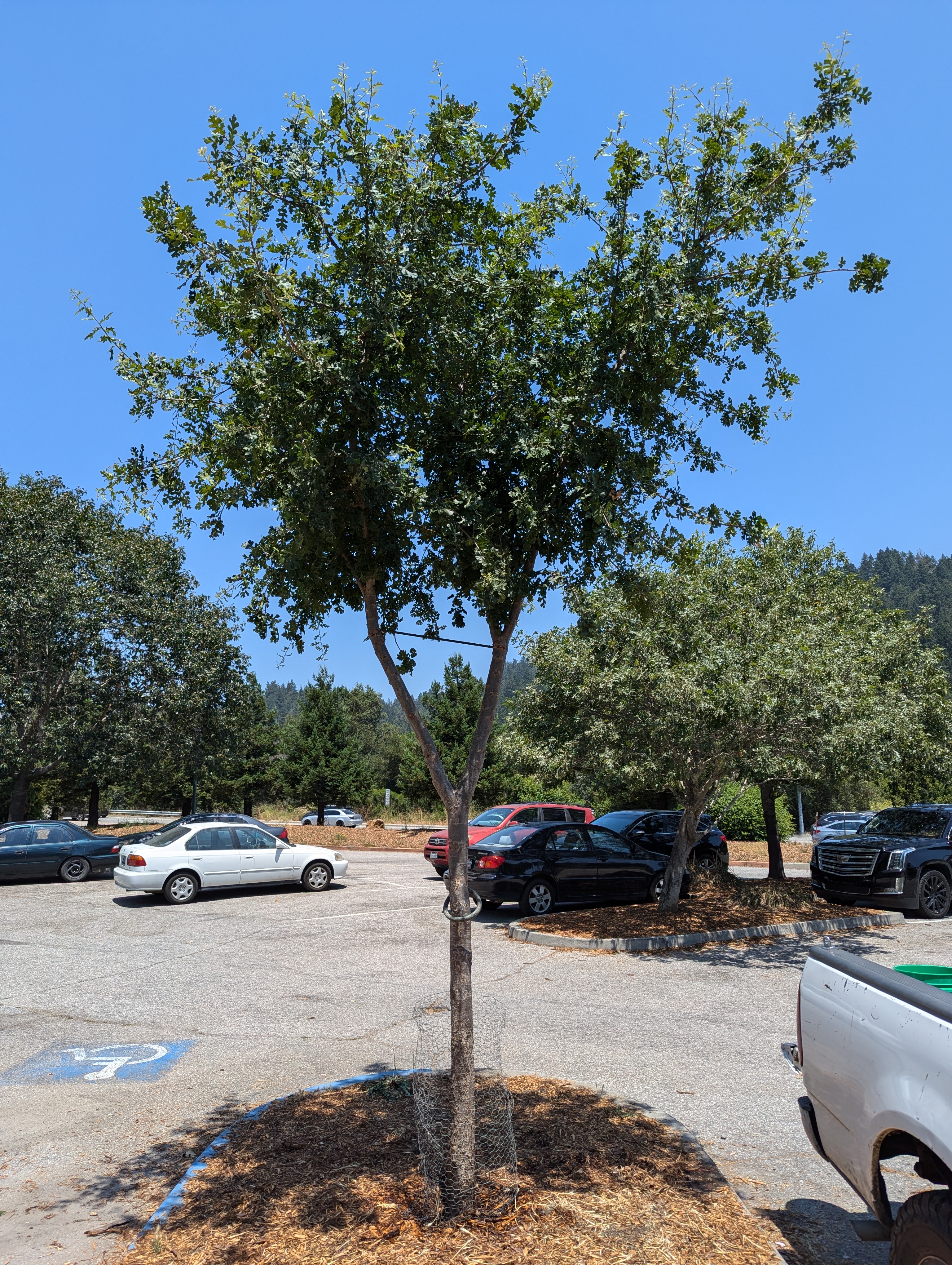
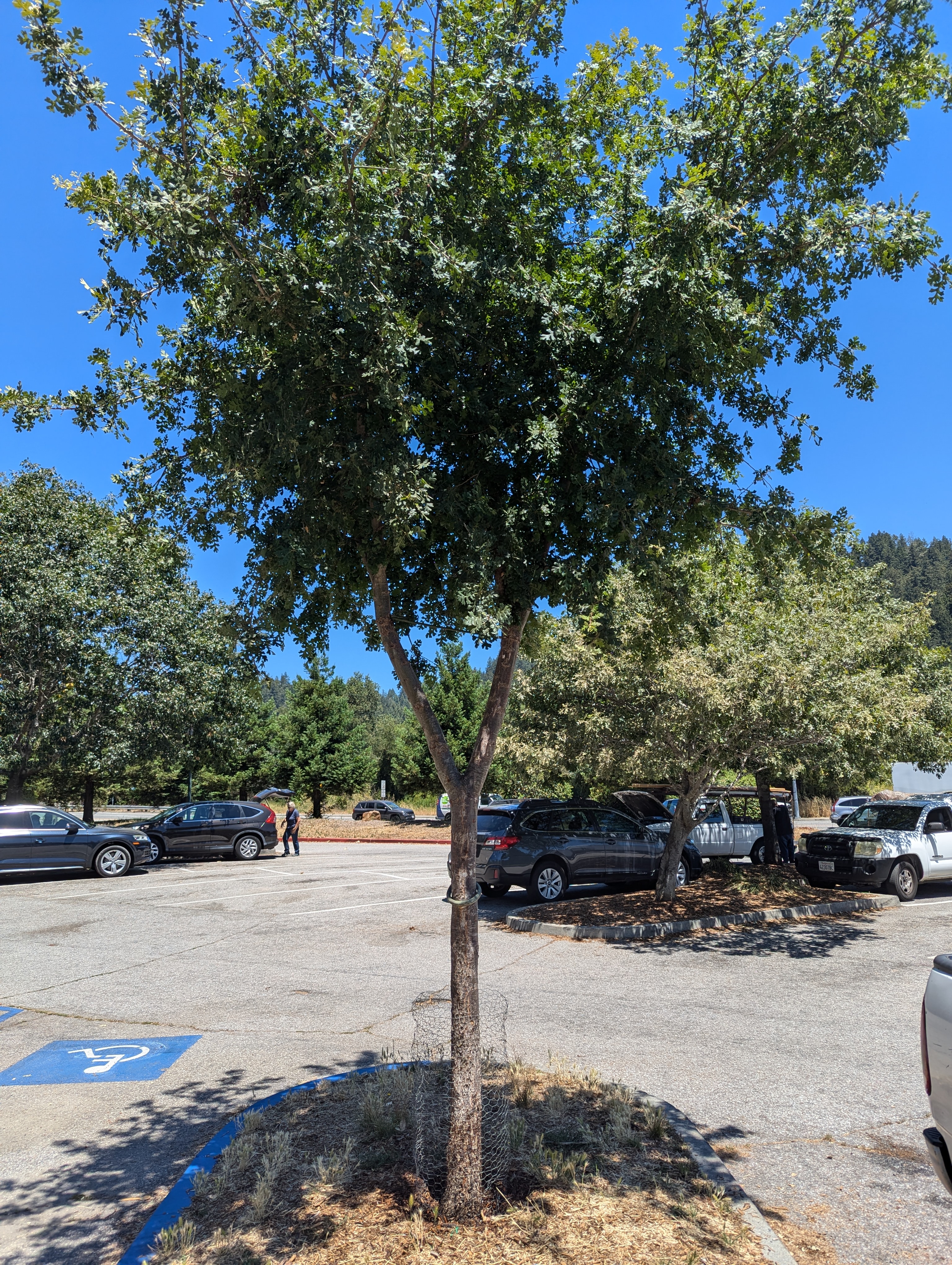
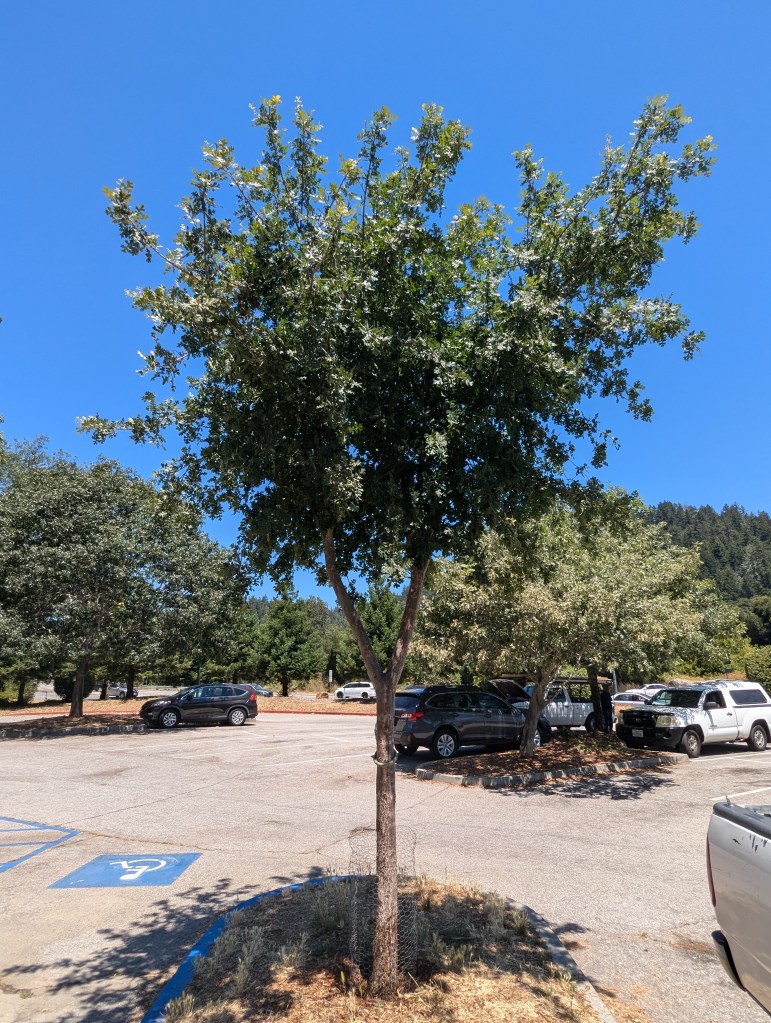
The young Memorial Tree in Felton Covered Bridge Park continues to grow at an impressive rate. It is still as remarkably healthy as it has always been. Now that the canopy has been directed upward and over the surrounding parking lot, it is maintaining adequate clearance without intervention. There is not much more to say about it. I suppose that I should conduct these updates in autumn, after growth has finished for the year, but prior to defoliation. For now, I will conform to the tradition of posting this update for the middle of July, as I have done for the past few years, but may also post another later, like I did last year. I was amazed by how much growth developed within the seven weeks between those two updates of July 12 and August 30 last year. Since the Tree is now too big for the size of pictures that I had been taking of it, I should zoom out for subsequent pictures as I did for the picture below, to show all of its expanding canopy. If I had planned it better, I should have taken a picture of the tree every summer from the same vantage.
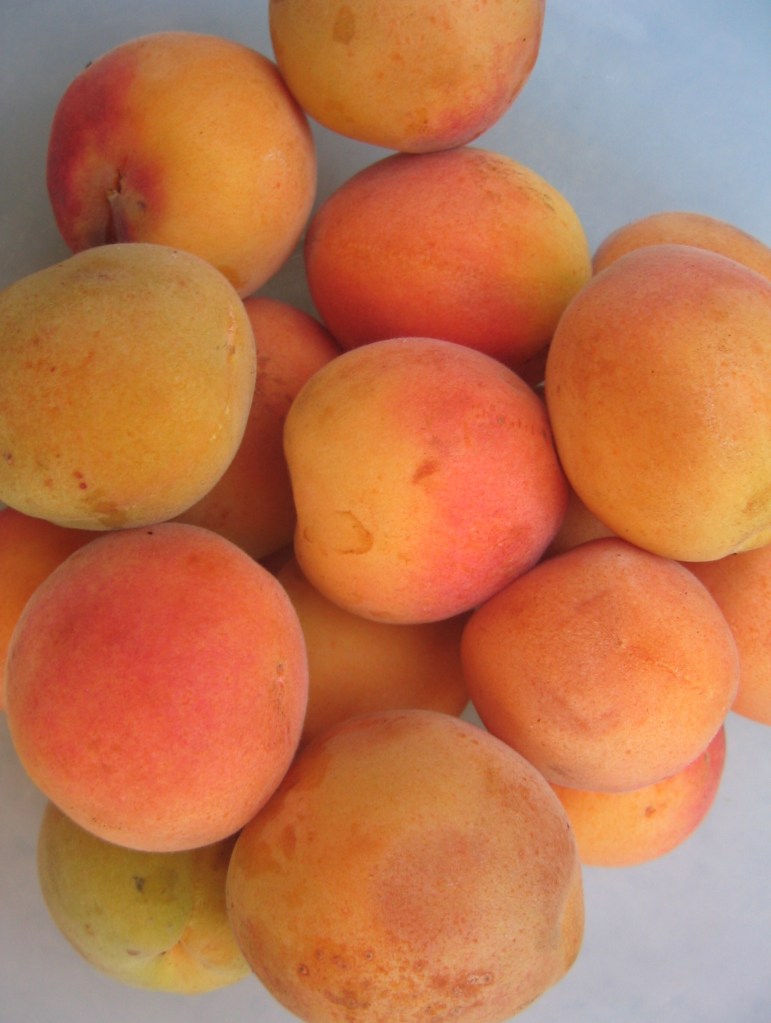
Apricot trees, which are mostly of the species Prunus armeniaca, have history here. Vast apricot orchards formerly inhabited the Santa Clara Valley. Many remain as a significant industry of the San Joaquin Valley. Apricot trees are both famously reliable and famously productive here. If they can not inhabit orchards, they can be as happy in home gardens.
Home garden apricot trees are not quite the same as orchard trees. Most are grafted onto dwarfing rootstock to stay more compact than orchard trees. More cultivars are popular in home gardens than in orchards. Regardless, even relatively compact home garden trees need dormant pruning in winter. Otherwise, they provide more fruit than they can support.
Apricot trees change with the seasons. They are strikingly bare while dormant for winter. Their profuse white bloom is spectacular for early spring. Their rich green foliage mostly obscures their fruit as it ripens through early summer. It then turns cheery yellow before it defoliates in autumn. Home garden trees should be about ten feet tall with good pruning. Fruit is difficult to reach in overgrown trees.
Wildlife is not the only menace to home garden fruits, nuts and flowers. All sorts of insect pathogens want their share also. Old fashioned nonselective insecticides can be helpful, but can leave toxic residue. They also eliminate beneficial insects that might help control pathogens. Integrated pest management, or simply IPM, is likely a more practical option.
Integrated pest management involves biological, cultural and physical pathogen control. Biological control can involve introduction of beneficial insects that consume pathogens. Ladybugs or lacewings are available from certain nurseries, for control of certain insects. However, doing nothing but allowing beneficial insects to proliferate naturally may work.
Some types of integrated pest management are standard procedure for home gardening. Cultural control may be as simple as growing varieties that are resistant to certain pests. This also involves not growing varieties that are susceptible to locally problematic pests. Sanitation is merely removal of detritus that some pathogens proliferate or overwinter in.
Physical or mechanical integrated pest management can be as simple as picking snails. Copper tape as a barrier to exclude snails and slugs is more involved but more effective. Sticky barriers, like ‘Tanglefoot’, prevent ants from cultivating aphid. (Ants cultivate aphid for sustenance.) Then, wasps, which are a biological control, control the aphid naturally.
Integrated pest management also includes various insect traps. Wasp traps use bait, like pheromones or sweet aroma, to attract stinging insects. Although they are not a problem for vegetation, stinging insects complicate gardening. Thrip traps attract thrip with yellow color, and trap them in glue. Apple maggot traps resemble developing apples, with glue.
Chemical pesticides are not beyond the realm of integrated pest management. However, such pesticides should be as nontoxic as possible. Furthermore, they should target only very specific pathogens. Although modern pesticides are safer than old fashioned types, they are still poison. They have significant potential to interfere with natural ecosystems.
Giant bird of Paradise may not look so good in its picture, but started the trend for these Six for this Saturday. White is my favorite color.
1. Strelitzia nicolai, giant bird of Paradise did not pose for a good picture, but impresses with its fancy bloom nonetheless. It bloomed nicely last year too, just three months after getting relocated from another garden. It is still canned, so is not even in the ground yet.
2. Nerium oleander, oleander reminds me that, contrary to the mild weather, it really is the middle of summer. This particular oleander was so overgrown and shabby from bad pruning for many years that it was coppiced. It worked so well that we could do it again.
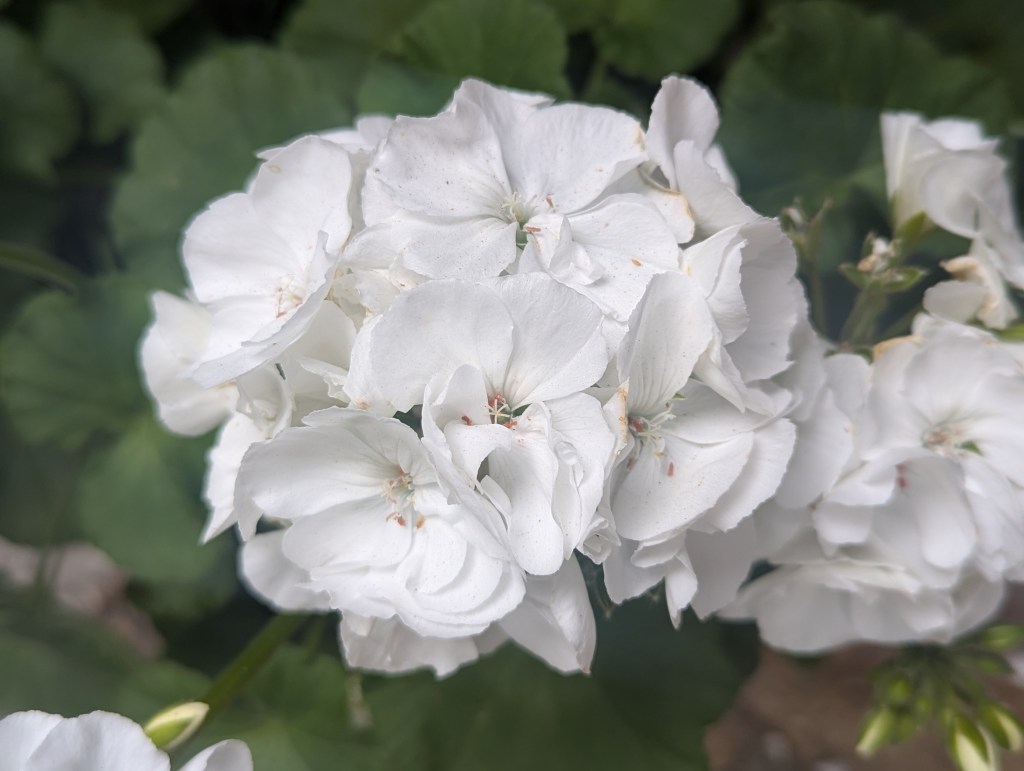
3. Pelargonium X hortorum, zonal geranium is a short term perennial, but provides too many replacement cuttings for extinction. I do not know how long it has been here, but I do enjoy propagating it now, not just because it blooms white, but also because it is easy.
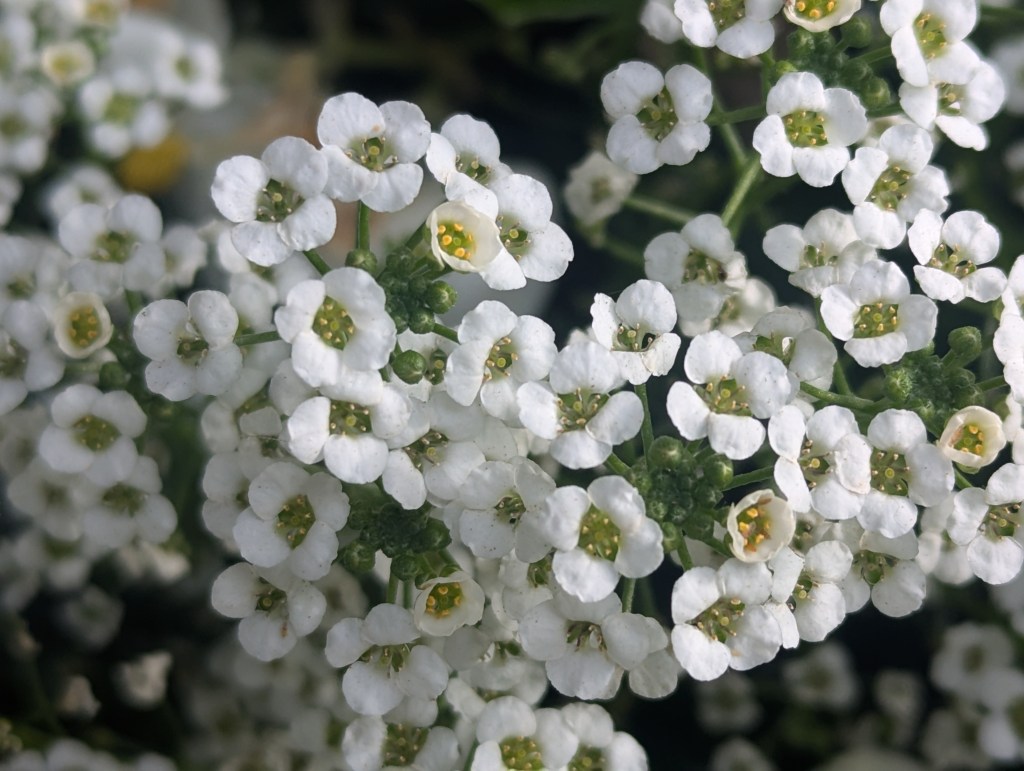
4. Lobularia maritima, sweet alyssum has been here a bit longer than expected also, but is not as perennial as zonal geranium. It was planted as a warm season annual early last summer. Because wax begonia is growing around it, it will not be replaced, but removed.
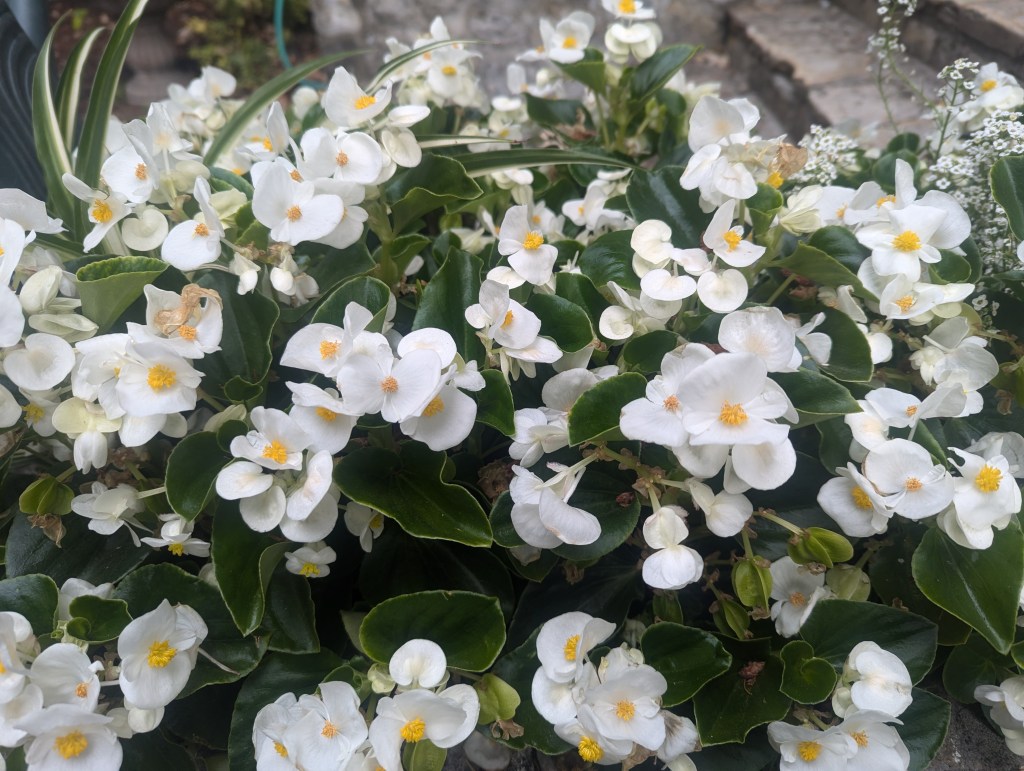
5. Begonia X semperflorens cultorum, wax begonia has been doing remarkably well now that it has its planter boxes within planter boxes to exclude aggressive redwood roots. It has been growing slowly but surely since last summer, so it now needs no replacements.
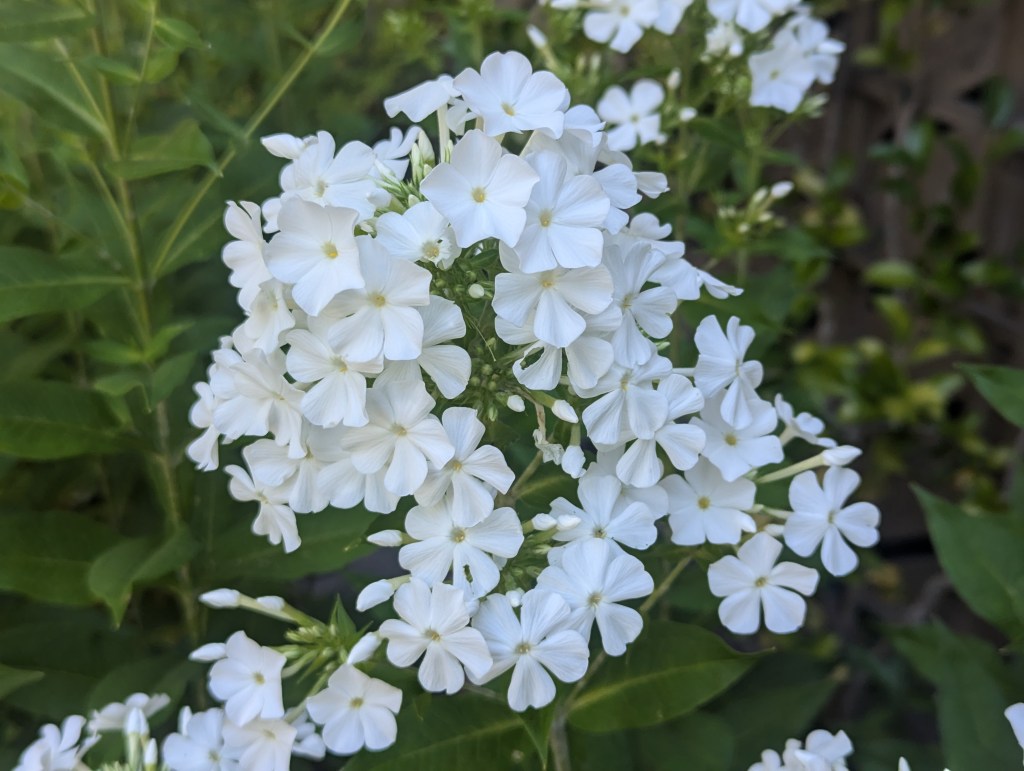
6. Phlox paniculata, garden phlox self sowed from an unknown source several years ago. It continued to self sow with such vigor that we thought it could become invasive. Then, it unexpectedly became docile, and now grows only where it is an asset to the landscape.
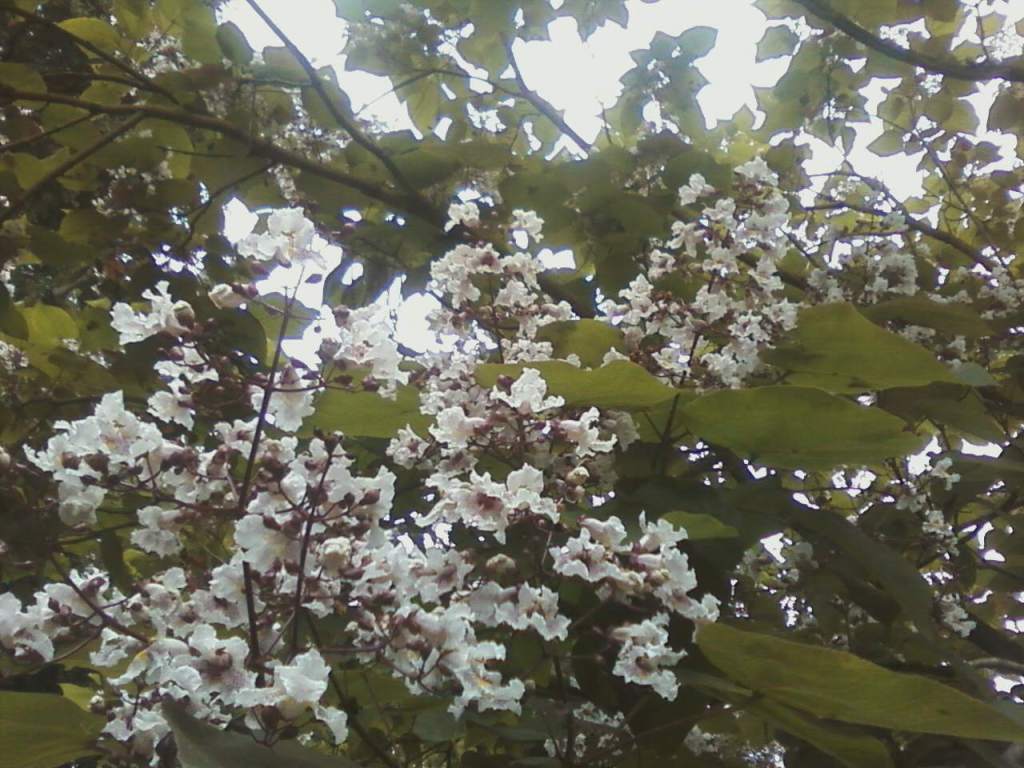
Those who know trees mostly agree that the more traditional catalpa, Catalpa speciosa, from the Midwest is the best catalpa, with soft leaves between half and a full foot long. In late spring or early summer, impressive upright trusses suspend an abundance of bright white, tubular flowers with yellow or tan stripes and spots at their centers. Individual flowers are as wide as two inches. Mature trees can be taller than forty feet and nearly as broad.
From the Southeast, Catalpa bignonioides, is a bit more proportionate to urban gardens though, since it only gets about seventy five percent as large, with leaves that are not much more than half as long. The flowers are also smaller, and not quite as bright white, but are more abundant than those of Catalpa speciosa are. The stripes and spots at their centers are slightly more colorful purplish brown and darker yellow.
Both catalpas can be messy as their flowers fall after bloom. Fortunately, the big leaves are easy to rake when they fall in autumn. Long seed capsules that look like big beans linger on bare trees through winter.
Catalpa speciosa is almost never seen in modern landscapes, and not exactly common even in older Victorian landscapes around downtown San Jose. A few remarkable specimens remain as street trees in older neighborhoods of Oakland, Burlingame and Palo Alto. Most young trees were not planted, but instead grew from seed from older trees that are now gone.
Catalpa bignonioides is actually quite rare locally. A few old but healthy specimens can be seen around downtown Felton, with a few younger trees that grew from seed around the edges of town. Trees in Golden Gate Park in San Francisco are not as happy because of cool and breezy summers and mild winters.
My great grandfather could remember more summers in Sunnyvale than anyone else. He knew how unique every summer was and continues to be. Some summers are uncomfortably hot from beginning to end. Last summer though, was the coolest in recorded history!
Warm summers are of course best for the fruits and vegetables that like warmth. Peaches, grapes, tomatoes and rhubarb in my great grandfather’s garden always got the best flavor during warm weather. Warm but not too hot weather early in summer made the best ‘Bing’ cherries on my grandmother’s tree in Santa Clara.
Although cool summers are more comfortable for dogs, cats and people, they are not quite as conducive to growing fruits and vegetables. It is still too early to know what this summer will be like, but even though it is now getting warm, the warmth is developing late. The past spring was remarkably mild, with rain lingering later than it typically does.
Consequently, some fruits and vegetables, as well as some flowers and trees, are developing slowly. Peaches may be a bit smaller than they typically are, with slightly milder flavor. Rhubarb should have good flavor because of recent warm weather, but may develop a bit late because it got a late start.
Tomatoes are perhaps expressing the most dissatisfaction with the mild weather. Even tomato plants that were put out in the garden early in spring have grown slowly, and are not nearly as productive as they typically are by the beginning of summer. Some are not yet producing!
Fortunately and unfortunately, the weather has gotten significantly warmer. This may be uncomfortable for us; but is a party for the formerly bored tomato plants. Warmth of course promotes bloom and fruit production, and enhances flavor. If they get what they need, tomato plants that seemed sickly in the past may suddenly grow like weeds.
They should waste no time making up for lost time. Even if mild weather continues into summer like it did last summer, it will still get warmer than it has been. Maturing tomato plants will want more water and fertilizer (if used) as they get larger, and the weather gets warmer.
Platanus, or sycamore, supposedly derives its botanical name from the Greek word “platys”, which means “broad”, and describes its wide leaves. However, some believe that its name was derived from “Plato”, who lectured about philosophy within the shade of a sycamore grove, rather than an olive orchard, outside of Athens. The Tree of Hippocrates, is an individual Platanus orientalis that was planted centuries ago, supposedly where Hippocrates lectured about medicine under a much older tree of the same species. Trees grown from cuttings and seed from the Tree of Hippocrates have been shared with medical institutions, schools and libraries all over the World. One seedling was planted at Dominican Hospital in Santa Cruz in 1968. Until only the last few years, it had been pollarded in an exemplary manner, which left no twigs for me to get cuttings from during winter. Only last summer, a gardener left me a few twigs, which I plugged as early cuttings. Of course, most succumbed to summer warmth. Some of the survivors did not root through winter. Now, though, there are four surviving rooted cuttings! So, we have four copies of a seedling of the second Tree of Hippocrates! Does that count for anything?