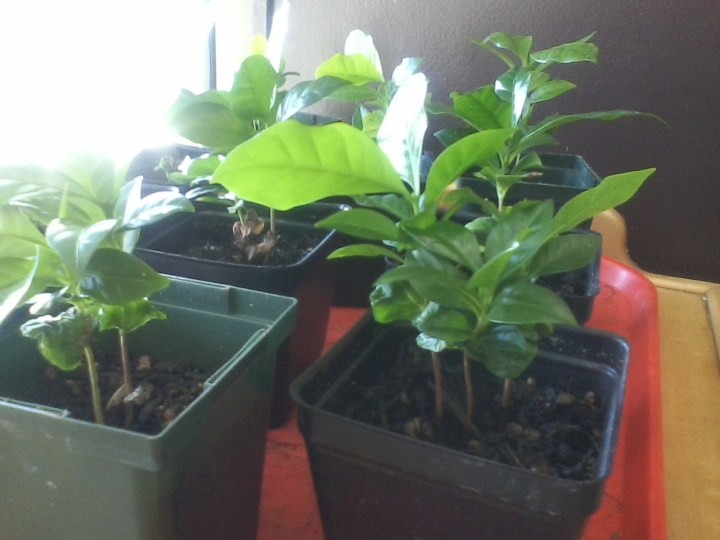
 There are certain things that we expect to find in a coffee shoppe. Mainly, we expect to find . . . coffee. Yes, coffee, . . . duh. We can get all sorts of coffee beverages; hot, chilled, steamed, infused with things that have no business going into coffee. They have all sorts of cool sounding but strangely irrelevant Italian names that white people enjoy telling people of Italian descent how to pronounce. Yes, my name is Tony Tomeo; and I don’t want twenty cups of coffee with bread. Well, besides the coffee beverages, there are plenty of coffee beans; all sorts of roasts. I do not know of any coffee shoppe that grows any of the beans that it sells, but there is nice coffee shoppe in Felton, The Mountain Roasting Company, that grows coffee trees.
Yes, that is unique. I noticed a few years ago that besides the typical Ficus benjamina, there are three large coffee trees. They look similar to the Ficus benjamina, but are a bit less refined, and lack the braided trunks. They grow up to the ceiling before getting cut back to stumps to start the process all over again. The Ficus benjamina do not grow that well; but the coffee trees are happy enough to bloom there.
I have not asked how they get pollinated. I really do not know how coffee flowers get pollinated in the wild. Somehow, they make a few fruits, known as coffee cherries, with viable coffee beans inside. The seeds get collected, germinated, and potted for customers who have an appreciation for growing something unique. Small coffee trees can now be found in well outfitted nurseries, but it would be so much cooler to grow one that was grown at a local coffee shoppe.
I am embarrassed to say that I do not know how to grow coffee trees. I think of them as tropical plants, but I really do not know. Just because they are cultivated closer to the tropics does not mean that they originated there. I do believe that they are understory trees, that prefer to live in the partial shade of larger trees. Old text, as well as a few not so old gardening books from the 1960s, describe them as houseplants. There is not much mention of them after that. They only recently started appearing in nurseries. I like when old traditional plants make a comeback, particularly if it happens to be an alternative to a boringly common plant like Ficus benjamina.
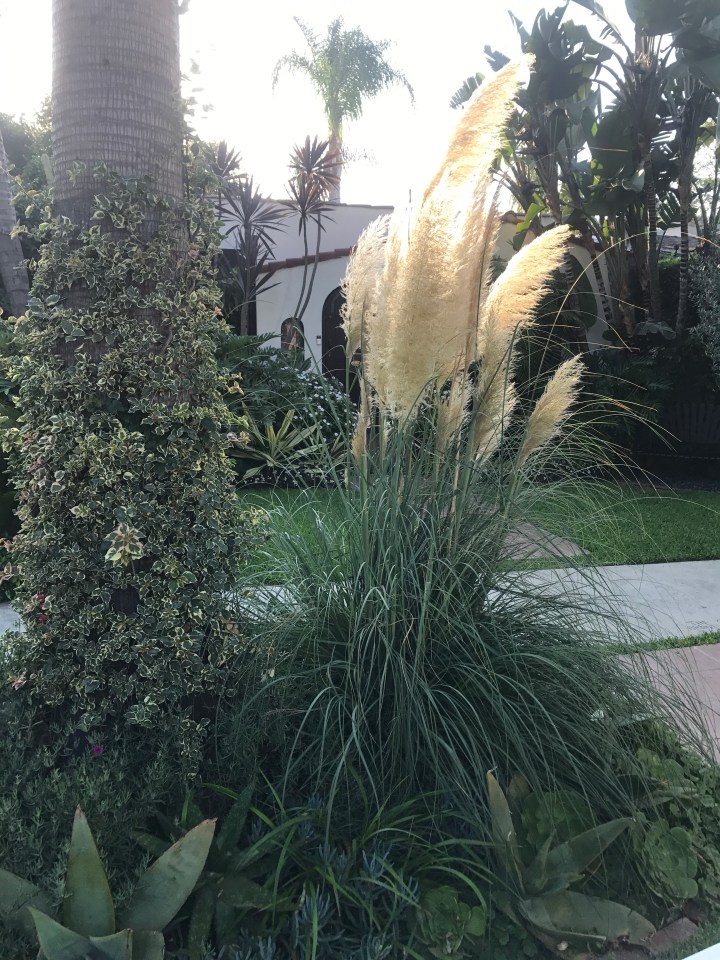 Modern garden varieties of pampas grass found in nurseries are generally non-invasive. Their flowers are described as ‘sterile’, and therefore unable to produce seed. What that really means is that they are exclusively female, and unable to produce seed without male pollinators. However, they have the potential to be pollinated by naturalized pampas grass, and sow a few hybrid seed.
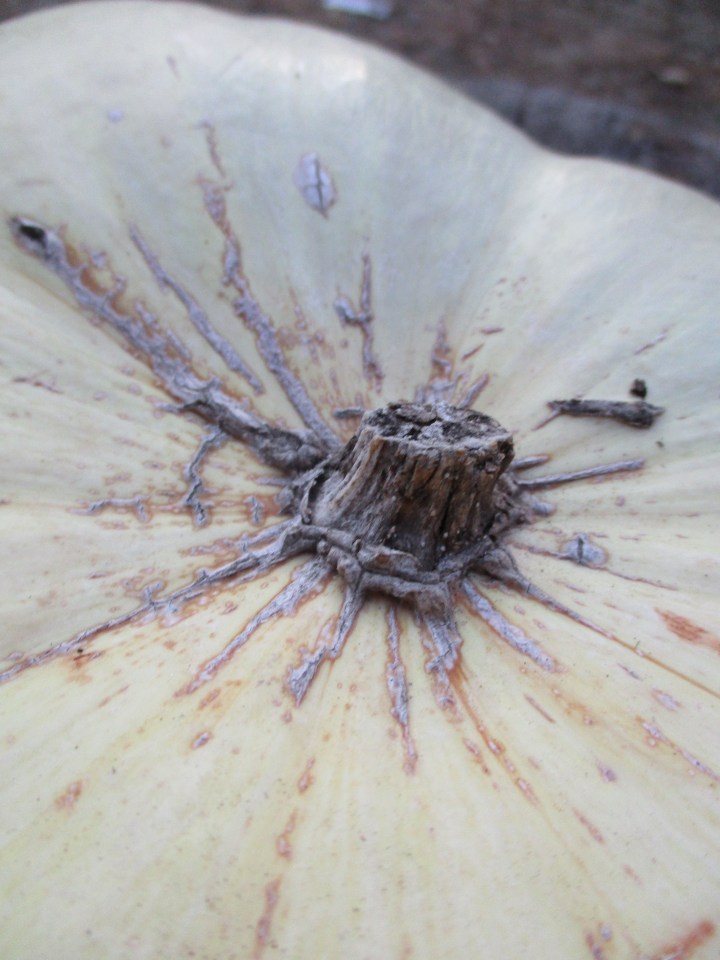 Things might have gone better for Cinderella if she had taken a Buick to the ball instead of that detrimentally punctual pumpkin coach. It was on such a tight schedule! It might have seemed like a good idea on the way too the ball. It certainly was a unique ride. The problem was that it made no accommodation for Cinderella’s tardiness at midnight. It adhered firmly to its own strict schedule.
 This has very little to do with gardening; but like I said in the description of this blog, anything goes when it comes to the ‘Elaborations’ category. Anyway and furthermore, I do not like to write about garden sculpture, garden art, or any of those knick-knack fads that involve putting more than plants and the necessary infrastructure to sustain them into the garden. I do happen to like certain tasteful garden statuary, like Saint Francis, or Saint Fiacre (the rarely seen ‘real’ patron saint of gardening) or any of the saints; but only if I have a suitable space for them. This is nothing like that; but is just excellent enough that I wanted to mention it.
 Brent and I met in college, when we were assigned to the same dorm room in Fremont Hall at Cal Poly in San Luis Obispo. Our similarities were remarkable. He came two hundred miles north from west of Los Angeles. I came two hundred miles south from west of San Jose. We were both the middle of three children, although I had just acquired an extra younger sister the year before. While the other boys we grew up with were playing with Hot Wheels, Brent and I were busy planting miniature trees around the miniature roadways. His childhood dog was Speckles. Mine was Freckles. We were weirdly similar prior to September of 1986, but have been perfecting our differences since then.
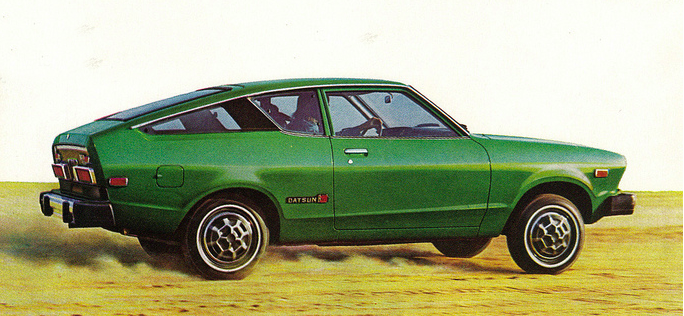 Sir Isaac Newton had something to say about an apple that was a victim of gravity. My high school physics professor was even better. He taught us all about velocity, force, inertia, vectors and much of what he had to teach us about physics with the help of a very ripe persimmon . . . and an insipid green 1976 Datsun B210.
 Many people have a favorite color. I learned how seriously some people can take their preference for a particular color when I was in high school, and taking care of the yardwork for a few homes in the neighborhood. There were three tract homes next to each other. One was grayish blue, with a silvery blue Sedan deVille in the garage, and a garden of blue flowers. The middle house next door was soft amber yellow, with a buttery yellow Oldsmobile 98 in the garage, and a garden of exclusively yellow flowers. The house next door to that was iron oxide red, with an exquisite rich red Electra in the garage, and a garden of, you guessed it, red flowers.
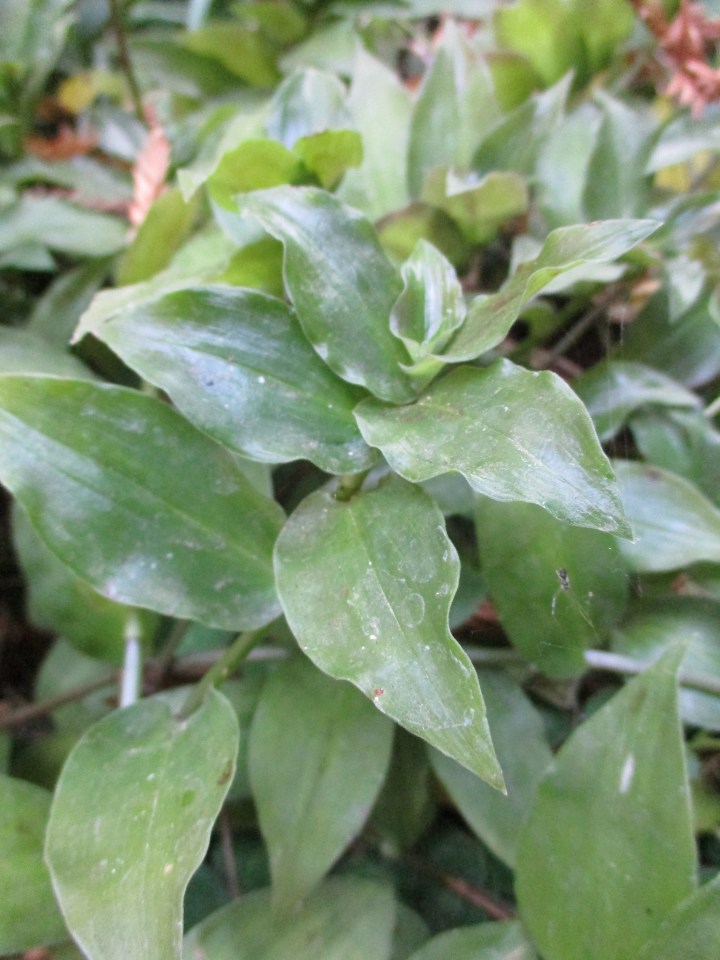 It could not have survived out in the desert for forty years. Wandering Jew, Tradescantia fluminensis, would have desiccated before its first summer. Well watered gardens are a completely different situation. Wandering Jew can become invasive and mix with other more desirable ground covers, only to die back and turn dark brown through winter. It starts over the following spring.
