Citrus Are Summery For Winter

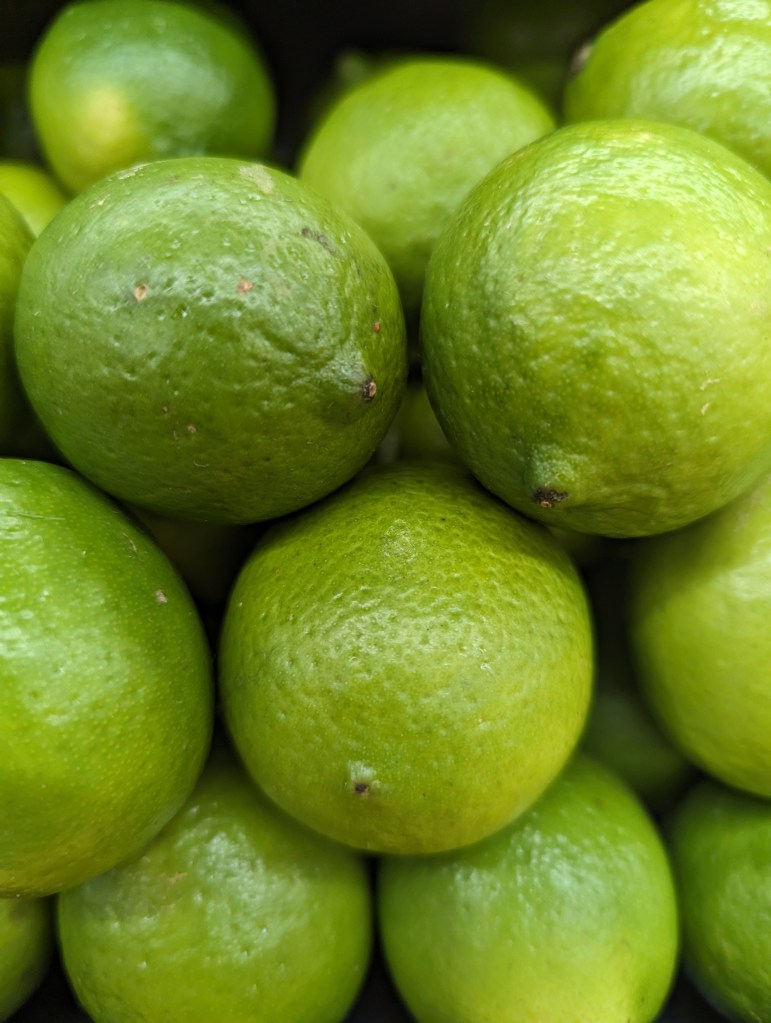
Limes are the most diverse citrus.

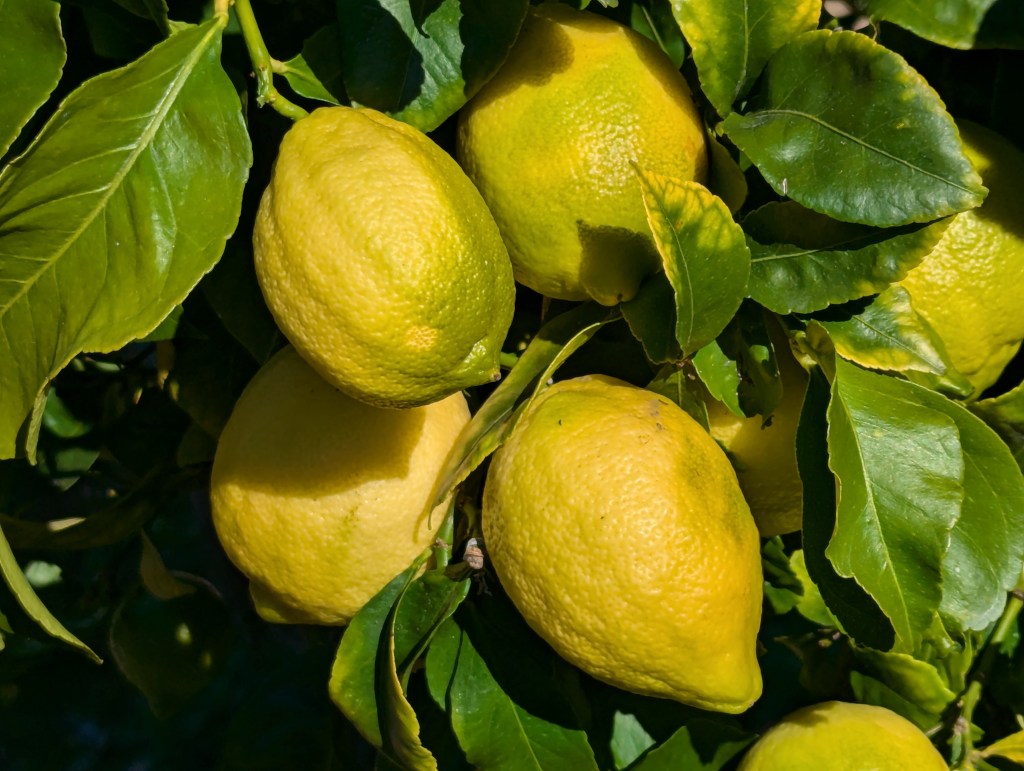
Citrus trees are not like deciduous fruit trees. They are not marketable as bare root stock. They do not need winter pruning. Actually, winter pruning might initiate premature growth that is vulnerable to frost. Deciduous fruit trees remain dormant so can only dream about fruiting for next summer. Citrus trees are happily evergreen, and fruiting abundantly now.

Citrus somehow seem to be more summery than fruit that actually ripen for summer. Iced lemonade is so traditional for warm summer weather. Oranges for Christmas might seem to be out of season when they really are not. Although Mandarin oranges are perishable, other ripe citrus last for weeks or months. Several ripen sporadically throughout the year.

‘Valencia’ oranges, which are the traditional juicing oranges, might last through summer. They may sustain the belief that orange juice is a summery beverage. Several grapefruit cultivars can last about as long. ‘Eureka’ lemon is mostly seasonal, but also generates a few fruits throughout the year. ‘Bearss’ lime may be even more productive out of season.

With only one exception, all species and cultivars of citrus are of the same Citrus genus. Kumquats are of the Fortunella genus, but typically qualify as Citrus for simplicity. Citrus fruit is sweet, sour or bitter. Most familiar oranges are sweet. ‘Seville’ is a sour orange for marmalade. ‘Bouquet de Fleur’ is a bitter orange for infusing with Grand Marnier cognac.

Oranges, lemons, limes, grapefruits, kumquats and Mandarins are all very familiar. All of these fruits are available from grocery markets. Their trees grow in many home gardens. Tangerines are simply Mandarins or Mandarin oranges of the Americas. Pomelos, which are larger ancestors of grapefruits, are still uncommon. So are tiny and tart calamondins.

They are not the most unusual, though. Blood oranges provide tangy red juice. ‘Rangpur’ lime is a sour Mandarin orange that is as acidic as a ‘Eureka’ lemon. Tangelos combines the tartness of grapefruits with the sweetness of Mandarin oranges. Sweet limes lack the acidity of typical limes, so are for eating like oranges. These are merely a few examples.
Six on Saturday: el Catedral de Santa Clara de Los Gatos II

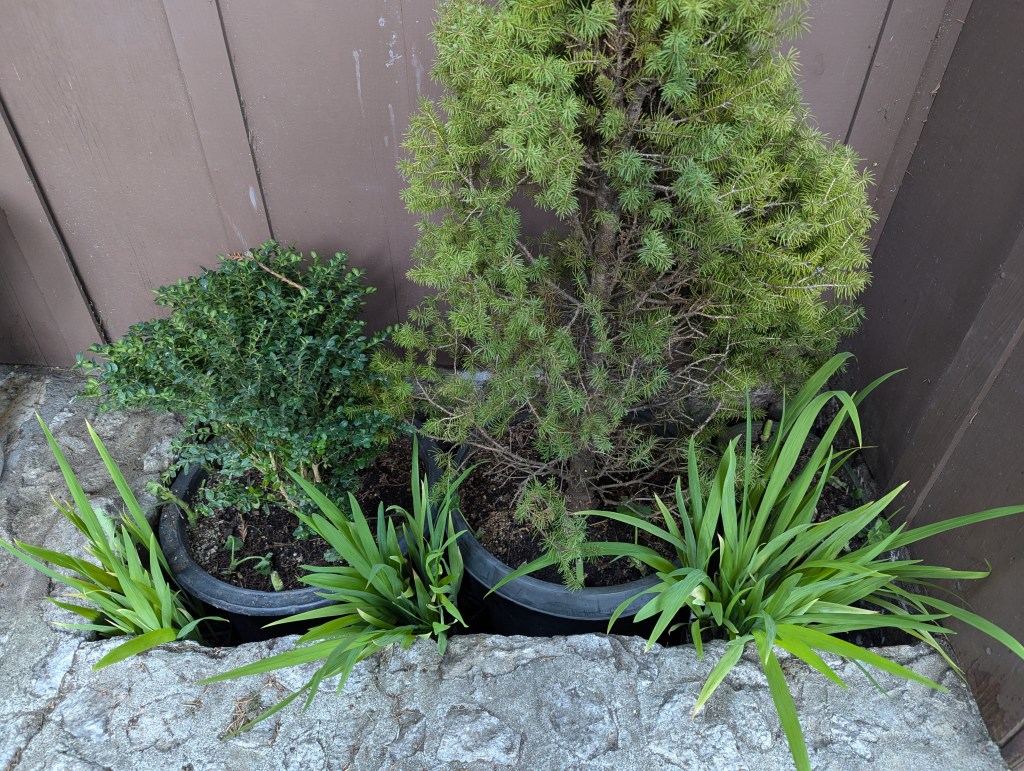
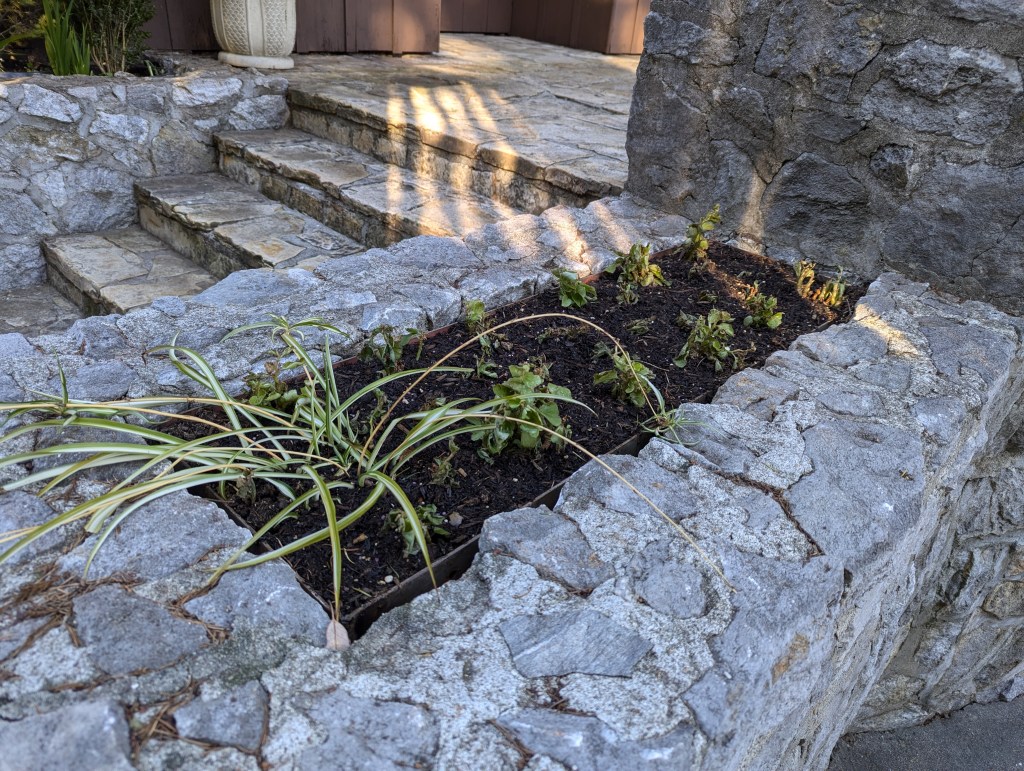
El Catedral de Santa Clara de Los Gatos is merely the Mount Hermon Memorial Chapel, which is a more proportionate name that does not trivialize its Memorial status. I prefer it to seem grander than it is. Also, I maintain a strict standard for its minimal landscape. All of its flowers bloom exclusively white. However, most of its flowers have been rather pekid because of aggressive invasion of consumptive redwood roots into irrigated areas. Because I can not stop the encroachment, I removed the soil from four primary planters. Within the front pair of planters, I suspended customized planter boxes. Within the rear pair of planters, I suspended a few nursery cans that contain new plants. Redwood roots can not reach into these planters or cans. The recycled vegetation still looks shabby, but should perform better than ever for this summer.

1. Chlorophytum comosum, spider plant, with Begonia X semperflorenscultorum, wax begonia, are icky through winter, but should perform better than ever by spring without aggressive redwood roots. Their planter within their planter is visible at the front corner.

2. Picea glauca var. albertiana ‘Conica’, dwarf Alberta spruce, and Buxus sempervirens, English boxwood, are within #15 cans within their planters. Crocosmia X crocosmiiflora are in 4″ pots. It is trashy, but is for their own protection from aggressive redwood roots.

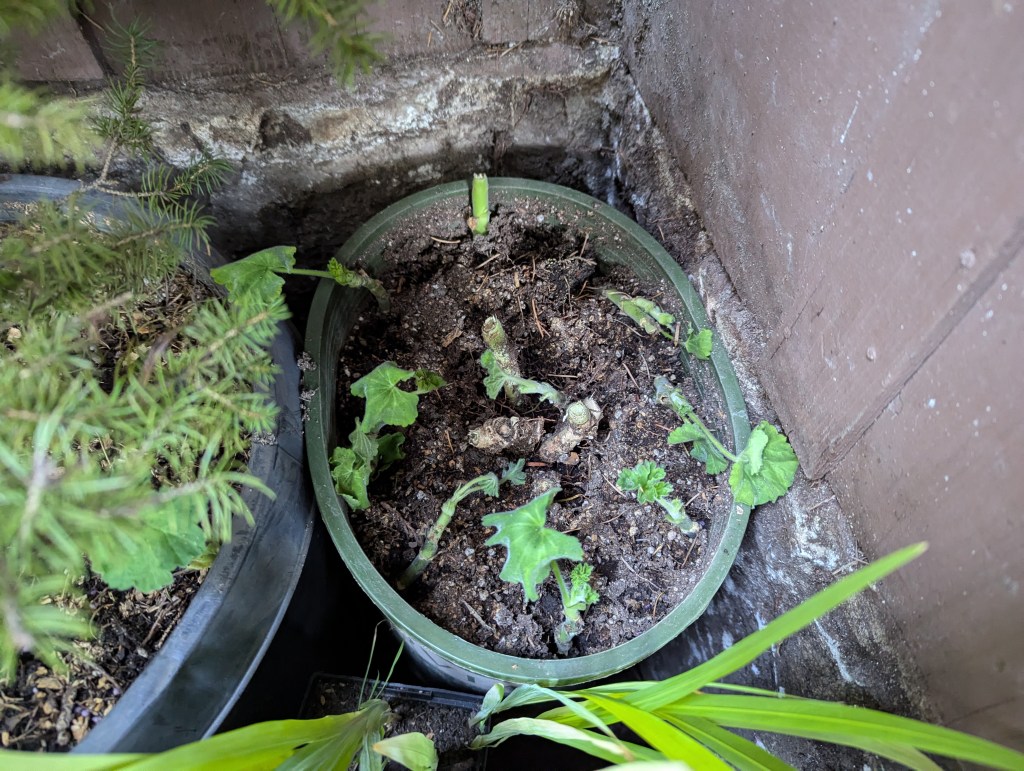
3. Pelargonium X hortorum, zonal geranium, within a #5 can that is obscured to the far right of the items described above, is merely cuttings from what was here prior. They, as well as several more within the cans of the other items, should grow to obscure the cans.

4. Pelargonium X hortorum, zonal geranium, that was here prior to this renovation was abundant enough to provide many more cuttings that we could utilize. These few should obscure these bare bases of a pair of lemon cypress, Cupressus macrocarpa ‘Goldcrest’.

5. Collectively, it should look sharp for summer. The Crocosmia X crocosmiiflora is just temporary until the zonal geranium grows to replace it. I do not want their bright orange bloom within this exclusively white garden. Everything in this new landscape is recycled.

6. It only looks puny from across the road because the stone wall is so big and ominous. It will be prettier as the zonal geranium and wax begonia begin to bloom for late spring. The cypress may not conform to a white garden, but their color is foliar instead of floral.

This is the link for Six on Saturday, for anyone else who would like to participate: https://thepropagatorblog.wordpress.com/2017/09/18/six-on-saturday-a-participant-guide/

Iceland Poppy

Native California poppies are nothing like this.

Because winters here are so mild, Iceland poppy, Papaver nudicaule, gets planted out in the garden in autumn to bloom through winter and into early spring. Where winters are cold, bloom must wait until after winter, whether plants are put out in autumn or sown from seed as winter ends. Iceland poppy prefers good drainage because it is out in the garden during the coldest and rainiest time of year, but is otherwise not too demanding. Picking the flowers and removal of deteriorating flowers (deadheading) promote continual bloom. 

Circular flowers up to three inches wide in shades of orange, yellow, pink, white and nearly red hover up to a foot high on wiry and hairy stems. Prominent fuzzy stamens are bright yellow at the center of each flower. Some varieties have brighter colors and taller stems. The hairy and deeply lobed leaves form basal rosettes about five inches wide.

Dormant Pruning of Deciduous Fruit Trees

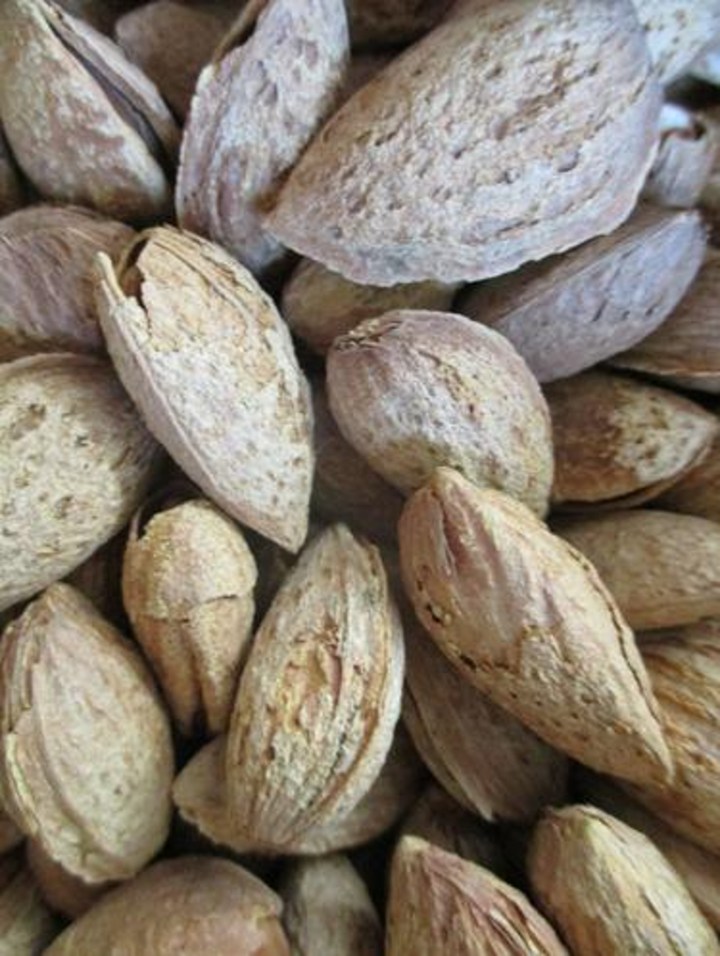
Almond trees require specialized dormant pruning.

There is nothing like the flavor of ripe fruit fresh off the tree during summer; whether cherries and then plums, prunes and apricots early, or peaches and nectarines in the middle, or pears and apples at the end of summer. Even though summer is still a few months away, it is already time to get ready for summer fruits, as well as almonds, by pruning the deciduous fruit trees that produce them while they are still dormant in winter.

Because fruit trees have been bred over the past many centuries to produce unnaturally large and abundant fruit, most are unable to support the weight of their own fruit without some sort of unnatural intervention. Trees consequently need to be pruned so that they do not produce so much fruit that their limbs break, destroying the fruit and disfiguring the trees. Pruning also helps to concentrate resources into fruit of superior quality instead of excessive but inferior fruit.

There are as many different techniques for pruning deciduous fruit trees as there are different types of deciduous fruit trees, and certainly too many to write about in a single gardening article. For example, cherries, plums, prunes, apricots, peaches, nectarines and almonds are all ‘stone fruit’ which need varying degrees of similar pruning. Peach trees produce the heaviest fruit, so require the most aggressive pruning. Cherry trees are pruned in a similar manner, but only minimally because they are not so overburdened with fruit. Only evergreen fruit trees like citrus, avocado, guava, olive and tropical fruits do not get some sort of pruning this time of year.

(Stone fruit have substantial seeds which are known as ‘stones’. Almonds are the stones of the fruit that comprises their hulls.) 

It is best to become familiar with the pruning requirement of each type of fruit tree before planting them, since some are simply too labor intensive for some people, and most are too involved for almost all maintenance gardeners. It is also easiest to start with young trees and become more familiar and comfortable with pruning them as they grow over the years.

(Because this post is from an old article, outdated information was deleted below.)

Apricot, cherry, prune, almond, walnut, apple, pear, plum, fig and various other trees will be there. The 3.3 acre Historic Orchard was developed in 1994 to include more than 220 of the many types of fruit and nut trees that once made the Santa Clara Valley famous as the Valley of Hearts Delight.

Fe

ICK!

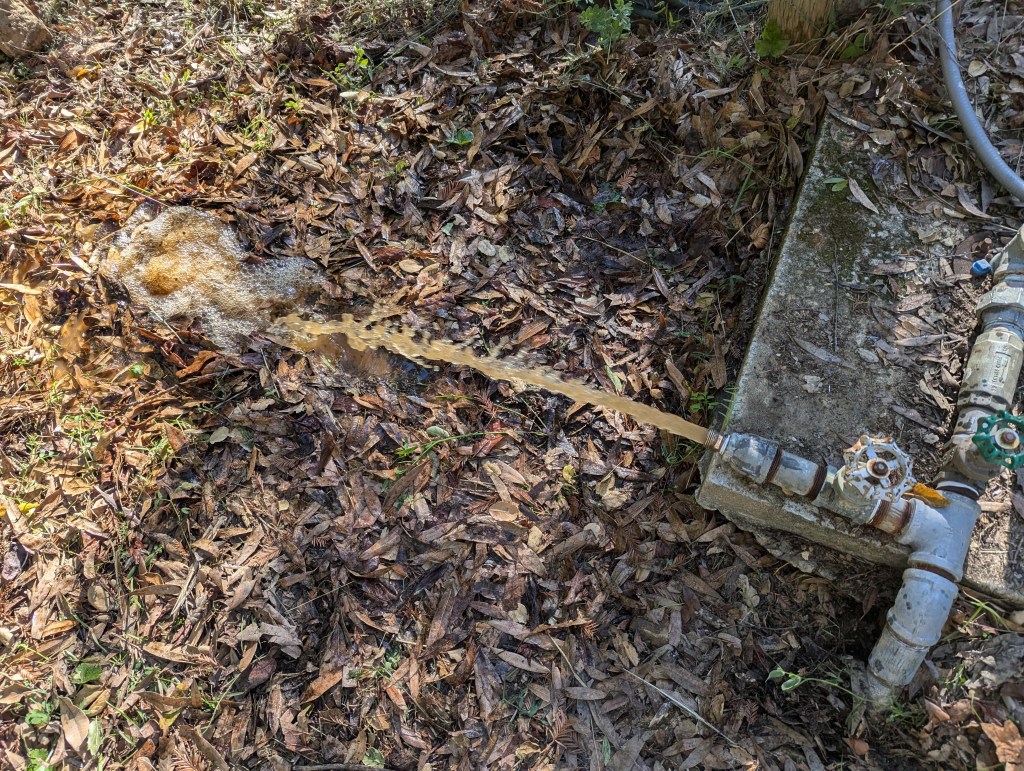
Ferrum, which is abbreviated as “Fe”, is the chemical and element name of iron. It is apparently too abundant in this well water. Actually though, it is from the lining of the well. It accumulated because the pump has been inactive for so long. I am impressed that it functions at all after being idle for so long. I am concerned about the lining of the well, though. The hydrologic engineer tells me that I must superchlorinate the well to kill most of the iron oxidizing bacteria, and then flush the well by operating the pump for a long time. That all sounds like quite a bit of risky work. I do not like the concept of pouring something into a well that does not belong there. I am also concerned about what to do with the chlorinated water as it gets pumped out. I suppose that I could apply it to undesirable vegetation around the well. There will undoubtedly be a large volume of such water; but there is also a large amount of undesirable vegetation. I suppose that I could collect some or much of the water into an otherwise unusable tank to let the chlorine slowly volatilize from it. For now, until this superchlorination process begins, I suspect that this water is safe for irrigation. I do not mind if it leaves a temporary rusty residue that eventually rinses away. The water was even muckier before, and will get less mucky as more of it is used, so it could appear to be clean before superchlorination. Besides, I suspect that mucky water is less toxic to vegetation than superchlorinated water is. Because the rain stopped as suddenly as the rainy season began, and no rain is forecast for the next week, irrigation is now becoming a priority.

Coral Bark Japanese Maple

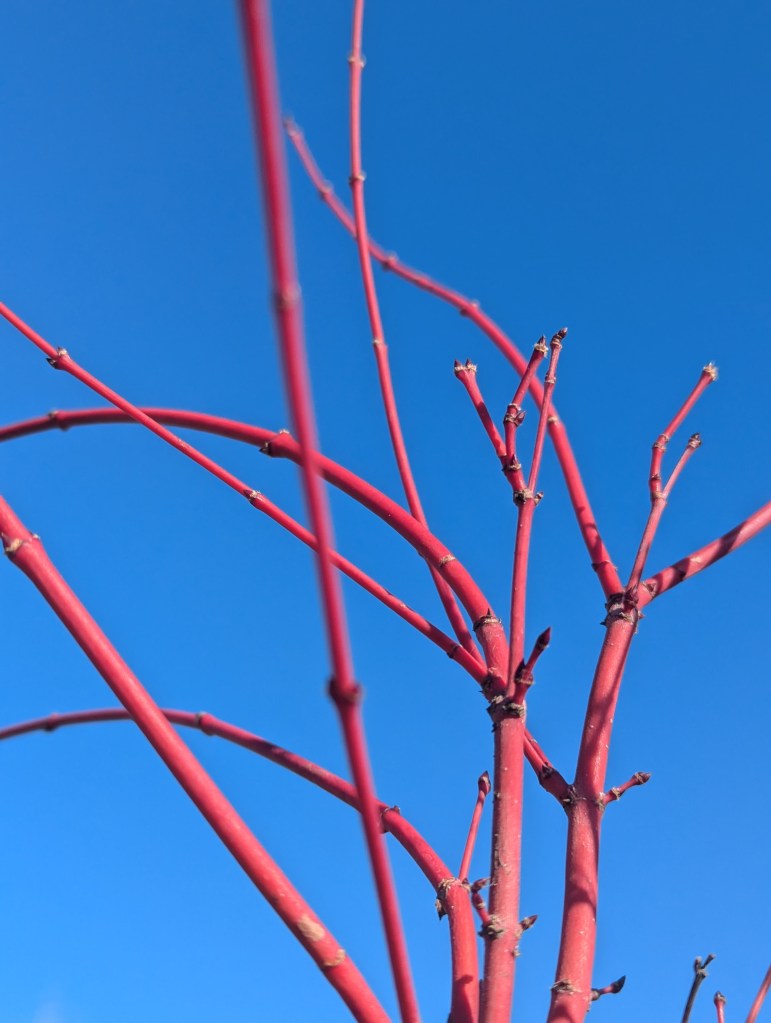
Defoliation reveals impressively red bare twigs.

Bloom is probably the favorite component of home gardens. Foliage is likely the second favorite component. Japanese maples are popular as much for their form as for any other characteristic. The intricate textures and autumn color of their foliage is likely secondary. Coral bark Japanese maple, Acer palmatum ‘Sango Kaku’, is even a bit more distinctive.

Relative to other cultivars of Japanese maples, its foliage is not remarkable. Actually, it is more vulnerable to foliar scorch with arid warmth. Its form is not overly remarkable either. For coral bark Japanese maple, the bright red bark of its young twigs is its primary allure. It is obscured by foliage for most of the year, to be revealed by defoliation through winter.

Coral bark Japanese maple is an understory tree, so can tolerate partial shade. With full sun exposure, it particularly dislikes arid wind. It can grow as tall as twenty feet, or might stay as short as ten feet. It naturally produces many long and limber stems with shiny red bark. Severe pruning to promote growth of such stems is likely to ruin its sculptural form.

Coppiced Vegetation Regenerates With Vigor

Coppicing can alleviate congested basal growth.

Winter dormancy has advantages. It facilitates acquisition and establishment of bare root stock, and winter dormant pruning. Coppicing and pollarding are the most severe sorts of winter dormant pruning. Although initially ugly, coppiced and pollarded vegetation mostly grow vigorously later. Most species bloom and fruit better. All species foliate more lushly.

There is certainly nothing wrong with proper coppicing and pollarding. Both are common beyond America, particularly within Europe. However, both are very unfortunately vilified as disfigurement here. Not many arborists know how to perform such techniques, or may not admit to it. Yet, some coppiced vegetation is covertly popular in some home gardens.

Coppicing and pollarding are genuinely extreme and harsh techniques. Coppicing is the removal of almost all growth that is above the surface of the ground. For some shrubbery or trees, short stumps may remain. Coppiced vegetation is therefore not much to look at. Pollarding is similar, but retains primary trunks and limbs. Pollarded trees seem hideous.

Hideousness is subjective, though. By European standards, pollarding is an acceptable horticultural technique. European arborists know how to perform it properly during winter dormancy. They do so neatly, without stubs or torn bark, and direct growth as necessary. Coppiced vegetation is not as hideous because not much of it remains to see afterwards.

Because of its vilification, coppicing became more tolerable with different classifications. “Cutting back” perennials, such as African iris, lion’s tail and canna, is the same process. So is cutting back carpet roses or honeysuckle to the ground. The alternate classification is more acceptable. It is just as effective for removal of thicket or deteriorating old growth.

Also, coppiced vegetation regenerates more vigorously for spring than it may otherwise. Elderberries prefer selective grooming, but coppiced plants produce bigger fruit clusters. English Laurel, osmanthus, photinia and red twig dogwood respond nicely to coppicing. However, coral bark Japanese maple is grafted, so is likely to lose its scion if cut too low down.

Six on Saturday: Yellow

Only one of these six is as yellow as it should be. Two are not yellow enough. Two are too yellow. One is not yellow at all, but is affiliated with another who is.

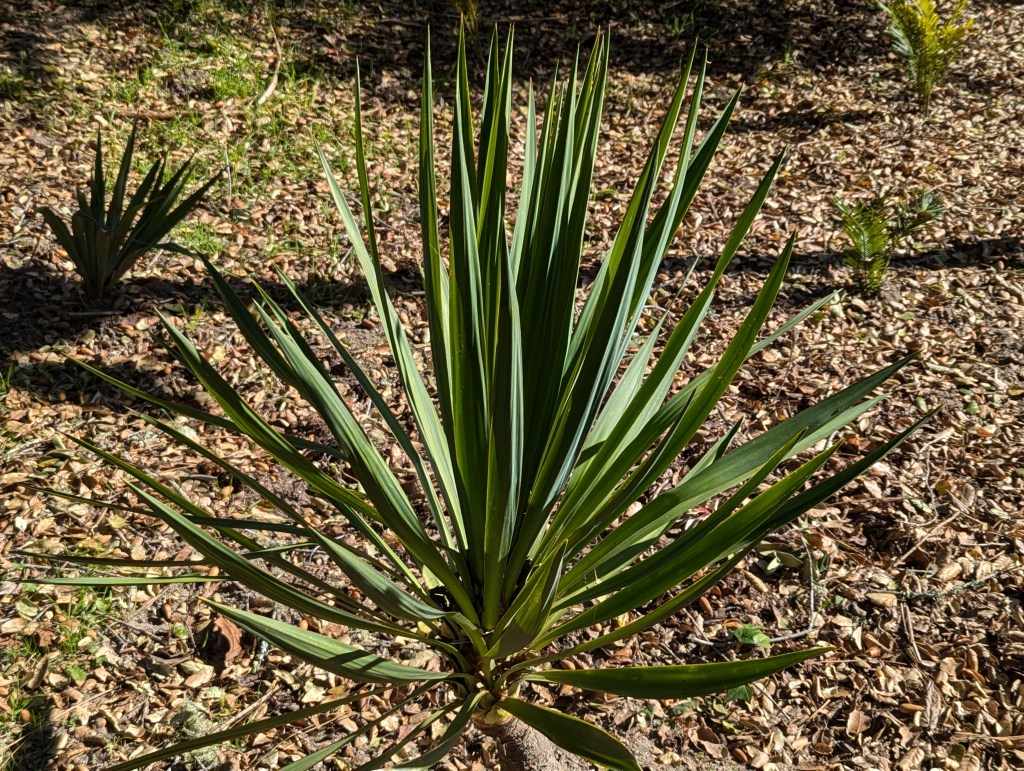
1. Yucca X recurvifolia, curve leaf yucca, which is now known by its new botanical name of Yucca gloriosa var. tristis, remains impressively green after transplant, but is related to the rather sickly looking cultivar, ‘Mellow Yellow’, with ghastly chartreuse foliar color.

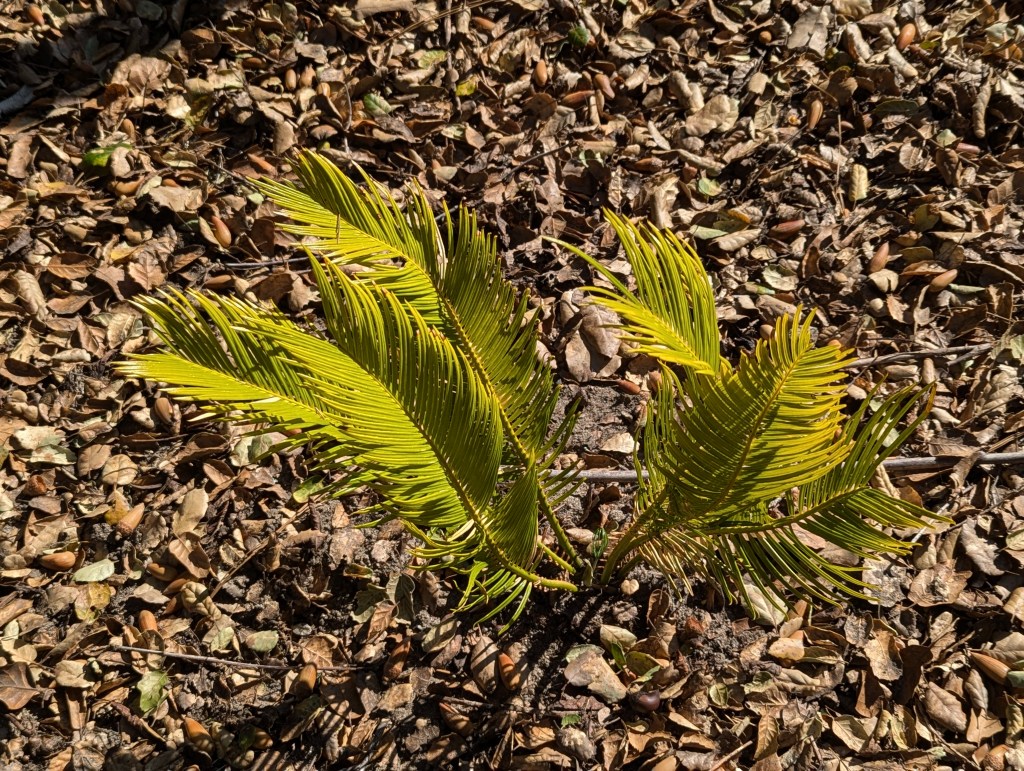
2. Cycas revoluta, sago palm, which was transplanted with the curve leaf yucca, displays this more predictably yellowish foliar color now. It should develop its more typical richly dark green color and foliar symmetry as it resumes growth with warmer spring weather.

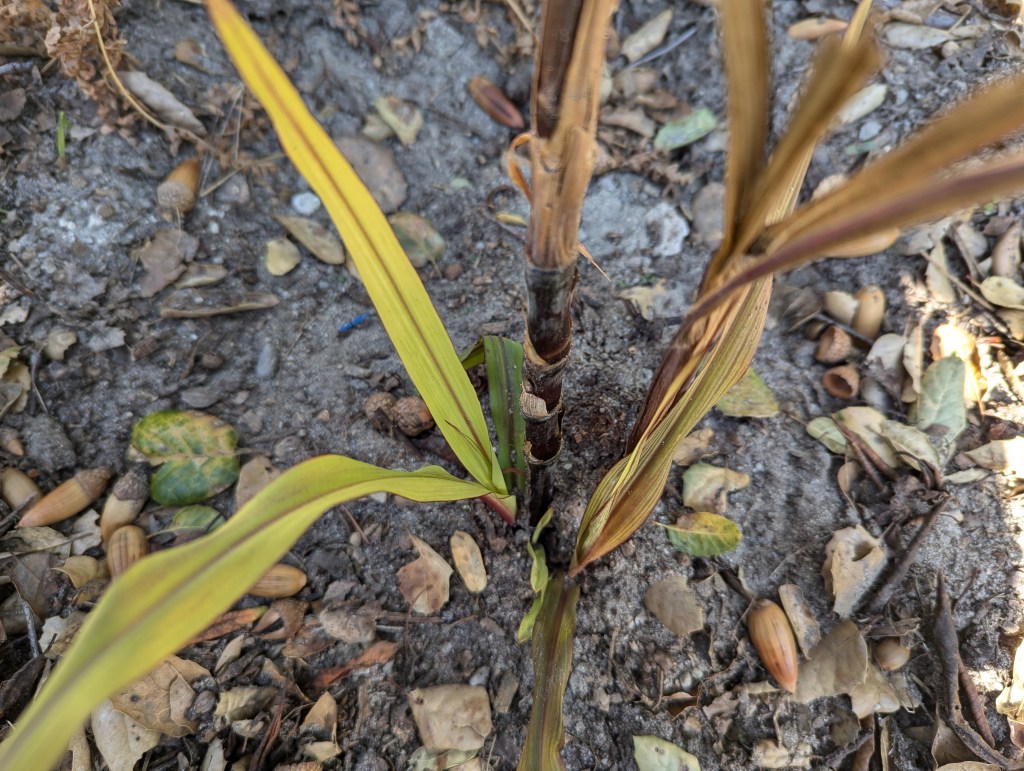
3. Saccharum officinarum ‘Pele’s Smoke’ sugarcane retains its cultivar designation only because I do not know what it is. It is likely a different cultivar, and might be a different species. Its new foliage is yellow because the weather is still too cool for it to be bronze.

4. Citrus X limon ‘Eureka’ lemon should be more yellow than this by now. None seem to be completely ripe. Variation of ripening is an attribute of ‘Eureka’ since, unlike ‘Lisbon’, it provides a few ripe lemons randomly throughout the year. Still, most ripen for winter.

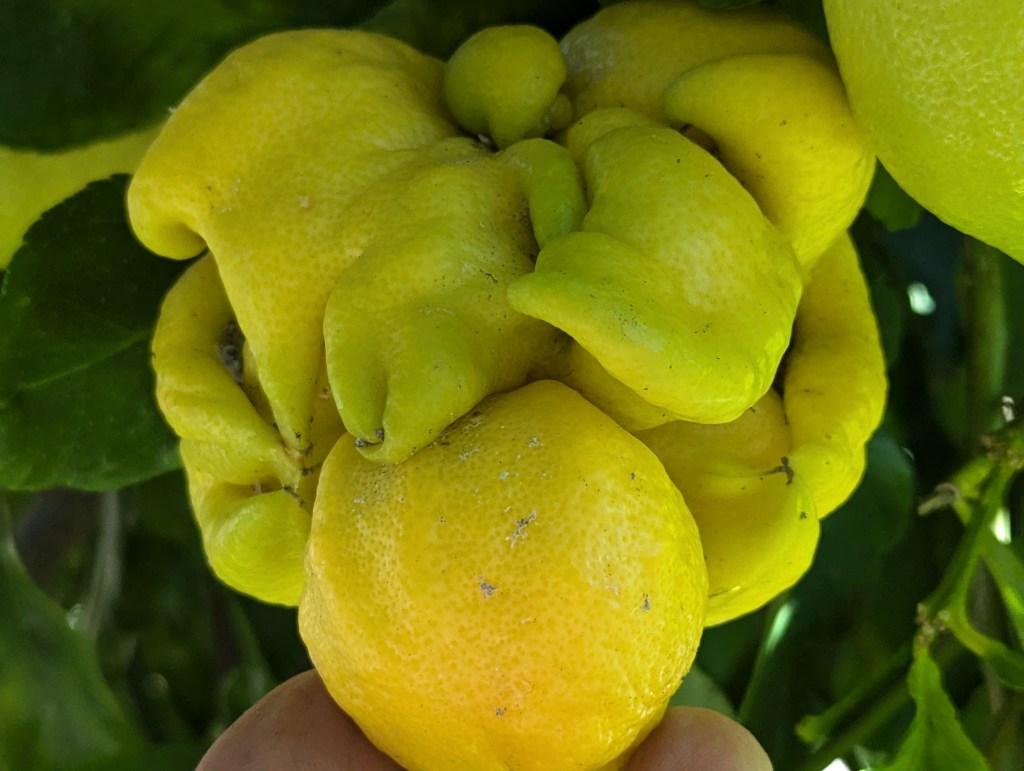
5. Citrus X limon ‘Eureka’ lemon is susceptible to minor damage from citrus bud mite. It may seem to be more than minor, and for this particular lemon, the damage is obviously quite major. However, only a few of the hundreds of lemons of this tree will be damaged.

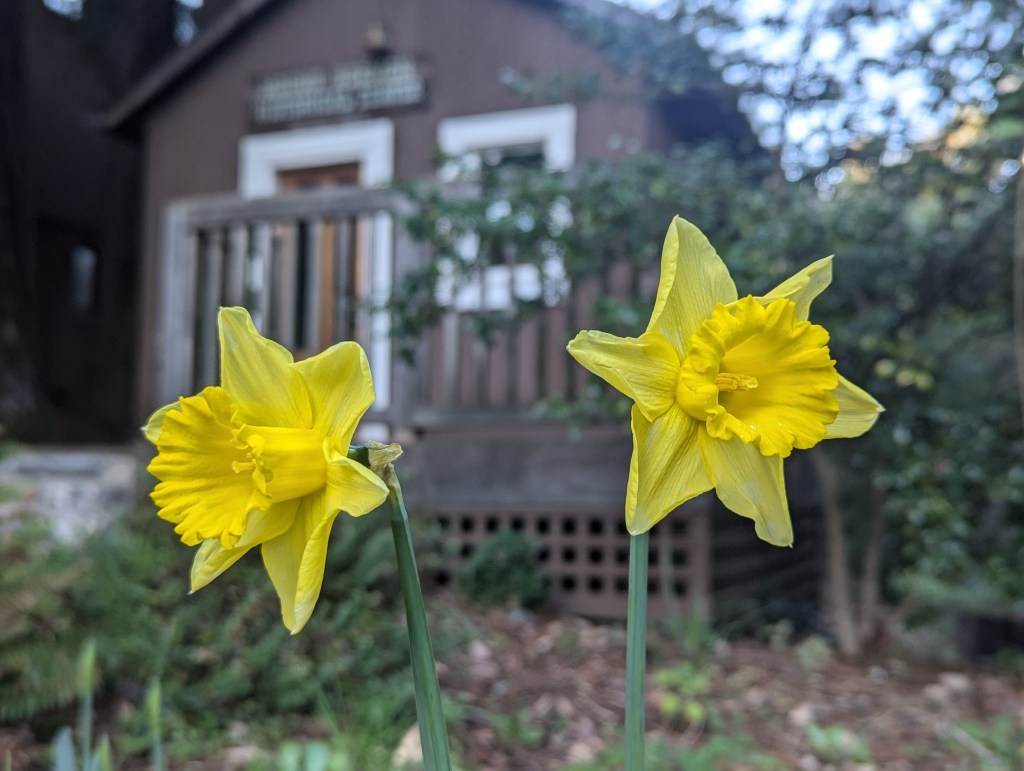
6. Narcissus pseudonarcissus ‘King Alfred’ daffodil may be a more modern cultivar, but has been naturalized here long enough to be genuine. Although happy to bloom like this annually, bulbs do not multiply, which is why I can not get many flowers in one picture.

This is the link for Six on Saturday, for anyone else who would like to participate: https://thepropagatorblog.wordpress.com/2017/09/18/six-on-saturday-a-participant-guide/