Horticulturists are by nature, nonconforming. I happen to find it difficult to conform to what makes us nonconforming. Trends are fleeting. Old technology that has worked for decades or centuries is still best. Although I am not totally against chemicals, I find that almost all are unnecessary for responsible home gardening. Pruning is underappreciated, and fixes many problems.
Coral bell foliage is as pretty as its delicate flowers for which it is named.
Even though their delicate trusses of tiny hanging flowers on one or two foot tall wiry stems make good cut flowers and attract hummingbirds in spring and early summer, coral bells, Heuchera micrantha, is more often grown for its colorful foliage. Contrary to their common name, the flowers (of this species) are more often pale or greenish white anyway. Their foliage can be all sorts of shades of green, gold, tan, brown, bronze, and purplish. The rounded and lobed leaves have somewhat raspy tomentum (hairs) and can be about two and a half inches wide. ‘Ruffles’ has more ruffled and deeply lobed leaves. ‘Palace Purple’ is a very popular cultivar with distinctive deep bronze or purplish foliage.
Mature plants can be divided in spring to make more plants every few years or so. Where protected from frost, division can be done in late autumn. Coral bells can also be propagated by cuttings. Rich soil and good exposure are preferred; but partial shade is best in warm spots.
As soon as any unsold Christmas trees move out of nurseries, bare root plants move in. Like Christmas trees, bare root plants are available within a limited season, while they are dormant through winter. They will all be gone by the time they start blooming and producing new foliage at the end of winter.
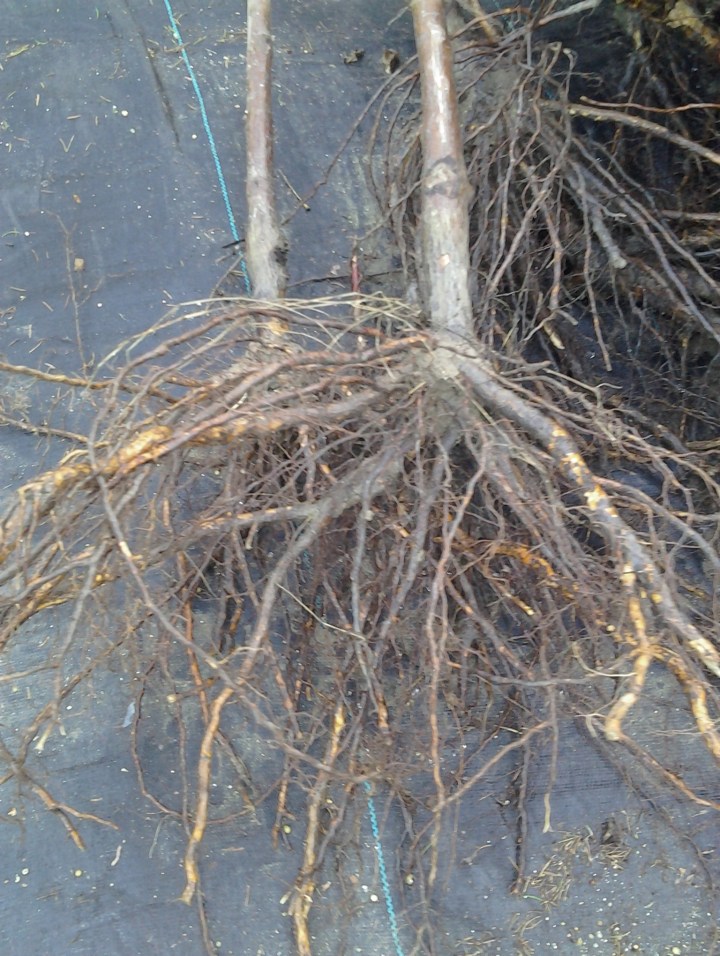
Bare root plants of course have ‘bare roots’, without typical media (potting soil) contained within cans or pots. Some get their roots wrapped in lightweight coarse sawdust to keep them moist without too much bulk. Others get their roots heeled into moist sand in nurseries, so that they can simply be dug when purchased.
Because bare root plants need much less space than canned (potted) plants, many more different kinds of deciduous fruit trees, roses, grapes, berries and even a few ornamentals are available. Bare root plants also cost about half as much as typical canned plants.
Since no nursery can stock all of what is available, more varieties are available from mail order catalogues and online. Most of what is available in local nurseries is selected for local climates. Plants purchased from catalogues or online need to be selected accordingly.
A main advantage of bare root plants is that they get established in the garden more efficiently than typical canned (potted) plants do. They get dug, transported and replanted into the garden all while dormant. By the time they wake up in spring, they are already in their new home, where they immediately adapt and start to disperse their roots into relatively uniform soil. Canned plants have confined roots that must disperse into unfamiliar garden soil
Bare root plants should get into the garden as soon as possible. If they do not get planted immediately, plants that were pulled from sand in nurseries should get heeled into damp soil or mulch, and watered to settle the fill. Alternatively, they can wait with their roots in buckets of water for a day to two. Bare root plants that are wrapped in bags of sawdust should be safe for more than a week in the shade outside.
Planting holes should be just large enough to accommodate the roots. If too deep, the loosened soil below is likely to settle and sink. Soil can be mounded into a small cone (known as a ‘volcano’) in the middle of each hole to spread roots over. Graft unions (seen as kinks low on trunks of fruit trees or where rose plants branch) of grafted plants should stand above the surface of the soil. Backfill soil should only be amended lightly, if at all.
Even though dormant plants get more moisture than they need from rain through winter, freshly planted bare root plants should get soaked twice immediately after planting to settle the soil around their roots. Lastly, damaged or superfluous stems can be pruned off. Most bare root fruit trees have much more stems than they should for padding in transportation and to allow more options for pruning.
It blooms splendidly, and has stayed compact for many years, but I do not trust it.
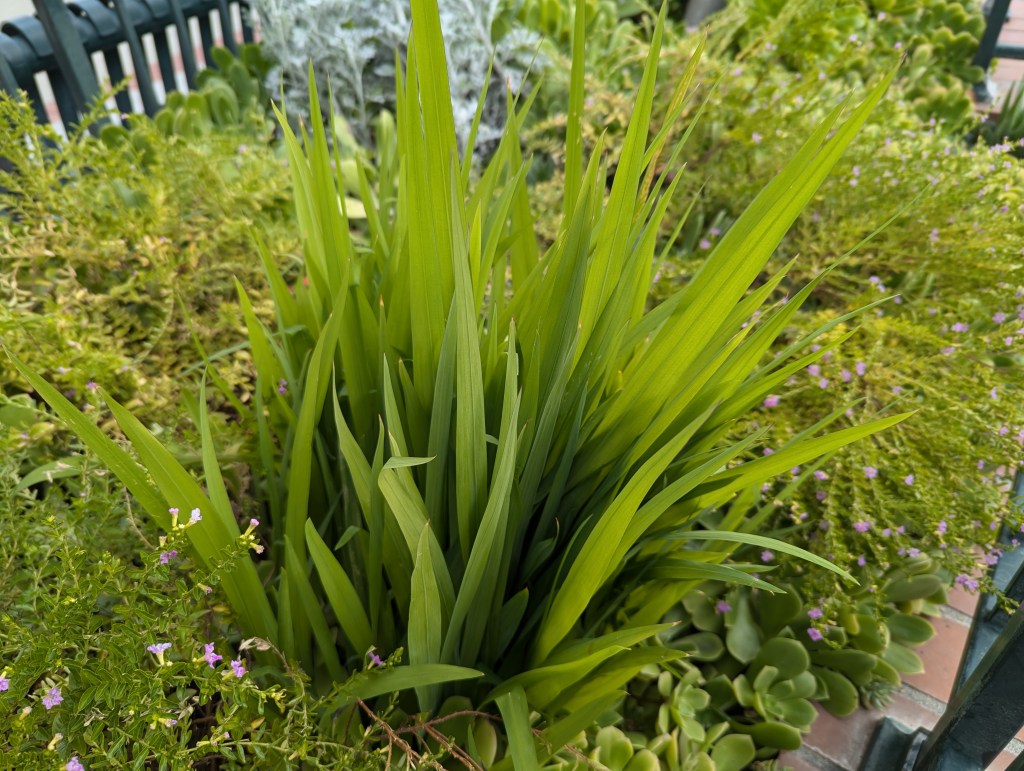
Many exotic species that became aggressively naturalized here escaped from home gardens and landscapes before anyone who enjoyed growing them was aware of how invasive they could be. Although I am aware of this, I was not particularly concerned with it while I lived within a suburban area in town through the 1990s. If I chose to grow something there that had potential to be invasive, it had no place to escape to. I mean that, from my suburban home garden, it could not migrate into a natural ecosystem to naturalize into it. Even if seed from something managed to get into the suburban drainage system, which flows into Los Gatos Creek, it would not be the first. I mean that anything that could naturalize there had likely already done so from seed from the countless other home gardens and landscapes in town. I have not lived within that suburban neighborhood for a very long time, though. I need to be more careful with what I select to inhabit my home garden. For example, the yellow flag iris and montrebetia that I enjoy growing at work can not inhabit my home garden, from which each has potential to escape and naturalize into the wild. The montbretia seems to be sterile and noninvasive, and I have been acquainted with it since childhood, but I just do not trust it. Another variety of montbretia that has inhabited my downtown planter box since before my time, and that I have been acquainted with for many years, also seems to be sterile and even less invasive than my first variety. After all this time, it was tediously slow to migrate outwardly, and provided me with only a few spare bulbs. Nonetheless, I can only enjoy it within the confinement of the downtown planter box.
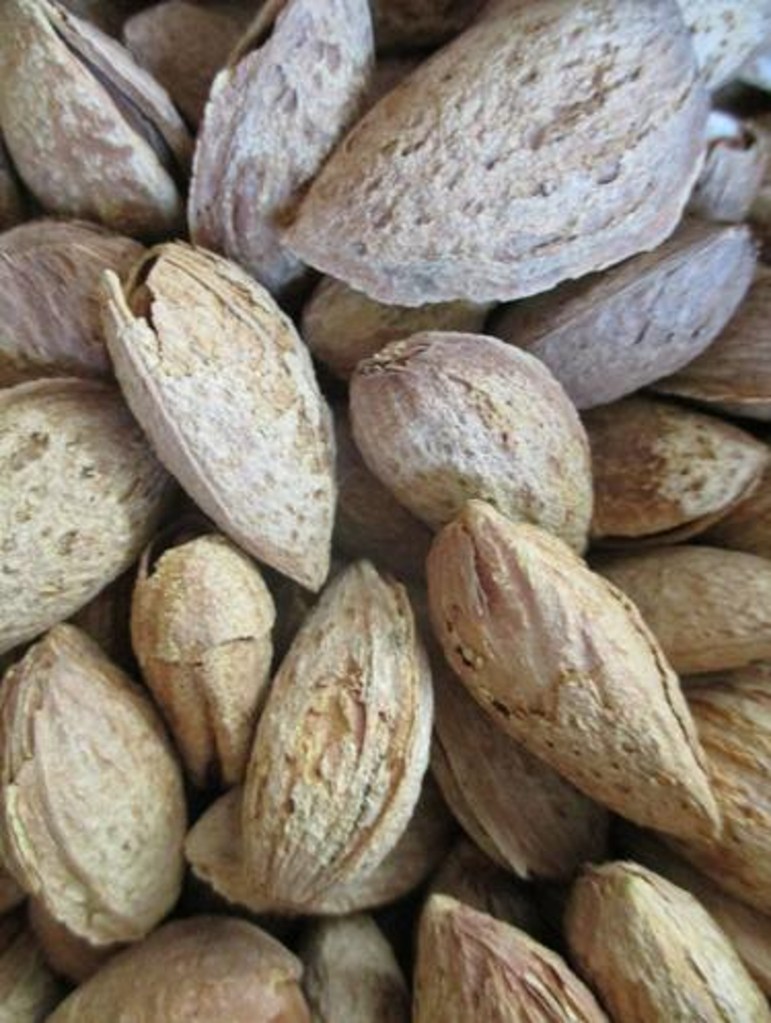
Is the pronunciation of the “al” of almond comparable to that of “salmon” or “palm”? That is about as controversial as the pronunciation of pecan. While pecan is related to walnut, almond, Prunus dulcis, is a stone fruit. That can be controversial also. Unlike other stone fruit, its mesocarp develops as leathery hulls instead of edible flesh. It is fruitless stones.
Like other stone fruit trees, almond trees need maintenance while dormant during winter. Bare root trees that are now available should be in the ground before their spring growth. Established trees need winter pruning before warming spring weather stimulates bloom. Almonds ripen for late summer though, after plums, apricots, peaches or other stone fruit.
Almonds are not as heavy as other stone fruits, and need no gentle handling. Therefore, winter pruning of almond trees may not need to be very aggressive. Such trees can grow as small shade trees with splendid white spring bloom. It is easier to shake unreachable nuts from tall trees than to pick them anyway. A few old fashioned cultivars need compatible pollinator cultivars.
Specialized dormant pruning improves fruit production.
Bare root season is synchronous with winter for one simple reason. Winter is when bare root stock is dormant. Dormancy similarly justifies winter pruning of deciduous fruit trees. It functions like anesthesia for surgery. While dormant, deciduous fruit trees are unaware of relocation or pruning. They resume growth for spring as if nothing stressful happened.
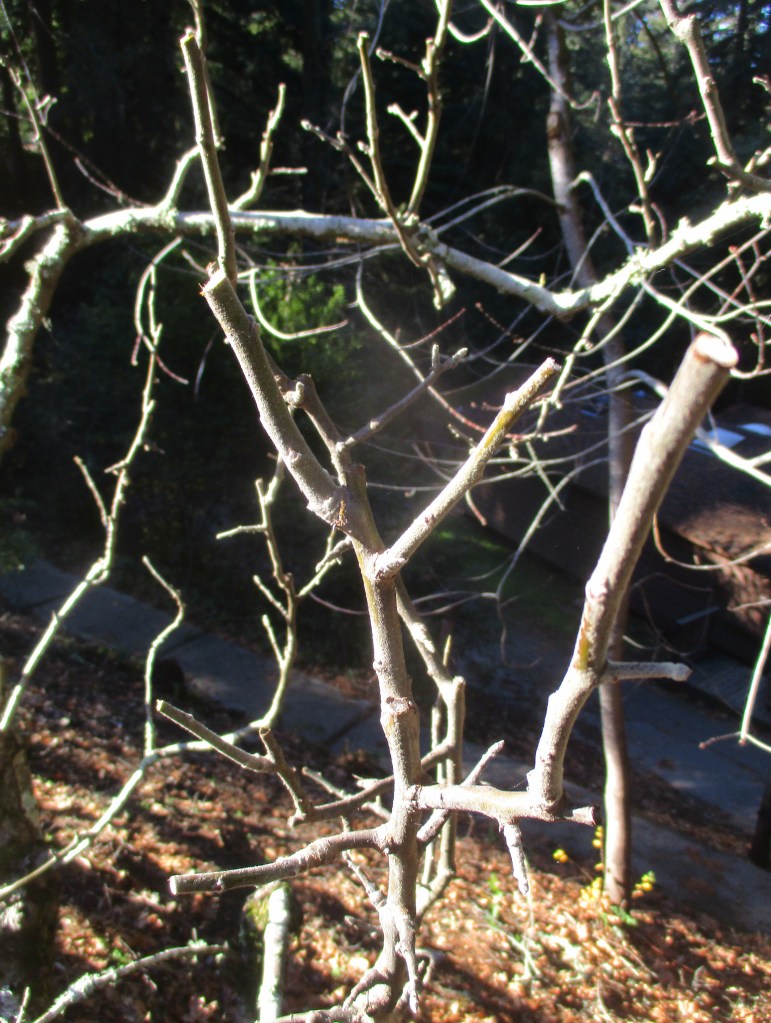
Winter pruning, or dormant pruning, would be inappropriate at any time other than winter. It is both very specialized for particular deciduous fruit trees, and, for most, very extreme. Some trees that benefit from it could not survive such procedures while vascularly active. Such pruning would involve the removal of most or all foliage if it were not already gone.
Winter pruning is no more unnatural than major breeding that necessitated it. Because of breeding, fruit trees produce unnaturally heavy and abundant fruit. Many can not support the weight of the fruit that they could potentially generate. Major pruning limits production and improves structural integrity of stems. It also confines production to reachable stems.
Production of unnaturally big and abundant fruit consumes substantial resources. Winter pruning concentrates resources into less excessive fruit of better quality. Since fruit is not as congested as it would otherwise be, it is more resilient to pathogens. So are its stems, foliage and precursory bloom. Fruit is easier to harvest from less congested stem growth.
Stone fruit trees and pomme fruit trees are the most common that require winter pruning. Stone fruit include cherry, apricot, plum, prune, peach, nectarine and almond. They need distinct degrees of similar pruning. Large fruit like peach necessitate aggressive pruning. Cherry and almond do not require as much. Pomme fruit include apple, pear and quince.
Deciduous fruit trees are certainly not low maintenance. Their reliance on winter pruning is undeniable. Those who would like to grow such trees should be aware of their cultural requirements. Diligent research of pruning techniques is very helpful. Annual experience is even better. It is an opportunity to observe how trees respond to all earlier procedures.
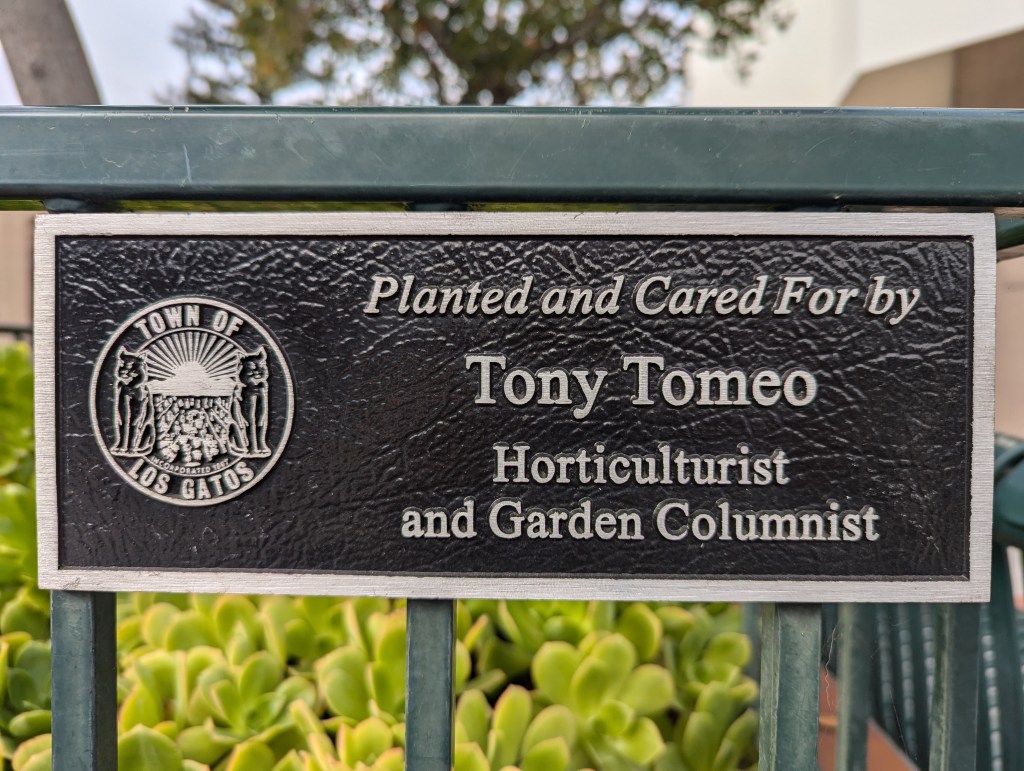
While away from work and home, and tending to errands downtown, I got these pictures from my downtown planter, which inadvertently became something of a Memorial.
1. Cuphea hyssopifolia, Mexican heather is not my favorite component of the downtown planter, but remains because it was installed by someone who was here prior to my time. A uniquely confined colony of montrebia that I will discuss on Wednesday also remains.
2. Senecio cineraria, dusty miller and the stonecrop below are from the garden of a now deceased client so can only be removed if a bit of it gets established in my home garden. It and the Mexican heather above are the only two of these six which are not succulents.
3. Sedum reflexum ‘Blue Spruce’ stonecrop is being displaced by the unidentified species of Aeonium below, but is also already established in my home garden. I expected it to be displaced eventually when I put it here several years ago. It is gratifying to see remnants.
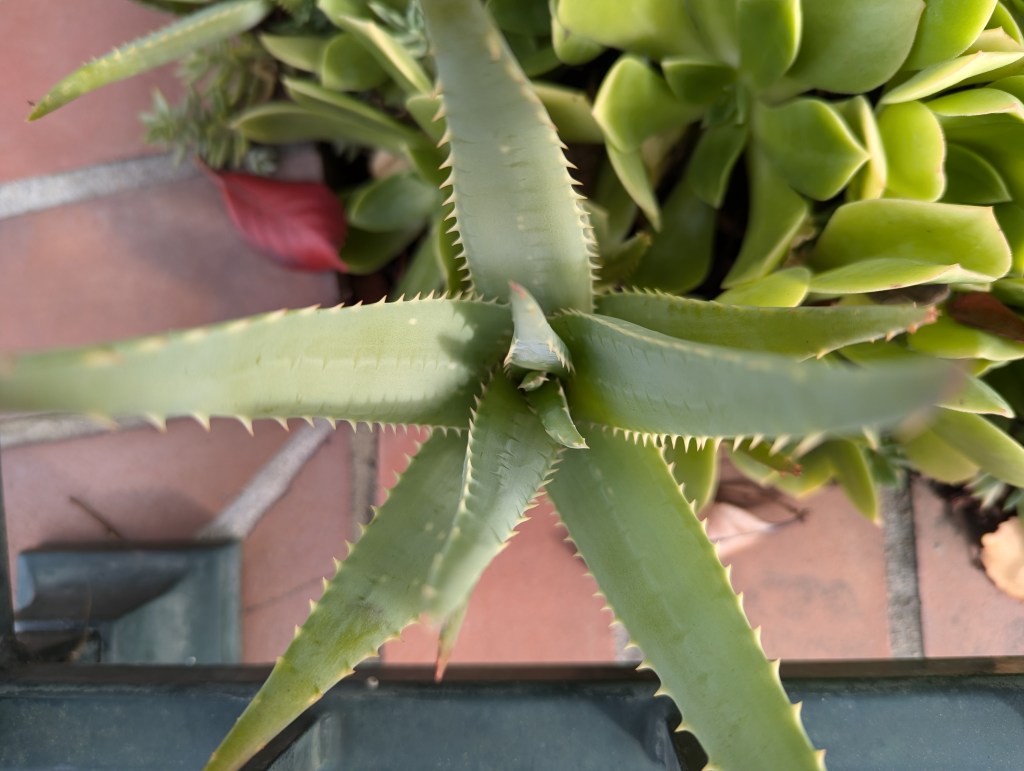
4. Aloe, as the Aeonium at the bottom of this list, is unidentified. It and both of the last six are from the garden of the deceased mother of a deceased friend who happened to be a direct descendant of Spanish explorers who were the first to arrive where Monterey is.
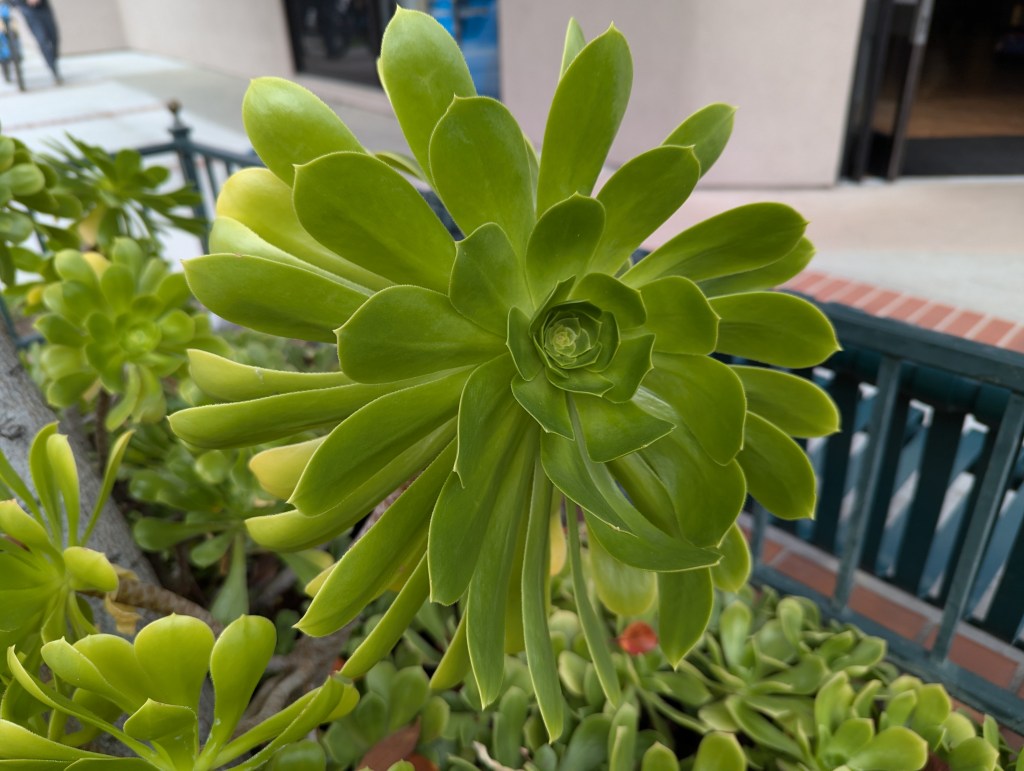
5. Aeonium arboreum, tree houseleek is the most striking vegetation within the planter, but is also occasionally disfigured by theft of its most sculptural stems. A darkly bronzed cultivar from the same special origin was taken piece by piece until none of it remained.
6. Aeonium is as unidentified as the Aloe above. It initially resembles the tree houseleek, also above, but remains low, dense and mounding. It is the most abundant vegetation of the planter, so was the primary culprit of the displacement of the stonecrop, also above.
This is the other side of the landslide that I posted a picture of for Six on Saturday a few days ago. As I mentioned then, it looked worse from this side. I suspect that it came down immediately prior to my arrival. No one else was aware of it, and there was no indication that anyone had tried to get around it or move any of its debris. It was just past my driveway, which is where Carson, the Roadmaster, was parked. However, because there are two households beyond it, the debris needed to be removed promptly. I did not want anyone else to do it, though. I wanted to separate the stone from the soil because I can use the stone to construct low retaining walls. Also, I wanted to use the soil to fill low spots within parking spaces at the top of the driveway. Although these low spots are very close to where the soil and stone was, and it should have been very obvious that soil could have been used to fill them, I know from experience that few put much effort into performing such a tasks in an efficient manner. Actually, they often seem to put significant effort into inefficiency. For example, the mound to the far right of the picture is debris from an landslide that occurred earlier. It is directly adjacent to a low spot that remains low because no one bothered to put any debris into it. So, now, there is a high spot directly adjacent to a low spot. Large stones were pushed over the edge, where they rolled into a portion of my garden below, bashed bark from trees, and are now where I do not want them to be. I hoped to avoid such problems with this landslide.





 Tony Tomeo