Elderberry

Blue elderberry is native here.

Although almost never planted intentionally, elderberries occasionally appear in strange places, wherever their seeds get dropped by the birds or rodents who eat their berries. The blue elderberry, Sambucus mexicana / caerulea, is native and most common between California, British Columbia and the Rockies. The American elderberry, Sambucus canadensis, is more common elsewhere, and also appears in the west where it had historically been imported for berry production. Some modern cultivars (cultivated varieties) with gold, bronze, or lacy foliage are actually related to European elderberries.

Except for compact cultivars, elderberries grow rampantly to about fifteen feet tall and wide. Aggressive pruning in winter keeps them looking fuller and more densely foliated. Overgrown plants can be rejuvenated by getting cut to the ground. The big leaves are divided into seven leaflets that are two to six inches long. Blue elderberry foliage is softly serrate and a bit more variable, with five to nine leaflets that may be as short as one inch.

Wide flat trusses of pale white flowers that bloom in late spring or early summer produce small but potentially abundant and richly flavored berries. Blue elderberries are dark blue dusted with white powder on trusses to about six inches wide. American elderberries are darker and more purplish on trusses that can be wider than eight inches. (Red elderberries are toxic!)
Birds Enjoy Colorful Fruits and Berries.

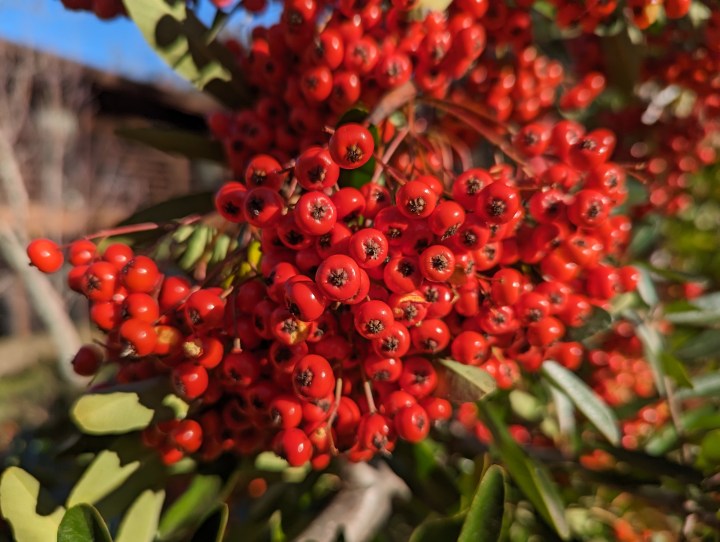
Brightly colored berries are an incentive for birds to disperse the seed within.

Colorful fruit and berries that ripen in autumn and winter bring more than their own color to the garden. They also attract all sorts of birds. Some birds want to fatten up on the earlier and typically more abundant and colorful fruit before migrating south for the winter. Other birds that stay through winter eat fruit and berries that develop over a longer season, after the migratory birds are gone.

The most abundant and brightly colored red fruit of pyracantha (or firethorn) appeals to the early migratory birds that want to fatten up fast and get south. Cotoneaster, toyon and English hawthorn are not quite as flashy, but appeal to the same crowd of migratory birds. These sorts of plants get their colorful fruit early on in the season, but are then stripped of it rather efficiently.

The fruit of pyracantha, cotoneaster and toyon is not often very messy since almost all of it gets consumed; but the birds that eat it can be remarkably messy before they fly south. Coincidentally, these three plants are often grown as informal hedges and screens around the perimeters of large parking lots, so the mess is a traditional nuisance for many parked cars this time of year.

Chokeberry and elderberry ripen early enough for the migratory birds, but do not get devoured so efficiently because they are not so brightly colored. Migratory birds seem to prefer bright red or orange berries, so are likely to leave black chokeberries and blue elderberries for overwintering birds, which stay through winter. Strawberry tree, although not very productive, appeals to both crowds, and anyone else who might be interested in their fruit, by producing bright red berries throughout the year.

Persimmon, holly, loquat, some mahonia and some crabapple are even a bit more selective, by ripening their fruit later in autumn and winter after the migratory birds are gone. Pomegranate fruit splits open in the middle of winter, exposing a buffet of juicy red berries with meaty seeds for anyone who hasn’t gone south for the winter. Many pittosporums do the same, but without the colorful advertisement. Of course, most of us want to get our persimmons, loquats and pomegranates before the birds do!

Citrus such as lemons, oranges, grapefruits and mandarins that ripen later in winter do not attract birds, so we only need to share these fruits with our friends and neighbors. Citrus are colorful enough on their own anyway.

Horridculture – Trash Talk

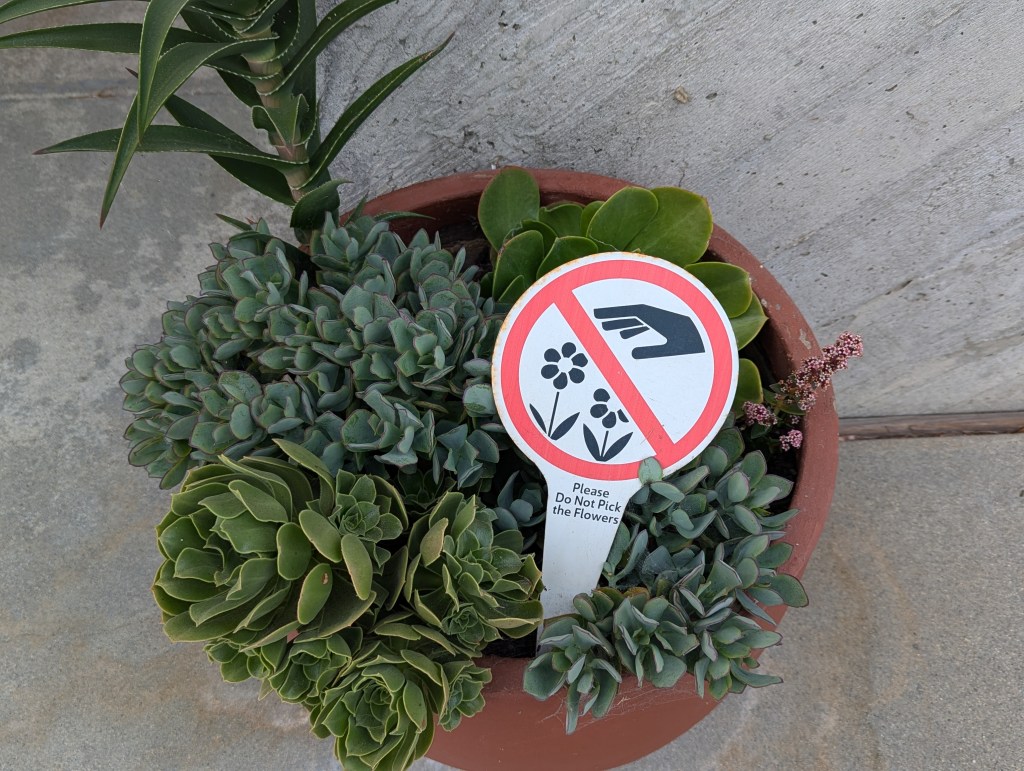
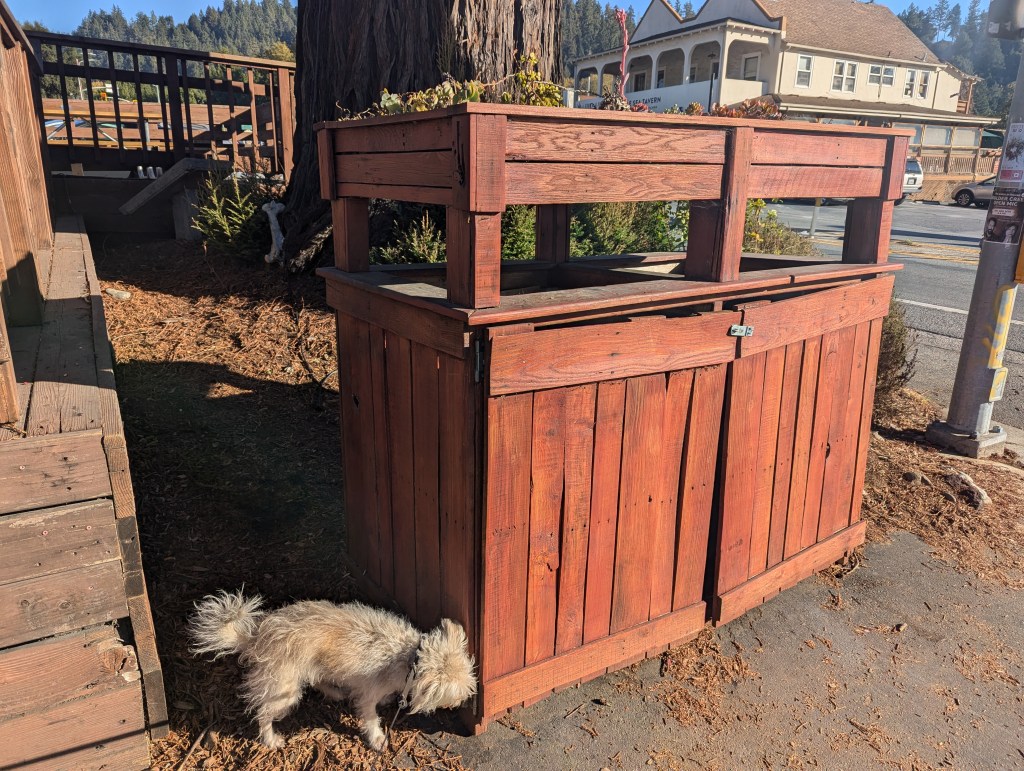
Public trash receptacles are a good concept. Without them, some of us would be more likely to litter. Contraptions such as this are most likely a good concept too, since they are somehow more visually appealing than exposed trash cans. Also, they are unlikely to fall over and spill as exposed trash cans sometimes do. Originally, one half of this receptacle was designated for trash, and the other half was designated for recyclables. This is another good concept, but was very unfortunately discontinued because it is so commonly ignored that someone must sort through less than efficiently sorted trash and recyclables. The only obvious component of this device that may not have been such a good concept is the planter box that hovers above it. Once outfitted with a nice collection of succulent perennials, it was left to survive as well as it can, which has not been very well. Succulents were likely selected for this particular application because they are supposedly ‘drought tolerant’. However, only some are drought tolerant, and only because they extend their roots as they must in order to find moisture, which they are unable to do while confined to this hovering planter box. Although they have been surviving, they have not been very happy about it. I suspect that someone must sometimes give them water, but these succulents want a bit more. Realistically, they would be happier in the ground behind the trash receptacle. There is certainly plenty of vacant space for them there, and they would be more visually appealing where they would actually be more visible than they are above average eye level. If some sort of vegetation is desirable above the trash receptacles, small shrubs or vines in the ground next to them would be happier than succulents above them. It would have been better to maintain the space that is already in need of maintenance than to add more.

Chinese Elm

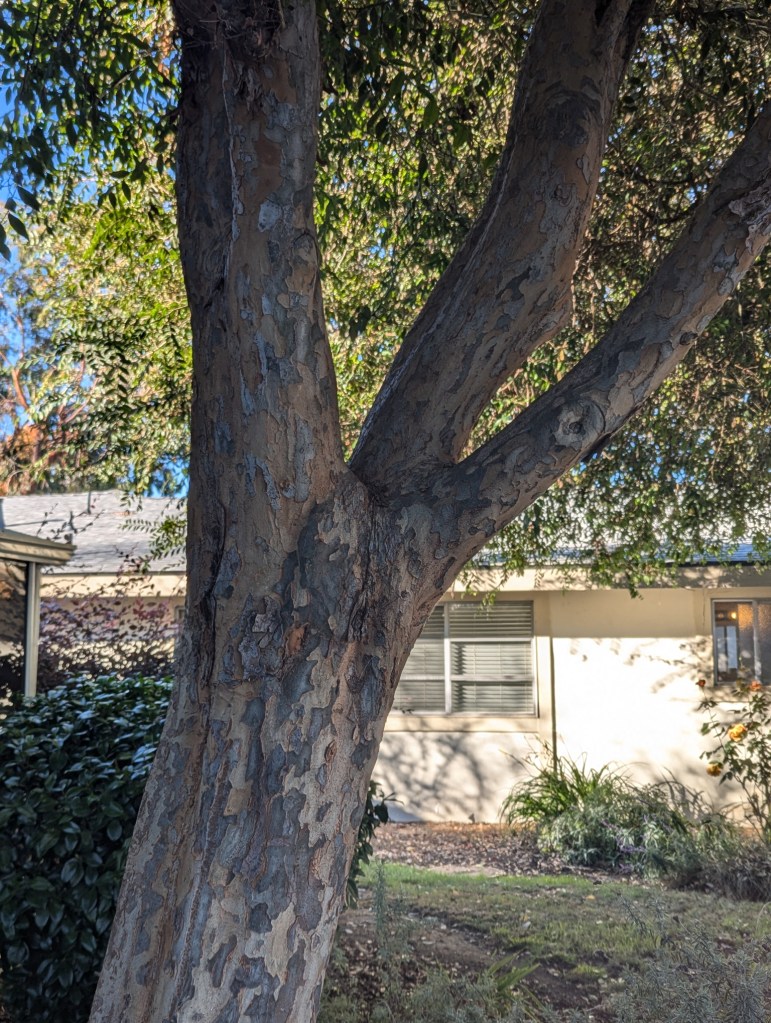
Chinese elm is sculptural and textural.

Dutch elm disease became a serious problem for American elms in the 1930s. However, it did not reach California until half a century or so later. Chinese elm, Ulmus parvifolia, is not very susceptible to the disease, but is a vector. In other words, it can survive infection to share it with other species of elm. Consequently, it became unavailable by the 1980s.

Some mature specimens of formerly common Chinese elm still inhabit older landscapes. Younger specimens in newer landscapes are mostly ‘Drake’ Chinese elm. They are a bit more upright, with more symmetrical form. More importantly, they are not vectors of Dutch elm disease. Other cultivars that are also resistant are rarely available at local nurseries.

Classic and formerly common Chinese elm can eventually grow more than fifty feet high. Some can grow thirty feet wide to shade an entire urban front lawn. Some cultivars might grow nearly as high, but are generally not quite as broad. Their blotchy gray and tan bark adorns curvaceous limbs. Their small deciduous leaves are not very colorful for autumn. They can be copious, messy and quite tedious to rake.

Falling Leaves Are Getting Messy

Deciduous foliage gets messy through autumn.

The primary problem with autumn foliar color is that it eventually becomes quite a mess. Premature shedding started the process even before much of the foliar color developed. Evergreen foliage can contribute to the mess, but most debris now is deciduous. Autumn is, obviously, its season for defoliation. Falling leaves merely do what is natural for them.

Falling leaves fall at different rates. Just as some fall prematurely, some might linger into winter. Also, some that usually linger into winter may fall earlier or later for some winters. Unusually cool, windy or rainy weather accelerates defoliation. However, defoliation can be slower with milder weather. Prolonged foliar color is pretty, but prolonged mess is not.

Besides falling at different rates, falling leaves are quite diverse. Big leaves of sycamore and fruitless mulberry are easy to rake away. Small and abundant leaves of Chinese elm require a bit more effort. They tend to sift between rake tines. Sycamore leaves disperse tomentum that is irritating and perhaps dangerous to inhale. Oak leaves stain pavement.

In a few relevant regards, falling leaves are quite convenient. Their absence allows more warming sunshine through as the weather cools. Not very long ago, they provided shade during summer warmth. Defoliation also allows wintery wind to blow more safely through deciduous trees. Otherwise, such trees would be more susceptible to damage from wind.

Falling leaves are also quite inconvenient. They clog eavestroughs and gutters precisely when they should not. As rainy weather begins for winter, it dislodges even more foliage. Also, it dampens foliar detritus so that it stains concrete and decking more than while dry. Raking detritus is most important while it is most unpleasant because of wintery weather.

Some coarse groundcover, such as Algerian ivy, can absorb smaller falling leaves. Most groundcover or turf is not so accommodating, though. Bigger leaves can overwhelm and shade them, as well as low or dense shrubbery. Slugs and, where they do not hibernate, snails can proliferate within this damp shade. So can fungal pathogens that tolerate chill.

Not So Spicy

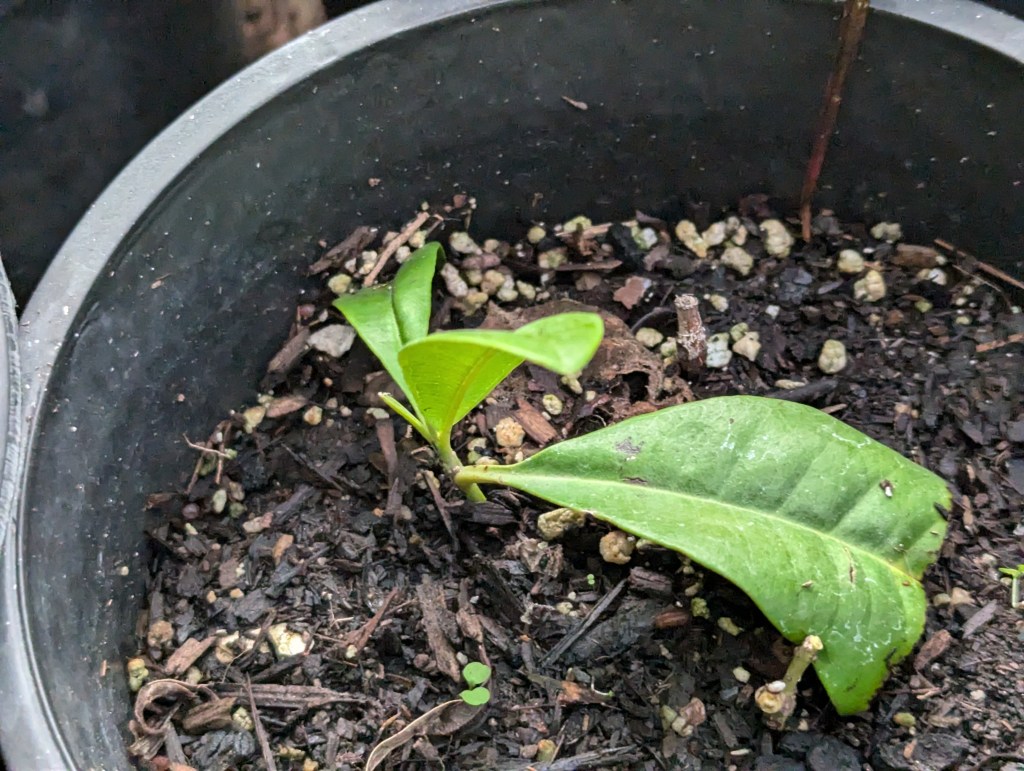
Jamaican allspice, Pimenta dioica, is rare here. I am beginning to learn why. Because it is tropical, it is vulnerable to even very minor frost. Actually, it is not so keen on chill either. It is rated for climates that are no cooler in winter than Zone 10. This is Zone 9. It seems to grow reasonably well in the Los Angeles region, where I collected my cuttings from Brent’s Jungalow Garden, but it is rare there also. That could be because it is not much to look at. Its foliage is no more interesting visually than that of common privet. Although the foliage is splendidly aromatic, only those who are familiar with the species, or become acquainted with its aroma while pruning it, would know. Its bloom is neither prominently colorful nor fragrant. What is worse is that the bloom is dioecious, with male or female flowers on different specimens. Single specimens have no problem blooming, but can not produce allspice fruits without a mate. Single male specimens are fruitless for obvious reasons. Single female specimens are fruitless without pollination. Not many people who grow the very rare single specimens are aware of this, although most are satisfied with the delightfully aromatic foliage. New specimens only very rarely become available in nurseries, and when they do, all of them were likely grown from the same stock specimen, so are genetically identical and of the same gender. Only seed grown specimens are random in regard to their respective genders, and even among them, their genders are unknown until they eventually bloom. The potential for growing both genders is proportionate to the number of seedlings. For example, one seedling will be of one gender. Two seedlings are as likely to be of the same gender as they are to be of different genders. Three are more likely to include one of another gender. Several or many are proportionately less likely to be of the same gender. All of my several cuttings were from the same specimen, so would have been genetically identical. It does not matter much now anyway, since only one survived, and even it is still rather wimpy. It has developed only two new leaves, and retains a trimmed portion of one of its original leaves. I am pleased with it regardless of its gender, and will be satisfied with only its aromatic foliage.

Please Do Not Pick the Flowers

Am I that predictable? How did whoever posted this sign know I would be here? I do not want their stupid flowers anyway. Besides, only that dinky twig of some random species that I can not identify is blooming on the far right. Is that all they got? What I really want, or more accurately, what I would want if I did not find them to be either uninteresting or redundant what is already in my garden, is stem bits of the succulents for propagation. I suppose that I am not the only one who might want that, which is why the sign, although slightly irrelevant to such desires, became necessary. Actually, I have direct experience with pilferage of bits of succulents from my small planter box downtown, so I am aware of why such signs might be useful. I would not install any such sign within my planter box because such a sign would be bigger and more prominent than any of the flowers that it would be intended to protect. If I were to grow more flowers, I would prefer those that are so abundant that no one would miss a few that might get pilfered. The most abundant flowers are also smaller than less abundant flowers, so they would not be as tempting to those who might want more impressive flowers. For example, the bearded iris within my downtown planter box blooms with only a few big and bold floral stalks. Not only are the flowers tempting and easily taken, but when they are taken, there are no more to replace them. Anyway, I do not actually mind if those who want copies of my succulent perennials take a few bits if only they do so properly. It may happen more often than I am aware of, but of course, I am not aware of it if otherwise useless bits are taken from below the visible growth, or where they should be pruned away anyway. That is how I justify what you likely know I will mention next. Yes, only about a hundred feet from this urn filled with succulents and the sign that requests that I refrain from doing as such, even if it does not mention the subject matter and procedure directly, I ‘borrowed’ a few bits of stem from the underside of a shabby specimen of what seems to be ‘Roman Red’ Salvia guaranitica that should eventually get pruned back for winter anyway.

Six on Saturday: Day Out

Rhody and I were in Capitola to attend to a few important tasks. Consequently, I did not take any pictures from home or work. My ‘Six’ for this week are therefore totally random without a theme.

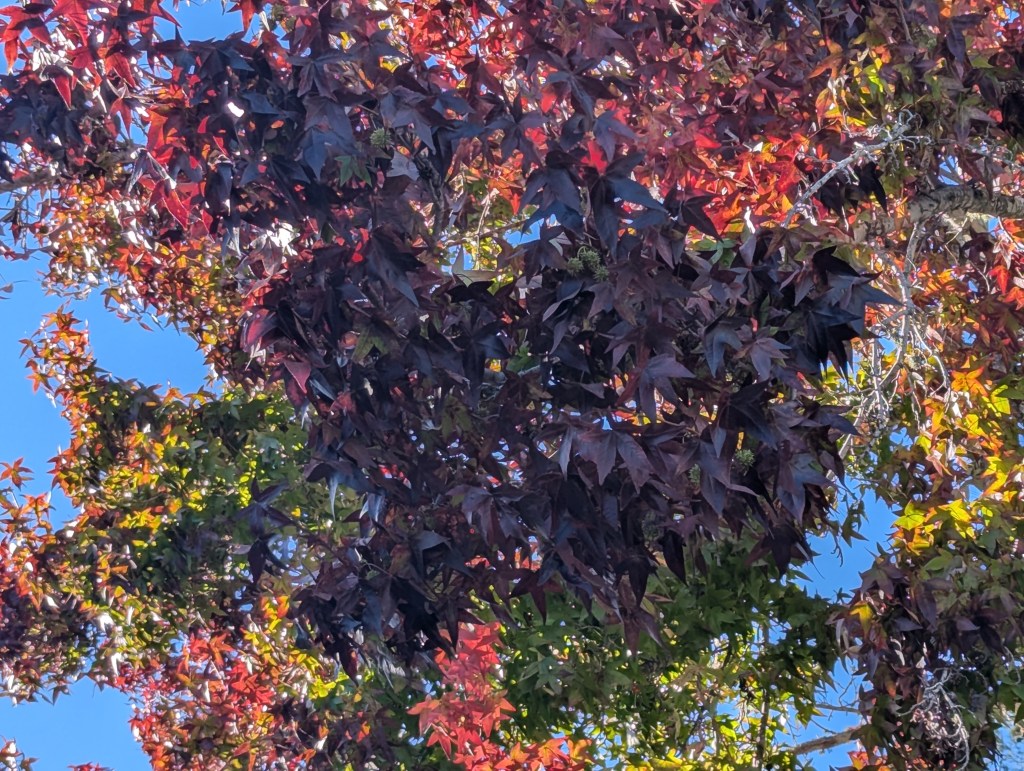
1. Liquidambar styraciflua, sweetgum does not require much chill to exhibit exemplary foliar color for autumn. This deep garnet red is almost too dark to be visually appealing. It looks like it should be in Vermont rather than here on the Central Coast of California.

2. Archontophoenix cunninghamiana, king palm is more common closer to Los Angeles than here. I know of only a few here, and almost all are somewhat shabby like these are. King palm is less tolerant of slightly excessive chill than sweetgum is of inadequate chill.

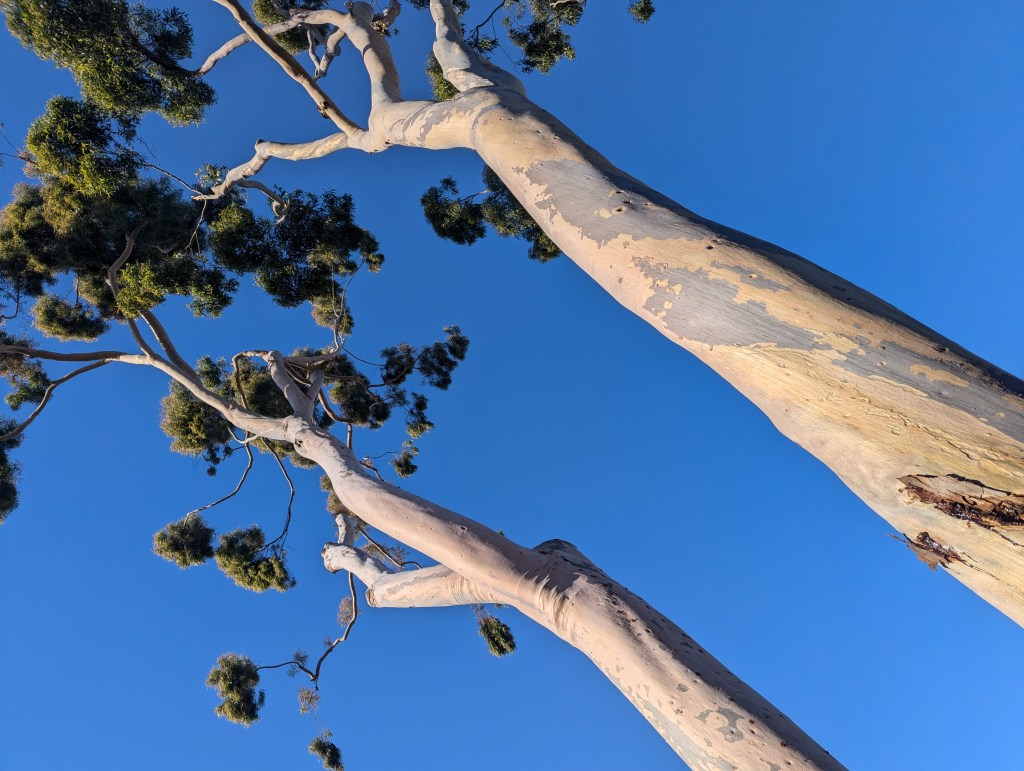
3. Eucalyptus citriodora, lemon gum is also more common in Southern California, likely because it prefers warmer winters. Although these are reasonably happy here, not many are so happy within the Santa Clara Valley on the other side of the Santa Cruz Mountain.

4. Cortaderia jubata, pampas grass is the aggressively invasive sort which is naturalized so wickedly on the West Coast of California and Oregon. This is not a good picture, since it shows only its bloom peeking above the edge of the cliff, with foliage concealed below.

5. Eucalyptus globulus, blue gum is another aggressively invasive naturalized species. It has a completely different personality, though. Where it competes with other tall trees, it grows very high, and is very combustible. This exposed tree is relatively short and stout.

6. Carpobrotus edulis, Hottentot fig, which most of us know incorrectly as ice plant, was imported from South Africa more than a century ago, and is now so abundant that some believe that it is native. Technically, it is invasive too, but it is not easy to dislike as such.

This is the link for Six on Saturday, for anyone else who would like to participate: https://thepropagatorblog.wordpress.com/2017/09/18/six-on-saturday-a-participant-guide/

Sweet William

Sweet William can grow as a short term perennial.

Because they do not like warm weather through summer much, sweet William, Dianthus barbatus, is appreciated more as a cool season annual from autumn into winter and even into spring. They can also be planted early in spring for color before summer warmth. They can sometimes survive as perennials in sheltered areas, particularly if mixed and hidden amongst other perennials and annuals. Deadheading (removal of deteriorating flowers) prolongs bloom.

New plants are easy to propagate from division, cuttings or layering of tired older plants. (Layering involves rooting prostrate stems by burying them slightly and them separating them when they have developed roots.) By the time the old plants become too deteriorated to salvage, the new cuttings or layers should be ready to replace them. New plants like to start out in rich and well drained soil, but not watered too much since they can be susceptible to rust and fusarium wilt.  

The white, pink, rosy pink, red, somewhat purplish or bicolored half inch wide flowers form rather flat dense trusses on top of short stems. Minute but abundant green bracts fill the spaces between the individual flowers. The rich green leaves below are about an inch to two and a half inches long. Mature plants of the more common varieties are typically less than a foot tall and wide. More compact and larger varieties are available as seed.

Automated Irrigation Should Adjust To The Weather.

Some irrigation becomes temporarily obsolete through the rainy season.

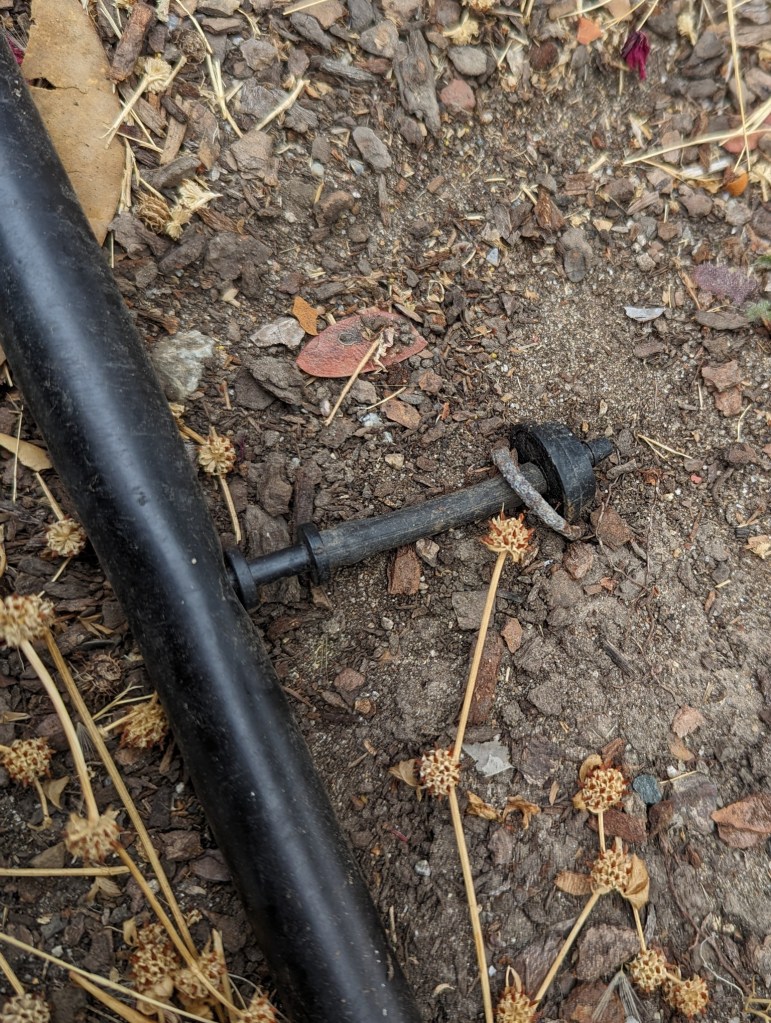
Now that it has started to rain, what should be done with automatic watering systems? In almost all situations, automatic irrigation systems should be adjusted to accommodate for moisture provided by rain. If rain is sufficient to provide enough or too much water, irrigation can be discontinued until needed again when the rain stops a few months from now.

If the first few storms are discontinuous enough with warm and dry weather mixed in between, lawns and plants that want more substantial watering may need to be watered a few times until the rain becomes more reliable. However, because of cooler temperatures and shorter days, plants do not use nearly as much water as they did during the summer anyway, so do not need to be watered nearly as much as they were only a month or so ago.

Deciduous plants that are losing their leaves need the least moisture, since they can not lose any moisture through evapotranspiration (evaporation from foliar surfaces). The very few plants that bloom or even start to grow during winter use a little bit more water than those that really are dormant, but are still likely get all they need from rain even without getting watered.

Flowering annuals, particularly left over warm season annuals that continue blooming late, may get moldy with too much rain. Their flowers and some of their foliage can turn to mush until there is a break in the rain. Removal of damaged flowers and leaves slows the spread of the mold but does not cure it. Good air circulation among well spaced plants and in exposed areas helps inhibit mold. Regardless, moisture from abundant rain can eventually cause mold to be a problem.

In fact, the only plants that are not likely to get all the water that they need from rain are those that are in pots and planters under eaves or in the home as houseplants. Nonetheless, sheltered plants that are outside should still get much less water now than they do during the long and warm days of summer. These plants are either dormant or at least more sedate because of the shorter cooler days through winter. Houseplants may likewise use less water because the home environment is also cooler.

However, if the heating system of the home decreases humidity, some large houseplants may actually want a bit more water through winter! Humidity fluctuates most in older deficiently insulated homes that are heated by wood stoves or fireplaces; since these homes get humid without a fire burning, but then get much drier with a fire.