Staking Helps Keep Trees Straight

Binding can interfere with trunk development.

Planting trees often involves staking. Until they disperse new roots, many new trees rely on stakes for stabilization. Their stability is limited by the initial confinement of their roots. Nursery stakes and their associated binding provide different support. They merely direct straight trunk growth. In a home garden, nursery stakes subordinate to landscape stakes.

This process is different for different trees. Small palm trees need no staking at all, either in nurseries or home gardens. Spruce trees are too stout to need support after they grow beyond their nursery stakes. Camphor trees may need both types of stakes concurrently. Landscape stakes maintain their stability as nursery stakes maintain their trunk integrity.

Typically though, landscape stakes completely replace nursery stakes of most trees. For adequate stability, they must extend into undisturbed soil below excavated soil. For most trees with bare trunks, such staking should reach lower limbs. Some trees need only one stake. Some, particularly those with large canopies, may need a pair of opposing stakes.

Straps that attach trees to their landscape stakes need proper installation also. They are more durable than nursery binding, but must not be too restrictive. They should only hold trees upright without interfering with their natural development. Straps should be as high as practical on their respective stakes. Additional ties may be needed to prevent bowing.

Some old fashioned straps are strips of old tires with bailing wire at each end. Others are simple bailing wire through bits of old hose. Modern straps are more refined and diverse to facilitate staking for diverse subjects. They should cross over between the stakes and the trees they support to limit abrasion. Short nails may attach them firmly to their stakes.

Staking should be as unobtrusive as possible. Trunks that can move somewhat freely in mild wind are studier than those that can not. Binding for trees that initially require it with staking should be as loose as practical. Incremental loosening might be safer for weakly limber trunks. Without loosening, tight binding might harmfully constrict trunk expansion.

Exposure

Sunshine promoted bloom to the left. Shade inhabited bloom to the right.

Naked ladies like exposure. Amaryllis belladonna can certainly survive and actually develop lushly healthy foliage in partial shade. However, it needs sunshine to bloom. This picture above, which was recycled from yesterday when I mentioned that I might elaborate on it later, demonstrates how discriminating this species is. As mentioned yesterday, a row of naked lady bulbs extends completely across the picture from left to right. It does not extend only from the left to the middle of the picture, as the bloom might imply. Now that bloom is finishing, foliage will develop throughout the entire row, including the portion of the row that currently lacks bloom, so that the extent of their herd will be more apparent. The lack of bloom to the right is the result of the shade of a densely foliated coast live oak above. Because coast live oak is evergreen, it shades the area below its canopy through winter, when naked lady is also foliated and storing resources for subsequent late summer bloom. Those that do not get sufficient sunshine to initiate bloom within any particular season will be unable to bloom for the beginning of their subsequent season. When we installed these recycled bulbs here, we considered that bloom would likely be inhibited below the coast live oak, and that we would relocate bulbs that were too shaded to bloom, but we expected more of a transition between the shaded area and the sunnier area. This is so blunt, with bloom to the left, but none to the right. At least we now know precisely which bulbs to relocate while they are dormant next summer. Although there is technically no need to relocate them, and they can be adequately healthy here, they would be more appealing within a sunnier situation that would promote bloom.

Madonna & Black Lace II

Sambucus nigra ‘Black Lace’ can produce a few berries without pollination from another cultivar.

The internet never ceases to amaze with its inefficiency of providing information that should be more readily available. Old fashioned horticultural texts and even encyclopedias were more reliable. I remember reading that elderberry could be self pollinating, but that it would be more productive with another cultivar of the same species. Because I could not remember what species of the genus that information was relevant to, I more recently tried to determine the requirements of each of the few species that I grow. Ultimately, it seems to me that all are about the same in regard to both their ability to self pollinate to a minimal degree, and their ability to pollinate more efficiently with other cultivars. However, I still do not know. Furthermore, I am now confused about the identity of American elderberry, which many sources insist is merely a variety of common black elderberry of Europe.

Sambucus caerulea, blue elderberry is native and too common for me to know or care if it is more productive with other genetically distinct specimens, which, since the species lacks cultivars, are merely other wild specimens. In other words, blue elderberry specimens here can not be adequately isolated from other specimens to determine how reliant they are on others for pollination. Regardless, I will grow about four together within my garden.

Sambucus racemosa, red elderberry is supposedly native here, but I have never seen it in the wild. Consequently, I do not know if other specimens are close enough to pollinate specimens within my garden. Rather than experiment with single and potentially isolated specimens, and because there is no need to separate the four specimens here anyway, I will grow all of them together within my garden. I am considering adding ‘Sutherland Gold’ or other ornamental cultivars in the future.

Sambucus canadensis, American elderberry is not native, so could be grown in isolation here. However, I want berries more than I want to know how reliant this species is on pollination from other genetically distinct specimens. Before I grow cultivars, I will grow about four specimens within my garden from seed. I might consider cultivars in the future, but for now, would prefer to grow them as most people within their native range experience them, and as I grow blue and red elderberries.

Sambucus nigra, black elderberry is a species that I find to be less interesting than the three North American species that I actually want to grow. However, I have grown ‘Black Lace’ at work for a few years, and recently got it ‘Madonna’ as a pollinator so that the two can make berries together. Because I grew several more copies of each than we can accommodate at work, I will likely grow a pair of each within my own garden. Both are ornamental cultivars that happen to also produce berries. However, formerly without a pollinator, ‘Black Lace’ has been fruitless. This year, one of the copies managed to make these few berries in the picture above without bloom from ‘Madonna’. I suppose that this is consistent with what I read about its ability to self pollinate somewhat. Now, I want to see what it does next year if ‘Madonna’ blooms well.

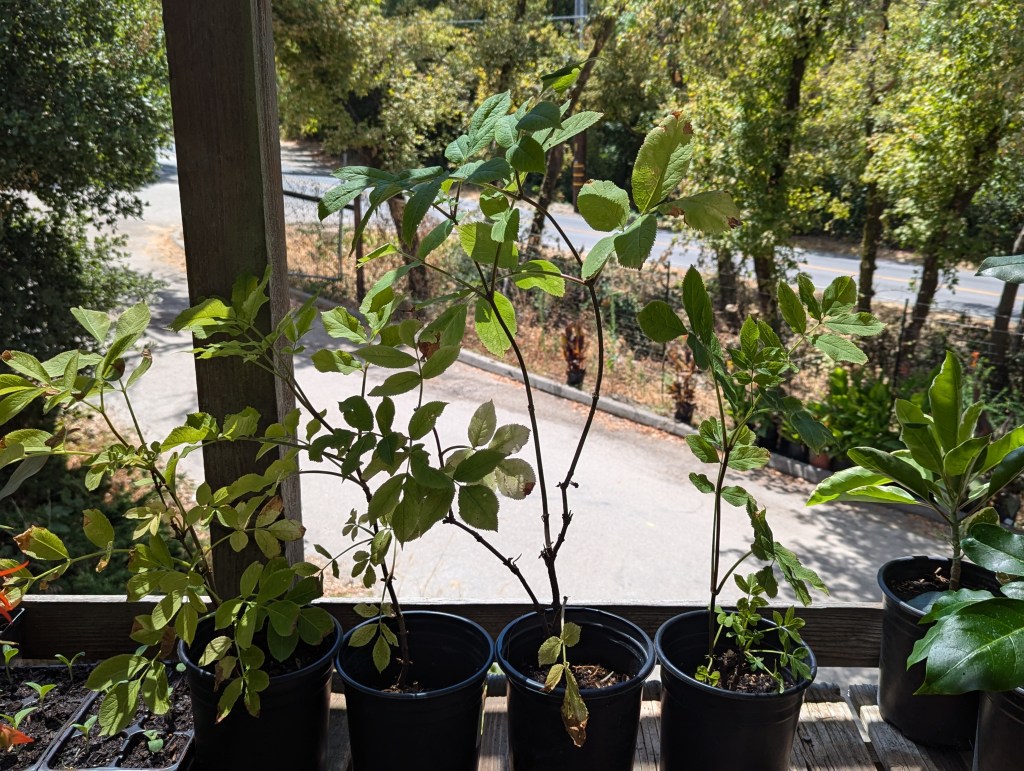
Four wild seed grown specimens of Sambucus racemosa, red elderberry that were a gift from Tangly Cottage Gardening have been canned for too long, and want to get into the garden.

Six on Saturday: More About This Later

Brevity is not always easy with Six on Saturday. I might elaborate on some of these later. There is no common theme. These are merely six random pictures from last week.

1. Sambucus nigra ‘Black Lace’ European black elderberry got ‘Madonna’ as a pollinator only this year. ‘Madonna’ will not bloom until next year. ‘Black Lace’ makes a few berries anyway. I hope that they are prettier when more abundant. I can elaborate about it later.

2. Amaryllis belladonna, naked lady is demonstrating is preference for sunny exposure. This row of bulbs extends from left to right across this picture, but blooms only half way, with no transition to where bulbs are too shaded to bloom. I can elaborate about it later.

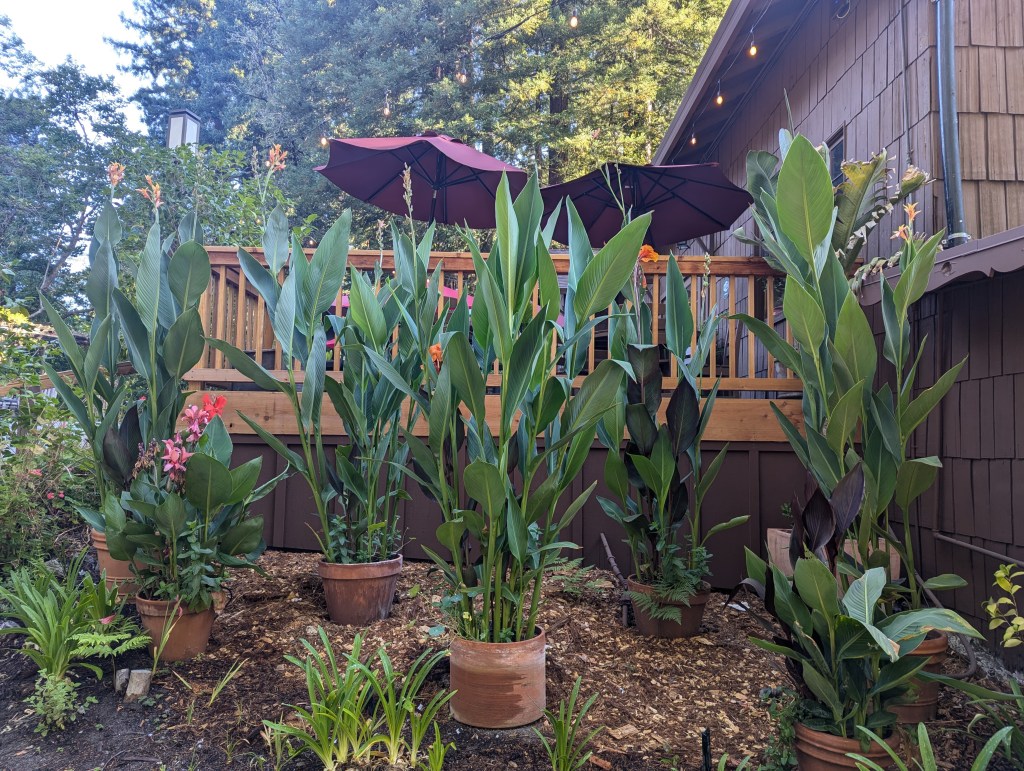
3. Canna musifolia, canna, which has been very fun to grow, was a gift from a neighbor, but not practical for our landscapes. These, with a few fancier cultivars, were potted here temporarily until a new landscape develops this autumn. They earn many compliments.

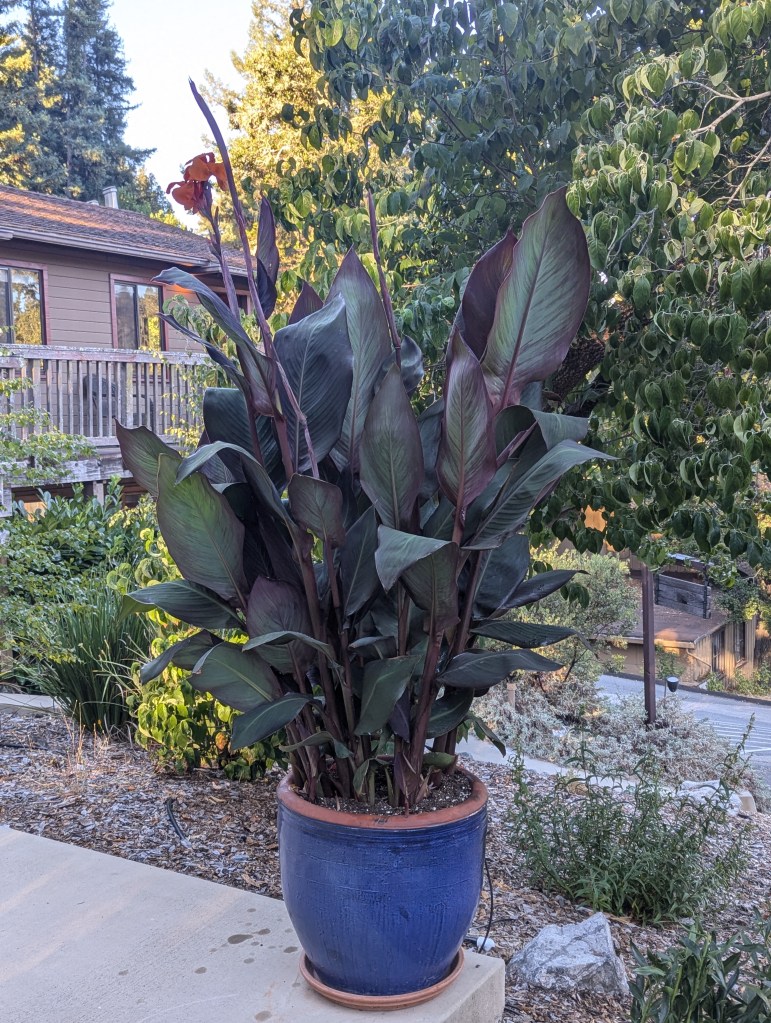
4. Canna X generalis ‘Inferno’ canna arrived with Canna musifolia. I think that it looks like ‘Wyoming’. Without a plan, we put this specimen into this ugly cobalt blue pot from a very dead Ficus benjamina houseplant that someone left for us, and now it looks RAD!

5. Hymenocallis festalis, Peruvian daffodil had been in the nursery for too long when we finally put all ten into three landscapes shortly before bloom. It is supposedly as reliably perennial as some of the more reliable types of Crinum. If so, it should be more popular.

6. Dahlia ‘Tabasco’ dahlia was purchased as a bedding dahlia, which implied that it is as disposable as annuals. However, this is its third season. It was originally red with orange stripes. Then, it was yellow with orange blotches. Now, it is this delightfully simpler red.

This is the link for Six on Saturday, for anyone else who would like to participate: https://thepropagatorblog.wordpress.com/2017/09/18/six-on-saturday-a-participant-guide/

Billbergia sanderiana

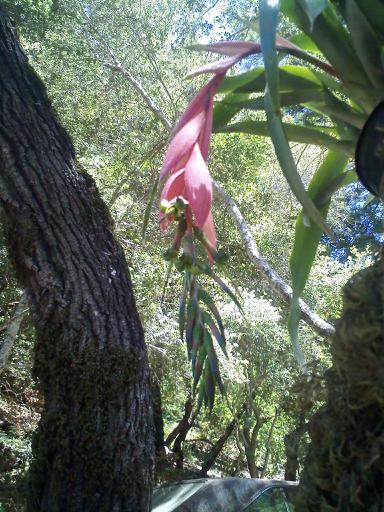
Billbergia sanderiana is like a larger version of Billbergia nutans.

To many of us, Billbergia sanderiana is really just a coarser version of the related and more common queen’s tears bromeliad, Billbergia nutans. The somewhat stiff leaves of the former are substantially wider but are actually shorter than those of the latter, less than a foot long. Billbergia sanderiana foliage has minute teeth for lightly snagging against flannel sleeves, and is sometimes spotted with white. The dense basal rosettes of foliage are always producing pups that can be divided to propagate copies for friends and neighbors.

Their nearly foot long flower spikes look like bunches of perch hanging from jigs on fishing poles. The small weird flowers buds are tipped with almost navy blue, with lime flavored Pez green at the base. These flower buds hang upside down, with their blue tips pointing downward at first. Their petals curl back and upward as they open. The bright pink bracts that wrap the stems that suspend these bunches of flowers puff out as bloom progresses. By the time the lemony yellow pollen laden stamens emerge, the most memorable colors of 1985 are represented.

All specie of Billbergia are naturally epiphytic (grow within the canopies of large trees) so their wiry roots are rather minimal and seem to cling to the inside of their pots while ignoring potting media (potting soil) within. They like to be watered regularly but not excessively while weather is warm, but do not need much at all through the cooler time of year. Their media should be very loose and drain well.

Bromeliads Are . . . Weird.

Tillandsias, to the left and right, as well as Spanish moss, which hangs downward throughout, are types of bromeliads.

After certain botany classes, some of my Cal Poly colleagues and I found it difficult to enjoy eating certain fruits and vegetables like we did previously. Simple things like pineapples, figs, potatoes and Brussels’s sprouts were much less appealing, or even unappealing, once we discovered what they really are. Yet, we also gained a bit more respect for these seemingly weird plants. Even though their adaptations do not always make sense to us, and some adaptations are a bit outdated by a few thousand centuries, or much more, many plants are remarkably adapted to their particular situations within their natural environments.      

Pineapple is still one of my less favorite ‘fruit’. However, the related bromeliads, of the family Bromeliaceae, are fascinating. Almost all are ‘stemless perennials’ with basal rosettes of foliage. (Their ‘stems’ are actually out of sight below their foliage.) Most are epiphytes that live within the canopies of larger trees or on exposed rock formations, sustained by whatever organic matter that happens to fall onto them from above. They are consequently very well adapted to confinement in pots, so can be quite happy as houseplants. A few bromeliads that live in deserts or other comparably harsh environments actually resemble yuccas.

Some people like to water large bromeliads  in the ‘reservoirs’ formed by the densely set leaves at the middles of the foliar rosettes. In the wild, these reservoirs naturally collect rainwater to use during drier weather. Bromeliads can either absorb moisture directly from their reservoirs through their leaves, or they release some of the water between their foliage to their roots below as their leaves lose turgidity (wilt slightly) because of a lack of rainfall or humidity. Either way, bromeliads really know how to conserve and ration water accordingly.

Many bromeliads are appreciated for their unusually colorful and often strangely textured foliage. Many have very interesting or downright strange flowers that mostly stand high above their foliage. The flashiest bromeliads have all of the above ; oddly textured and colorful foliage with interesting flower trusses outfitted with bracts (modified leaves that adorn flowers) that are so colorful that it is difficult to know where the foliage ends and the flowers begin.   

Travel

This does not happen often. Actually, it is quite rare, which is one of the consequences of enjoying my horticultural professions a bit too much. I almost never crave travel as I have been lately. Why should I? I live and work in such an excellent region which is excellent for horticulture and just about anything else. It is the sort of region that those who are not here travel to. Furthermore, there is nothing here that I want to get away from. In order to travel, I must first make obligations where I intend to travel to. Then, I can not change my plans for such travel. Even then, some of my obligations are horticultural pursuits, as if I must make work where I intend to go to compensate for my inability to take all of my work with me. I prune apple trees when I go to the Pacific Northwest. I procure regionally rare species where they are more available when I go to the Southwest. While vacationing in the region of Los Angeles last May, I spent a day greeting guests at one of Brent’s three landscapes that were featured on ‘Blooms With a View’, the Spring Garden Tour of View Park and Ladera Heights. I have no such plans anywhere yet. Now that it is late summer, it would be inconvenient to leave here for more than three days anyway. So, why should I so arbitrarily want to travel? I do not know. I suppose that I could go to the region of San Luis Obispo for Monday and Tuesday. I would like to find a pup of the regional variety of Hesperoyucca whipplei spp. whipplei that I first encountered while studying horticulture at Cal Poly there. But of course, I need no excuse to travel.

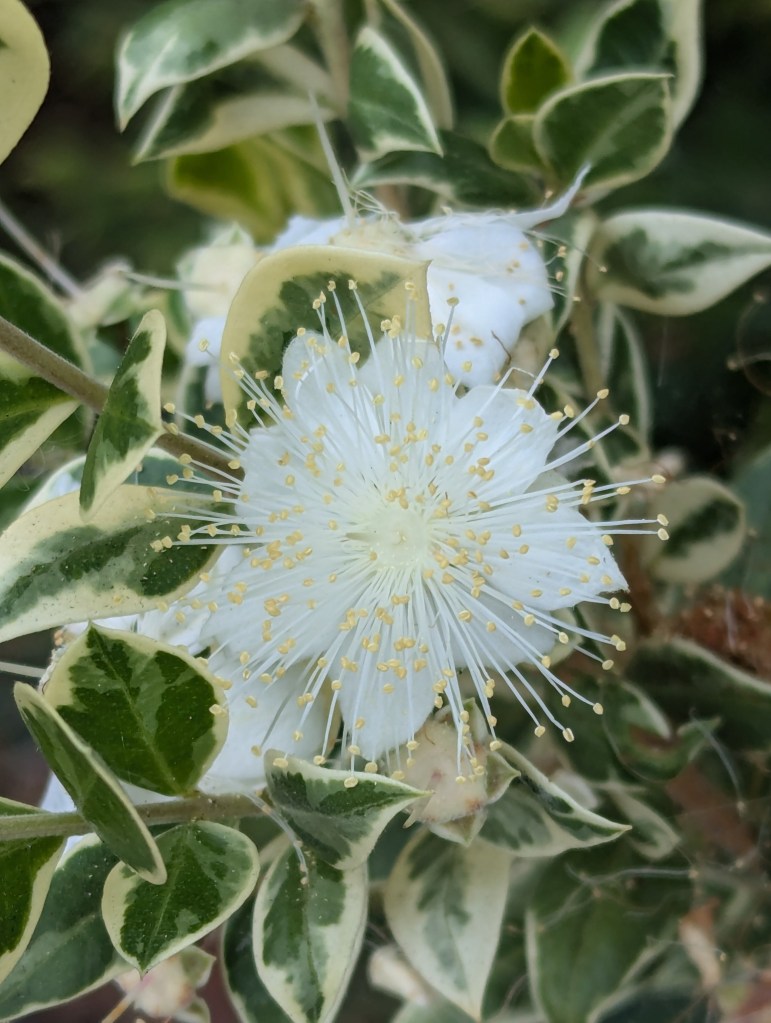
Myrtle

Myrtle is more foliar than floral.

Old landscapes of the Victorian Era may still include myrtle, Myrtus communis. It is quite a survivor. It had been popular for centuries because of its resiliency. It is very conducive to the sort of formal hedging that was popular during that time. As formal hedges became old fashioned, so did myrtle. Yet, it is still more sustainable than more popular shrubbery.

Besides, myrtle is not limited to refined shorn hedges. It can just as efficiently become an unshorn and informal hedge or screen. It can grow as tall as fifteen feet, but rarely grows higher than first floor eaves. Without pruning, it typically grows about half as wide as it is high. Selective pruning rather than shearing limits its size without ruining its natural form.

Myrtle foliage is densely evergreen and pungently aromatic. Individual leaves are merely an inch or two long. Small white flowers with prominent stamens may not be very showy. Small and darkly bluish black berries are sparse. ‘Compacta’ grows only about three feet high and wide. ‘Compacta Variegata’ is slightly more compact and variegated with white.

Planting Should Not Be Complicated

Soil amendment should not be excessive.

Autumn and winter are generally the best seasons for planting. Most vegetation is either less active than during other seasons, or dormant. It is therefore more complaisant to the distress of planting procedures. Weather is cooler and wetter than during other seasons. It is therefore less stressful to vulnerable vegetation recovering from planting procedures.

Nonetheless, planting continues throughout the year. Seasonal vegetables and annuals are seasonal at various times. Planting after any lingering chill or potential frost of winter is safer for several species. Also, planting commonly happens whenever it is convenient for whomever does it. Many species are most tempting whenever they happen to bloom.

Generally, this is no problem. Planting while vegetation is active during warm weather is riskier but feasible. It should preferably happen after the warmest time of day. Weather is likely cooler after three in the afternoon. Unusually hot weather justifies delay for another day. Once planted, thorough soaking settles comforting wet soil around vulnerable roots.

Realistically, most planting techniques and concerns are the same regardless of season. The processes only have more potential to be more stressful now than during dormancy. A few species are actually dormant during summer or even spring. Several spring bulbs, such as narcissi, are now ready for division or relocation. Bearded iris rhizomes are also.

Soil amendment helps new plants to feel more comfortable within their new situations. It encourages them to extend roots from their original media into surrounding soil. It should not be excessive though. Contrary to overly popular belief, it is unnecessary below roots. New plants can sink detrimentally below grade if amendment or loose soil below settles.

Stakes for trees that need them must extend past roots and into solid soil below. Binding nursery stakes should be loosened or removed if possible. Binding, which initially keeps trunks straight, can later interfere with trunk development. All new plants need systematic watering through dry seasons until they disperse roots. Most appreciate a layer of mulch, to retain moisture and insulate.

Down On The Corner

Yucca elephantipes at Taco Bell in San Luis Obispo in 1968.

Down on the corner, or at least next door to the western corner of Olive Street at Santa Rosa Street in San Luis Obispo, Creedence Clearwater Revival stopped at Taco Bell, supposedly about the second of August of 1968, on their way from Palo Alto to Santa Monica. They were famous for such horticultural songs as ‘Run Through The Jungle’, ‘Have You Ever Seen The Rain’, ‘Cotton Fields’ and ‘I Heard It Through The Grapevine’, which I incidentally remember playing on the radio as I drove over the Grapevine Highway on my second trip to Los Angeles sometime in about 1987. This particular Taco Bell is conveniently located for travellers, since its corner location is also the interchange of southbound Highway 101 and Highway 1. The two highways are concurrent to the south. The original Taco Bell building has been replaced with a larger modern building that also occupies the parcels to its left and right, so that it really is down on the corner now. A bit more than eighteen years after the picture above was taken, in autumn of 1986, Brent and I became very familiar with the original. It was the scene of one of his more notorious adventures, which is too naughty for me to describe here. Another tamer incident involved the relatively small giant yucca, Yucca elephantipes, to the lower right in the picture. It was larger by 1986, and prior to one of our visits to Taco Bell, it had suspiciously deposited a few small limbs onto the sidewalk. Upon closer inspection, we found bits of pulverized chrome plated plastic and an emblem from what was likely a relatively new Cavallier of the early 1980s. Of course, we could not just leave the yucca canes there on the sidewalk to eventually be disposed of. We loaded them into the trunk and took them back to our dormitory, where we shared them with neighbors. The smallest shoot grew in a can of soil in our dorm room until it matured enough to also be given away. Because I sort of enjoyed it while it was there, Brent gave me a larger and more impressive specimen with an even more scandalous history a few years later. I have grown hundreds of giant yucca specimens since then, but the original that Brent gave me before 1990 is still here. I wonder if any of the others survive.