Six on Saturday: Off Color Angel’s Trumpets

Angel’s trumpet continue to bloom even as the weather cools. Perhaps they will continue until frost. Their floral color is a bit off though, perhaps as a result of the cooler weather. They work out nicely for ‘Six on Saturday’, though. Strangely, not much else is blooming as well as angel’s trumpet is now.

1. Angel’s trumpet probably should not bloom so late, but does not seem to know or care that it is autumn. I was impressed by a previous bloom phase, so will see what this does.

2. This is a more open flower of the same angel’s trumpet as above. Its floral color is the most variable of the cultivars, but has most commonly been more peachy pink than this.

3. This angel’s trumpet flower should be frilly double white. I suppose that it is not so off color. However, it is barely frilly, and lacks double form. I can not complain. It is pretty.

4. This angel’s trumpet flower blooms with the peachy pink color that #2 should exhibit, but should bloom yellow. Again, I can not complain. I just wonder what is going on here.

5. If I remember correctly, this rhododendron is not off color like some angel’s trumpets are but it is very off season. My complaint is that it will not bloom for spring as it should.

6. Rhody might disapprove of all this off color commentary if he were not so thoroughly distracted by someone with goodies. He can not see the same colors as humans anyway.

This is the link for Six on Saturday, for anyone else who would like to participate: https://thepropagatorblog.wordpress.com/2017/09/18/six-on-saturday-a-participant-guide/

Blood Red Trumpet Vine

Blood red trumpet vine can get aggressive.

Abundant lush foliage is actually the main asset of blood-red trumpet vine, Distictis buccinatoria, with the sporadic clusters of three inch long tubular flowers blooming as an added benefit during warm weather. Bloom can certainly be impressive when least expected though; and has a sneaky way of getting a late blast of color out during Indian summer weather patterns, when the weather gets warm after a cool phase in autumn. Contrary to the name, the flowers are more ruddy orange with yellow throats than blood red. The rich green leaves are compound, with a pair of three inch long leaflets and a three fingered tendril reaching out from between.

The vines are somewhat aggressive and can climb more than twenty feet, so need adequate support. They should not be allowed to overwhelm smaller or slower plants, or escape out of reach into adjacent trees. The tendrils can grab onto and damage shingles and light fences, but are an advantage for covering chain link fences. Given the opportunity, blood-red trumpet vine can even climb rough cinder block or stucco walls.

Autumn Planting Of Spring Bulbs

Spring bulbs start now.

Some of the most familiar flowers to bloom in the earliest of spring get planted now as bulbs. They sit and wait in the garden to finish their dormancy, perhaps get a bit of a chill through winter, and get an early start to their bloom cycles as soon as weather permits. Because winters are so mild here in the Santa Clara Valley, some do not even bother to wait for spring, but are instead happy to start bloom before winter ends.

Bulbs become available in nurseries when they can be planted. Those that are not available yet will become available when it is time to plant them for later spring or summer bloom. The first to become available are generally the first to bloom; although bearded iris seem to know when they want to bloom, regardless of when they get planted.

As long as they do not get stored too long or get planted too late, bulbs do not need to be planted immediately, and actually extend their performance if planted in phases. The earliest phases to get planted will bloom earliest. Phases of the same bulbs planted a few or many days later should bloom about the same amount of time later.

With proper planning, later phases bloom as earlier phases finish. For example, because crocus flowers do not last very long, different phases of bulbs can be planted only a few days or a week apart, so that more flowers start to bloom in time for earlier flowers to fade. Freesia flowers last a bit longer, so different phases can be planted two weeks or so apart.

Narcissus and daffodil bulbs are not so discriminating about how deeply they get planted, so various phases can be put in the same spots. As long as they do not get planted too deep, the earliest phases can be planted deep and covered with only a bit of soil, so that later phases can be planted above. If similarly covered with only a shallow bit of soil, later phases of the same bulbs can be stacked, as long as the last and shallowest phase still gets planted deep enough.

Not many bulbs are actually real bulbs. Most are corms, tubers, rhizomes or tuberous roots. They all do the same thing though; store resources through dormancy to sustain quick bloom as weather allows. Although many bloom reliably only once in their first season, some naturalize to bloom at about the same time each year. Tulips are capable of naturalizing, but rarely get enough chill in winter to bloom after their first season.

Anemone (windflower), hyacinth, lily, rananculus, tulip and small colorful callas are the less reliable of spring bulbs after their first year. Crocus, freesia, hymenocallis and harlequin flower can be more reliable if they get what they want. Grape hyacinth, narcissus, daffodil, watsonia, bearded iris and the old fashioned white callas are the most reliable of bulbs that get planted about now.

Pet Rock

It has been nearly seven years since I documented the discovery of this mysterious Pet Rock in a hanging pot of zonal geranium at work. Until only recently, it had remained where it was for all this time. I did not want whomever left it to return to find it gone. Even after the zonal geranium were replaced with ivy geranium, it was returned to its original position. Unfortunately though, the ivy geranium did not perform much better than the original zonal geranium, so their hanging planters were recently removed completely with no plans to replace them. The Pet Rock was regrettably removed with them. There are no other planters nearby to deposit it into. I can only hope that whomever left it will not miss it. Realistically, I suspect that it was forgotten about shortly after it was left there. The difficulty is that I do not know. Well, the Pet Rock remains in the nursery at work, just in case someone asks about it. Perhaps it will eventually be deposited elsewhere in a landscape for someone else to wonder about. Perhaps that is how it was deposited into the hanging pot of zonal geranium where I found it!

Chinese Pistache

Chinese pistache develops fiery foliar color.

Chinese pistache, Pistacia chinensis, does not need too much chill to begin to turn color. In some climates, it is already yellowing. With cooler weather, it will develop fiery orange and red foliar color. Not only does it color reliably with mild weather, but it actually retains its color better. It could defoliate more efficiently within frostier, windier or rainier weather.

Chinese pistache grows about thirty feet tall and broad. Old trees can eventually grow to about forty feet tall. Some old trees are female, so can produce annoyingly abundant red berries. Modern trees should be fruitless male cultivars. Pinnately compound leaves are about nine inches long, with a dozen or so leaflets. Leaflets are two or three inches long.

Because of its resiliency, Chinese pistache is among the more popular shade trees here. Established trees do not need much irrigation and can likely survive with none. Frequent irrigation can promote shallow root dispersion, which can damage pavement. Otherwise, Chinese pistache is a good street tree. It merely needs pruning for clearance over roads, sidewalks and driveways.

Autumn Foliar Color Is Chill

Sweetgum excels at autumn foliar color.

Cool season annuals are not the only options for home garden color for autumn. Even in mild climates, deciduous foliage eventually notices increasing autumn chill. While some merely sheds, some first develops spectacular autumn foliar color. Such foliage is not as conducive to instant addition to gardens as annuals are. Yet some may already be there.

A few deciduous shade trees and street trees provide the best autumn foliar color. Some are less popular with those who prefer evergreen trees. However, they are quite practical for some situations. Some are less messy than evergreen trees. They only seem messier because they defoliate so much at once. Most evergreen trees shed throughout the year.

Sweetgum, or liquidambar, probably provides the most colorful autumn foliar color. It also happens to be among the messier deciduous trees. That is because it retains its colorful foliage later into autumn and winter. While prolonged mess is a disadvantage, prolonged foliar display is an advantage. It is an unwieldy large tree, though, with aggressive roots.

Chinese pistache is as colorful, with dazzling yellow, orange and red autumn foliar color. It seems a bit less messy because it defoliates a bit sooner. Also, it does not produce the spiky seed capsules that sweetgum trees produce. However, its smaller leaves require a bit more effort to rake than larger leaves. Chinese pistache is a rather popular street tree.

Flowering pear, or callery pear, produces similar autumn foliar color, with more deep red. It also provides billowy white spring bloom. Crepe myrtle is a smaller tree with both vivid autumn foliar color and summer bloom. Ginkgo is a tall and slender tree with exclusively brilliant yellow color. Boston ivy is a clinging vine that is as colorful as Chinese pistache.

Not all deciduous trees produce impressive autumn foliar color. Sycamore might already be defoliating with just a bit of pale yellow color. Valley oak does the same later. Both are quite messy as they defoliate slowly through much of autumn. However, both are notably sculptural while bare later through winter. There are other advantages to deciduousness.

Six on Saturday: Miscellaneous

Both work and home gardening were relatively mundane this week. Consequently, these six lack a theme. Irrigation is at that awkward phase when less is necessary, but it is still very necessary. No more rain came after the first storm of the season, but the weather is cooler, and the days are shorter. Autumn is arriving . . . slowly. Maybe I will get pictures of autumn foliar color for next Saturday.

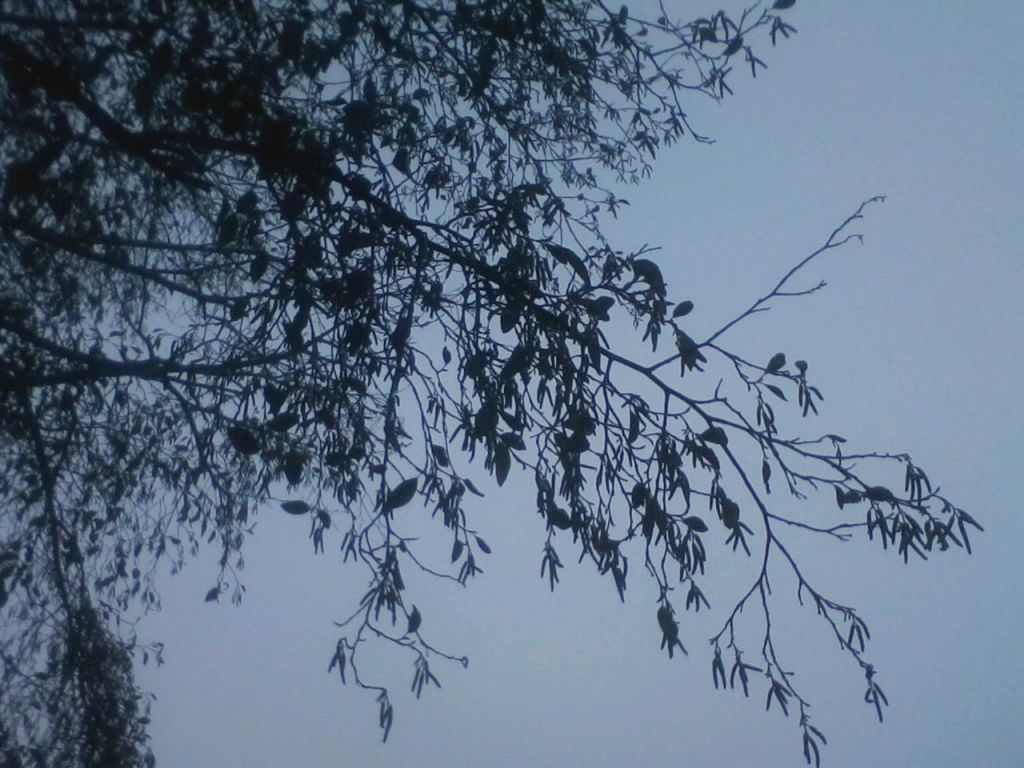
1. Robinia pseudoacacia, black locust is much more out of focus than I was aware of as I took this picture to show how blue the sky is without any rain in the foreseeable forecast.

2. Begonia X semperflorenscultorum, wax begonia succumbed to a major infestation of fungus gnat larvae. These fresh cuttings were made from their unaffected upper growth.

3. Amaryllis belladonna, naked lady seedlings grew from seed from white flowers. They will not bloom for several more years. I am curious to see if they might also bloom white.

4. Saccharum officinarum, sugarcane probably should not have been bothered until the end of winter, but I separated five clumps. This is the traditional Purple Ribbon cultivar.

5. Acer rubrum, red maple is redundant to a picture of the same two Saturdays ago, but is too pretty to not get a last picture of before the end of its season. It is mostly bare now.

6. Rhody was busy with relaxation while I was at work on Thursday. He is commendably proficient with such tasks, while not being late for petting sessions and treats afterward.

This is the link for Six on Saturday, for anyone else who would like to participate: https://thepropagatorblog.wordpress.com/2017/09/18/six-on-saturday-a-participant-guide/

Sticks on Fire

Sticks on fire is a more colorful and more compact version of pencil tree.

The old fashioned pencil tree, with leafless, succulent stems is a strikingly strange plant already. In mild climates of coastal Southern California, it can get quite large, nearly ten feet broad and twice as high. Sticks on Fire, Euphorbia tirucalli ‘Sticks on Fire’, stays less than half as large, but is even weirder because the stems are so oddly colored.

The inconspicuous leaves drop almost as soon as they develop, leaving distended fleshy stems that are either reddish or yellowish orange. Stems fade to softer yellow through summer, and then turn red in winter. Size and growth rate are limited by a lack of chlorophyll. Although related to poinsettia, the flowers of sticks on fire are not significant.

Sticks on fire prefers full sun exposure and warmth, but unfortunately needs protection from frost during winter. It can be happy under an eave on a south or west facing wall, or in a large tub that can be moved to shelter during winter. Plants in tubs are a bit more sensitive to rot if watered too frequently. The sap of sticks on fire is very caustic to skin and can be dangerous if it gets in the eyes.

Village Harvest

The Santa Clara Valley was formerly famous for fruit and nut production.

(This article is recycled from several years ago, so contains outdated information.)

The vast orchards that formerly inhabited the Santa Clara Valley were here because this is among the best places on Earth to grow apricots, cherries, prunes, almonds and walnuts. Actually, there are not many fruit trees that would prefer to be somewhere else. Home gardens continue to produce the many traditional fruits, as well as many other types of fruit that were not so common in the orchards; such as citrus, figs, apples, pears, persimmons, avocados, peaches, nectarines and too many more to fit into a brief list.

Those of us who enjoy growing fruit trees do not need to be reminded of how well they do here. Some trees produce too much and  can become overwhelming. It is not always possible to can, dry, freeze or share with friends and neighbors all the fruit from the more productive trees. Leaving the fruit out in the garden is not only wasteful, but also bad for the garden, attractive to vermin, very messy and smelly.

Besides, there are other people in the community who could use it. During this past year, Village Harvest has harvested from local gardens, and distributed to those who can use the produce, approximately 156,000 pounds of fruit. The record for distribution of produce may be exceeded this year after apples, persimmons and citrus are harvested.

Volunteers make Village Harvest possible, by collecting excessive fruit from home gardens. Some of the people with productive trees like to retain some of the fruit. Volunteers are also welcome to take some of the fruit. The vast majority of fruit gets dispersed to others in the community who can use it.

(Most of the following information is outdated.)

The next apple harvest event in the Cupertino orchard on October 22 may no longer be able to accommodate additional volunteers; but the next major apple harvest in the Woodside Orchard on October 29 may still be in need of volunteers. Harvests take about three and a half to four hours, between 9:00 a.m. and 12:30 p.m.. Volunteers must be at least sixteen years old.

Volunteers can register for harvest events, or get more information at villageharvest.org. Early registration is recommended since space is limited. Volunteer instructions, including meeting location addresses will be e-mailed to volunteers a few days prior to each event. Those of us with excessively productive fruit trees who happen to be within range of harvest events can possibly make arrangements to get fruit harvested.

The next few neighborhood harvests will be on October 25 in Central San Jose, October 31 in Sunnyvale, November 1 in Central San Jose, November 6 in Mountain View, November 8 in Central San Jose, and November 14 in Sunnyvale. Sunnyvale harvests begin at 8:00 a.m.. Some harvests are repeated. For example, the Central San Jose harvests are weekly on Tuesday.