Horticulturists are by nature, nonconforming. I happen to find it difficult to conform to what makes us nonconforming. Trends are fleeting. Old technology that has worked for decades or centuries is still best. Although I am not totally against chemicals, I find that almost all are unnecessary for responsible home gardening. Pruning is underappreciated, and fixes many problems.
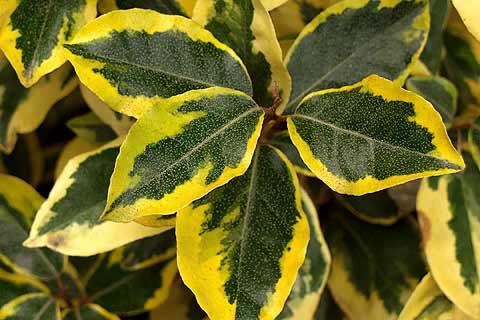
Most modern silverberry is variegated with yellow or white.
Old fashioned silverberry, Elaeagnus pungens, has always been useful for large informal hedges and barriers in difficult locations. It may not be as refined or as bright green as other plants that are more commonly used for formal hedges; but it is more adaptable to harsh exposure, since it has no problem with heat and reflected glare.
If necessary, silverberry can be shorn like privets, but is at its best with only occasional selective pruning to keep it within bounds. Without pruning, it can grow to more than ten feet high and nearly as wide. Despite its slower growth at maturity, it grows faster and fills out quite efficiently while young.
All parts of silverberry are covered with slightly raspy and silvery or ‘rusty’ tomentum (fuzz – although it is not exactly ‘fuzzy’). The one to two and a half inch long leaves often have undulate margins. The less than abundant, half inch long brownish berries taste better than they look. Somewhat spiny vigorous stems efficiently deter intrusion. Trespassers that might get through them once will not try again.
Modern cultivars (cultivated varieties) are neither as rugged as the straight species, nor as large, but have more colorful foliage. Leaves of ‘Variegata’, which is shown in the illustration, have lemony yellow or nearly white margins. ‘Marginata’ has brighter white leaf margins. ‘Maculata’ leaves are instead equipped with bright green margins around bright yellow centers. ‘Fruitlandii’ has larger silvery leaves.
(This article is recycled from many years ago, so contains very outdated information.)
Many succulents are remarkably easy to propagate from cuttings.
Succulent plants that were so trendy during the 1970’s seem to be gaining popularity again. This is actually one of the few trends that I like to see, since succulents are such useful and practical plants in modern urban gardens. Although some cacti, agave and larger succulents become quite imposing, most other succulents are quite compact and proportionate to small garden spaces. Some can by happy in the partial shade of atriums and under eaves. Succulents generally do not need much attention, are remarkably easy to grow, and are even easier to propagate. Most do not need much water.
‘Gardening with Succulents’, with master gardener Laura Balaoro and the Guadalupe River Park Conservancy, is a great program for experiencing the potential for succulents in containers and the garden. There will be several samples of container gardens to demonstrate some of the many possibilities for succulents, as well as their variety of textures and colors. Common pathogens, propagation methods, succulent that grow through winter, and succulents that are adaptable to partial shade will all be discussed. After a planting demonstration, there will be free cuttings for those who can not wait to add new succulents to their gardens.
‘Gardening with Succulents’ is only in a few days, from 10:00 a.m. to noon on September 11, so it is important to register right away by telephoning 298 7657 or online at www.grpg.org. If this program gets full to capacity first, there are many other interesting classes and programs described at the website for later. Admission is $15, or $10 for members of Friends of Guadalupe River Park and Gardens. ‘Gardening with Succulents’ will be at the Guadalupe River Park and Gardens Visitor and Education Center, which is located at 438 Coleman Avenue in San Jose.
Nearby in the San Jose Heritage Rose Garden, the last of the Rose Deadheading Blitzes will be from 5:00 to 7:30 p.m. on September 14, in order to remove spent blooms and promote more blooms before autumn. Volunteers should bring pruning shears and gloves, and wear closed-toe shoes; and of course, stay for ice cream afterward. (Loaner shears are available if necessary.) The San Jose Heritage Rose Garden is located on Taylor Street at Spring Street, just east of Coleman Avenue. Visit www.grpg.org or telephone 298 7657 for more information or to register.
There is nothing wrong with this picture yet. It simply shows African daisy as it begins to encroach into a row of lily of the Nile. Because it is already September, we will delay the pruning of the African daisy to maintain clearance from the lily of the Nile. Then, we can process the pruning debris into cuttings that we can plug into areas where we want more African daisy. These cuttings can grow slowly and disperse their roots through cool and rainy autumn and winter weather to be ready for next spring and summer. It is how a bit of something that is undesirable here can be desirable somewhere else. That is how the lily of the Nile arrived here. It needed to be removed from where it had migrated beyond its preferable confinement, so was relocated to become an asset to another landscape.
So called ‘gardeners’ would do this very differently; partly because, within their stringent schedules, they have no time to process cuttings or divide perennials, but partly because it is less profitable. They would be more likely to shear a neat edge for the African daisy whenever it happens to be convenient for them, and then efficiently dispose of all of the debris. If more African daisy is necessary elsewhere, they would purchase and install it, and charge their client accordingly. The lily of the Nile would probably not be here, since they would have likely disposed of it immediately after digging it from where it needed to be removed from. If any were desirable here, they would purchase it from a nursery and install it, and, of course, charge their client accordingly. Ultimately, their technique might not be much more expensive, but it is nonetheless wasteful, and frustrating to those who are aware of it.
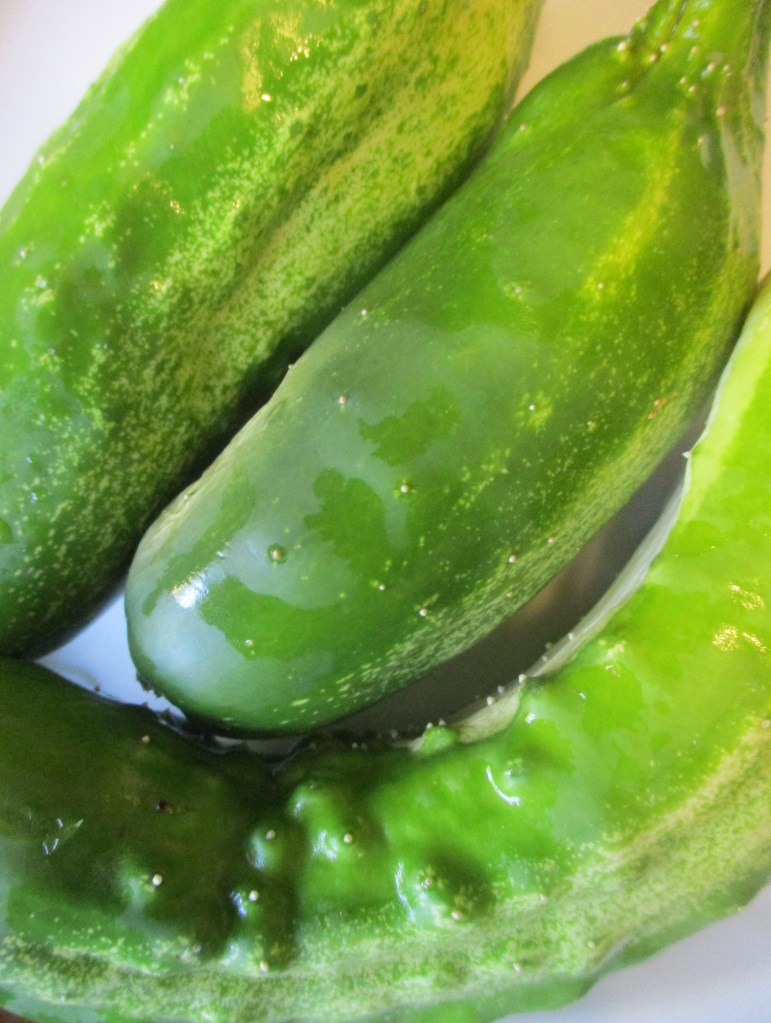
Cucumber, Cucumis sativus, technically qualifies as a summer vegetable. Several types can be productive through the warmest of summer weather. However, locally arid warmth can cause fruit of many varieties to be bitter. Such varieties perform better through spring or autumn instead of summer. Their seed should start a month or so before their season.
Individual cucumber vines are productive for less than a month anyway. Those that grow through summer will need occasional replacement to stay productive. Even within a brief spring or autumn season, more than a single phase is possible. Summer aridity does not limit performance for all varieties, but winter frost does. Consistent irrigation is important.
Most of the many cucumber varieties classify as slicing, pickling or seedless cucumbers. The biggest can potentially grow two feet long or four inches wide. The most popular are best before they mature, though. They are ready for harvest when just a few inches long. Regular harvesting promotes continuous production. Vines can climb about six feet high.
Winter bedding plants are a reminder. They become in season at about the same time as winter vegetables. Therefore, as pansies replace petunias, turnips may begin to replace okra. As for bedding plants, it is a slow process that can continue until frost. Some winter vegetables start earlier than others. Some summer vegetables produce later than others.
For example, young okra plants that started late can continue to be productive until frost. There is no need to replace them until then. Instead, older okra plants that started earlier also finish and vacate their space earlier. Early phases of turnip seed can use this space as it becomes vacant. Then, later phases of turnip seed can replace later phases of okra.
Winter vegetables, or cool season vegetables, do grow slower than summer vegetables. In that regard, spring and summer warmth is an advantage. Consequently, recovery from delays is not as easy for them. More winter vegetables than summer vegetables are true vegetables. In other words, they are not fruit that contain seed. Many are distended roots.
This is why most winter vegetables should grow directly from seed. Root vegetables are susceptible to disfigurement from transplanting. Also, most usually grow in quantities that are impractical for transplanting. Most winter vegetables that are practical for transplants grow big above ground. This includes small groups of broccoli, cauliflower and cabbage.
Because broccoli, cauliflower and cabbage are so big, only a few of each are necessary. One or two cell packs of seedlings may be sufficient. They may not cost much more than packets of seed. Also, they are immediately ready for transplant. Seed must start growing earlier, in cells, flats or in their gardens. However, more varieties are available from seed.
Beet, carrot, radish, turnip and parsnip are roots that must grow from seed. Baby lettuces grow from seed because they are so numerous. Hedding lettuces can grow from seed or seedlings. So can peas and cucumbers, but they are more likely to grow best from seed. Successive sowing or planting prolongs production time of almost all winter vegetables. Subsequent phases begin production as their preceding phases finish.
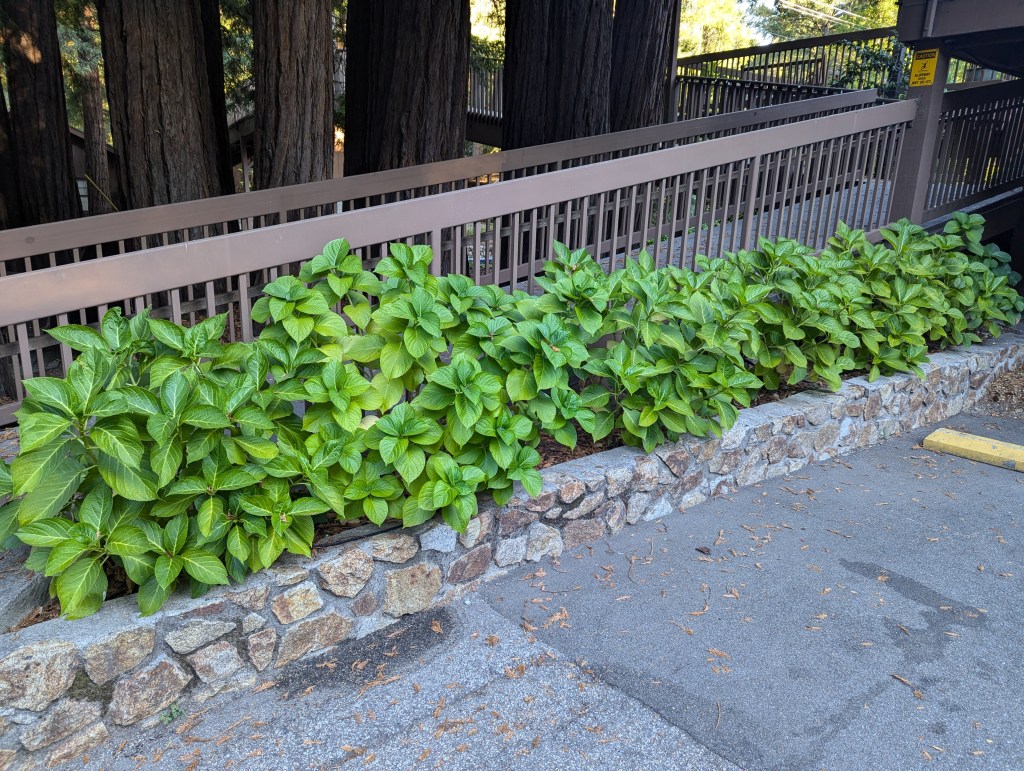
This hedge of modern Hydrangea is completely devoid of bloom.
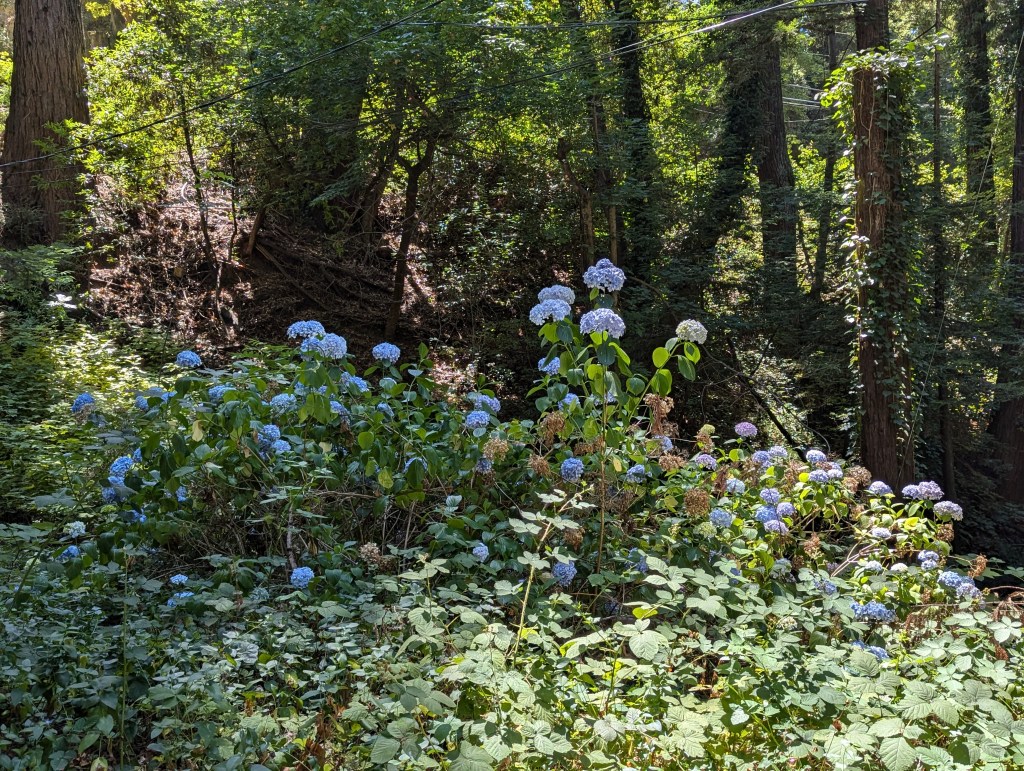
Modern cultivars of Hydrangea were not easy to adapt to. I learned how to prune old fashioned cultivars during their winter dormancy. I knew to retain the terminal buds of their retained canes to bloom for their following season. Pruning canes of modern cultivars back shorter and depriving them of their terminal buds in order to promote shrubbier growth seemed to be more like pruning roses. I did not trust them to bloom without their terminal buds. Not only do they bloom, but they do so a bit more abundantly, and with sturdier floral trusses that last and retain their floral color somewhat longer than those of old fashioned cultivars. Old fashioned cultivars have bloomed so reliably for the past few years that I am not so hesitant about pruning them back. However, this year, they inexplicably did not bloom. I do not mean that they bloomed sparsely, or that a few of the total did not bloom. I mean that none of the modern hydrangeas bloomed at all. The only hydrangeas that bloomed within the landscapes at work this year are the few remaining old fashioned sorts. All of the hydrangeas are healthy with vibrantly green foliage. Neither disease nor insect pathogens have been problematic. I can not explain this odd lack of bloom. With such vigorous canes, pruning should be easy this winter. However, I am more likely to leave awkwardly long canes in order to retain their terminal buds. Even if they are not necessary, terminal buds might provide an earlier prebloom prior to the bloom of stems that grow from lateral buds. I can not help but wonder why, while modern cultivars did not bloom, old fashioned cultivars did. A colony of unpruned feral Hydrangea near the bank of Zayante Creek was unusually prolific in bloom.
Heather just became a bit less mysterious. We now know why she came here to work as a mouser, and protect fruits and vegetables from rodents. A neighbor, prior to relocation to Hawaii, left her and a few other kitties with another neighbor who intended to find new homes for them. Another kitty who already lived at the second home was so inhospitable to her that she stayed outside most of the time, and eventually disappeared. She was assumed to have been a victim of coyotes. All but one of the relocated kitties, who happens to be Heather’s mother, were assigned to new homes. Heather’s mother and the original kitty of the household then relocated a few miles away. It is impossible to know where Heather was between leaving her previous temporary home and arriving here. She could have been here longer than anyone was aware of. Because we knew nothing about her when she arrived, she likely got more vaccines than she needed. She was already spayed, although not provided with a chip. Ultimately, she seems to be happy here, and has been very proficient with dissuading rodents. I am pleased that she is happy and decided to stay.
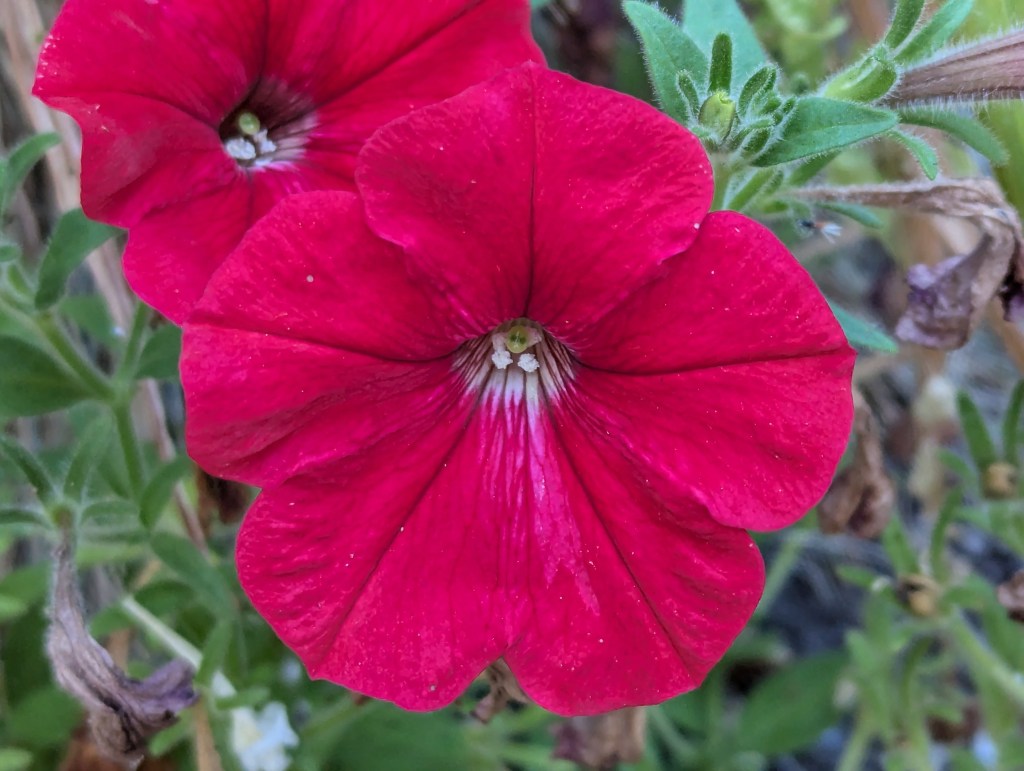
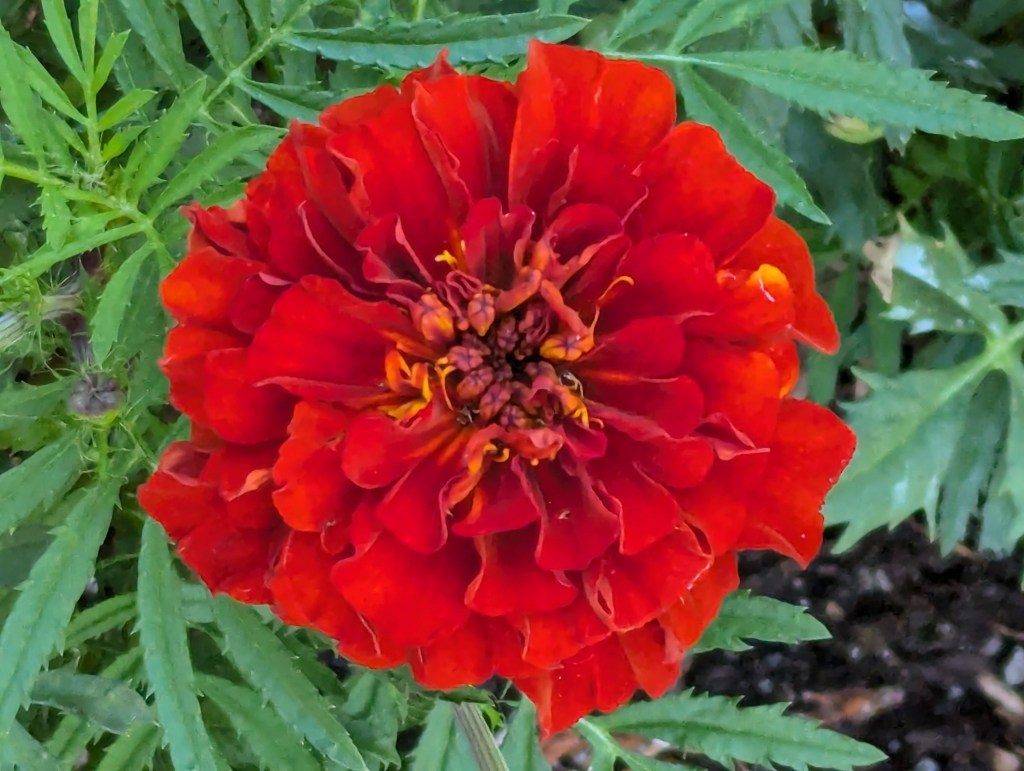
Cool season annuals are beginning to replace warm season annuals not because weather is beginning to cool for late summer, but because warm season annuals are beginning to deteriorate after their long and warm summer. Deterioration of remaining petunias was accelerated by warm weather today. It was warmer than a hundred degrees. Fortunately, marigolds are the first and only cool season annuals that were added into the landscapes already and they tolerate such warmth. I believe that they are varieties of ‘Durango’. I do not know what the petunias that they are replacing are, but they resemble old fashioned red, white and blue varieties of ‘Madness’ that were too popular during the Bicentennial Summer of 1976, although a comparable white variety is notably lacking.
1. ‘Madness – Blue Vein’, if I remember accurately, looks something like this. Its name is not as appealing as its color, and might have been less appealing in the summer of 1976.
2. ‘Madness – Blue’, which looks like this, was one of the three most popular varieties for the summer of 1976, with ‘Madness – Red’ and ‘Madness – White’, but is almost purplish.
3. ‘Madness – Red’ is more convincingly red, very much like this, and just like ‘Madness – Blue’ and ‘Madness – White’, was very popular in profusion through the summer of 1976.
4. ‘Durango – Gold’ is not very different from marigolds that were overly popular during the 1970s, when ‘Madness’ petunias were popular. I do not know when it was developed.
5. ‘Durango – Orange’ is just as familiar as ‘Durango – Gold’ because of its similarity with old fashioned varieties. Only a few specimens of ‘Durango – Flame’ are blooming nearby.
6. ‘Durango – Red’ is the only of these Six that, to me, does not seem to resemble the sort of varieties that were popular in the 1970s likely because red bloom was developed later.
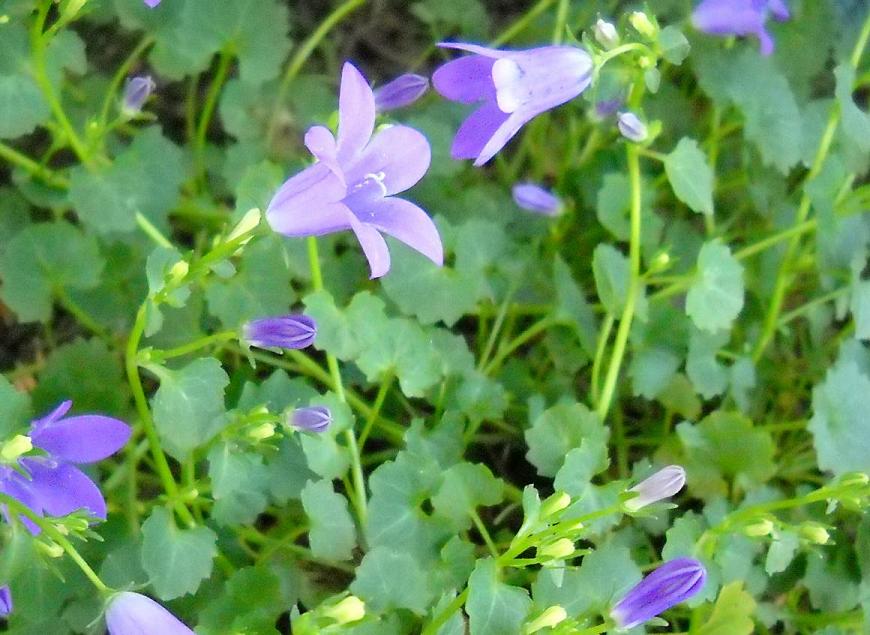
Many home garden Campanula are easier to identify by cultivar name than by species.
Of the hundreds of varied Campanula (Campanula spp.) that can be found in the wild, almost all of the few grown in gardens are small scale ground covers or creeping perennials, with blue or white bell or star shaped flowers. Most campanula fill in nicely between clumping perennials, and will spread wherever they have other plants or features to shelter them, although they are rarely reliable as ground cover for exposed areas. Campanula can be grown from seed, but is easiest to propagate by division. Pieces trimmed off from around the edges or pulled out of shrubbery also root very easily.
(This article is recycled from several years ago, so some of its information is irrelevant to current conditions. Also, it posted more than half a day late.)
Weather should but does not always get cooler at this time of year.
After the coolest July in a century, and one of the mildest summers in memory, the recent warm weather at the end of August seemed unseasonable, even though it is actually not unusual for this time of year. Predictions of an Indian summer for this year were made shortly after predictions for this past El Nino winter materialized. The ash blasted into the atmosphere by a volcano in Iceland may have changed all that. No one really knows. The weather continues to change like the weather.
For right now though, the damage caused by the sudden warmth is becoming evident. Fortunately, most of the damage is harmless and should be gone by winter. Some is a bit unsightly. The desiccation of small or potted plants may unfortunately be as serious as it looks. The most severely damaged plants may not recover.
The yellowing inner foliage that eventually turns reddish brown in redwood trees is actually a normal response to foliar desiccation that results from warm or dry weather. As long as the outer foliage remains healthy, this discoloration is harmless. Inner foliage that is more expendable is merely being shed to conserve moisture for the more important outer foliage. This shedding foliage will deteriorate and get cleaned out by wind and rain in autumn.
This older foliage typically sheds naturally throughout summer. However, because the summer was so mild, much of the foliage that should have been shed was not shed. As the weather only recently but suddenly became warm, all the foliage that should have been shed earlier became discolored and began to shed at the same time, which is why it is now so much more noticeable.
A few other trees are also shedding some of their foliage. Trees in areas that are not landscaped or watered may drop dried leaves in even slight breezes. Leaves of deciduous trees that would be colorful and pliable if they fell on schedule in autumn are instead crispy and brown. Maple, oak, ash, sycamore (including plane), willow, poplar, eucalyptus and madrone are among the most affected. Fortunately, this is a harmless response to the warm weather after such a mild summer.
Some Japanese maples are damaged more significantly, but should recover. Because they are naturally understory trees (which prefer to grow in the partial shade and ambient humidity of larger trees), they are not well adapted to warm and dry weather, particularly if it becomes warm as suddenly as it recently did. Some got roasted so quickly that the foliage stays attached to the stems as it shrivels and dries. Foliage that is still partially viable (and hopefully functional) should fall in autumn and winter. Foliage that is necrotic (dead) may linger until it is forced to fall by new foliage that emerges next spring.
Potted plants that were desiccated by the heat may not be so fortunate. Even though they can be unsightly, roasted plants that may be rooted into the ground through their drainage holes should not be moved right away, since the roots that are in the ground are the least damaged and the best hope for recovery. Similarly, roasted plants that hang over the edges of their pots should not be pruned back too severely until later, since exposing the pots to more sunlight will cause more heat to be absorbed if the weather gets warm again.