Horticulturists are by nature, nonconforming. I happen to find it difficult to conform to what makes us nonconforming. Trends are fleeting. Old technology that has worked for decades or centuries is still best. Although I am not totally against chemicals, I find that almost all are unnecessary for responsible home gardening. Pruning is underappreciated, and fixes many problems.
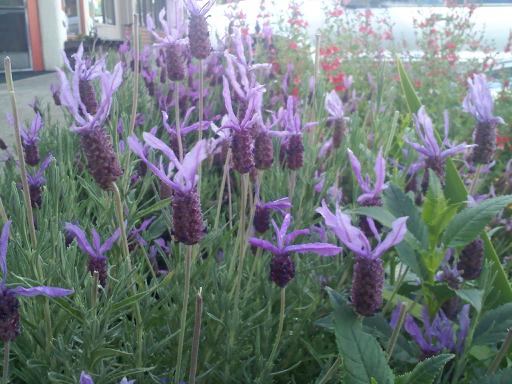
It is neither as variable as the many varieties of English lavender, nor as traditional as French lavender, but Spanish lavender, Lavandula stoechas, has the most unusual flower spikes. These short plump spikes are less than two inches long, but are topped with one or two pairs of distended terminal bracts that are almost as long; like simple little packages with big ornate bows. The flower spikes get their color from densely set bracts that surround the minute flowers, and can be various shades of purple or purplish pink or even grayish white. The large terminal bracts are lighter shades of the same colors.
Bloom begins during warm spring weather and continues into summer. Flower may stay close to foliage on stems less than two inches long, or may stand more than six inches above the foliage. The aromatic grayish leaves are narrow and about an inch long.
Mature plants may be three feet wide, and nearly as tall. Aggressive shearing after bloom promotes secondary bloom later, and keeps plants compact. Without pruning, old plants eventually die out in the center.
All lavenders want good drainage and good exposure, but do not want mulch or fertilizer. Inadequate drainage, crowding or mulch can promote rot. Fertilizer can inhibit bloom. Once established, lavenders do not need much water.
Foliar aromas and flavors that are useful for culinary application deters many grazing animals.
The infinite variety of colors, fragrances, flavors and even textures that plants use to solicit the help of wildlife is amazing. Flower color, fragrance and sometimes texture are customized to attract very specific pollinators, and guide them to where they are needed. Many flowers direct and reward their pollinators with flavorful nectar. Fruit color, flavor and aroma attract specific animals to take the fruit, and disperse the seeds within. There is no end to what plants will do for their friends. We are merely secondary beneficiaries.
It is ironic that we also enjoy aromas and flavors that are instead designed to be objectionable to plundering herbivores. For example, the appealingly pungent foliage of most herbs is actually intended to repel grazing animals or feeding insects. We not only exploit these herbs for culinary purposes, but also to add their aromas to our gardens.
Lavender, mint, rosemary and the various thymes and sages are the most popular herbs that are attractive both aromatically and visually, whether or not we actually use them in the kitchen. Rosemary is actually a common and practical ground cover for large areas. Thyme is a good ground cover for smaller areas, and stays low enough to be grown around stepping stones where it becomes even more aromatic if stepped on.
Grecian or sweet bay is another herb that actually grows into a sizeable but practical evergreen tree. The native bay laurel is a bit too large to be as practical where space is limited, but is even more pungent. Although generally not useful as herbs, the various cypresses, pines, cedars and eucalypti are appreciated for their aromatic foliage as well. Incense cedar is particularly pungent.
Two of my favorite types of plants, junipers and geraniums, are among the more common aromatic shrubbery. Although actually considered to be perennials, zonal, ivy and of course, scented geraniums, can be used as small shrubbery or small scale ground cover. Junipers of course, range from ground covers to shrubbery to small trees.
Rockrose, breath of Heaven (Coleonema spp.) and myrtle are all quite aromatic. The old fashioned myrtle that gets considerably larger than the modern compact variety is even more aromatic. Lantana is an aromatic ground cover or low mounding shrubbery.
The aromas of aromatic foliage are strongest as fresh new foliage emerges in spring, and particularly after spring rain. Some people like to put aromatic plants where they will be slightly in the way, since foliage relinquishes its aroma more readily when slapped with a gate, bumped, or otherwise disturbed.
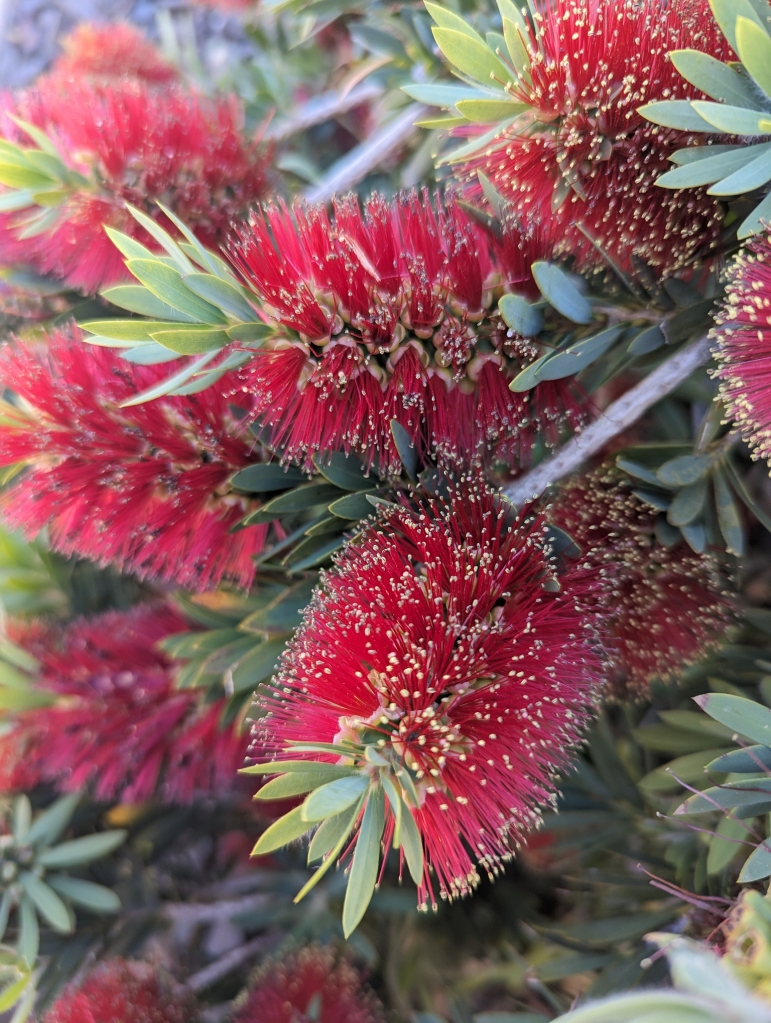
Old fashioned lemon bottlebrush would be so practical, if only it did not get so bulky. It is impressively resilient. Although appreciative of occasional watering, it needs none once established. Phases of red bloom continue through warm spring and summer weather. A few sporadic blooms may continue throughout winter. Hummingbirds are very fond of it.
‘Little John’ bottlebrush, Callistemon viminalis ‘Little John’, is all that and less. It remains much more proportionate to compact home gardens. Growth is relatively slow and tame. Mature specimens may grow no bigger than three feet tall and five feet wide. They prefer to assume naturally mounding form without shearing. Any pruning should be quite minor.
More than compact form distinguishes ‘Little John’ bottlebrush from lemon bottlebrush. Its evergreen leaves are relatively small and slightly grayish. Their foliar texture is relatively tidy. Its lemony foliar aroma is relatively subdued and only evident if foliage is disturbed. The fuzzily staminate floral trusses are relatively small with relatively mellowed red color.
California poppy dramatizes favorable weather conditions.
Superbloom occurs only about once every decade or so. It is very unpredictable though. It can happen for two or even three consecutive springs. Alternatively, it may not happen for two decades. It can be as early as late February, or as late as late May. It can last one or a few weeks. Superbloom is as variable as the environmental factors that influence it.
Actually, all bloom relies on influence from variable environmental factors. That is how it knows how and when to bloom. It is also why many species are so irregular about doing so. Various species prioritize reliance on various environmental factors. Therefore, some may bloom early or late while others adhere to stricter schedules. It can get complicated.
Warmth is undeniably the most significant of environmental factors that influence bloom. Cool weather inhibits bloom, even as growth resumes at the end of winter. Then, warmth accelerates bloom, mostly during spring, but also into summer. Many species continue to bloom as long as the weather stays warm. Very few prefer to bloom during cool weather.
As mentioned, the influence of environmental factors can get complicated. Many species actually require sustained winter chill, or vernalization, to bloom well. It is how they reset their growth seasons to begin in winter. Peony is unreliable here because of inadequate chill. After unusually cool winter weather though, flowering cherry and lilac bloom better.
Humidity is another important environmental factor. Although it does not stimulate bloom for more than a few species, it can prolong bloom. Some flowers, particularly from humid climates, can desiccate with aridity. Conversely, even flowers from desert climates retain hydration better with humidity. Also, rain provides water for areas that lack any irrigation.
Species from mild but not tropical climates might rely more on photoperiod than weather. Poinsettia in the wild does not experience sufficient chill to distinguish winter. It monitors the photoperiod, which is the duration of daylight, instead. It knows to bloom when nights are longer than days. A few species use the same very consistent technique to bloom for other seasons.
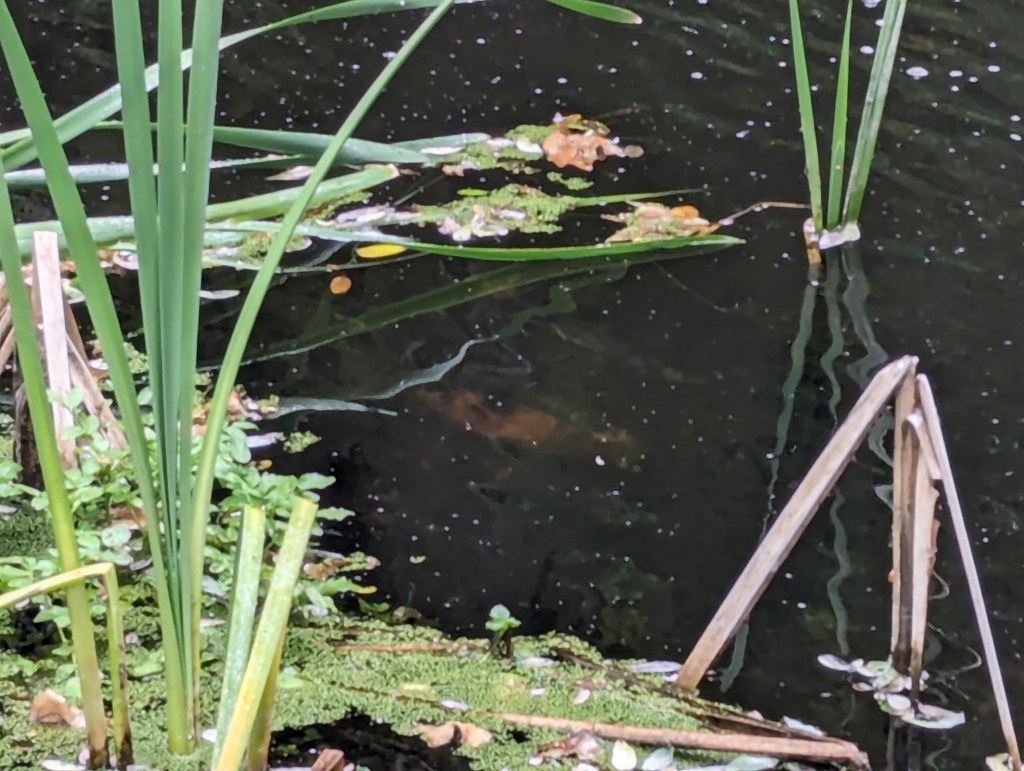
The larger of two koi is difficult to see at the center of this picture. The other is rarely seen.
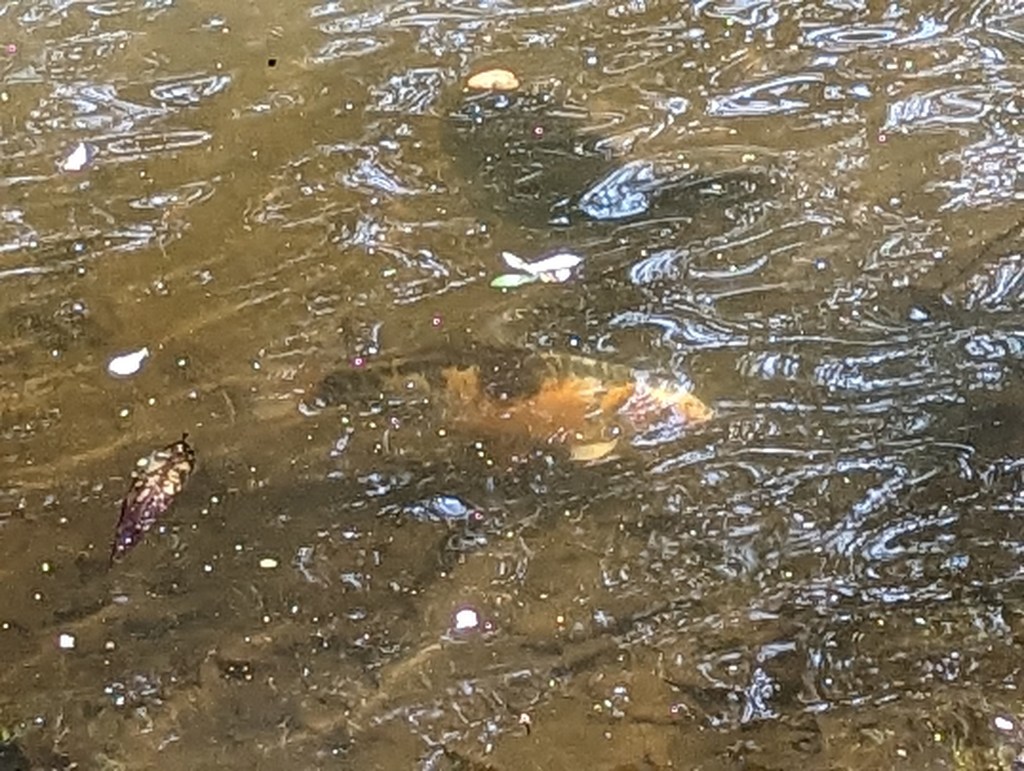
Attempts to tame the recently discovered but still unidentified pair of koi within the drainage pond have been futile so far. Both remain elusive. Although the larger of the two is almost as big as Rhody, we still are not certain if they are actually a koi. We just do not know what else they could be. I try to get them to accept koi food, but the food floats on the surface of the water until a pair of ducks eats it. I should try to feed them some sort of food that sinks, at least until they respond to food, if they ever respond.
The larger and more visible of the pair is typically referred to as “Cheeto”, although not yet formally named. Cheeto happens to resemble, and could potentially be, one of the original koi who was also known as such. Its associate is known merely as its “Associate”. Even well trained koi do not respond to names. Nonetheless, we should probably assign them names, just in case they ever become tame. These are some of the options, besides Cheeto, for either of them.
Jaws
Nemo
Kraken
Moby
Sashimi
Gill
Charlie (Tuna)
Nessie (because of their elusiveness)
Roy (don’t need to be koi)
Blinky (of the Simpsons)
Wanda (a fish called Wanda)
I hope that whomever they are, they help to limit the proliferation of aquatic vegetation, particularly duckweed, within the pond, although I doubt that they can consume enough to make a noticeable difference. Also, I hope that they become friendly enough to amuse visitors. Neither are brightly colorful enough to be prominent if they remain elusive at a distance. We intend to add a bit more vegetation to somewhat mitigate erosion on the edge of the pond, as well as to displace other shabbier vegetation.
‘Double Mahoi’ is not even a fraction of a single yet, but can grow fast.
This is not banana territory. The soil is good, and water is readily available; but the climate is a limiting factor. The weather does not get very warm for very long. When it rarely gets almost unpleasantly warm during the day, it generally gets tolerably cooler overnight. Bananas are none too keen on such comfortable weather. They want sustained warmth, with less fluctuation of temperature between night and day.
This is precisely why I should not have acquired as many as fourteen cultivars of banana. Some may never do more than generate appealingly lush foliage here. Those that produce fruit will unlikely produce fruit that is much more than marginally palatable. One of the cultivars is the oem, which is the largest banana ‘tree’ in the World. I have NO idea of how to manage it. ‘Mekong Giant’ also grows quite large and heavy. Two cultivars are unidentified, so could possibly be copies of others. ‘Kokopo Patupi’ may not have survived last winter, as it has not begun to regenerate yet. Four other cultivars were given away, but then generated pups that are now returning! I do not remember how many cultivars are here now, but I know that there are too many.
Oem is resuming growth faster than the others, but with small leaves from within pseudostems that produced larger leaves last year. ‘Double Mahoi’ is likewise regenerating dinky and pale leaves that are actually dinkier than those that emerged earlier from a shriveled carcass of a dinky pup that got frosted last winter.
I want all of the cultivars of banana to survive and thrive, but I should have planned for them better. Now, I should plan to find homes for most of them instead. Even if I could manage them all, I can not justify doing so.
My vacation was in two halves of two weeks each, with two weeks in between. It seemed to be six weeks collectively. Quite a bit happens within the landscapes during that much time at this time of year. The first of my Six is from Arizona, and happens to be the State Flower of Arizona. The others are some of what I returned to, including the State Flower of Colorado, and a relative of the State Flower of Hawaii. One is German from Monterey. One is Algerian from the Canary Islands. One is European from Washington. Oh, this is all such confusing nonsense and false trivia. California poppy, which is the State Flower of California, is blooming, but I got no pictures of it for this week.
1. Carnegiea gigantea, saguaro was a species that I should have gotten more pictures of before leaving Arizona. This is one of only two pictures. It is the State Flower of Arizona.
2. Persicaria bistorta ‘Superba’ snakeroot came from Tangly Cottage Gardening not too long ago, but is already blooming splendidly among watercress on the edge of the pond.
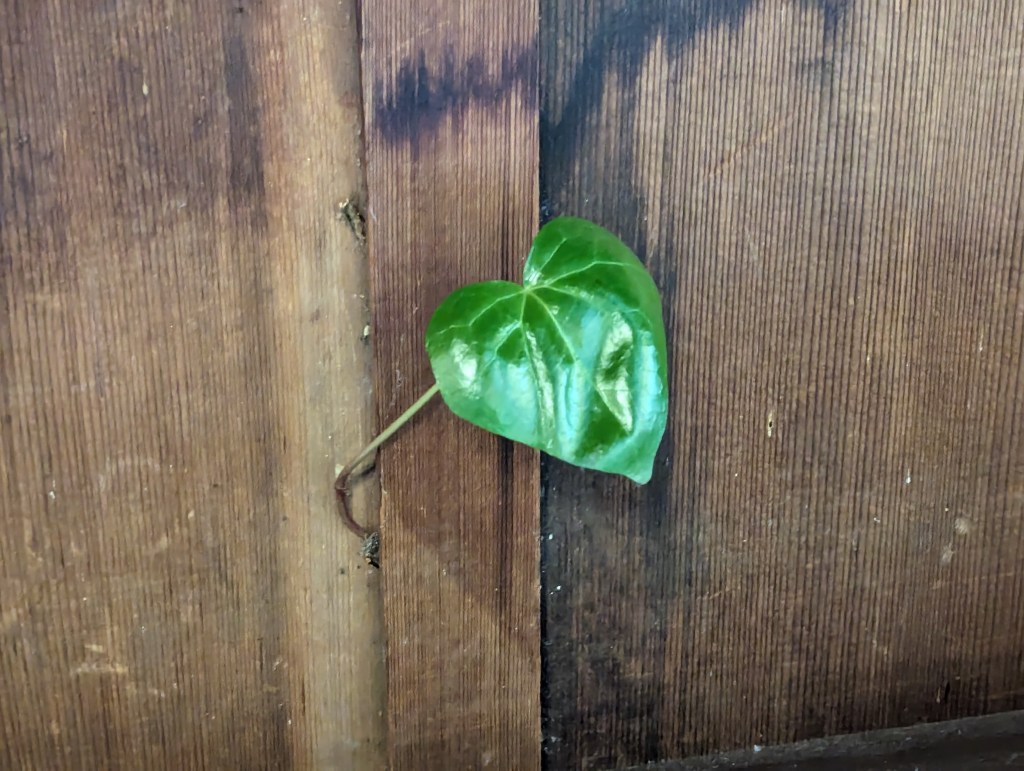
3. Hedera canariensis, Algerian ivy clings to the exteriors of several buildings at work if not pruned back frequently. This vine is getting even more aggressive by coming inside!
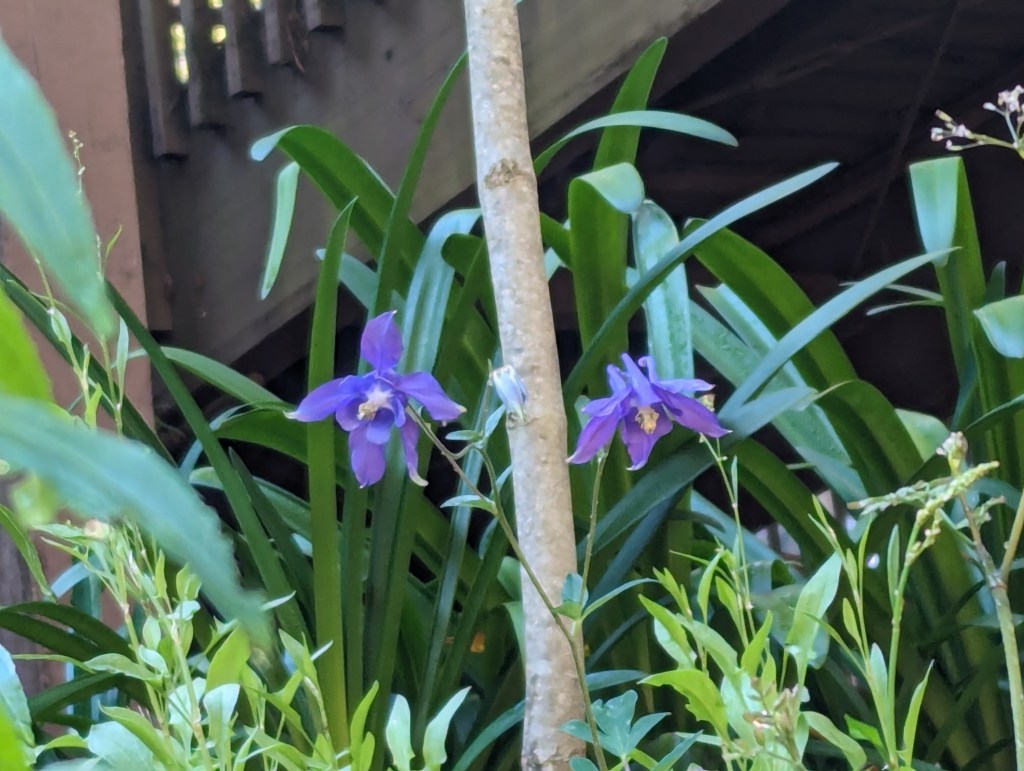
4. Aquilegia X hybrida, columbine refuses to grow where planted, but tosses seed before it dies. Its feral seed then grows in random situations. It is the State Flower of Colorado.
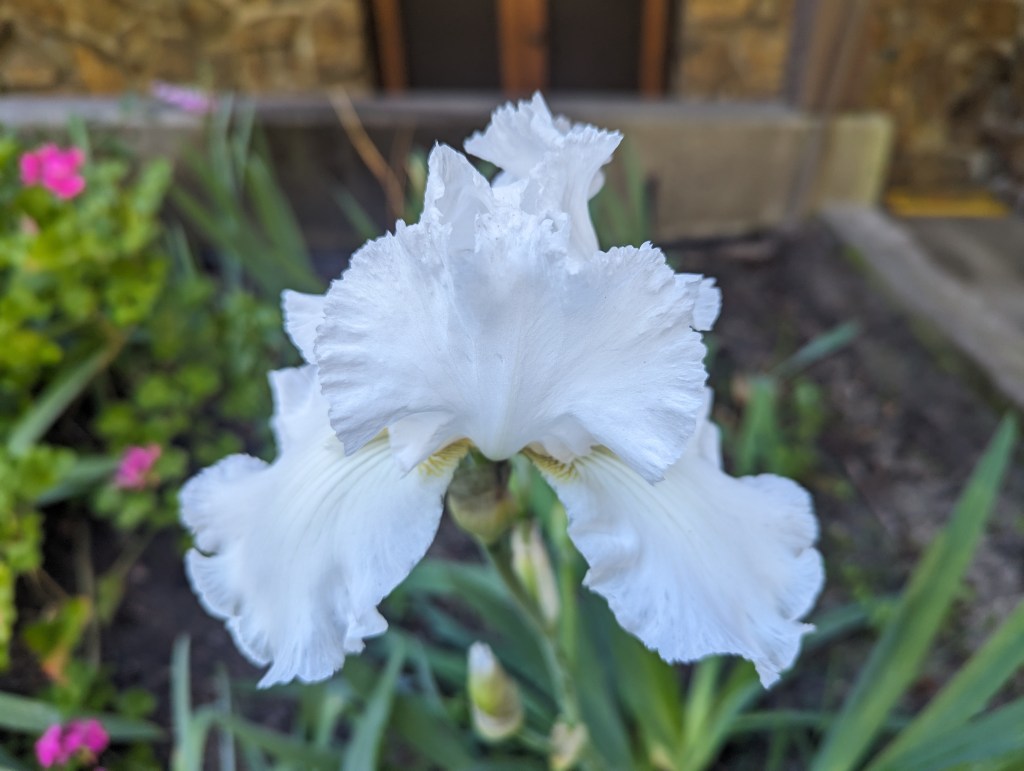
5. Iris X germanica, bearded iris bloom is finishing about now. I earlier mentioned that this cultivar seemed weirdly pale. It might be feral. However, it seems bright white now.
6. Hibiscus rosa-sinensis, tropical hibiscus is blooming as vibrantly here as it was in Los Angeles and Phoenix. It is related to Hibiscus brackenridgei, the State Flower of Hawaii.
These grew from formerly small and shriveled clumps of tuberous roots.
It is hard to imagine how the small shriveled clumps of tuberous roots of ranunculus, Ranunculus asiaticus, planted last autumn can produce such bright pink, red, orange, yellow and white flowers between late winter and early spring. The two or three inch wide, semidouble or double flowers stand about a foot high, just above their soft deeply lobed foliage. Those of us who did not get ranunculus in the ground last autumn can find blooming plants now. Ranunculus want to be in full sun, in rich, well draining soil.
Deadheading (removal of fading flowers) promotes subsequent bloom; but the season is rather short. Foliage will soon be turning yellow, and will eventually die back. If not watered too much, dormant ranunculus can survive through summer, but should be dug and stored in a cool dry place until next autumn if they are in pots or areas that will get watered regularly.
Extensive breeding can compromise floral fragrance.
As I enjoy good friends and cheap coffee out on the deck, I am also savoring the sweet fragrance of the abundant white bloom of the black locust off in the distance. I know that black locust is a noxious weed that invades riparian environments; but they smell so good on such pleasantly warm spring days. Modern varieties are certainly better behaved and more colorful with their pink to purplish flowers, but their fragrance does not compare so well.
Earlier here on the deck, one of my friends and I discussed how modern Buicks are much safer than old classic Buicks are, but are not quite as elegant and stylish. It made me think of how decades ago, modern roses were developed for flower size, form, color and stem length, but in the process, were deprived of, among other qualities, their fragrance. Perhaps I would have been more attentive to my friend if the coffee were as potent as the fragrance of the black locust.
Modern varieties of many classic flowers are less fragrant than their ancestors were. This is because decades (and centuries) ago, fragrance generally had not been prioritized in breeding as much as were other physical characteristics, such as flower size, form, color and so on. The plants that were consequently used for breeding typically had the most visually appealing flowers, but lacked fragrance. Such disparity is actually quite natural among plants with variable flowers.
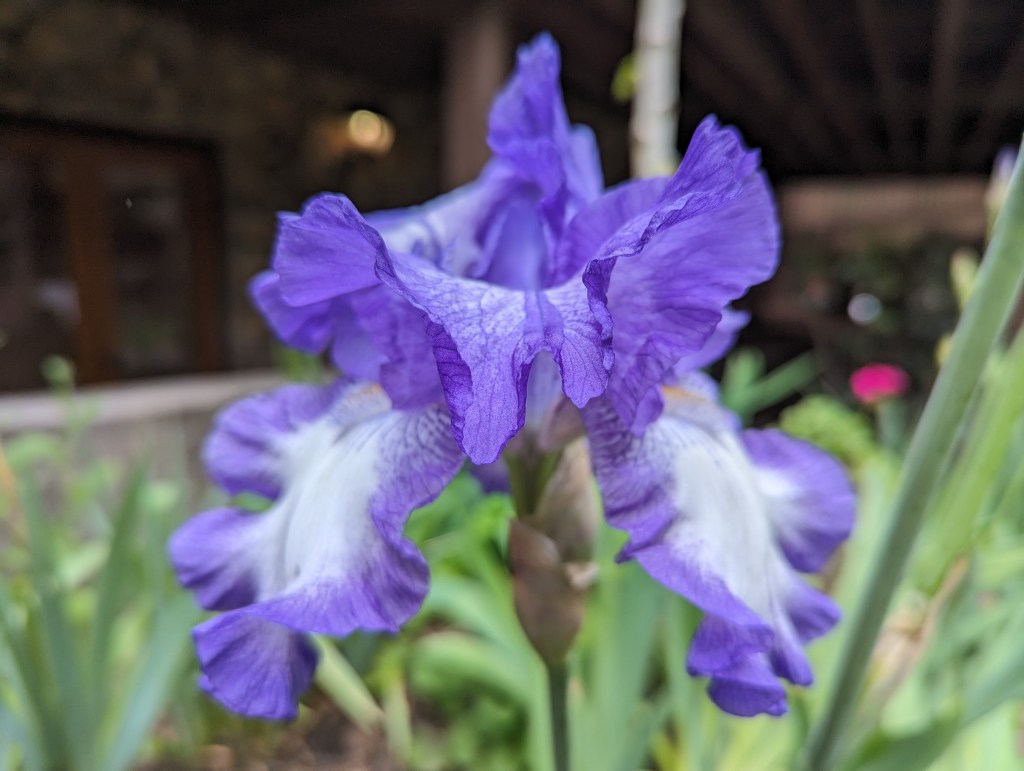
For example, most bearded iris that naturally have the biggest, fanciest and most brightly colored flowers are also the least fragrant. Their progeny that have become the modern varieties are just as flashy, and also, just as deficient of fragrance. Conversely, the relatively small and simple pale purple flowers of my favorite ‘Grandma Sheppard’ bearded iris are remarkably fragrant.
To the iris, this is all quite sensible. Their fragrance is not designed to impress us, but is merely intended to attract pollinators. If they are fragrant enough to entice the insects that bring them pollen, they do not need to waste any more effort on visual appeal. Without fragrance though, they can alternatively use color (including infrared and ultraviolet) to direct insect traffic where they need it to go in order to accomplish pollination. Almost all of the many varieties of iris prefer to specialize in one or the other; either fragrance or visual characteristics, but not both.
So many of the old classics seem to have lost some or most of their fragrance as they have ‘improved’ over the years because visual appeal has been prioritized more than fragrance. Besides flowering locusts, roses and iris, some types of honeysuckle, mock orange, sweet pea, violet, hyacinth, lily and even narcissus are less fragrant than their ancestors were. However, traditional as well as modern fragrant roses and iris seem to be gaining popularity. Fortunately, gardenia, lilac, wisteria, stock and the fragrant types of angel’s trumpet and jasmine are probably as potent as they have ever been because they have not been tampered with as much.






 Tony Tomeo