Six on Saturday: No Rhododendrons

Rhody’s rhodies were spectacular in bloom. This year, I refrained from posting too many pictures of them by posting none at all. I thought that I might get a few at the end of the season; but now find that the few that remain are either shabby or difficult to get a good picture of. There is plenty of other bloom though, even without exploitation of the warm season annuals. Now that daylilies are blooming, they will continue until autumn. Roses continue at least as late, but bloom in phases since most are partially shaded. All but one of these six species were recycled, although one was recycled by remaining where it was.

1. Daylily is not actually a lily. With all the bickering amongst botanists, its classification remains vague. This surplus from thinning a congested colony now borders the iris bed.

2. White climbing rose that was removed from the garden of a renovated cabin has been relocated to el Catedral de Santa Clara de Los Gatos, where merely white flowers bloom.

3. Rose lily that was plumply budded for Six on Saturday two weeks ago is now finishing. It recycled itself from a previous froufrou garden as the rose garden was installed over it.

4. Carpet rose was originally too close to a walkway, so was relocated to a wide roadside embankment. I am none too keen on carpet rose, but it is appropriate for its application.

5. Easter lily that was left from a wedding at el Catedral de Santa Clara de Los Gatos was added to the perennials across the road, but could have remained with the white flowers.

6. Unidentified hybrid tea rose, which had the color but not the form of ‘Double Delight’ before it began to fade, blooms in the rose garden, which was installed over the rose lily.

This is the link for Six on Saturday, for anyone else who would like to participate: https://thepropagatorblog.wordpress.com/2017/09/18/six-on-saturday-a-participant-guide/

White Sage

White sage is so aromatic that it may be be objectionable to some.

‘White’ is not often associated with ‘sage’, since so many sages are known for the rich shades of purple, blue and red of their flowers. Others have lavender, pale blue, pink, yellow or ‘almost’ orange flowers. Compared to these, the whorls of small, slightly blushed white flowers of white sage, Salvia apiana, are relatively unremarkable, even though they are held as high as a foot and a half above the shrubby foliage on elegantly slender flower spikes.

However, the evergreen silvery foliage of white sage is quite remarkable both visually and aromatically. It is so aromatic that some people may actually find it to be objectionable. Those who initially grow white sage as an herb or for use as incense later realize that it also becomes a prominent ornamental, particularly with dark green foliage, like junipers or arborvitaes, to contrast with its strikingly silvery color. Mature plants get taller and wider than three feet, with simple three inch long leaves. After spring bloom, flower spikes can be shorn off to promote fuller foliar density. I prefer to prune stems back more aggressively to promote more aromatic vigorous vegetative (non-blooming) growth. These vegetative stems become less aromatic as they too eventually bloom.  

Herbs Are Not Confined To Herb Gardens.

Spanish lavender is as herbal as English lavender.

While waiting for my white mocha at the White Raven coffee shop, I noticed white sage smudge sticks (incense) for sale. I also noticed that white sage is a component of at least one of the many herbal teas available. Although white is my favorite color, I am doubtful that it would be one of my favorite flavors. White sage seems to me to be much too pungent. I suppose that I should at least try it to satisfy my curiosity. Otherwise, the many other herbal teas included more docile but equally compelling herbs like sunflower petals, cactus flowers, chamomile, lavender, mint, catnip and various geraniums.

My mocha was ready too quickly, before I could investigate all of the herbal teas. Since I needed to get out of the way at the counter, I went to peruse the incense, where I again noticed some familiar herbs, like various sages, lavender, rosemary and bay laurel. A few plants that I do not commonly think of as herbs are common components of incense as well, such as juniper, cedar and pine. This was all too baffling; so I took my mocha to a table out front by a roadside garden, where I noticed some of the exact same herbs that I came outside to get away from!

All these fancy herbs and incenses and girly boutique beverages are simply not my cup of tea. Although at the White Raven, I know better than to be surprised by what might be in an excellent tea. Regardless, the garden out front is still more my style, and reminds me of how so many utilitarian herbs can also be very appealing ornamentals.

Rosemary, lavender and several of the sages are actually quite common in ordinary landscapes, whether or not anyone even notices that they have herbal merit. Some types of creeping thyme are sometimes used as ground cover in small areas, particularly around pavers or stepping stones where they release their fragrance if lightly trampled. Santolina and various yarrows and scented geraniums are less ordinary, but are similarly grown more often for their aesthetic value than as herbs. In my own garden, I really do not know what yarrow is good for. I like to add geranium leaves to sun tea, even if it makes it a girly boutique beverage.

Some herbs are almost too happy in my garden. The feverfew, chamomile and nasturtiums (my favorites!) that grew from seed from Renee’s Garden two years ago have spread outside of their area. I actually gave my mints away before they could escape. The catnip is confined to a hanging pot by the neighbor’s cat who gets sufficiently overindulgent to eradicate any self sown seedlings below. I never would have guessed that an inebriated cat could be so useful! Calendula, chive and oregano have all been grown from seed and become happily naturalized. 

Feverfew

Feverfew blooms with many tiny daisies.

Historical herbal applications were the origin of its now silly name. Feverfew, Tanacetum parthenium, is a relative of chamomile. Its leaves are useful for herbal tea like floral buds of chamomile. Feverfew is delightfully aromatic, although some may disagree about how delightful it is. Some believe that it can repel unwanted insects, but may also repel bees.

Feverfew is likely more popular for its floral display than its aromatic foliage. Its abundant small composite blooms are very similar to those of chamomile. They are nearly as wide as three quarters of an inch. Their yellow centers are a bit flatter. Their ray florets (petals) are a bit wider. They bloom on open trusses that hover loosely above their basal foliage.

Feverfew has lime green foliage with a fine texture. It can stand almost two feet high with bloom standing a bit higher. It migrates slowly, but can slowly get where it should not be. Pruning scraps can root as cuttings. Feverfew prefers rich soil but does not need it. Good sun exposure and even watering are more important. ‘Aureum’ is bright greenish yellow.

Botanical Names Should Simplify Horticulture

Buick is a distinct automotive genus.

Botanical names of the vegetation that home gardening involves may seem complicated. Some are difficult to pronounce or spell. A few seem to be as lengthy as sentences. They seem to be a foreign language because most are Latin. Some are Greek. However, they are more valid than common names. What is common here might be uncommon abroad.

For example, Acer pseudoplatanus is a type of maple here in North America. However, it is a type of sycamore in England. Its common name is regionally inconsistent, so can be confusing. Its botanical name, though, is the same everywhere. Incidentally, Acer is Latin for “maple”. Pseudoplatanus is Latin for “false sycamore”. Technically, it truly is a maple.

Technically though, only a few cedars are truly cedars. Both deodar and blue Atlas cedar are species of Cedrus, which is Latin for “cedar”. However, incense cedar is a species of Calocedrus, which is a separate genus. Western and northern red cedars are species of Thuja, which is arborvitae. Again, botanical names are more valid than common names.

Nomenclature is a standardized application of names. Simple botanical nomenclature is binomial, which indicates that it involves two names. The first is the “general” or “genus” name, which is capitalized. The second is the “specific” or “species” name, which is not capitalized. Both are italicized. Species is singular and plural. Genera is plural of genus.

Botanical names are actually very similar to automotive names. Only italicization and the lack of capitalization of the species are different. Buick, Chrysler and Mercury are all like genera. Electra, Imperial and Grand Marquis are all like species. Sequoia sempervirens uses the same binomial format as Buick Electra. Botanical names really are that simple.

Many automotive species include variants, such as Limited, Custom and LSE. These are like varieties or cultivars of plant species. Such variants are evident by single quotes, but lack italicization. For example, ‘Soquel’ is the cultivar of Sequoia sempervirens ‘Soquel’. (‘Cultivars’ are ‘cult’ivated ‘var’ieties that are true to type only by vegetative propagation. Varieties can be naturally true to type by seed.)

Locusts!

the SWARM!

Well, not exactly locusts; although, until they were reclassified within the Order Mantodea, they were of the same Order Orthoptera as locusts. Nor are they affiliated with either honey locust, Gleditsia triacanthos that I wrote about for last Tuesday, or carob, Ceratonia siliqua that I wrote about for the previous Tuesday, and which is the sort of locust that sustained John the Baptist in the desert. These abundant critters are young mantises, which likely hatched shortly before posing for this picture that my niece took on her front porch. My niece had seen a slow moving adult mantis there last autumn, and guessed that it might have deposited eggs, and then later died in privacy. Fortunately, she enjoys all sorts of flora and fauna, and was not too disturbed by this scene, or by the mother last autumn, as even some who work outside might have been. In fact, to the contrary, she was pleased that their mother felt that her porch was safe enough for them to start their lives on. She knows that there are plenty of insects for them to eat within the vegetation that inhabits the landscape there, as well as in nearby landscapes. This many mantises will eventually disperse into the neighborhood to satisfy their voracious appetites as they grow. That is why mantis eggs are available for sale from some nurseries. They are beneficially predatory insects because they consume detrimental insects. Since their arrival, my niece did a bit of research on their sort, and found that some people actually raise certain rare varieties of mantises as pets. As weird as it seems, it is no weirder than pet tarantulas. Anyway, this picture was taken more than a week ago. These baby mantises are likely already growing fast and dispersing elsewhere into Los Angeles.

Road to Nowhere

Music videos were so artistic in the 1980s. Some of them said as much as their associated music. The Talking Heads composed a music video for Road to Nowhere that, although it seems ridiculous now, was captivating at the time. It seemed to be about how life is dynamic with deviations from that which is expected. To me, it also seemed to be about enjoyment of being here now, or perhaps, there then. After all, it was filmed near Hi Vista in 1985, far away and long ago.

I did not experience Hi Vista in 1985, but did manage to get to Littlerock in about 1987, about two years later and thirty miles to the southwest. I am glad to have seen the region then. It has changed so much that I sort of hope to never see it again. Although I do not intend to avoid it if there is ever any reason for me to return, I would prefer to remember it how it was about thirty-seven years ago. There are plenty of other scenic regions of the Mojave Desert to tour.

While in the region, I noticed that a few interchanges on the highways that we drove on were more substantial than the highways were. They were proportionate to the urban development that was expected for the region. The portions of the highways between the interchanges were upgraded later, which is now a long time ago. So much of what I remember as rural is now suburban or urban.

That is what this landscape reminded me of. It is near my formerly rural home south of San Luis Obispo, where I lived while in college. Although this parking lot was here before I was, it has since been renovated. The area beyond was merely pasture occupied by cattle. This long and prominent crosswalk crosses the parking lot as if going somewhere important, only to terminate at this empty landing, which is surrounded by ceanothus. It certainly looks odd. Obviously, the walkway is intended to continue in some form into development that is planned for the adjacent site. I had not been here in about thirty-four years, so should not be surprised by such changes. Perhaps I am no more surprised than I am amused by this landscape and its associated road to nowhere.

Six on Saturday: &

Odds & ends. Bits & pieces. Rhythm & blues. That is all I got here. The latter might make sense with #4 below. It makes this no easier for me though. I have difficulty writing with characters such as “&”, and even “#”, although I do use “#” when necessary to describe a caption number or can size as for #6 below. Perhaps I should challenge my comfort zone a bit more, as I did when I tried using contractions a few months ago. Although I did not continue using them afterward, it was not nearly as awkward as I thought it would be. At least I now realize that I could do so if I choose to. I simply choose to not do so. In other simpler words, I could, but I don’t.

1. Carson, Rhody’s Roady, posed for this thumbnail illustration for a recent article about how similar binomial botanical nomenclature is to traditional automotive nomenclature.

2. Purchases are almost against the rules in my garden. They can only involve items that I lack access to. This purchase that was delivered by mail apparently needed ventilation.

3. Someone who does not take compliments well diverted this one to me. No one knows what seed it contains, but I suppose that we will find out when it grows after next winter.

4. Salvia guaranitica ‘Rhythm & Blues’ came as a cutting in a red Solo cup with the pack of unidentified wildflower seed. This is why I abide by my rule that disallows purchases.

5. Saccharum officinarum ‘Pele’s Smoke’ sugarcane provided more cuttings than I knew what to do with. Fortunately, most succumbed to frost. I can accommodate these fifteen.

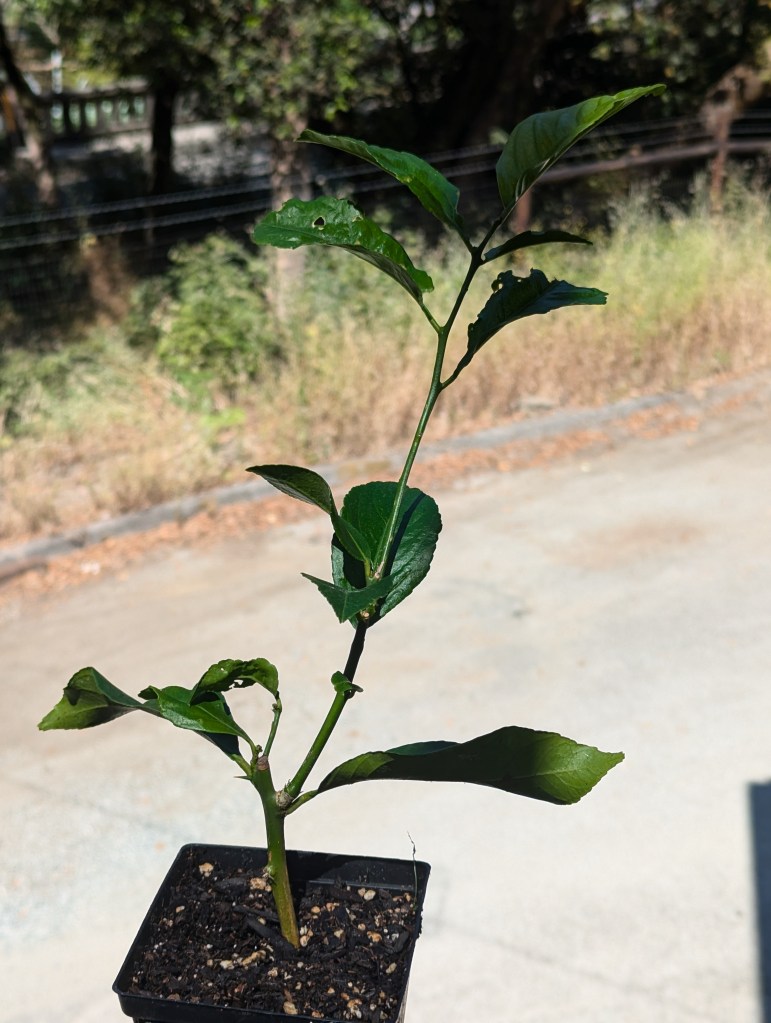
6. However, they are merely the fifteen best specimens that were big enough for #1 cans. At least as many smaller cuttings that got separated from them still need four inch pots.

This is the link for Six on Saturday, for anyone else who would like to participate: https://thepropagatorblog.wordpress.com/2017/09/18/six-on-saturday-a-participant-guide/