Horridculture – White

White bloom brightens a shady landscape.

White is my favorite color. Do not argue with me about it. I do not need to hear that it is not truly a color or that it is the absence of color. Technically, it is either or both the complete absence of color or the complete saturation of all color. In that regard, it has either or both the same or opposite definition as black.

A prism demonstrates the colorfulness of white light by separating it into all other colors that it contains. Nothing is lacking.

Other colors can be mixed with a bit of white to become a tint, but retain their identity. They can be mixed with a bit of black to become a shade, but retain their identity. They can be mixed with other colors for various hues. Only white and black lose their identities with the addition of another color. No matter how pale, white becomes a tint of the additional color. No matter how dark, black becomes a shade of the additional color.

Pink is not really a color, but it is somehow more acceptable as such than white is. It is merely a tint of red. In other words, it is red with white.

Furthermore, brown is not really a color, but is somehow more acceptable as such than white is. It is merely a shade of orange. In other words, it is orange with black.

Gray is either or both a tint of black or a shade of white, but only if either or both black or white is considered to be the color that it is. Goodness, this is getting complicated.

Ultimately, such analysis is irrelevant to my predilection for white. Brent says that I am a white supremacist. That is rude. I just know that my favorite color is white.

Celery

Celery season conforms to local climate.

It could be either a warm season vegetable or a cool season vegetable. Celery, Apium graveolens variety dulce, dislikes both frost and arid heat. It is a warm season vegetable where summer is mild but winter is not. It is a cool season vegetable where winter is mild but summer is not. Where winter is cold and summer is hot, it prefers spring and autumn.

Celery is a biennial, which grows vegetatively for its first year, and blooms for its second. Because it is ready for harvest in less than half a year, bloom is not a concern. Any that mature enough to bloom are too tough to eat. Celery appreciates organically rich soil. It needs regular watering. Growth is irregular if its soil becomes too dry, even temporarily.

Celery naturally grows as densely vertical foliar rosettes, or bunches. Its distended and elongated petioles are its primary edible parts. Its disproportionately small leaflets are also edible though. Mature celery grows about a foot and a half to two feet tall. It grows well from cell packs if only a few bunches are necessary. It also grows well from seed.

Vegetables Change With The Seasons

Zucchini seed can be sown now.

Annuals are not all that change with the seasons. Vegetables do also. After all, with few exceptions, vegetable plants are also annuals, or perform as such. Most of those that are biennials are edible only during their first year. They bloom and become inedible if they survive for a second year. Most perennial vegetables are easier to replace than recycle.

As with annuals, it seems to be a bit too early to replace cool season vegetables. Some continue to produce, and may do so for a while. The weather still seems to be a bit too cool for warm season or summer vegetables. Technically, it actually is too cool for some. However, some must grow from seed. The weather will be warmer by the time they do.

Most cool season vegetables are actually vegetables. In other words, their edible parts are vegetative rather than fruit. Conversely, most warm season vegetables are actually fruit. In other words, they contain seeds. Tomato, chili, eggplant, cucumber, squash, corn, okra and bean are familiar examples. Some but not all continue to produce until autumn.

For example, zucchini and other summer squash produce until frost. So do pole bean, some cucumbers and indeterminate tomatoes. However, winter squash only grow during summer to ripen all at once for autumn. Okra, eggplant and various chilis should produce throughout summer, but likely will not. Secondary phases can prolong their production.

Determinate tomatoes, bush beans, and corn benefit most from phasing. They produce all their fruit within a brief season and then produce no more. Subsequent phases should start before preceding phases finish. Some can eventually replace lingering cool season vegetables. With good soil, fresh new tomato plants can start below aging tomato plants.

Seed for corn, beans, root vegetables and greens prefers direct sowing into their garden. Seedlings are stressed by transplant, and too many are needed. Cucumber and squash grow as well from seedling as seed, and a few should suffice. Tomato, chili and eggplant prefer to grow from a few seedlings a bit later. Some varieties are available only as seed, though. Such seed should be sown by about now, directly or within cells, outside or in.

More Palm Silliness

Mexican fan palm, Washingtonia robusta

Mexican fan palm, Washingtonia robusta, is the most familiar palm throughout most of California. It is most typically groomed to remove deteriorated leaves without removing the associated toughly fibrous petiole bases that form a neat lattice-like sweater of stubble around its trunks. Some are groomed to also remove the stubble, leaving a clean shaven and leaner looking trunk. Some are shaven only part way up, with a sweater higher up. Without grooming, or if grooming discontinues, some accumulate beards of deteriorated leaves. Although generally harmless, such beards are combustible and can be infested with rats. On rare occasion, they become dislodged from their trunks and fall. They are dangerously heavy and very messy. This silly looking Mexican fan palm was groomed part way up, and then neglected long enough to accumulate a significant beard. The beard then fell, leaving the bare trunk exposed. Only the few lowest of the old leaves remain below where the beard was. A new beard is now forming above.

Queen palm, Arecastrum romanzoffianum, was an uncommon palm until it suddenly became very popular and almost too common through the 1990s. By that time, selective breeding produced the standardized modern variety, which is a bit greener, fluffier and more vigorous than most old specimens. Although it is a bit more genetically conformative than old specimens, it still exhibits genetic variability. Unless some are cloned by tissue culture, all are grown from seed. Some grow slower, so stay shorter. Some develop unusually plump trunks. Some are unusually floppy. This one is just weird. Its foliar canopy is so strictly narrow that it resembles the locally rare Andean wax palm, Ceroxylon quindiuense. Perhaps it actually is an Andean wax palm! A pindo palm, Butia capitata, lives in the associated front garden, and it is not exactly common.

queen palm, Arecastrum romanzoffianum or Andean wax palm, Ceroxylon quindiuense or something else?

Palm Ignorance

Bismarckia nobilis

Many years ago and before I started writing my gardening column in response to all the horticultural misinformation that I had been observing in the San Jose Mercury News, I heard some of the most idiotic commentary I have ever heard about palms on the radio. I do not remember what radio station it was broadcast from, but it was likely in San Jose. The commentator was expressing his disapproval of the many mature palms that were being incorporated into public landscapes there at the time. He started by stating that, “There are two kinds of palms . . . ” Well, that certainly got my attention. He continued to say, ” . . . the tall skinny kind and the short fat kind.” Wow, I can not forget a comment like that. I knew that he was referring to Mexican fan palm and Canary Island date palm, which were and probably still are the most common palms in San Jose. Also, they were the two species that were so commonly installed into public landscapes at the time. There was no mention of queen palm, windmill palm, Mediterranean fan palm or California fan palm, all of which also inhabit San Jose. Since then, queen palm and the formerly rare pygmy date palm have become more common than they had been. Hesper palm remains rare. I brought three distinct species of bamboo palm from Los Angeles, and would like to bring a few more of the palms that perform well there, even if they do not perform so well here. I happen to be fond of the few types of king palm. I very much want to procure Bismarck palm like this one. Although still uncommon in Los Angeles, it is not completely rare. No one knows how well it performs here because no one has tried it yet.

Six on Saturday: Winter to Spring

Spring is beginning to express itself. Only one of my six thinks that it is still winter. After a mild winter, I expected this sooner.

1. Colocasia gigantea ‘Thailand Giant’ elephant ear is the only one of these six to remain dormant. I still must determine if two will go directly into a landscape or get canned like the other two next week. I actually purchased these corms, but do not feel guilty about it.

2. Alocasia macrorrhiza ‘Borneo Giant’ elephant ear is another guiltless purchase. It has a very similar name and is from a similar region as the ‘Thailand Giant’ elephant ear, but grows from smaller rhizomes rather than fat corms. It is already generating new growth.

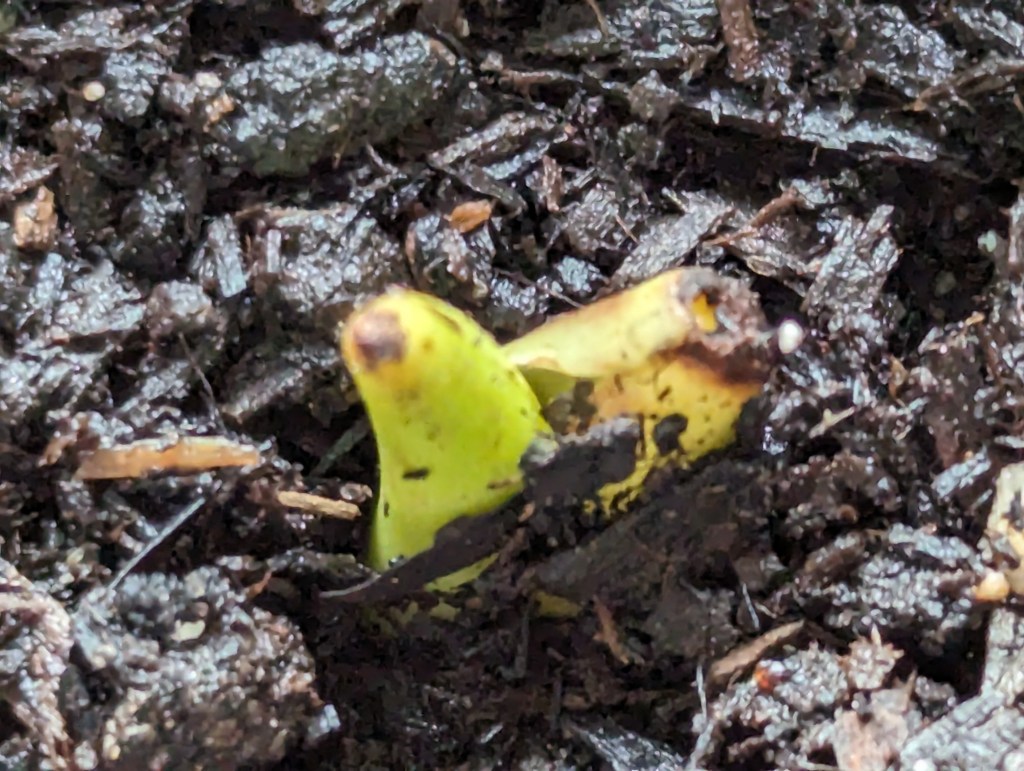
3. Musa acuminata ‘Double Mahoi’ banana was one of several items that I brought back from Los Angeles last year. After taking several small pups from it, I gave the original to a neighbor. Then, all the pups seemed to die! Now I am pleased that they are recovering.

4. Actinidia deliciosa, fuzzy kiwifruit cuttings are generating foliage. I hope that they are also generating roots. They are a male pollinator for a female cultivar that grew last year from a single pruning scrap that an associate here neglected to remove from his pickup.

5. Platycerium bifurcatum, staghorn fern looks weird as it extends new foliage. Actually, it always looks weird, which is its primary allure. I am concerned that such fresh foliage can be damaged by cold rain. It likes rain and humidity but in conjunction with warmth.

6. Viburnum tinus, laurustinus is the only floral feature of these six. I am not so keen on it, but am learning to appreciate it because its early spring bloom is popular where harsh weather through winter inhibits other bloom. It is simple white, without any pink blush.

This is the link for Six on Saturday, for anyone else who would like to participate: https://thepropagatorblog.wordpress.com/2017/09/18/six-on-saturday-a-participant-guide/

Horridculture (deferred from Wednesday) – Bad Garden Tour

The Jungalow, as I wrote six years ago, is Brent’s home and associated gardens. It is an overgrown mess of lush foliage. I perceive it to be a frivolous waste of very limited space. Everyone else perceives it to be a phenomenally luxuriant urban oasis.

The house next door is more my style. It is a compact and simple home with simple bisymmetric architecture and an even simpler landscape. If Brent had not installed a symmetrical pair of tipu trees at the curb, a symmetrical pair of Tolleson’s weeping junipers flanking the porch and a foundation planting of star jasmine, it would have no landscape at all. It might be my favorite house in the neighborhood. Brent hates it.

More specifically, he hates that it is right next door. He would prefer it to be a bit farther away, so that a home with a landscape that is more compatible with his could be next door instead.

Anyway, sadly, a back bedroom of the house next door that I am so fond of burned a few days ago. Fortunately, Brent was in his office behind his home when it happened. He noticed a red glow and heard a window break. When he investigated, he could see the fire and smoke through the hedge between the backyards, so called 911. A fire crew arrived within only a few minutes to extinguish the fire before it ruined more of the home.

Brent sent this brief and blurry video of the situation shortly after the fire was extinguished. It resembles a hasty video garden tour, but speeds past some of the more interesting features of the garden, including my homeless camp, before turning back to show smoke rising from the house next door. It is a saddening situation for the next door neighbor.

New Guinea Impatiens

New Guinea impatiens can be perennial.

Busy Lizzie had been unavailable for years because of a downy mildew epidemic. It has only recently been regaining availability and popularity. During its absence, New Guinea impatiens, Impatiens hawkeri, became more popular. Although a closely related species of the same genus, the two are actually very different. Resistance to mildew is important.

Besides that, New Guinea impatien is about as foliar as it is floral. Its bolder and slightly bigger flowers are notably less abundant than those of busy LIzzie. Also, its floral color range is limited to white, pink, red, lavender, magenta or orange. Its rich green or bronze foliage below compensates though. Many cultivars are variegated with yellow or salmon.

New Guinea impatiens are unfortunately a bit more expensive than most other annuals. The smallest that are available are in four-inch pots. They are unavailable in smaller and less expensive cell packs. They can grow about a foot wide and slightly taller if crowded. During winter, they deteriorate; but they can be tender perennials with shelter from frost.