Litter Problem

It will not DIE!

We have a litter problem. At least three species of Agave continually have litters of pups. We give almost all of the pups away to friends and neighbors, but more constantly appear. I suppose that we could dispose of some, but that is not easy for those of us who enjoy growing vegetation instead of destroying it.

Pups of one Agave continue to appear where the original was relocated from several years ago. Although I do not know what species it is, it is likely my favorite of the three. However, we can not accommodate all these pups! The original is happy with its new situation, but is beginning to generate a few more pups there as well.

Pups of Agave americana, century plant, got canned because we thought that we could eventually find homes for them. Now, and for the past few years, these maturing pups are producing more pups, some of which are emerging from the drainage holes of their cans! The original is happy to be a neighbor of the unidentified Agave, but could generate more pups at any time.

Agave ovatifolia, whale tongue agave, was purchased by the other horticulturist for a specific situation. It was a striking specimen that was worth what was spent on it. However, it began to generate pups almost immediately after installation, and then suddenly and unexpectedly bolted and bloomed. It was disappointing for such an expensive specimen of a monocarpic species. We removed it after bloom, with the intention of replacing it with one of its several maturing pups. Of course, I could not simply dispose of its carcass. I canned it like a dormant perennial, just in case it did something. Well, now it is doing something! It is bolting and blooming from the grave! I expect more pups soon. We really should get all the Agave spayed!

Agave really should be spayed!

Six on Saturday: Hello Yellow

White is my favorite color. I sometimes post six pictures of exclusively white flowers for Six on Saturday. Also, I posted six pictures of exclusively red flowers merely to show that I could. I might have tried other colors as well. I do not remember trying yellow though. California bay gave me the idea, although its bloom is rather unimpressive. Silver wattle is much more colorful. So is daffodil. Dandelion is merely a weed; but technically, silver wattle is also. Ultimately, I got four pictures of yellow flowers, a picture of an aberrative beet, and a picture of someone who might qualify as golden retriever light gold, which at least sounds yellow. He can not see most colors anyway.

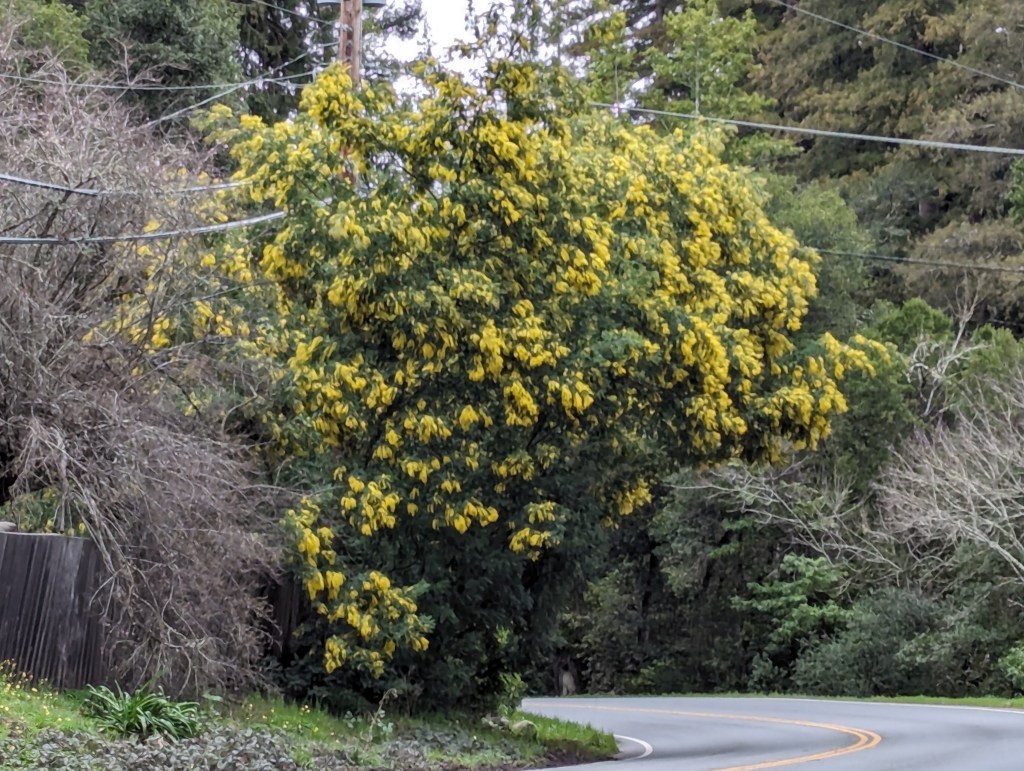
1. Acacia dealbata, silver wattle is an aggressively naturalized exotic species. It certainly is pretty though. It typically blooms earlier, and maybe by New Year’s Day farther south.

2. Umbellularia californica, California bay does not bloom as prettily. Its flowers are too tiny, too sporadic and too high in its canopy to be prominent, but it blooms nonetheless.

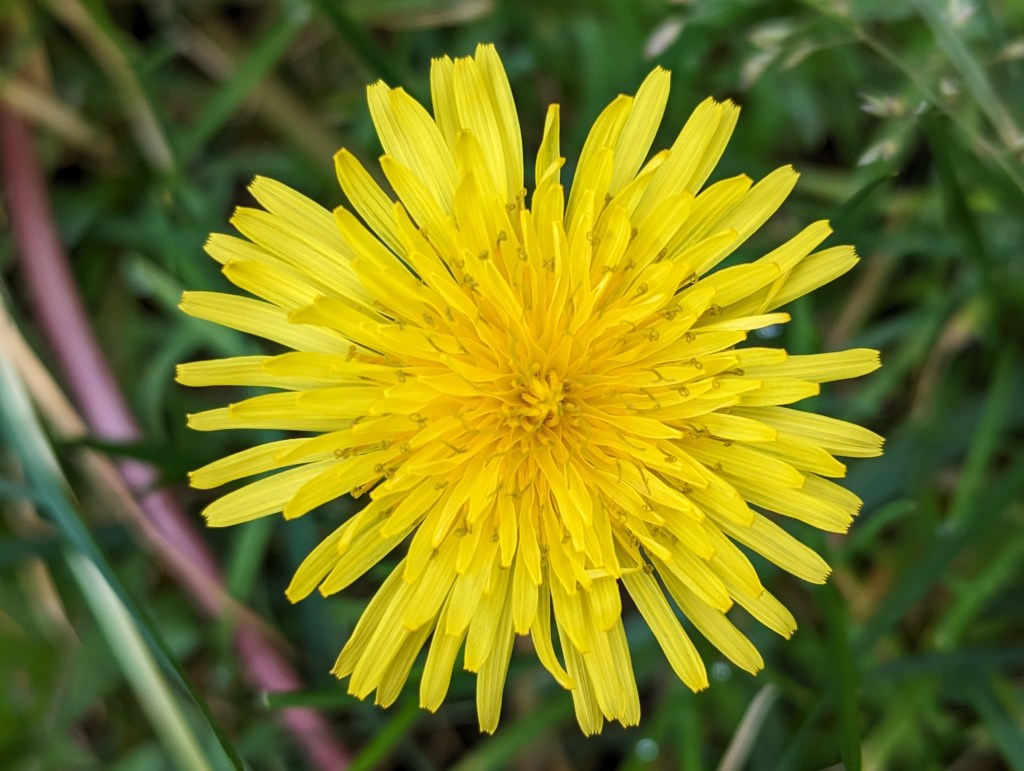
3. Taraxacum officinale, dandelion, like silver wattle, is also an aggressively naturalized exotic species. It infests most lawns, and blooms to toss its seed whenever it wants to.

4. Narcissus pseudonarcissus, daffodil continues to bloom. Several are still budded. If it were not so variable with its bloom schedule from year to year, I would say that it is late.

5. Beta vulgaris, beet should be red, not yellow. ‘Detroit Dark Red’ is best! This seems to taste about the same, but looks like a sick carrot! I loathe carrots! Why do this to a beet?

6. Rhody remains unimpressed. He is no more interested in beets than carrots. He could be more concerned about the first of a few storms that should arrive in only a few hours.

This is the link for Six on Saturday, for anyone else who would like to participate: https://thepropagatorblog.wordpress.com/2017/09/18/six-on-saturday-a-participant-guide/

‘Citriodora’ Monterey Cypress

This cultivar is also known as lemon cypress.

            Supposedly, ‘Citriodora’ Monterey cypress, Cupressus macrocarpa ‘Citriodora’, can get more than thirty feet tall and nearly as wide. Yet, it grows slowly enough to function like small trees or large shrubs. Even if it eventually gets a bit too large, it is much more conducive to occasional pruning than typical Monterey cypress is, and can even be artfully pruned into informal hedges. (However, nonselective shearing deprives if of its naturally appealing form.)

            With its lemon yellow foliage, ‘Citriodora’ Monterey cypress resembles golden arborvitae, but is even brighter yellow and has distinctive cypress-like branch structure. Its older foliage within eventually turns darker green to add depth and enhance the structure. ‘Citriodora’ Monterey cypress looks best locally if at least partially shaded by larger trees during the afternoon.

Raspberries Are Similar To Blackberries . . . But Different.

Like these dormant fruit trees, raspberry canes should go into the garden during bare root season.

            My grandmother would have gotten better results by sending me out to the garden for zucchini. She should have known better than to send me out for raspberries. I could have brought in as many zucchini as she wanted in a short while. With raspberries though, I was gone too long, and returned with meager spoils and diminished appetite.

            Neither raspberries nor zucchini will be exploitable for a few more months. Raspberries though, can get planted about now. Also, established raspberry canes should be pruned about now to promote abundant production later. Just like most deciduous fruit trees and blackberries, raspberries are not ‘low maintenance’, and require intensive specialized pruning.   

            New bare root plants should be spaced about two to three feet apart and mulched to insulate the soil until they develop enough foliage to shade their own roots. Their canes can then be cut back so that only a single bud is visible above ground. Because raspberries spread, root barriers are sometimes useful to keep them out of neighbors’ gardens.  

            Through summer, new plants should produce three or more new canes. These canes should be able to support themselves, but are less rampant if tied to a trellis or wire. I like to train them onto a fence like grapevines, because there are not many other uses for a fence.

            The more popular everbearing cultivars like Heritage, September, Summit, Golden Summit and Fallgold may develop fruit on the tops of their new canes during their first autumn. During the following winter, the tops of the canes should be cut back as far down as fruit developed. The remaining lower portions of their canes that did not develop fruit in the first year will do so during their second summer, and should get pruned out as they finish producing.

            At about the same time, about five to ten of the best new canes should be selected, and trained if desired. Superfluous canes should be cut to the ground. Like their predecessors, the remaining selected canes should fruit on top during autumn, get pruned in winter, and fruit again during the following summer before getting pruned out. This process should be repeated annually.

            Summer bearing cultivars like Willamette, Canby and Tulameen should not fruit in their first year, and should be pruned to about five feet tall during the following winter. Every subsequent summer, many new canes emerge as the older canes bloom and fruit. Every subsequent winter, about five to ten of these new canes should be selected, tied to support if desired, and pruned to about five feet tall, as all spent canes and superfluous new canes get cut to the ground.

            Black and purple raspberries are shrubbier, so get pruned differently than the more traditional red and yellow raspberries do.  During their first summer, canes should be pruned back to about two feet to promote branching. All except about six or seven of the best of these canes should be removed over winter. The side branches of the selected canes of black raspberries should then get pruned to about half a foot long. Side branches of purple raspberries can be twice as long. After these canes finish fruiting during the following summer, they should be cut to the ground. New canes can then be pruned like during the first summer so that the process can be repeated annually.  

Horridculture – Salvage

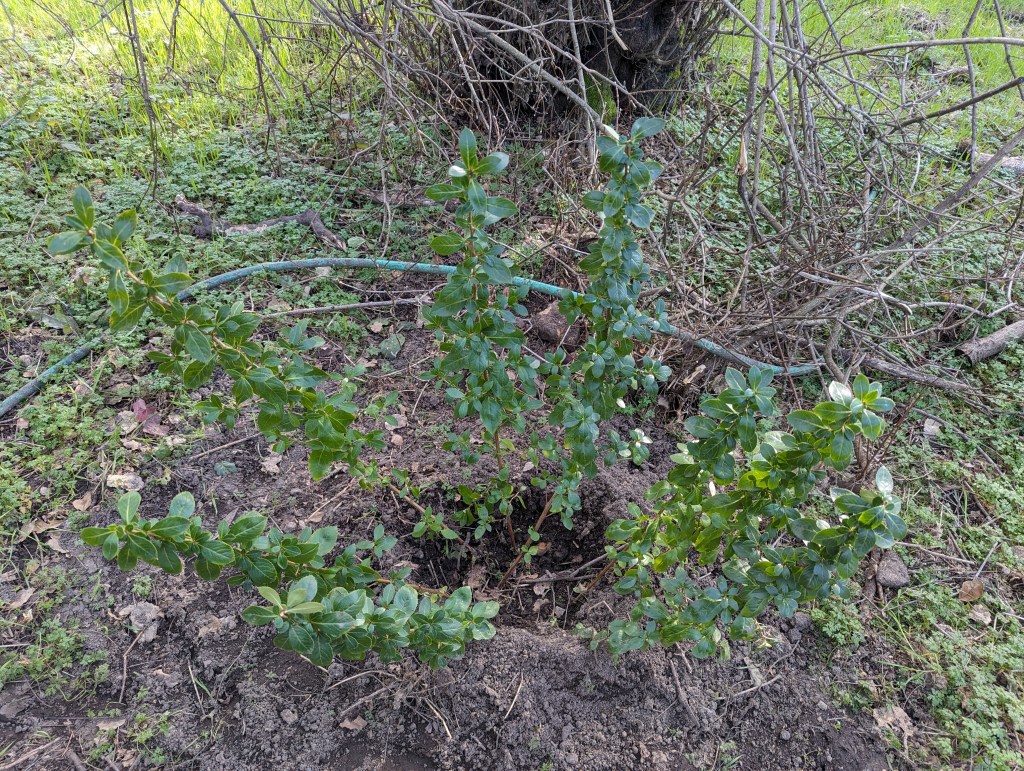
A hedge of a dozen like this came from one branched stump.

This is an old and redundant topic. I should know better. Some vegetation is not worthy of salvage. Even that which is worthy can become excessive if too much is salvaged. The problem is that I find it very difficult to discard vegetation that I can relocate to another landscape, or grow in the recovery nursery whether or not we have use for it.

A few stumps of shrubbery needed to be removed from a small landscape of one of the buildings at work. With one exception, the shrubbery was common Photinia X fraseri, which had been cut down some time ago, and had not grown back much. The one exception was a common Escallonia rubra, which had been cut down even earlier, so had grown back about five feet tall, with a few distinct trunks.

I had no problem discarding the Photinia X fraseri. The stumps came up with mostly severed large roots, and very minimal fibrous roots that they needed to survive. If I really want to grow more, it would be more practical to grow it from cuttings. I am none too keen on the species anyway.

The Escallonia rubra was not so simple. Although I was determined to discard it all, and I am no more fond of the species than I am of Photinia X fraseri, it came out with more than enough fibrous roots to survive relocation. What is worse is that the several trunks were easily divided into several individual well rooted specimens, with several more layered stems attached to them. I assembled an even dozen well rooted specimens as a hedge outside a fence of our maintenance shops, and nine smaller rooted cutting to alternate between cypress trees outside another similar fence. Although pleased with the results, I should have discarded them.

This is one of the smaller well rooted specimens, although the layered stems are smaller.

Blue Gum

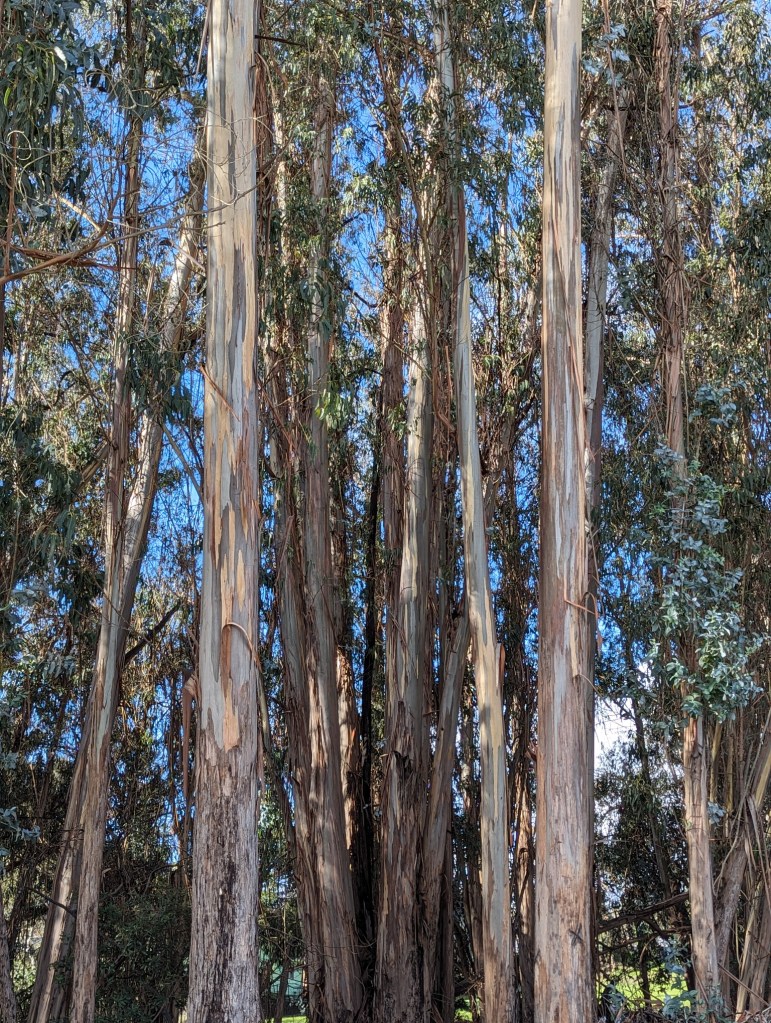
Blue gum easily outgrows home gardens.

Almost no one adds blue gum, Eucalyptus globulus, to a landscape intentionally. Almost everyone who is familiar with it understands why. It is much too big and much too messy. Even where space is sufficient for it to mature, it is innately hazardous. It sheds big limbs from very high up. It often disperses its roots too shallowly to maintain adequate stability.

However, blue gum inhabits a few home gardens. Some were already there as gardens developed around them. Some grew from seed from nearby trees. Blue gum naturalizes in some regions. Mature trees are tall enough to share their shade, debris and seed with a few gardens. The copious debris inhibits weeds, but also inhibits desirable vegetation.

Blue gum in the wild is one of the tallest trees in the World. Naturalized trees commonly grow more than a hundred and fifty feet tall here. They stay shorter in windy situations. The tall and straight trunks constantly shed long strips of smooth tan bark. Fresher bark is tan, gray, greenish or even pinkish. The curved lanceolate leaves are quite aromatic. Ovoid juvenile leaves are bluish gray, and even more aromatic. Fuzzy staminate bloom is white.

Wind Is Messy And Hazardous

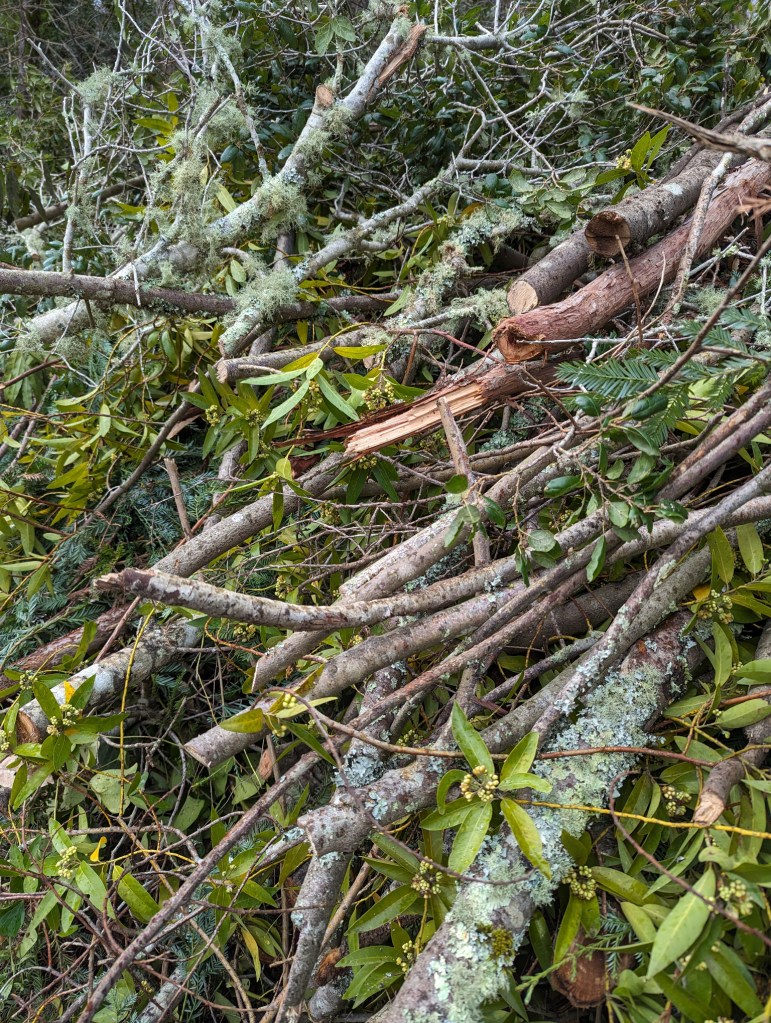
Trees lose limbs to strong wind.

Arborists become more popular after storms. That is when consequences of negligent tree maintenance become more apparent. Wind dislodges limbs and destabilizes whole trees. Unfortunately, the most diligent of tree maintenance can not prevent all damage. Trees and other vegetation are naturally vulnerable to frequently stormy winter weather.

Deciduous trees try to be less vulnerable to wind by defoliating prior to winter. Without foliage, they are less resistant to wind. In other words, they are more aerodynamic. Wind blows through them rather than against them. Some unfortunately defoliate slowly within the mild climate here. With such minor chill, some retain foliage until spring replacement.

For example, some sweetgum still retain much of their foliage. That is an advantage for the display of their autumn foliar color. It is a major disadvantage for their aerodynamics though. As a deciduous species, it does not expect to be so vulnerable to wind through wintry weather. What is worse is that sweetgum trees are innately structurally deficient.

Evergreen trees and other vegetation seem to be less concerned about wind. Actually, they merely employ different defensive tactics. Most cypress and some spruce are too dense and sturdy for wind to penetrate. Many pines develop sparse canopies that wind blows through. On the coast, coast live oak stays low and broad for wind to blow over.

Regardless of their efforts, trees of all sorts are vulnerable to damage from wind. Falling limbs or entire trees are very hazardous. Also, they can damage or destroy what they fall onto. That is why timely maintenance of trees is so very important. Any tree that becomes too hazardous to salvage necessitates removal. All trees eventually age and deteriorate.

Also, all trees, as well as all other vegetation, are messy. Some are messier than others; and many get messier as a result of wind. Some of such mess clogs eavestroughs and downspouts when they are most helpful. Detritus fills curbside gutters also. Actually, it gets everywhere. Its removal will be easier between the windy storms that generate it.

Mojave

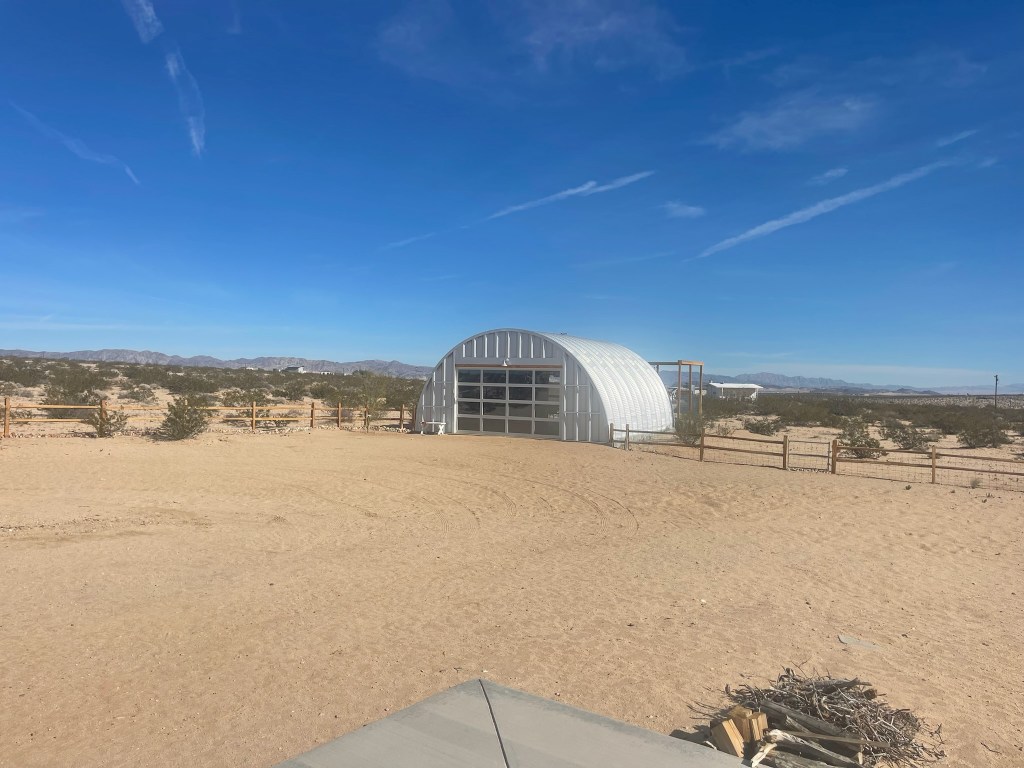
Joshua trees seem to be scarce near Joshua Tree.

About a quarter of California is desert. Most of that desert is part of the Mojave Desert. Much of it is very sparsely populated. All of it is fascinating to those who appreciate it.

Not many people live in the desert because the climate is so harsh, and because there is not much reason for many people to be there. Not far north of Los Angeles, which is the second most populous city in America, is one of the most sparsely populated regions of America within the Mojave Desert. It is unpleasantly hot and dry there all summer. It is certainly not the sort of place that should be appealing to horticulturists, although it is.

Brent sent me this picture from a place where he vacations near Joshua Tree. If there are Joshua trees near Joshua Tree, they are not visible within this picture. Actually, no trees are visible within this region where shade must be very important. The vegetation that is visible does not seem to be substantial. Vegetation is completely lacking within the fenced area. That small pile of firewood must have been brought from somewhere else. (Although nights are pleasant or warm between hot days, they can get very cold between cool days of winter.) I do not know what that building is. Without substantial vegetation, neighboring residences are visible in the distance.

Part of the allure of deserts for horticulturists is the very distinctive vegetation that lives only there. Part of the allure is the minimalism of such vegetation. Although many species live there, they are not very distinctive. Many resemble each other. In other words, much of the vegetation of the desert is easy to ignore. It is less distracting than that of other ecosystems that are more popular with those who are not horticulturists.

Ginger Ail

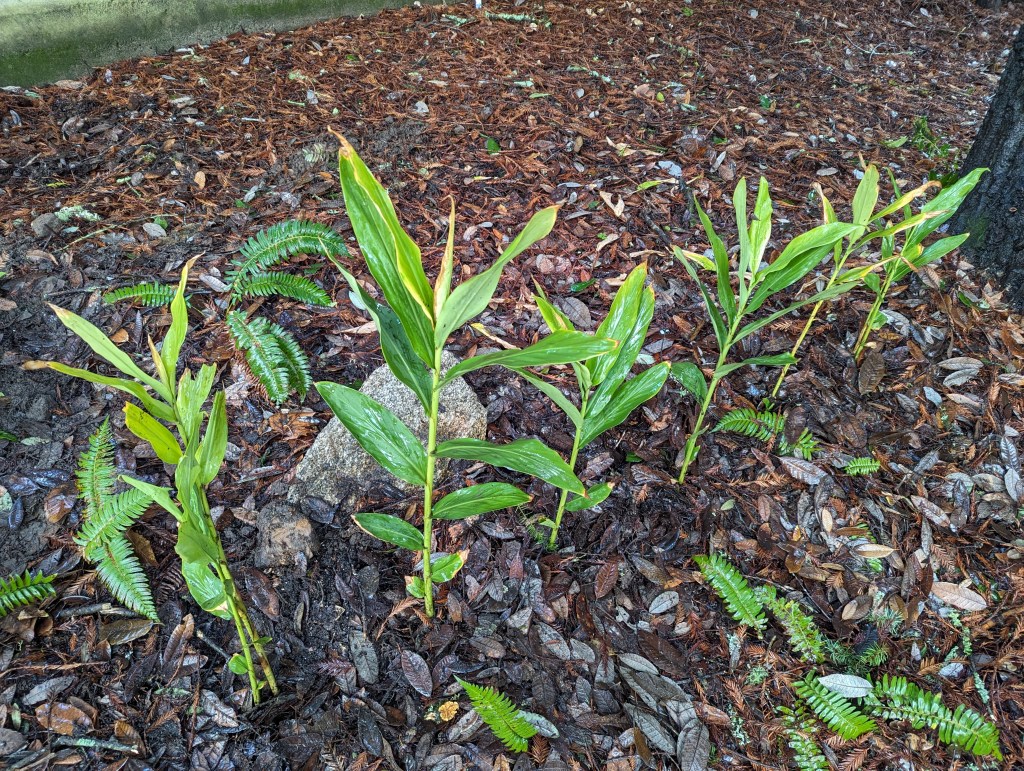
White butterfly ginger is still green.

At least seven gingers live here. Five are ornamental. Two are culinary. None have yet died back as they should for winter.

Now that it is time to divide them, I do not know what to do with their intact foliage. For this white butterfly ginger from Forest Garden, I divided the rhizomes and installed them into the landscape with their healthy foliage still attached. I do not want to cut it back until it succumbs to frost. I suppose that it can remain as long as it is healthy. It is likely promoting healthier secondary growth. Because none of the gingers are crowded yet, it should not be difficult to selectively groom out older growth as new growth develops. I doubt that older foliage absolutely must be pruned away during winter. If it were that important, the rhizomes would shed it naturally, with or without frost.

This is a mild climate, with very mild frost; but gingers should still die back for winter regardless. Cannas certainly do, even without significant frost. Even some of the banana trees were somewhat unhappy about the chill.

Actually, the banana trees seem to be bothered more by chill than the gingers. Is this normal? Angel’s trumpet, cup of gold vine and blue ginger (which is not related to ginger) also expressed more displeasure than the gingers.

I really should have sheltered some of these species better. Actually, I probably should not be growing so many species that are so sensitive to chill and frost. I will be going to Southern California again in about April, so could bring back even more tropical species. It is a bad habit.

Technically, the average last frost date is about a month and a half from now. Technically, a bit of frost is possible even after that.

Six on Saturday: Palm Springs

Palms spring up anywhere they want to. Only the fourth and sixth of my Six on Saturday are not feral. Incidentally, the last three are not my pictures; and Brent sent the last two. His curbside Mexican fan palm is at least one of the parents of my pair of seedlings here.

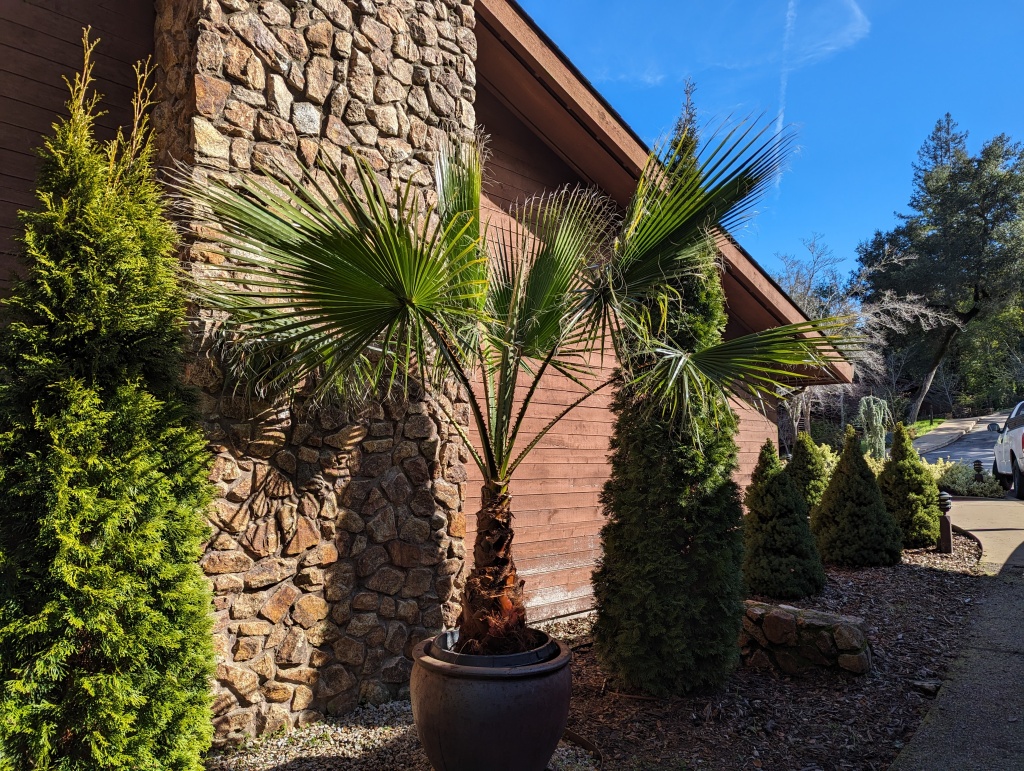
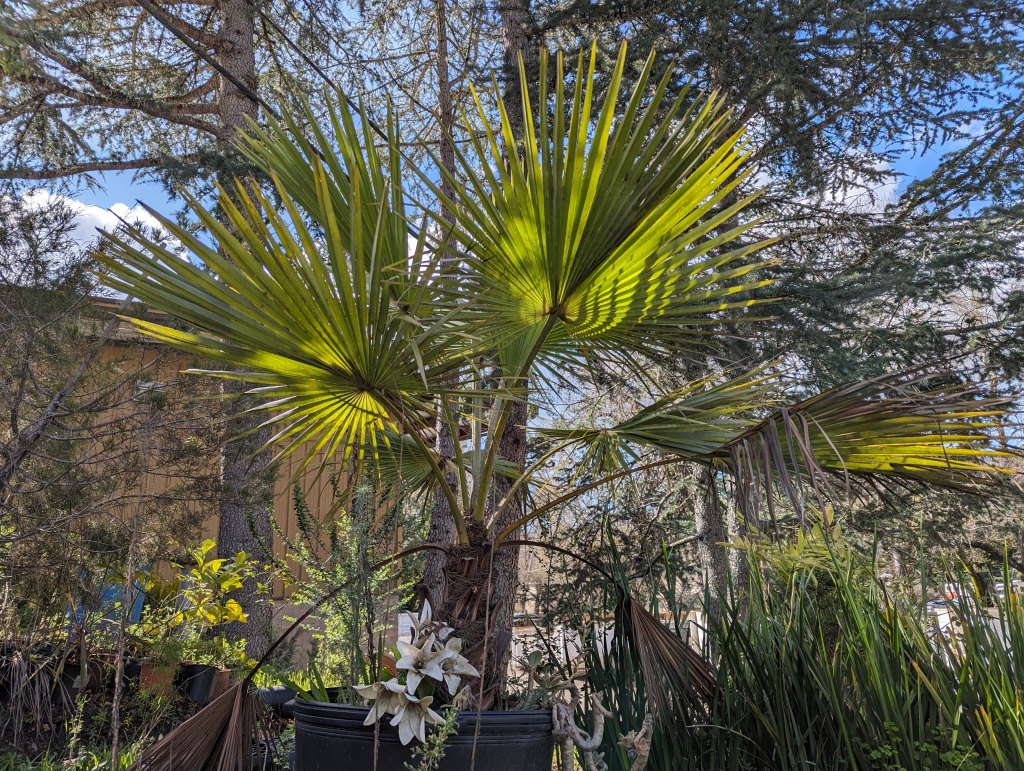
1. Washingtonia robusta, Mexican fan palm, which I wrote about earlier, was too pretty to stay in the recovery nursery where no one can see it. We put it here temporarily, until a pup from the Agave ovatifolia, whale’s tongue agave that bloomed and died here, gets large enough to replace it. It is canned within the big pot for ‘efficient’ removal, but is so heavy that I have no idea of how to get the can out of its pot. It will be a bit heavier later.

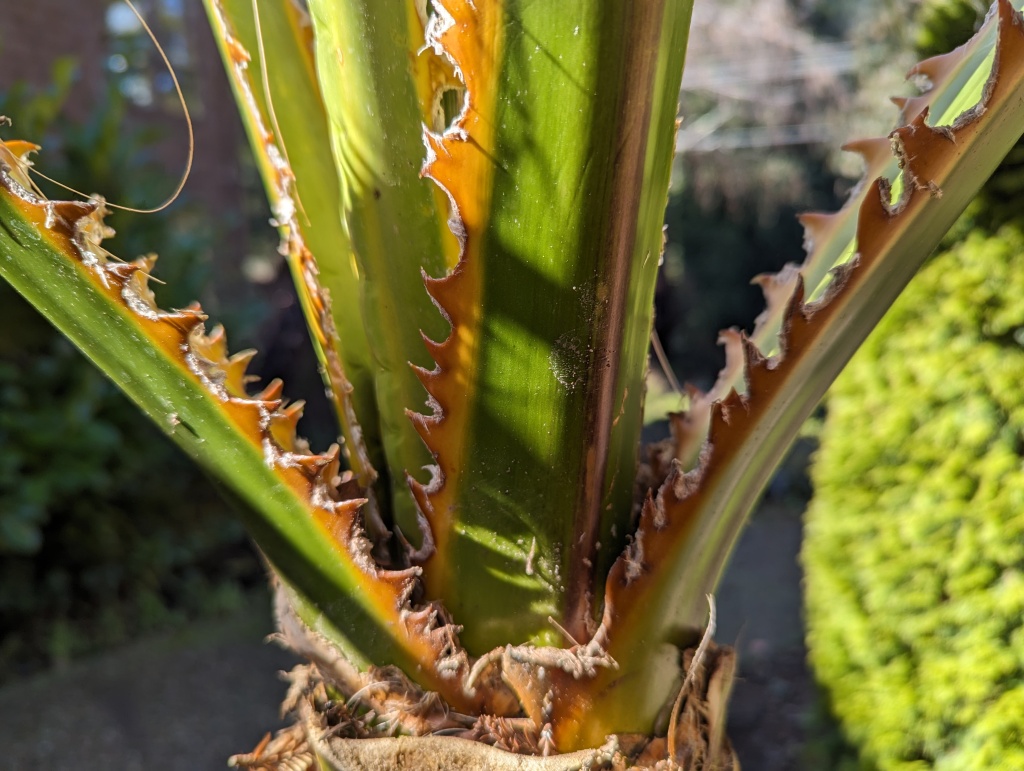
2. Wicked spines on its petioles contribute to the difficulty of relocating this heavy palm.

3. Trachycarpus fortunei, windmill palm is also too pretty to stay unseen in the nursery. It will also get groomed and relocated temporarily to a landscape next week. This young palm grew in the garden of the mother of childhood friends, so I am very protective of it.

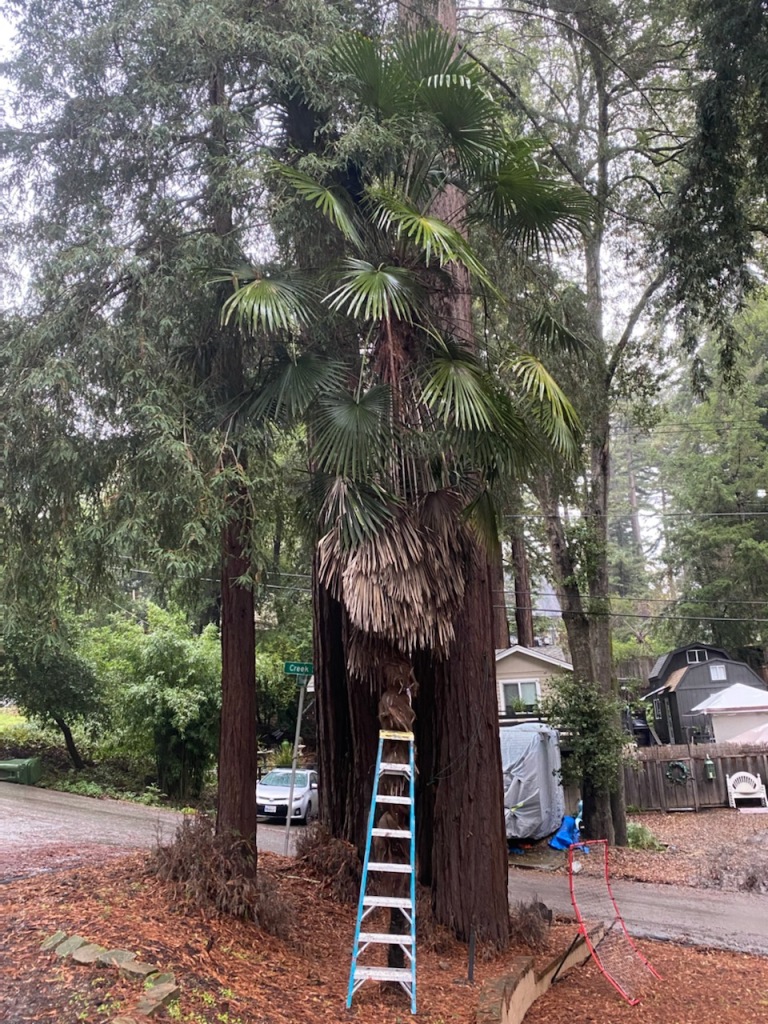
4. Palms and redwoods do not mix well. A colleague wants this windmill palm gone. It is about twenty four feet tall. That ladder is eight feet tall. It will be difficult to relocate, but I do not want it cut down and killed. Like the others, I have no idea of what to do with it.

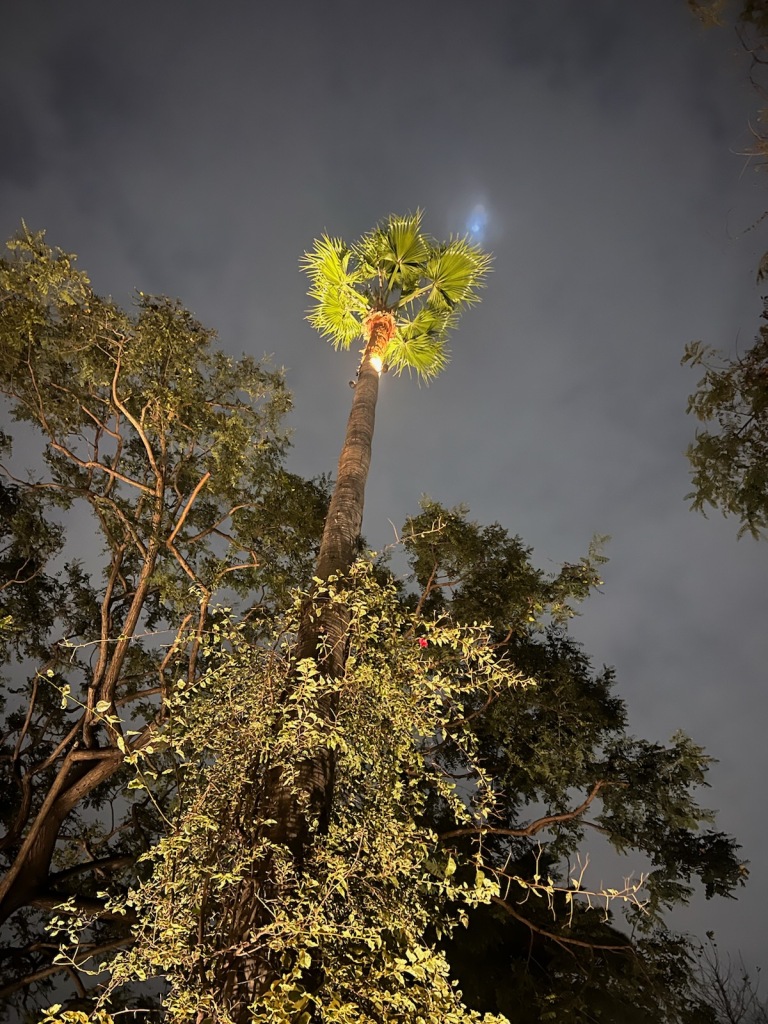
5. Brent’s curbside Mexican fan palm looks embarrassed with its silly uplighting. That is the moon above. This palm, which is a Memorial Tree for Brent’s brother, was about ten feet tall when relocated here because it grew under electrical cables several blocks away.

6. Bedford Drive, nearer to the original location of Brent’s curbside Mexican fan palm, is flanked by very old and alternating Mexican fan palms and Phoenix canariensis, Canary Island date palms. They were grandly uniform until the Canary Island date palms began to succumb to pink rot during the 1980s. The Beverly Hillbillies started their shows with a scene of their arrival in town on a similarly flanked street three blocks to the northeast.

This is the link for Six on Saturday, for anyone else who would like to participate: https://thepropagatorblog.wordpress.com/2017/09/18/six-on-saturday-a-participant-guide/