Pollard And Coppice During Winter

Proper pollarding and coppicing are rare.

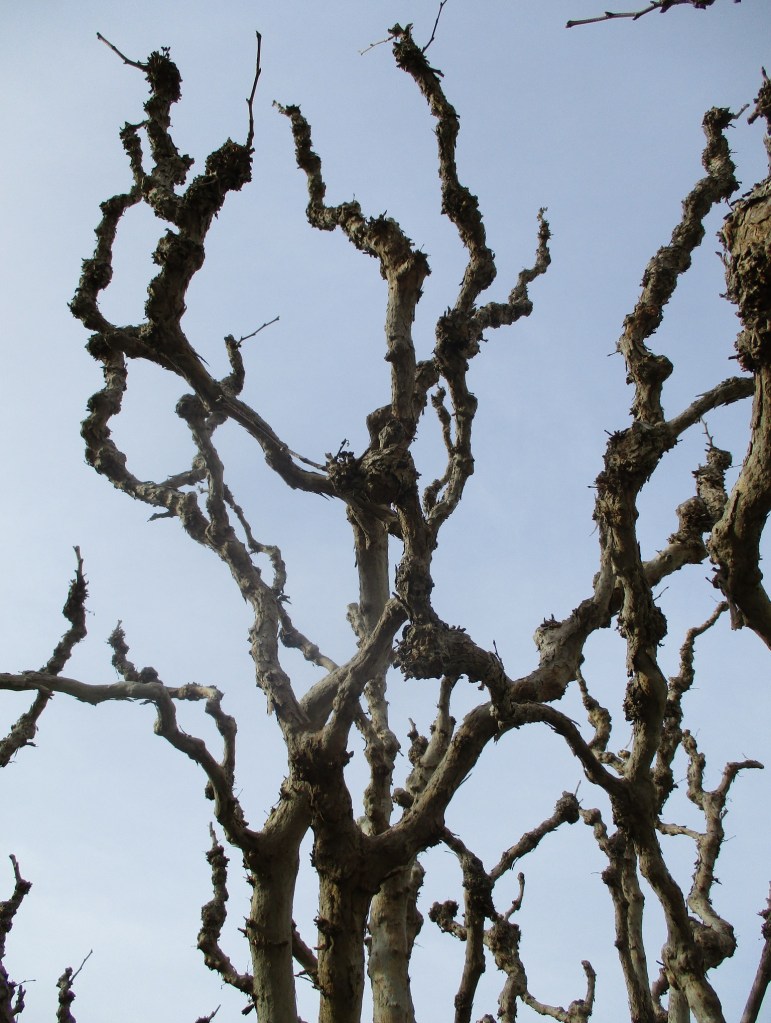
This is extreme dormant pruning. Pollard and coppice pruning involve complete removal of all new growth. They typically involve growth from a previous season annually. A two year cycle involves growth from two previous seasons, and so on. This repetitive pruning to the same origins stimulates distended callus growth there. It is as brutal as it sounds.

This is why pollard and coppice pruning are vilified in America. The techniques evolved through centuries of horticulture and several cultures. Both are still practical for various reasons everywhere else. However, American arboriculture classifies them as topping or disfigurement. Consequently, very few arborists here know how or want to do it properly.

Like other dormant pruning, pollard and coppice pruning must happen during winter. It is too severe for active vegetation. Also, pollard pruning exposes bark of trunks and limbs. Such bark would scald during sunnier summer weather. Growth from distended callus growth, or knuckles, shades lower stems by summer. It is very vigorous through spring.

That is what pollard and coppice pruning is still useful for within other cultures. Vigorous foliage is useful for fodder for livestock, including silkworms. Vigorous stems are useful for kindling and basketry. Some species bloom more vigorously on vigorous new growth. Others can not bloom to produce unwanted pollen or messy fruit within the same year.

Colorful or variegated foliage is more colorful in response to pollard or coppice pruning. Some eucalypti generate juvenile foliage for floral design. Such foliage is more aromatic than adult foliage. Improved foliar vigor enhances resistance to some diseases, such as mildew and rust. Coppicing can renovate some types of overgrown or shabby shrubbery.

The difference between pollard and coppice pruning is that pollard pruning retains limbs. Coppice pruning retains only a stump near grade. It is less reliant on repetition, and may never need it again. Pollard pruning compromises structural integrity, which necessitates repetition. Otherwise, pruning to restore structure will eventually become necessary. Not many species are receptive to such extreme pruning techniques.
Do Not Try This At Home

Before and After pollarding

Pollarding and coppicing are very unfortunately vilified here. I just wrote an article about these topics for the gardening column. Arborists are taught that they are comparable to topping, and that they cause irreparable disfigurement.

It is unfortunate because both procedures have very practical application. Both are still commonly practiced in other regions. If performed properly, both are quite sustainable, and can actually maintain some specimens of a few species longer than they typically live naturally. I use both techniques to a minor degree at work, and will likely do more of both within my home garden.

However, I almost never recommend either technique. Because they are so vilified, arborists do not learn about them. Consequently, it is nearly impossible to find an arborist who can perform either technique properly. Trees and shrubbery can very easily be ruined by either technique if performed improperly.

In fact, I am hesitant to allow reliance on pollarding and coppicing by trees and shrubbery at work because I am concerned that no one else will want to repeat the processes after my retirement or resignation, which could be at any time. Coppicing carpet roses should be no problem for whomever performs it in the future, but I can not be certain. Pollarding is a bit more specialized, so concerns me more.

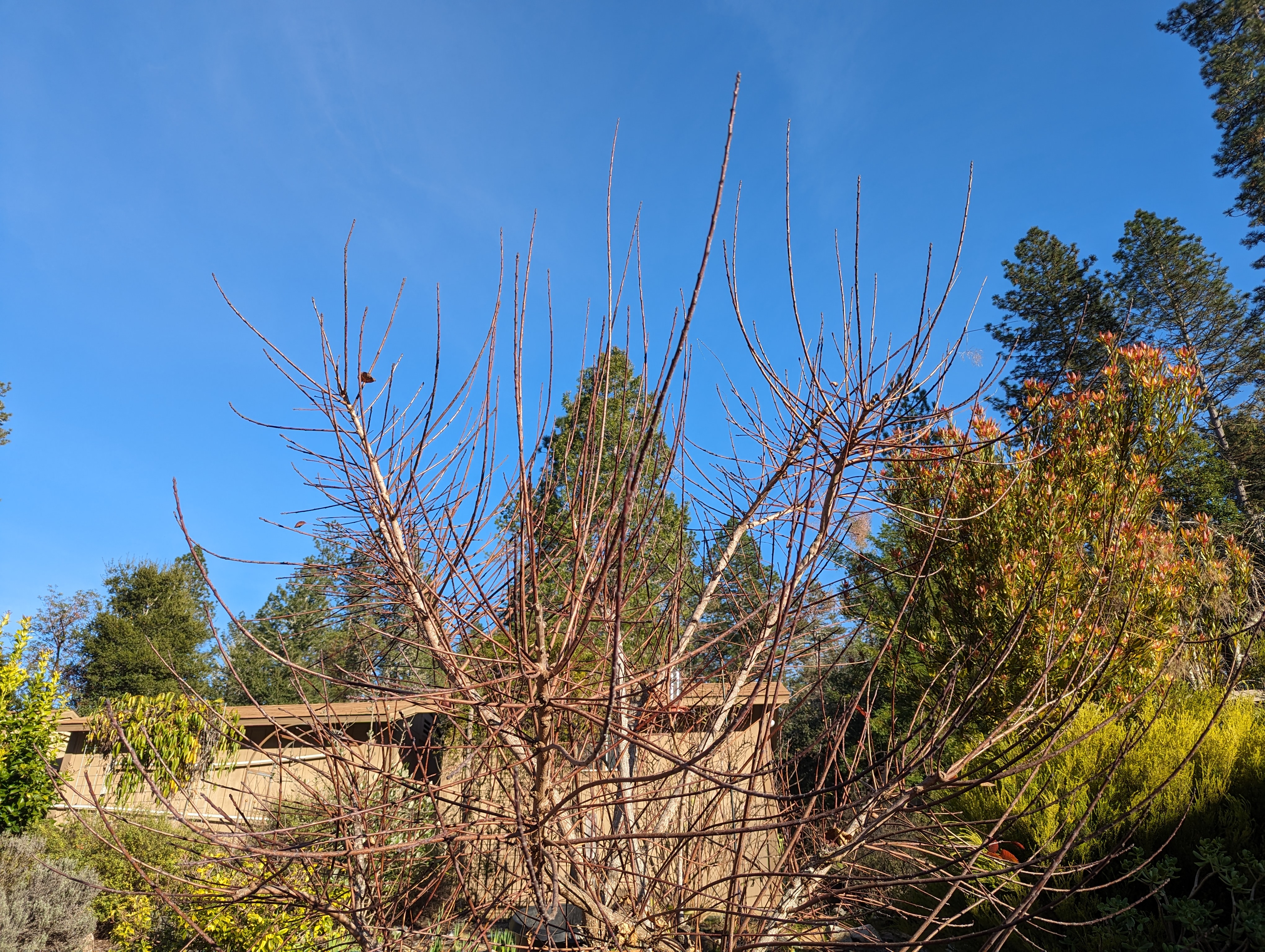
This smoke tree was initially pollarded for renovation. It was previously distressed and weak, but is now quite vigorous. Its purple foliar color is more vibrant through summer. So is its autumn foliar color. I previously believed that it bloomed only on year old stems, so would be unable to bloom on exclusively new canes after being pollarded. Instead, it blooms better on vigorous new stems that it on distressed year old stems.

It is not forming knuckles though. New stems emerge from all over the permanent stems, so leave pruning wounds that do not compartmentalize as efficiently as they would on knuckles. Also, without terminal knuckles, some permanent stems die back an inch or two annually. Although pollarding successfully renovated this smoke tree, it is not as sustainable as I would like it to be.

So, because the procedure is not sustainable for this particular specimen for very long, and I suspect that no one will want to repeat the process annually in the future, I will likely encourage more natural form. I left a few extra new canes for this year. For next year, the twiggy interior growth may be thinned, while upper and outer growth is allowed to develop into a more permanent canopy.

Dracaena Palm

Modern dracaena palms are more compact, more colorful and more user friendly than old fashioned sort.

(This article was deferred from yesterday morning.)

            While hoping to find some of the uncommon yuccas that I still lack, I instead encountered some of their friendlier kin in a local nursery. Even though dracaena palm, Cordyline australis, is an old fashioned plant that was probably considered to be too common until the past few decades, many more colorful modern cultivars are restoring its appeal. Classic dracaena palm has olive drab foliage. The nearly as traditional bronze dracaena, ‘Atropurpurea’, has reddish bronze foliage. The more contemporary ‘Red Star’ though is deeper purplish red. ‘Pink Stripe’ has bronzy green leaves with pink edges. ‘Sundance’ has pink in the middle with green edges.

            Modern cultivars also stay shorter so that their abundant foliage can be appreciated on a more personal level. The individual sword shaped leaves are about three feet long and three inches wide, a bit larger than traditional dracaena palm leaves. However, I actually prefer the traditional dracaena palms that can get taller than twenty feet and spread nearly half as wide, with sculptural bare trunks and high branches.  

            Any dracaena palm that gets too tall can be cut back to a more proportionate height. One of my colleagues recommends cutting about a quarter through trunks a year or more prior to cutting back, to stimulate new shoot growth just below the cut. The new growth prevents the trunks from being bare immediately after getting cut back. Overgrown heavily branched trees should first be thinned to decrease their weight before cutting partly through their trunks. Young plants can be cut back to the ground to regenerate with multiple trunks.

            Billowy trusses of tiny pale white flowers add interest at the end of spring, particularly against darker foliage. I am told that the flowers of modern cultivars are slightly fragrant. However, against the olive drab foliage of older dracaena palms, I think that the blooms look rather dusty, and do not smell any better.

Six on Saturday: Bucket List

Hyacinth Bucket of ‘Keeping Up Appearances’ might say, “It’s ‘Bouquet’.” However, this really is about the contents of two buckets, two cans, a bin, and a terracotta pot, without flowers. Most of these items must be processed prior to the end of the rainy season.

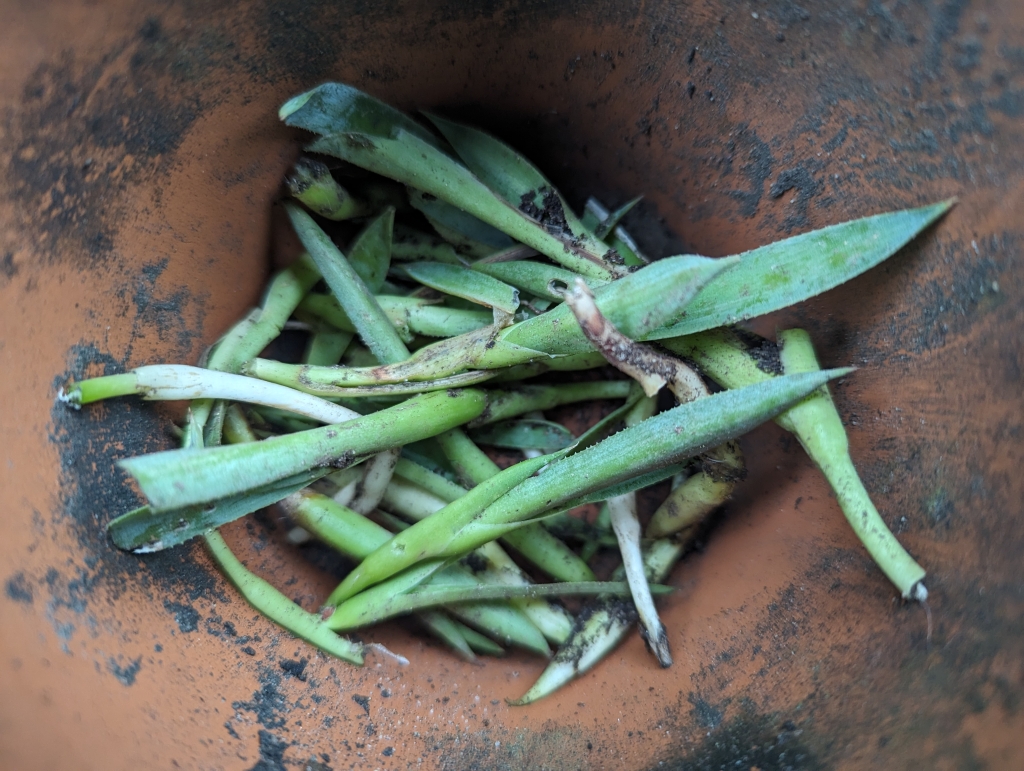
1. Agave ovatifolia, whale’s tongue agave bolted and bloomed too soon after installation. It is monocarpic, so died an ugly death while trying to replace itself with fresh new pups. I planned to later select the biggest pup to replace its original. Unfortunately, a gardener who did not know what they are pulled them all with nearby weeds. I scrounged through the debris to find these. Incidentally, I must still find homes for Agave americana pups.

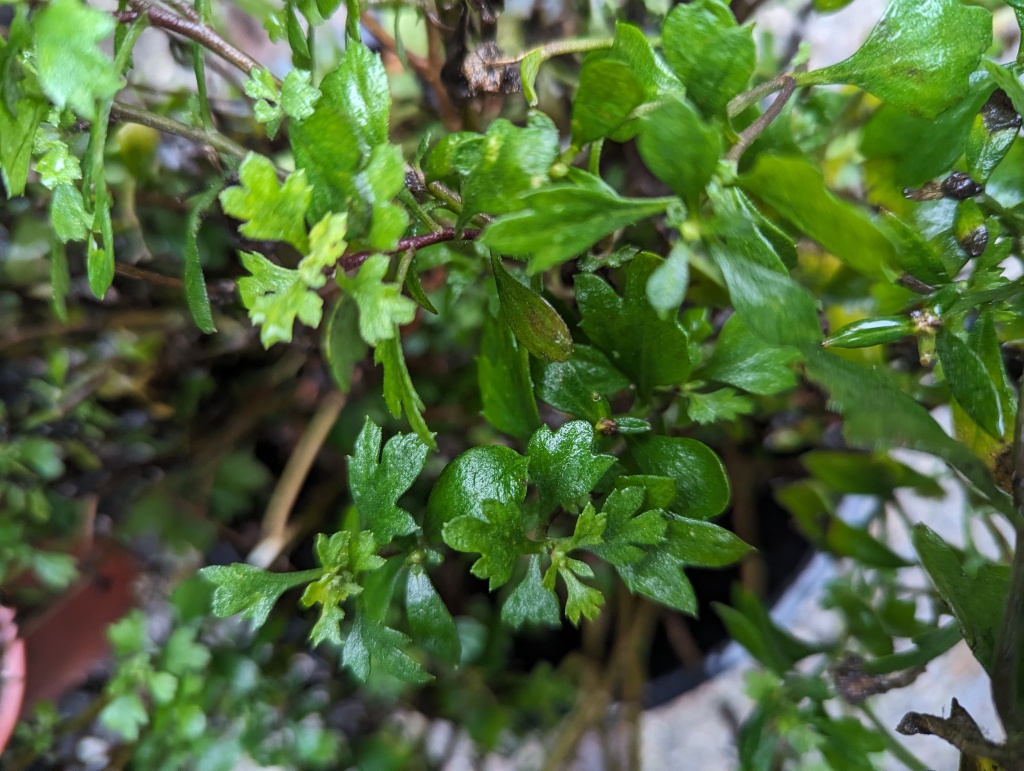
2. Chrysanthemum X morifolium, mum contrarily will not die. It was abandoned after a wedding, but then potted into a landscape as it bloomed again. Removal for replacement as it again finished bloom revealed that each of these many stems is rooted individually.

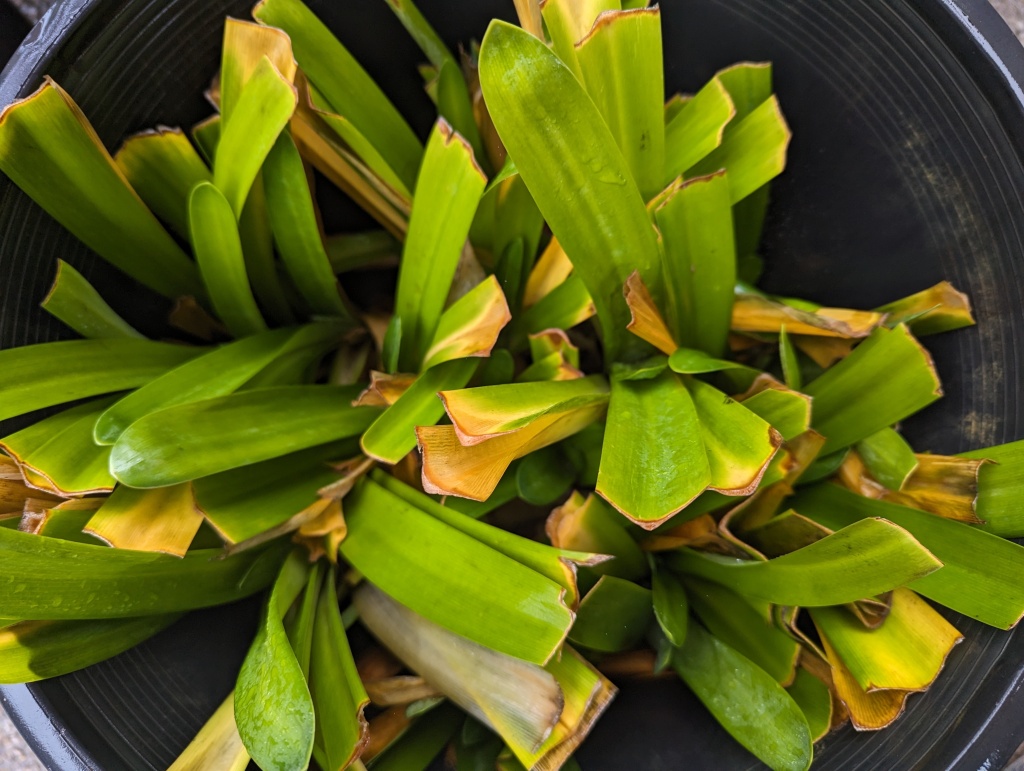
3. Agapanthus orientalis, lily of the Nile is getting to be rather tedious. These shoots are of the same batch that I featured last week, and that I processed more than a month ago. I processed too many, so must now get the leftovers into the ground before winter ends.

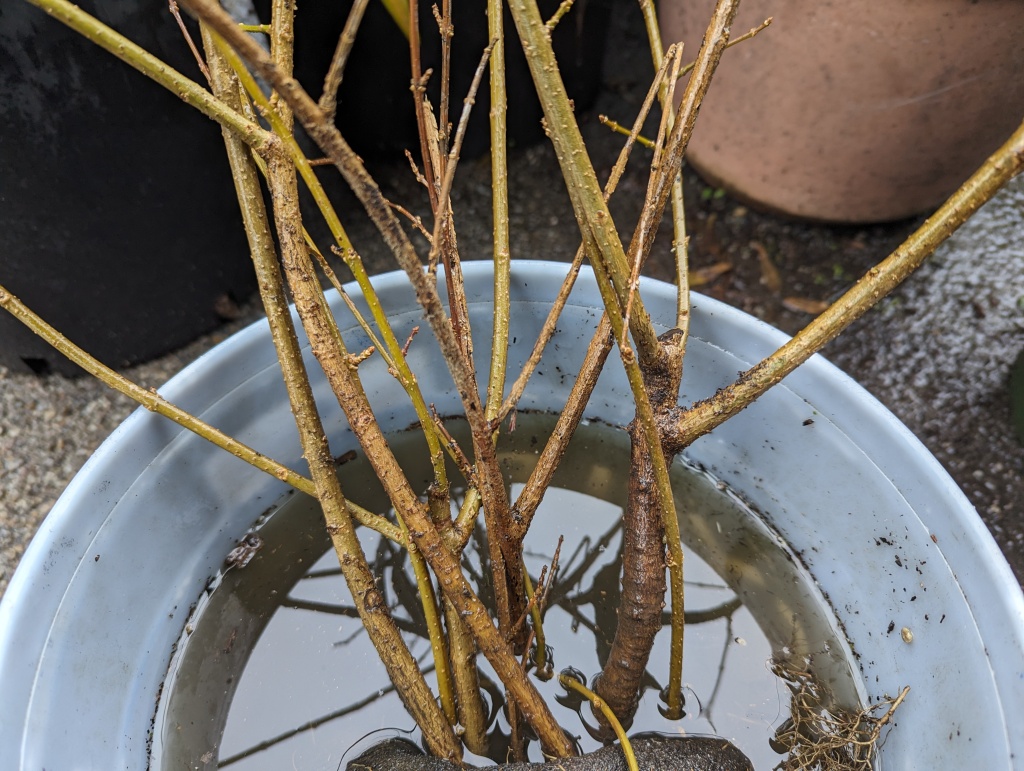
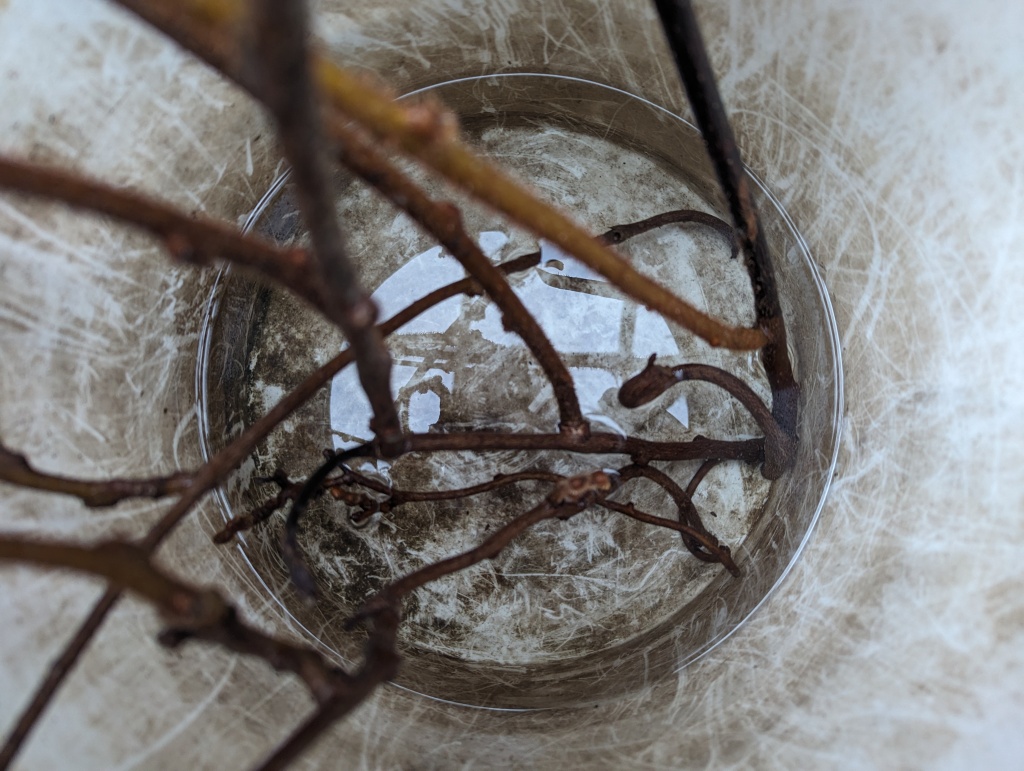
4. Forsythia X intermedia, forsythia will bloom soon, but for the moment, is dormant. I relocated an old specimen that was always in the way. These spare twigs can be forced.

5. Actinidia deliciosa, kiwifruit vines grew easily from a broken bit that I found in a load of debris that someone left here last winter. They are female without pollinators though. These are dormant pruning scraps of its male pollinator, and should grow just as easily.

6. Rain was falling yesterday and is forecast to continue lightly through most of Monday.

This is the link for Six on Saturday, for anyone else who would like to participate: https://thepropagatorblog.wordpress.com/2017/09/18/six-on-saturday-a-participant-guide/

Learn How To Prune Dormant Deciduous Fruit Trees Properly

(This article is recycled from 2010, so includes outdated information. It is deferred from yesterday because Wi-Fi was not operational.)

Deciduous fruit trees require very specialized pruning.

            So many of the kids I grew up with now have an apricot tree in their own back yard, even though not many of us actually like the fruit. We all remember the remnant orchards, mostly apricots, which were scattered about the Santa Clara Valley when we were young. We also remember how we consumed vast volumes of apricots in every form imaginable; including fresh, dried, canned and stewed, and in jams, jellies, compotes, syrups and pies. I could go on, but it would ruin my appetite.

            Deciduous fruit and nut trees are certainly not ‘low maintenance’. Most need to be pruned annually, while dormant in winter. If not pruned correctly, they become overburdened with their own fruit. Also, the process of selecting from the many different cultivars of the many different types of fruit is quite a chore. There are many more cultivars to choose from for home gardens than for orchards, particularly with the many modern cultivars introduced during the past few decades.

            Because those who maintained the orchards are now as nearly extinct from the Valley as the orchards are, we need to know how to care for our own trees. This is why Friends of Guadalupe River Park and Gardens has scheduled the Dormant Fruit Tree Pruning Class with Sean McGrail in only a few days, on January 23, from 9:30 to 11:30 a.m.. Tools, techniques and basic pruning concepts will be explained and demonstrated among the many fruit trees, including apricots, cherries, prunes, apples and others, of the Historic Orchard of Guadalupe Gardens. Participants will then get to participate in pruning some of these trees. The Historic Orchard is located just south of Taylor Street in San Jose, adjacent to the Guadalupe River Park Trails. Admission is $15. 

            A week later, on January 30 from 9:00 a.m. to noon, the Best of the Best class, also with Sean McGrail, as well as Nancy Garrison and the California Rare Fruit Growers, will discuss many of the best fruit cultivars for the Santa Clara Valley. Afterward, planting, site selection, drainage and pruning of new trees will be demonstrated in the Historic Orchard. Admission is $30. Required registration can be arranged by telephoning 298 7657. Information about both classes can be found online at www.grpg.org.     

Horridculture – WWW

Online, bay laurel often passes for culinary bay.

Anyone can say anything online. There is no shortage of inaccurate information. Much of it is stupidly inaccurate. Much of this stupidly inaccurate information is more popular and more efficiently dispersed than conflictingly accurate information. To make matters worse, some accurate information that seems like it should be readily available is notably lacking. For example, I can not determine if the native blue elderberry requires a pollinator for fruit production. It is a simple question that seemingly lacks an answer.

Facebook shared a link to an article about the twenty worst trees to select for home gardens. The article does not say where this information is relevant. Nor does it bother to mention that trees perform differently within different climates. It is presented as universally accurate information.

Chinese flame tree is first on the list. What is a Chinese flame tree? The article does not provide that information. This is what botanical taxonomy was invented for.

Eucalyptus is next on the list. What species of Eucalyptus? The article does not say. Nor does it mention any of the many species of Eucalyptus that are quite practical small trees. That is like saying that France, Spain, Italy, Greece and Portugal are all countries of Europe, but Africa is just Africa. (That happens also within other contexts.)

Tulip poplar is apparently dangerous because it drops branches. That sounds reasonable. However, coast live oak, blue gum eucalyptus, California sycamore and red willow are much more likely to do so here.

Black walnut is toxic. Although true, and some naturalized black walnuts remain from understock of the now extinct English walnut orchards, black walnuts are not commonly planted, and are not even available from nurseries.

Mulberry is messy. However, the only mulberry that is commonly planted is the fruitless mulberry. Fruiting cultivars are very rare, and mostly planted by those who actually want the fruit, and maintain them so that they do not get too big and messy.

Eastern cottonwood drops limbs. However, as the name suggests, it is Eastern, so is nowhere near here. Western cottonwood is a variety of the same species, and behaves similarly, but like black walnut, is neither planted intentionally nor is commonly available from nurseries.

The list goes on to include many trees that are not available here or that are simply not problematic. After describing all of the diverse species of Eucalyptus as one, it mentions a few species of similar cottonwoods as if they are more distinct from each other than they actually are. It shows a picture of common Mediterranean olive for Russian olive, which is not even remotely related. It says nothing about palms, which are good trees within appropriate situations, but require expensive maintenance by arborists who can climb them.

The internet is a useful tool, but is not perfect.

Apple

There are countless varieties of apple.

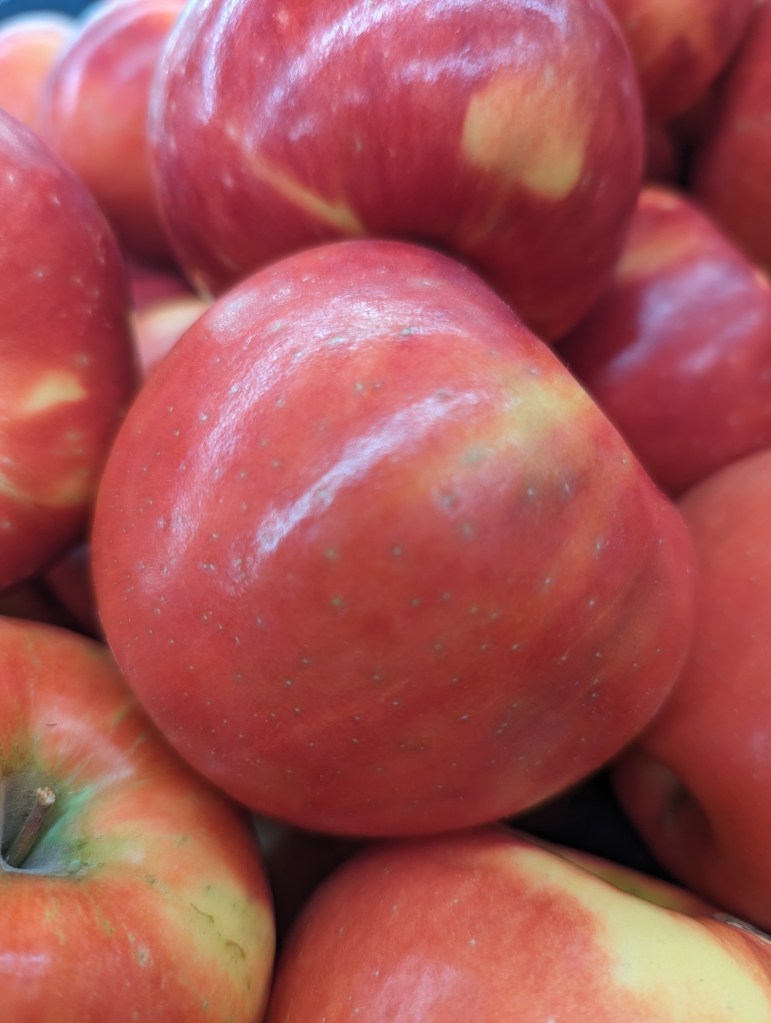
Apples are amazingly diverse. They have been in cultivation for thousands of years. Too many cultivars to document developed during that time. Some ripen as early as summer, while others ripen for late autumn. Some are best for eating fresh, while others are better for cooking, baking or juicing. Some are sugary sweet, while others are impressively tart.

Malus domestica is the general botanical name for most domesticated apples. However, this classification includes countless hybrids of a few species. Some are products of very extensive breeding. Most can grow as large as small shade trees. Grafting onto rootstock limits their size accordingly. Most ‘semi dwarf’ home garden trees are relatively compact.

Apple trees bloom with small but profuse and brilliant white flowers for spring. Flowering crabapple trees generally bloom pink or reddish pink, but produce dinky fruit. Otherwise, apples are about as big as baseballs. Some are significantly bigger or smaller. They can be variable shades of red, yellow or green. Some are striped or blushed with two colors. Their deciduous foliage turns yellow through autumn, and defoliates through winter.

Dormant Pruning Exploits Winter Dormancy

Fruit trees become congested without pruning.

Bare root season begins as the year ends for a simple reason. That is when deciduous plants are dormant. They are unaware of the otherwise distressful process of relocation. This is also why winter is the season for dormant pruning. Such pruning would be very distressful at any other time of year. While dormant, deciduous plants are unaware of it.

Dormant pruning of fruit trees is also important for a simple reason. Extensive breeding has increased reliance on horticultural intervention. In other words, deciduous fruit trees now generate more fruit than they can support. Their fruit is both unnaturally abundant and unnaturally large. It is both too heavy and too consumptive for its unpruned stems.

Dormant pruning enhances the quality of fruit by concentrating resources. Although less copious, fruit is bigger and better. Also, dormant pruning enhances structural integrity of supportive stems. Although more vigorous, vegetative growth is more compact. Stouter stems endure less leverage from fruit weight. As a bonus, more fruit is easier to reach.

Almost all deciduous fruit trees require very specialized dormant pruning. This includes some nut trees, as well as grapevines, kiwi vines, cane berries and roses. However, it does not include evergreen fruit trees, like citrus and avocados. They do not need such aggressive pruning. Besides, pruning stimulates new growth that is vulnerable to frost.

Unfortunately, dormant pruning is too specialized to describe in a few paragraphs. For most deciduous fruit trees, it is quite aggressive. Peach and nectarine trees may benefit from removal of half of their stem growth! Apricot and plum trees need a bit less pruning. Cherry and almond trees may need only minor pruning. Yet, all six are stone fruit trees.

Apple, pear and quince are all pomme fruits. Their trees require similar dormant pruning. Their many varieties require various degrees of such pruning though. Fig, mulberry and persimmon trees all require particular types of dormant pruning as well. Deciduous fruit trees are certainly not low maintenance. This should be considered before planting any.

No Bad Habit

Washingtonia robusta, Mexican fan palm

Technically, this one is different. I did not get it from a situation that it needed to be removed from at work, and then can it because I did not want it to be discarded. I did not grow it from seed or cutting that I ‘borrowed’ from a landscape somewhere else. I did not ‘borrow’ it from Brent’s gardens at the Jungalow. I did not find it for free on Craigslist.

I found it for free on the Marketplace of Facebook, which is NOT Craigslist or any other familiar source. Therefore, technically, it is not a bad habit.

It is a Mexican fan palm, Washingtonia robusta. It was too appealing to ignore. I noticed its post several days ago, but did not respond immediately. I thought that someone else would claim it if I ignored it long enough. No one claimed it; so it is here now. Actually though, I am very pleased with it.

It came from the Willow Glen neighborhood of San Jose, so is accustomed to excellent soil and climate. Its species is remarkably adaptable though. It will be as satisfied with the slightly cooler climate and sandier soil here. I will need to provide it with plenty of water while it disperses its new roots. It is only canned now because the situation that it will be installed into is not yet ready for it. A few deteriorating black locusts and box elders will need to be pruned or removed first.

As it recovers from transplant, the presently healthy leaves will likely desiccate and need to be pruned away. I will leave them until they do so because they may not, and they help to sustain new root growth and dispersion. The process is actually less stressful through the cool and rainy season of winter.