Horticulturists are by nature, nonconforming. I happen to find it difficult to conform to what makes us nonconforming. Trends are fleeting. Old technology that has worked for decades or centuries is still best. Although I am not totally against chemicals, I find that almost all are unnecessary for responsible home gardening. Pruning is underappreciated, and fixes many problems.
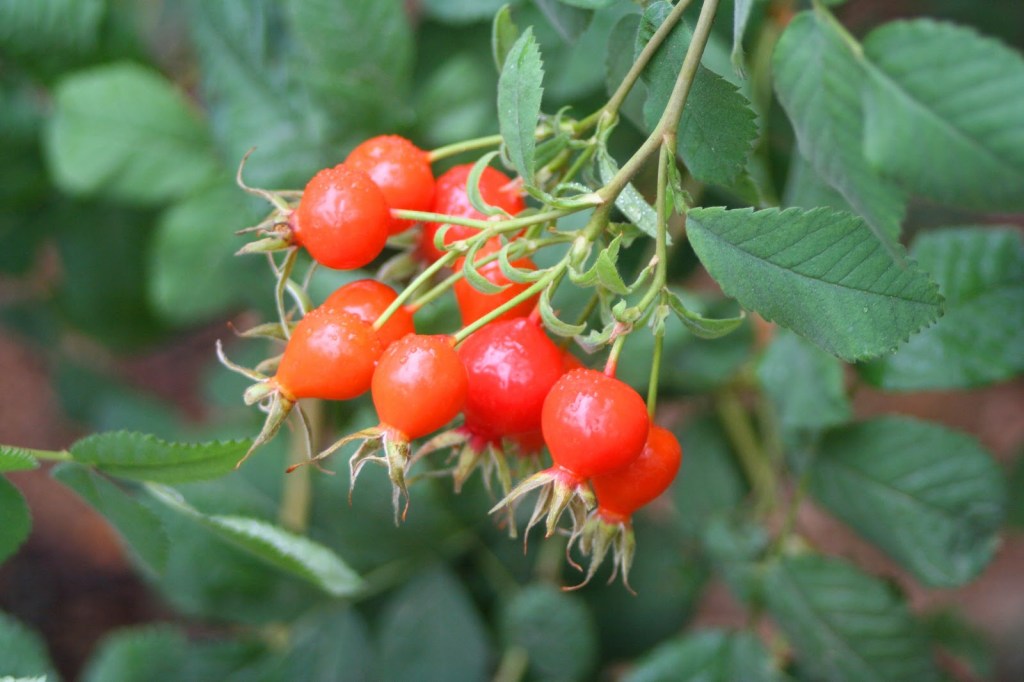
Even if bloom is not much to brag about, the rosehips can be pretty and useful.
Prickly thickets of California wild rose, Rosa californica, are not often much to look at, even while adorned with small and sparse pink roses in spring and summer. The fragrant flowers can actually range in color from white to rich pink, and may have more petals, but are not abundant enough to be very impressive at any one time. In autumn though, all the flowers that bloomed in the previous few months leave bright orange or red fruiting structures known as ‘hips’, that linger on the bare canes through winter.
The rose hips of California wild roses had historically been used to make herbal tea because they contain so much vitamin C and have a pleasant flavor. (California wild rose is a ‘tea’ rose but not a hybrid ‘T’ rose.) They can also be made into jelly or sauce. The only problem is that birds like them too, so often take them before anyone else has a chance to.
Aggressive dormant pruning promotes spring and summer bloom.
(This recycled article posted in 2012, so some information within is now outdated.)
Just about anyone can plant roses in the garden, and care for them for at least the first year. Pruning them properly while they are dormant in winter in order to get them to perform satisfactorily every subsequent year is what most of us who grow roses have difficulty with. Like deciduous fruit trees, roses should not be planted and expected to perform with minimal attention. They certainly should not be pruned with hedge shears!
The once modern, but increasingly old-fashioned, hybrid T roses have traditionally been the most common victims of inadequate pruning, since they need such aggressive pruning every winter to prevent overgrowth that interferes with healthy cane growth and bloom. More modern cultivars (cultivated varieties) designed to resemble older roses, as well as reintroduced old fashioned roses are generally not so demanding, but likewise perform best with proper dormant pruning. There are slightly, and not so slightly, different ways to prune the different types of roses. Even the ‘low maintenance’ carpet roses should be pruned to some degree.
Fortunately for those of us who are just learning about roses, the first of several free rose pruning lessons in the San Jose Heritage Rose Garden began this morning, January 4. These hands-on lessons continue at 9:00 a.m. every Wednesday and Saturday until late February. Participants meet in the center of the Garden. The minimum age to attend is sixteen; but minors without parental supervision require a signed minor release form that can be obtained from the Guadalupe River Park Conservancy.
Participants should bring bypass shears, leather gloves, closed-toe shoes and preferably a water bottle. Those who lack shears or gloves can borrow what they need at the Garden. The Heritage Rose Garden is located on West Taylor Street near Walnut Street in San Jose. Parking can be found on Seymour, Taylor or Walnut Streets. More information can be obtained by email to Emily of the Guadalupe River Park Conservancy at emily@grpg.org or by telephoning 298 7657.
The Heritage Rose Garden is the most complete collection of old world roses, the ancestors of modern roses, in the world! Although it lacks modern cultivars, it exhibits a remarkably extensive variety of roses, with all sorts of growth habits. There really is no other garden where one can prune roses with the same basic techniques in so many different ways.
Incidentally, modern hybrid T roses derive their designation from the ‘T budding’ technique employed to attach the scion (upper blooming portion) to the understock (roots), not because the rose hips (fruiting structures) are used to make tea. However, all sorts of roses, including floribundas, polyanthas, grandifloras and all sorts of climbing roses, are budded by the same means; and many hybrid T roses are actually grown on their own roots and not budded onto understock at all. The designation of hybrid T seems somewhat out dated, but is still effective.
Sustainability is a good idea gone bad. Theoretically, it is commendable. Horticulturally, it involves growing species and cultivars that require minimal intervention or resources that they can not obtain naturally from their environment. In more extreme application, it can involve growing only native species, but not their cultivars that would not be naturally occurring, in order to limit interference with natural and endemic ecosystems.
Capitalism is a good idea too. Unfortunately though, it too often compromises other good ideas. It is how sustainability became a cheap fad, which now involves all sorts of artificial but marketable products and interventions that are contrary to its original intention. Regardless of their sources, water, fertilizers and amendments that are not provided by nature are unnatural. Container gardening infrastructure, irrigation systems, artificial illumination and really anything that is made of unnatural material are violations of sustainability that should be more obvious than they are.
‘Sustainability’ has become a buzzword for marketing.
There is certainly nothing wrong with appealing exotic vegetation with the garden or home. Almost all of the best and most popular vegetation is not native, and most of it relies on unnatural intervention and resources to perform as desired. However, it should be recognized for what it is, and not marketed as ‘sustainable’ if it is not.
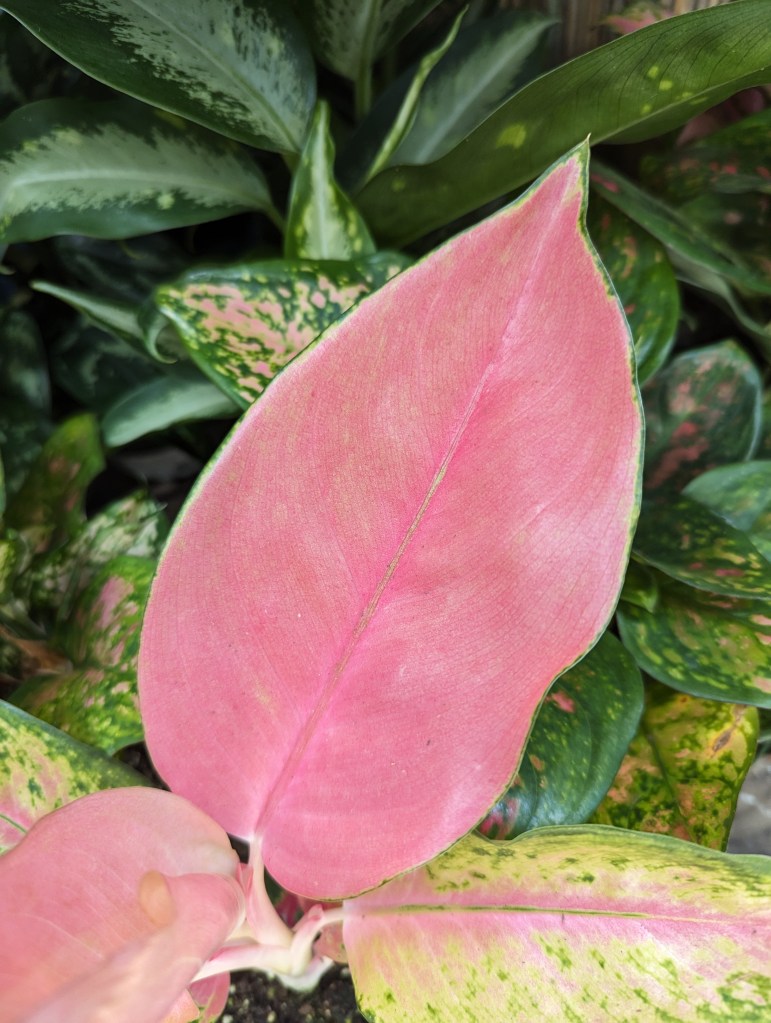
This unusual cultivar of Aglaonema was unnaturally selected or developed from species that are native to tropical or subtropical climates of southeastern Asia. it grows primarily as a houseplant here because it is vulnerable to even very mild frost. It grew in artificial potting medium, within a plastic pot. It will always be reliant on artificial irrigation, and will perform better with unnatural application of fertilizer. It will always be less vigorous than greener cultivars because it lacks chlorophyll. Yet, it is marketed as ‘sustainable’.
Heaths, which are several species of Erica, derive their name from their natural habitats. They are endemic to shrublands of acidic and seasonally dry soil of inferior quality. Such ecosystems, or heaths, do not sustain many big trees or shrubbery. Species from heaths should be resilient to dry chaparral summers. However, they dislike locally alkaline soils.
This is unfortunately why heaths are quite rare within gardens here. They are popular as blooming potted plants for winter, but become scarce afterward. Within planters of potting media, they may grow and bloom for many years. In the ground though, they are likely to languish without acidifying amendment. They prefer the company of coniferous species.
Heath blooms for winter or very early spring. Heather is a similar relation, but blooms for summer or autumn. Floral color ranges from white to pink to rustic purplish pink. Flowers are dinky but abundant. Comparably dinky evergreen leaves are like soft juniper scales. Almost all available heaths grow less than five feet high. Most grow less than a foot high.
Christmas trees and associated items are no imposition for nurseries. They are seasonal while not much else is appealing to a retail market. They occupy retail area that summer and autumn commodities relinquished earlier. Then, they relinquish their same space as bareroot stock becomes seasonable. The chronology is very coincidentally very efficient.
Bareroot season is not actually contingent on the end of Christmas tree season. It begins with winter dormancy of bareroot stock. This dormancy merely and fortuitously coincides with Christmas. It is as effective as anesthesia for surgery. Basically, dormant stock goes to sleep on a farm, and awakens in a new home garden. Timing of the process is critical.
Bareroot stock initially grows in the ground rather than within nursery cans. Separation of its roots from the soil they grew is harmless during dormancy. Both roots and stems need simultaneous pruning. Then, stock is ready for transport without soil. Some gets packing of moist sawdust in plastic bags. Most awaits resale from bins of moist sand at nurseries.
Bareroot stock has several advantages to more familiar canned nursery stock. It is much less expensive. It is also much less cumbersome. So, not only are more items affordable, but also, more fit into a car at the nursery. Their relatively small roots systems are easy to install. More importantly, without binding, their new roots disperse much more efficiently.
Deciduous fruit trees are the most popular bareroot stock. This includes stone fruits such as apricot, cherry, plum, prune, peach and nectarine. Also, it includes pomme fruits such as apple, pear and quince. Roses and cane berries are likely the second most popular of bareroot stock. Persimmon, pomegranate, fig, mulberry, and nut trees are also available.
Some of the more unusual bareroot stock is available only from online catalogues. More variety seems to become available locally though. Elderberry has only been available in California for the past several years. Currant and gooseberry are variably available here. Artichoke, asparagus, rhubarb and strawberry are perennials that are available bareroot. Cultivars of blueberry and grapevines are available.
I am not one to make resolutions for a New Year. Such resolutions can be made at any time. Most should probably be made as they become necessary.
I will say though, that in the future, I should post less frequently to this blog than I have been. I mentioned this a few times since I began posting here a few years ago, but never followed through with doing so.
My weekly gardening column posts in two parts, typically for Mondays and Tuesdays. That is really all that is necessary. Old columns also post in two parts, typically on Thursdays and Fridays. I could continue to recycle them, although, because topics are seasonal, the old articles are often redundant to the new articles that post at about the same time.
All other articles that post on other days are quite unnecessary. Horridculture articles that post on Wednesdays involve too much sniveling. Six on Saturday articles that post on Saturdays are fun for me, but lack substance for readers. Random articles that post on Saturdays at noon and Sundays have become somewhat too random and mundane.
Unfortunately, I can not write well with so much else happening. It is a long story, but what it comes down to is that I really should write less than I have been.
Therefore, for the future, I should commit only to posting my weekly gardening articles, from the gardening column, on Mondays and Tuesdays. I will likely continue to post recycled gardening articles for Thursdays and Fridays, even if redundant, only because they are already written. Although I may continue to post articles for Wednesdays and weekends, I may not. If not, this blog will become merely a compilation of the gardening column articles rather than a real blog. Perhaps less will be better.
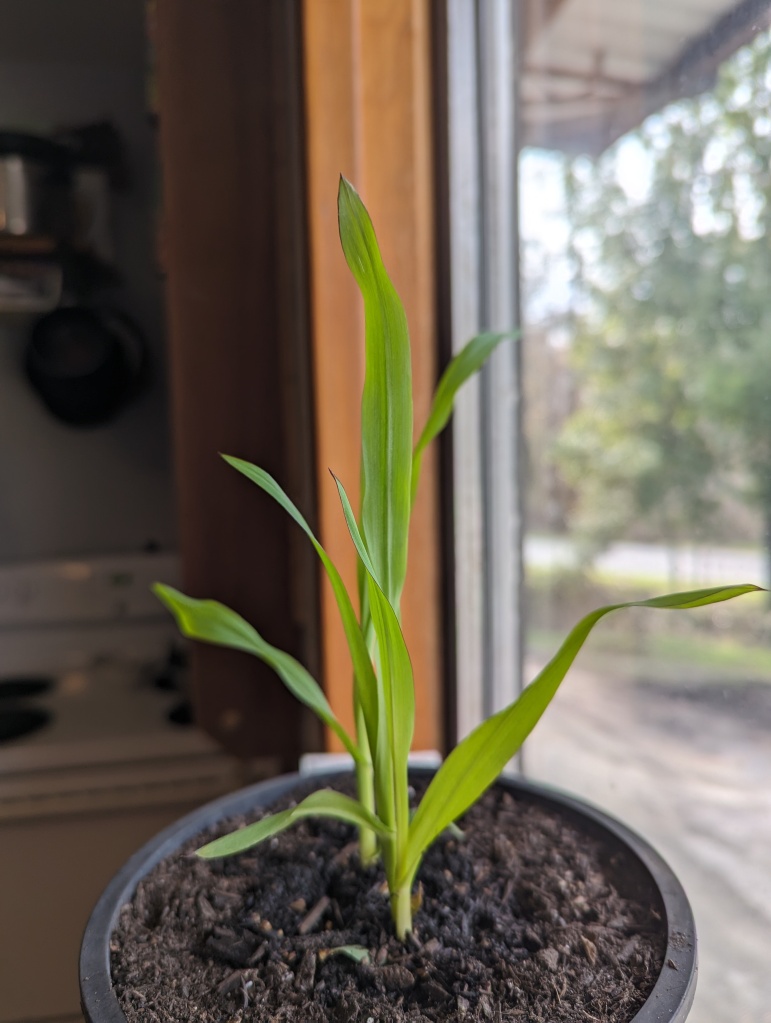
‘Pele’s Smoke’ is an ornamental sugarcane that should bronze with better exposure.
The internet is surprisingly deficient. It contains an amazing abundance of information, including a majority of information that most of us should not want. No one can filter out all the previews to disturbingly violent cinema, disturbingly idiotic political scandal, disturbingly aberrative sexual content, and so on. Yet, some of the simplest information remains mysteriously elusive.
I grow ‘Pele’s Smoke’ sugarcane only because it is what I obtained first. I grew it from scraps that I pruned from a specimen in the garden of a colleague in the Los Angeles region. It grows like a weed. I happen to enjoy growing it. It is primarily an ornamental cultivar though. With its bronze foliage, it is intended to be prettier than it is functional. Although it is considered to be productive, the canes are small and relatively tough.
I would like to grow a variety of sugarcane that is more utilitarian than ornamental. There are many varieties within three types of sugarcane that I should be able to choose from. Chewing cane is the sort that develops a soft and chewable pulp within its canes that can be chewed like a confection, leaving less inedible fibrous pith than other varieties. I do not want to bother growing chewing cane. Syrup cane may produce a bit more fibrous pith, but generates an abundance of sugar syrup, which unfortunately does not crystalize as readily as that of other varieties. I do not want to bother growing syrup cane. Crystal cane is the sort that produces the most sucrose, which should crystalize more readily than the combinations of sugars that other varieties produce. That is what I am still trying to find! Several varieties of sugarcane are available online, but very few are classified as chewing, syrup or crystal canes! I am still searching!
These six lack a common theme. I do find the botany of four of them to be annoying, but that is no theme. Leyland cypress has a new genus name, which I did not mention. I still do not believe that the native blue elderberry is the same species as the black elderberry of the East. I still do not know for certain if the double white angel’s trumpet is a hybrid, although I do believe that it is. Although I exceeded my preferred word count limit here, I tried to abbreviate some of the redundancy of nomenclature while including both Latin and common names with the same cultivar name. Otherwise, the first of these six would be Saccharum officinarum ‘Pele’s Smoke’, ‘Pele’s Smoke’ sugarcane, with ‘Pele’s Smoke’ mentioned twice, with a comma in between. I may continue this technique in the future.
1. Saccharum officinarum ‘Pele’s Smoke’ sugarcane continues to grow like a weed on the warm windowsill in the galley at work. It is not bronzing though. I suspect that this fresh new foliage will be too tender to survive outside even after early spring. It is no problem. It will simply make more. Many more cuttings are growing outside. They are slower but more resilient. For less redundancy, I used its same cultivar name after its species name and before its common name. Of course this explanation is longer than any redundancy.
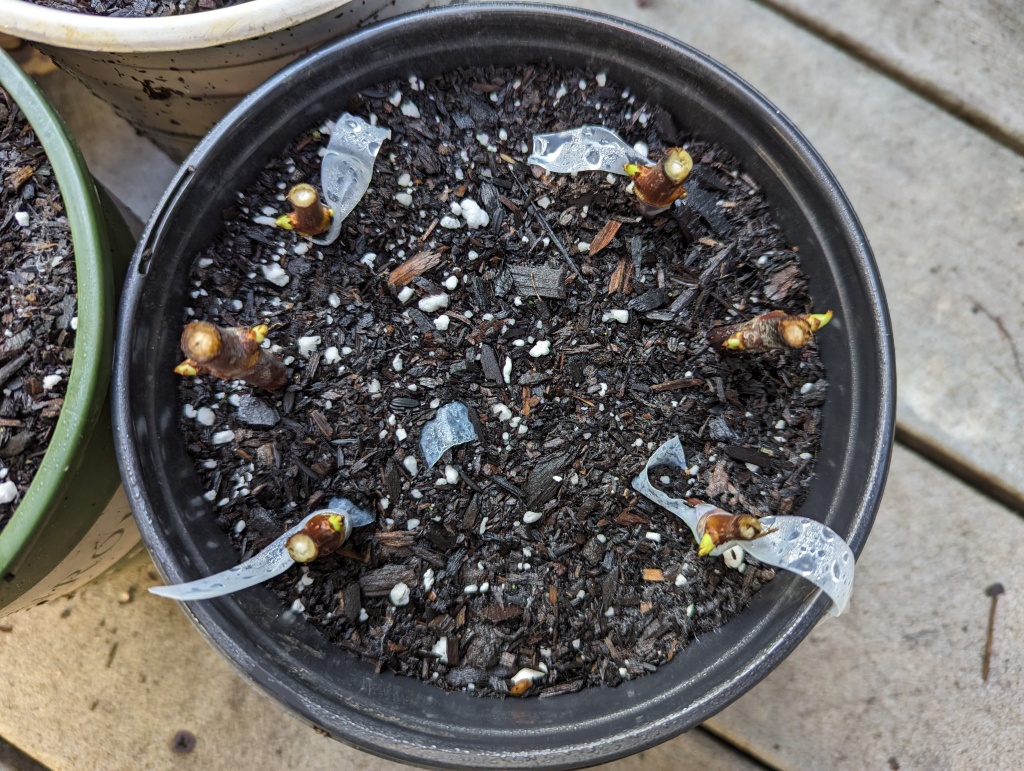
2. Sambucus cerulea, blue elderberry is classified by most botanists as a Western variety of American black elderberry. I know better. I am Californian. Regardless, I am growing a few cuttings from a few different parents because no one seems to know if they should be more productive with pollinators, like European black elderberry is. Four tagged bits are from the same very productive specimen, which must be removed from a landscape. The other pair is from a random roadside specimen. Three other pairs were added later.
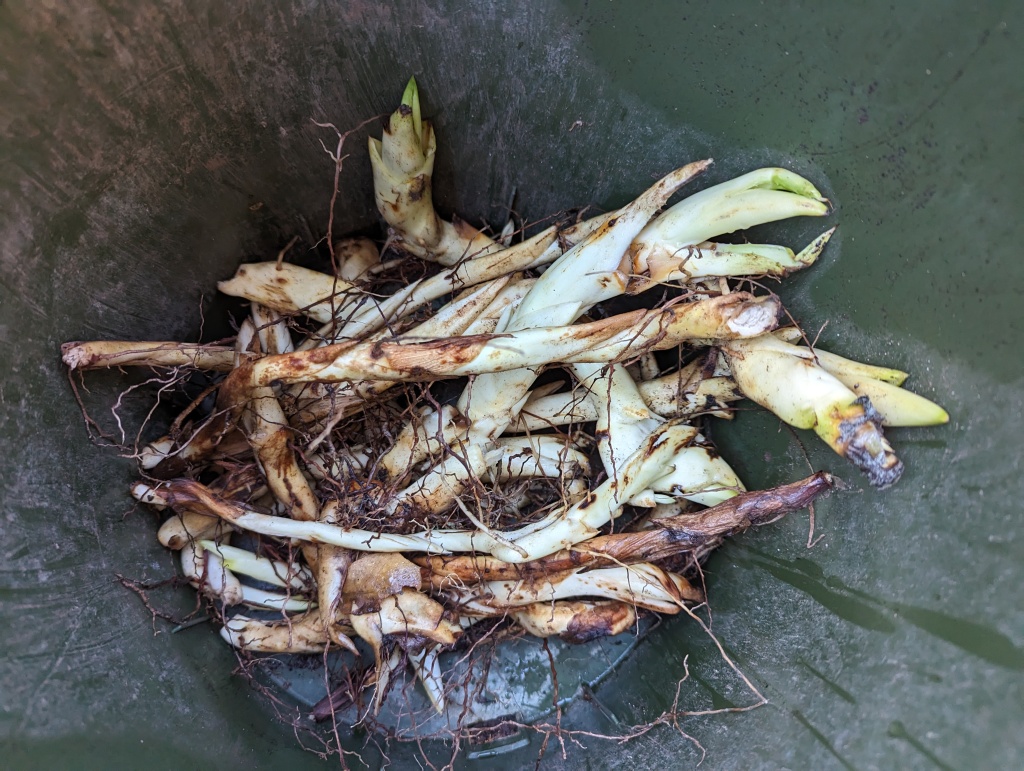
3. Agave americana, century plant is too prolific. We installed one of several ‘unwanted’ specimens and found all these pups within its can underneath. We can not use them all.
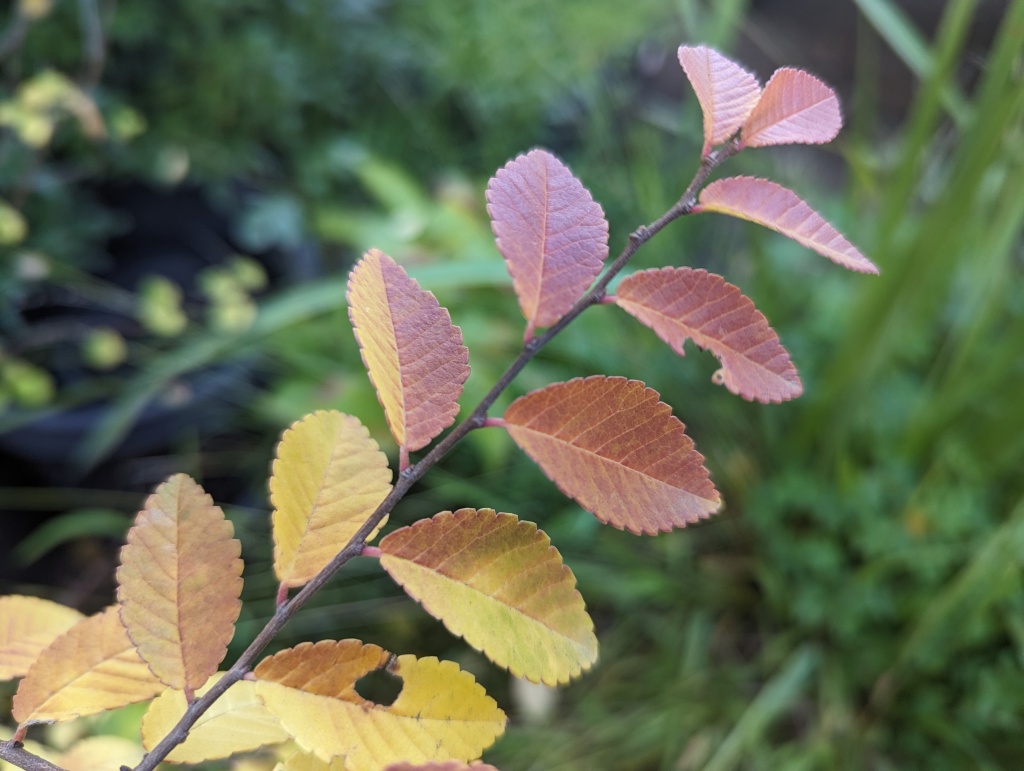
4. Ulmus parvifolia, Chinese elm became unavailable years ago after it was identified as a host for Dutch elm disease. Watersprouts continue to grow from a stump of a tree that was cut down years ago. If I could, I would grow several of this formerly familiar species.
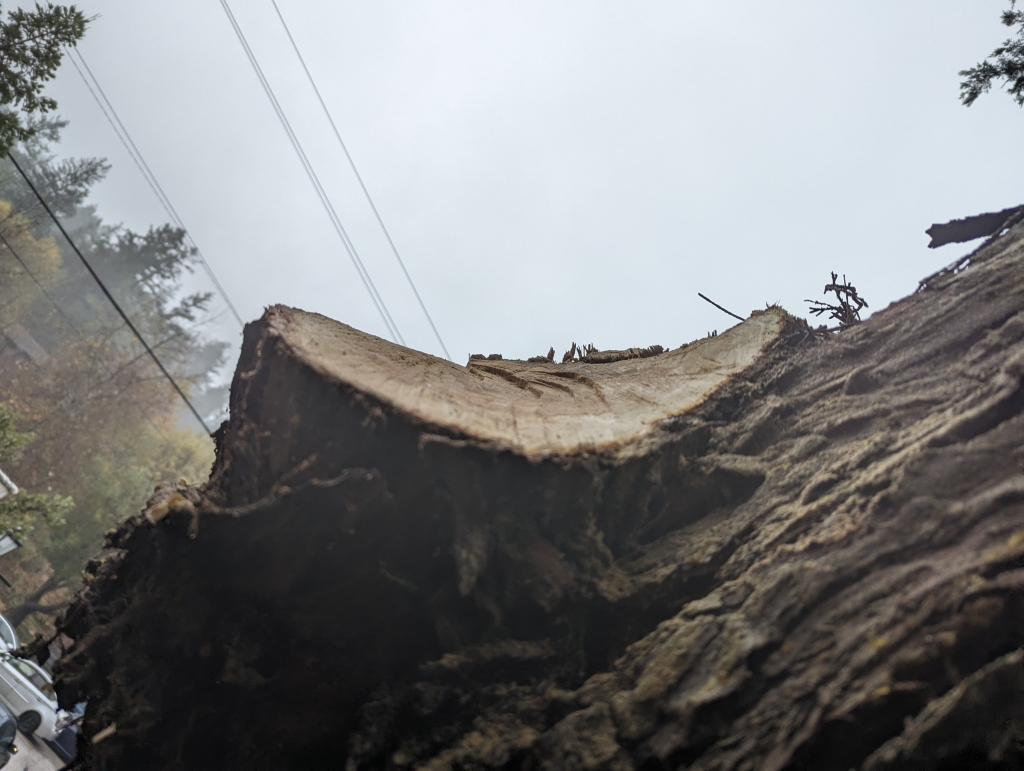
5. X Cupressocyparis leylandii, Leyland cypress is irrelevant to this illustration of how a chainsaw cuts if one side is sharper than the other. Another saw cut the flatter surface to the left. Incidentally, the ‘X’ preceding the genus name indicates an intergeneric hybrid.
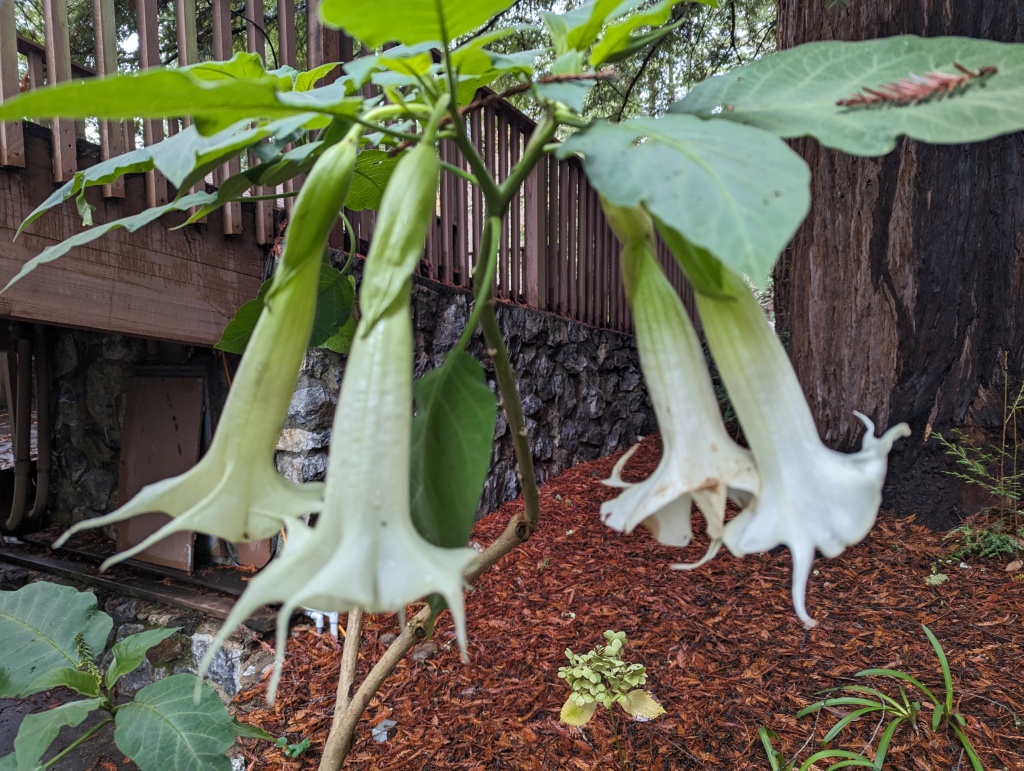
6. Brugmansia X candida ‘Double White’ angel’s trumpet should not bloom now. Either it does not know, or it does not care. Incidentally, the ‘X’ between the genus and species names indicates an interspecific hybrid. Like for the sugarcane, I used the same cultivar name after its species name, and before its common name. Is such abbreviation proper?
During the summer, the native white alder, Alnus rhombifolia, is a nice shade tree that looks bigger than it really is. By late winter, the bare deciduous canopy has an appealingly picturesque silhouette. This time of year is actually when white alder is typically less appealing, with dead foliage that provides no interesting fall color, but lingers until knocked down by rain or late frost. Yet, even now, it sometimes surprises with these funny looking floral structures that are interesting both in the early winter landscape, and with cut flowers.
In past decades, white alder was an ´expendable’ tree that was put into landscapes for quick gratification while slower but more desirable trees matured. By the time the desirable trees matured, the alders were removed to make more space for the desirables. This technique was practical because, like many fast growing trees, alders do not live very long, so start to deteriorate after about twenty five years anyway. However, alders often live longer than expected.
Mature alders are usually less than fifty feet tall where they are well exposed. They can get at least twice as tall where shaded by other trees or big buildings. Their plump trunks with mostly smooth silvery gray bark make them seem larger than they really are though. Too much water promotes buttressed roots which can displace pavement.
Now that nurseries and garden centers are no longer selling Christmas trees, they have plenty of room for bare root stock. All sorts of deciduous fruit trees, a few deciduous shade trees, shrubs and vines, and even a few perennials can now be purchased while dormant and without the cumbersome media (soil) that the roots need at all other times of the year. Not only is bare root stock easier to handle and transport in small cars, but it is also much less expensive than canned stock (that has roots contained in media, which is contained in nursery cans). Bare root stock typically costs about a third of what canned stock costs.
Bare root stock also has the advantage of adapting to new garden easier, since it does not need to leave the comfort zone of the media that it would have grown into (within a can) in order to venture out into unfamiliar soil. Instead, it starts to disperse roots into the new home soil immediately as it emerges from dormancy in late winter. Without cans, bare root stock can not get root bound. Instead of developing branch structure that is appealing to nursery marketing, bare root stock can get an early start on developing branch structure that is most practical and efficient for the gardens that it gets installed into.
It seems that all of the ´stone’ fruit can be found as bare root stock. These include apricot, cherry, plum, prune, peach, nectarine, almond (which is the seed, or ´stone’, of a peach like fruit) and the odd hybrids of these. The pomme fruits, apple, pear and quince, are perhaps the second most popular of bare root stock, although quince is still rather rare. Ornamental trees, shrubs and vines include flowering crabapple, flowering cherry, flowering quince, alder, poplar, willow, lilac, forsythia, wisteria and clematis. Perennials include rhubarb and artichoke.
Bare root stock can be purchased as soon as it becomes available, but does not do much until it starts to grow in spring. It should get planted quickly and soaked in, but will get more water than it needs from rain afterward. It should not need water again until after it blooms or gets new leaves in late winter or early spring. Despite guarantees of fruit in the first year, none should be expected. The few fruit trees that might set fruit will probably produce only useless underdeveloped fruit because new plants are busy producing new roots and growing. Actually though, this apples to canned stock as well, except only for citrus, olives and other evergreen fruit trees.





 Tony Tomeo