Cut Foliage For Christmas Decor

Coniferous evergreens are popular Christmas decor.

Christmas trees are extreme cut foliage. They grow on farms like cut foliage that florists use, but are entire trees! Although most fit under household ceilings, some within public venues are famously grand. Nonetheless, they are ultimately as disposable as any other cut foliage. Eventually, after their Christmas season, they become common greenwaste.

Other cut foliage is also popular as home decor through the Christmas season. Much of it is from the same sorts of coniferous trees that become Christmas trees. Almost all of it is evergreen, since deciduous vegetation is already defoliating. A few deciduous stems with colorful bark, such as red twig dogwood, are nice too. So are colorful winter berries.

Cut foliage is more practical as wintry decor within climates with cooler winter weather. Not much blooms during such weather. However, because of this same wintry weather, people prefer to be inside. While inside, they appreciate the color, texture, and perhaps aroma of cut foliage. Locally, such foliar decor for winter is more traditional than practical.

Actually, the most traditional cut foliage of Christmas is uncommon within local gardens. Scraps from the lowest branches of Christmas trees are a good source of minor bits of it. Premade wreaths and garland include a few types that are otherwise unobtainable here. Improvisation is necessary to create wreaths and garlands from locally available foliage.

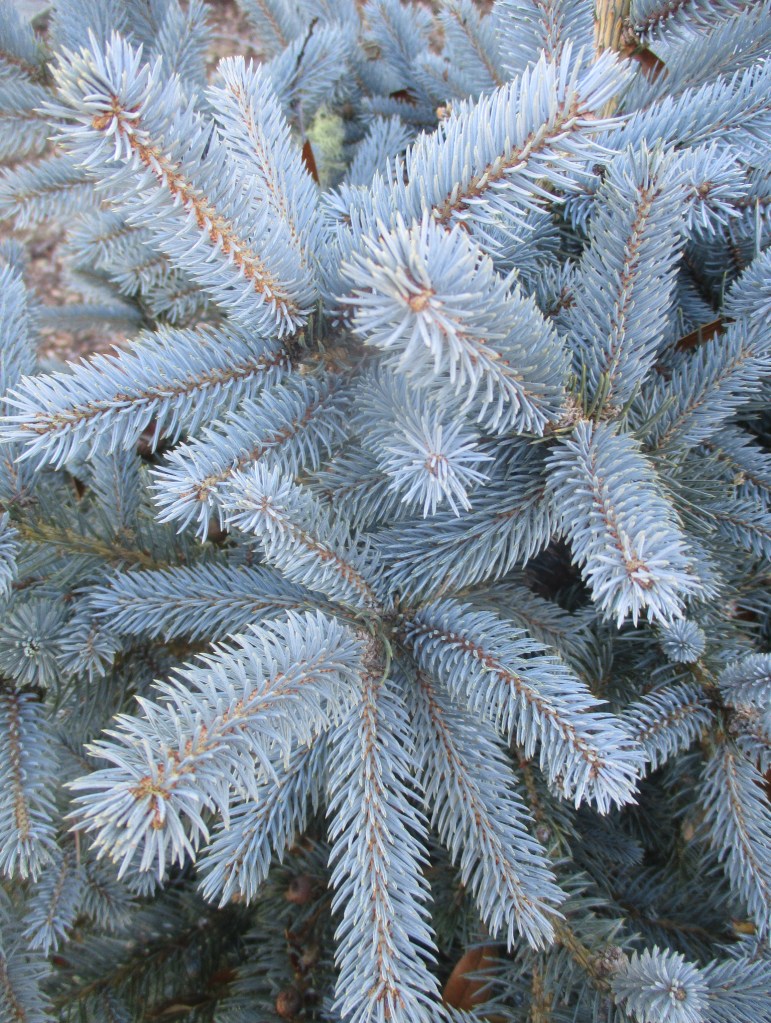
Only a few of the few blue spruce that live here grow large enough to share many stems. Their best foliar growth is also their most important structural growth. Removal of it might cause minor disfigurement. Other spruce, as well as various fir, are very rare within home gardens. So is Eastern white pine, although a few other pines are notably common here.

Atlas cedar, Deodar cedar, various cypress and various juniper are also rather common. A few sorts of holly are uncommon but not rare, but they produce only a few berries here. Holly olive may be more common, and resembles English holly, but produces no berries. Southern magnolia is a strikingly untraditional cut foliage, but becomes fragile as it dries.

New Mouser II

Does a kitty even respond to a name?

The New Mouser seems content to stay with us here. Actually, she seems to be a bit too content. She has been coming inside, where some on staff do not want her to be. Darla, her predecessor, was never so presumptuous.

Now that she is so comfortable with people, I can get here into a kitty transportation device and take her to a veterinary clinic to determine if she has a chip, and to get her inspected. If necessary, and if she stays here, we may need to get her spayed. (We only assumed her gender according to her color pattern. She may need to be neutered.) I suspect that she was dumped here while young and before getting spayed.

If she stays here, she should get a name. The crew has not agreed on one yet, and several options remain. ‘Snickers’ seems to be the favorite option, although I dislike it. I prefer ‘Holly’. ‘Heather’ is not bad, and seems to suit her better. These are some others that I considered, only to determine that I am not so totally keen on them:

Rhoda – This confuses Rhody.

Erica – This is short for Ericaceae, which is the family of Rhododendron. It is not so bad.

Azalea – This is another type of Rhododendron. I dislike it for this particular kitty.

Lyona – This is short for Lyonothamnus floribundus ‘Asplenifolius’. I am unimpressed.

Leona – This is short for Leonotis leonurus. I am still unimpressed.

Typha – This is Latin for cattail, but sounds like punctuation or a fever.

Myrtle – This is a ‘no’.

Lily – This is for a white kitty.

Rose – This is for a prettier kitty

Daisy – This is for some other kitty that is not this one.

Violet – No.

Flower – No.

Blossom – No.

Aster – Jasmine – Ivy – Poppy — No – No – No and No.

Raising Cane

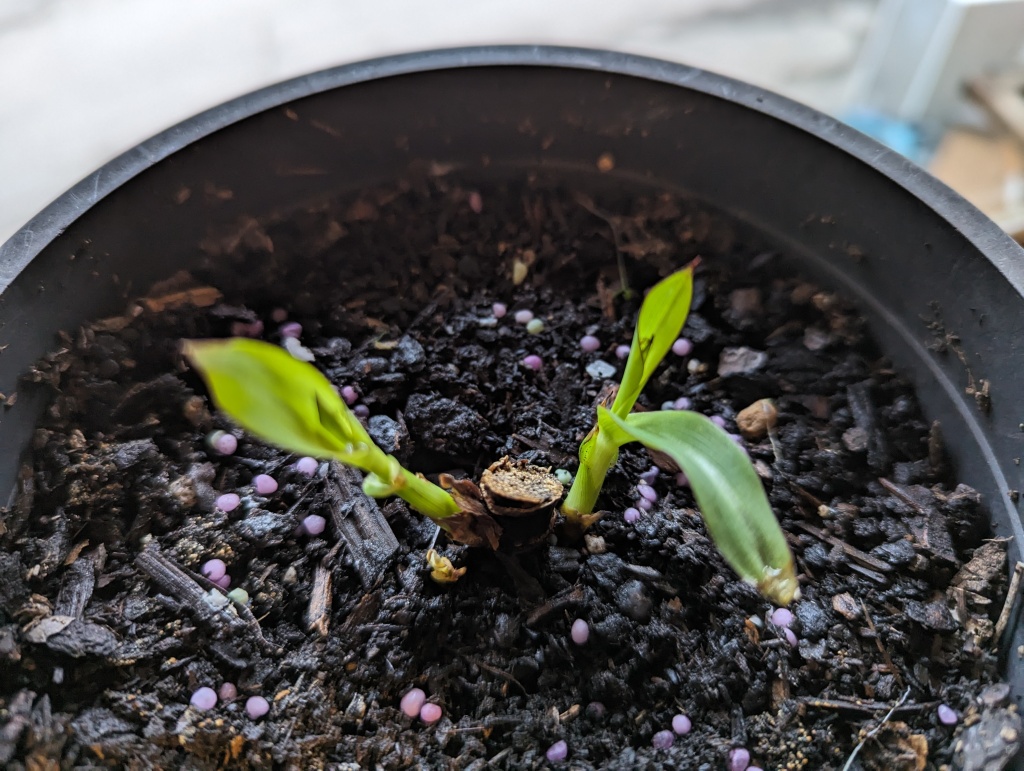
Sugarcane has been disturbingly easy to grow. This pair of pictures were taken about a day apart. The picture with smaller growth was taken yesterday morning, and posted with my Six on Saturday post at midnight. The picture with larger growth was taken this morning. If sugarcane grows this fast as a rooting cutting during winter, what will it do in the landscapes? Will it become an invasive weed? I suppose that I should be pleased with such healthy growth, but I am also concerned.

This particular sugarcane is likely ‘Pele’s Smoke’, which is more of an ornamental cultivar that should stay relatively compact. The original specimen from which I got the cuttings was not much more than six feet tall after at least two years, with bronzed foliage that is about the color of smoky topaz. It lives in Brent’s front garden. I pruned and groomed it while I was there for the first few days of November. Of course, I could not merely discard the scraps. I brought them back here and processed them into cuttings. I hoped that a few might take root.

The problem now is that most of the cuttings are beginning to grow. Only the softest of the terminal cuttings did not survive. Sugarcane is a tropical grass, so should not be growing much at all while the weather is cool. The many cuttings are stuffed into a pair of #5 cans, so may need to be separated prior to spring. I thought that only a few would survive at this time of year, and that they would grow too slowly to need separation until late next winter. Of course, I can not discard any surplus as I should. Only a few will go into the landscapes. Perhaps I can share some with neighbors.

Six on Saturday: Lily of the Nile Division

Now that the weather is getting cooler and almost rainy, it is time to relocate overgrown lily of the Nile. Quite a bit of it has slowly climbed over stone retaining walls to encroach into walkways. I remove rhizomes that are on top of walls, as well as any that are within a foot or so of the walls. After I divide and groom them, I install them where they will be more of an asset to the landscapes. They settle in with cool and rainy wintry weather, so should be ready to grow as soon as the weather gets warmer in spring. I neglected to get any before and after pictures to show where they came from and where they went to, (or to get six pictures).

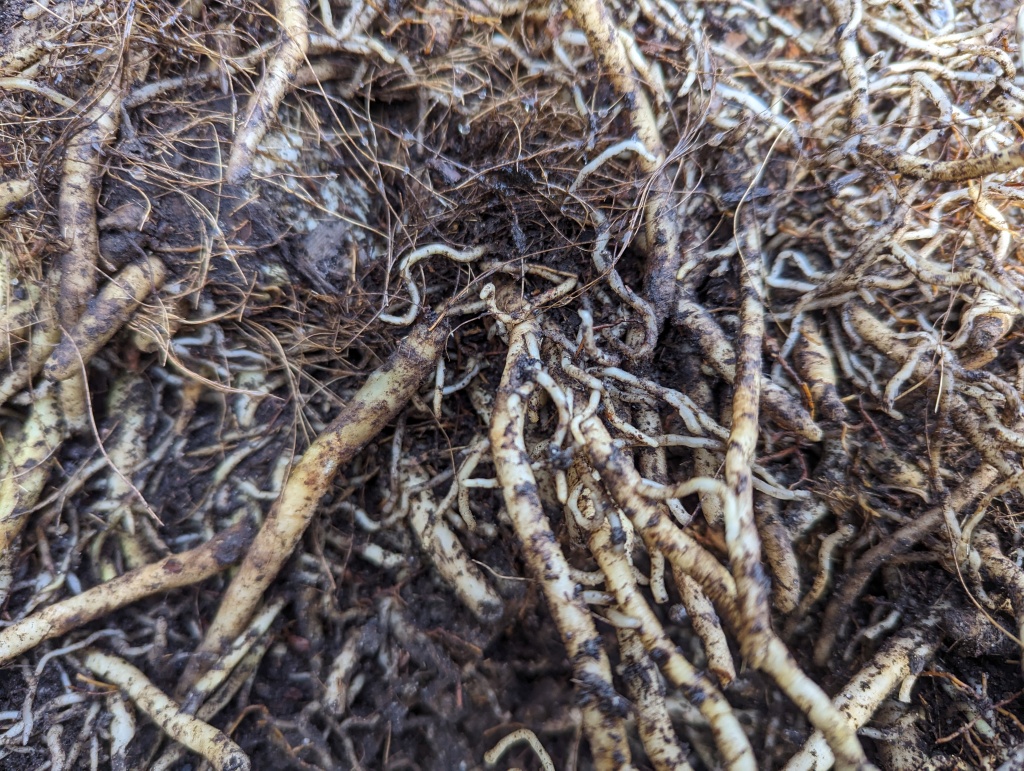
1. Roots of lily of the Nile can hold firmly onto a silty riverbank as the river floods above. They are impressively densely meshed. They are fleshy though, and therefore easily cut.

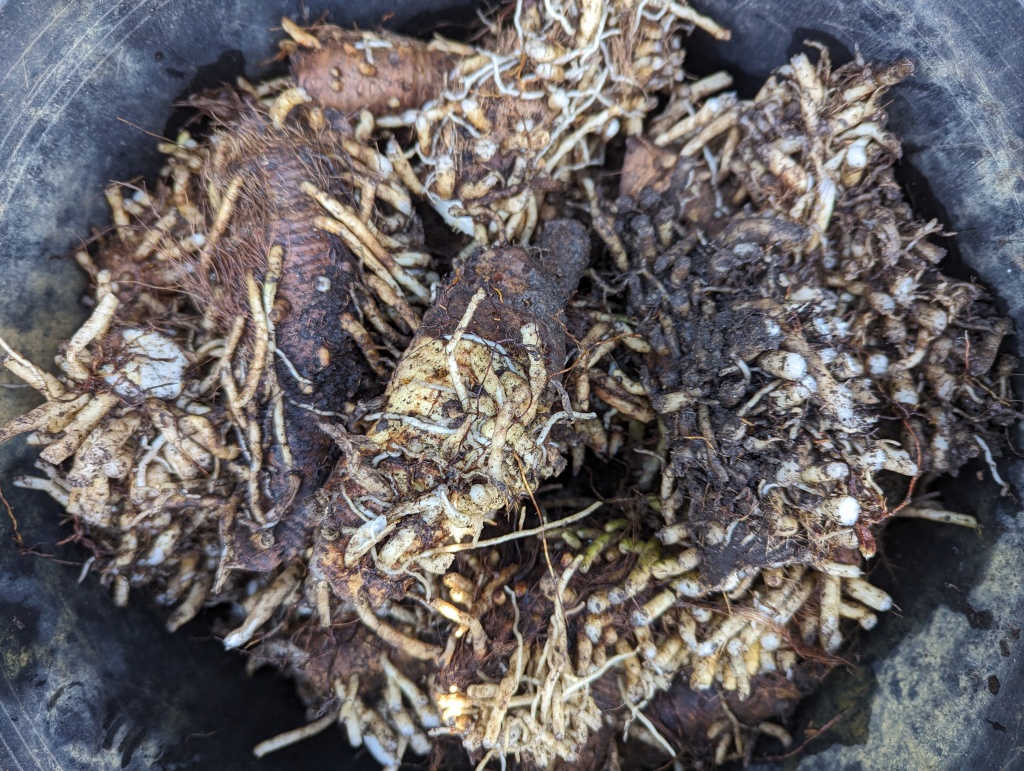
2. Rhizomes are also both impressively densely meshed and fleshy. Division is no simple task. I separated these scraps by cutting their roots. I bury them between divided shoots.

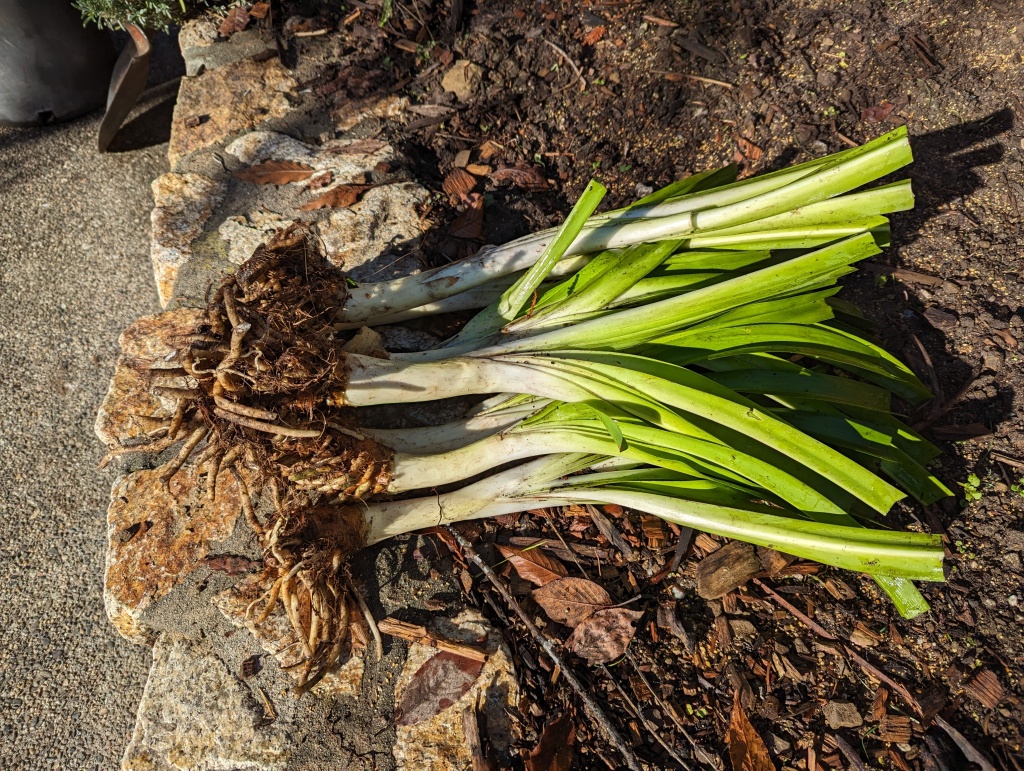
3. Foliar shoots or rosettes with a few inches of their rhizomes will grow into new plants. These have been groomed, so are ready for plugging with scraps of rhizomes in between.

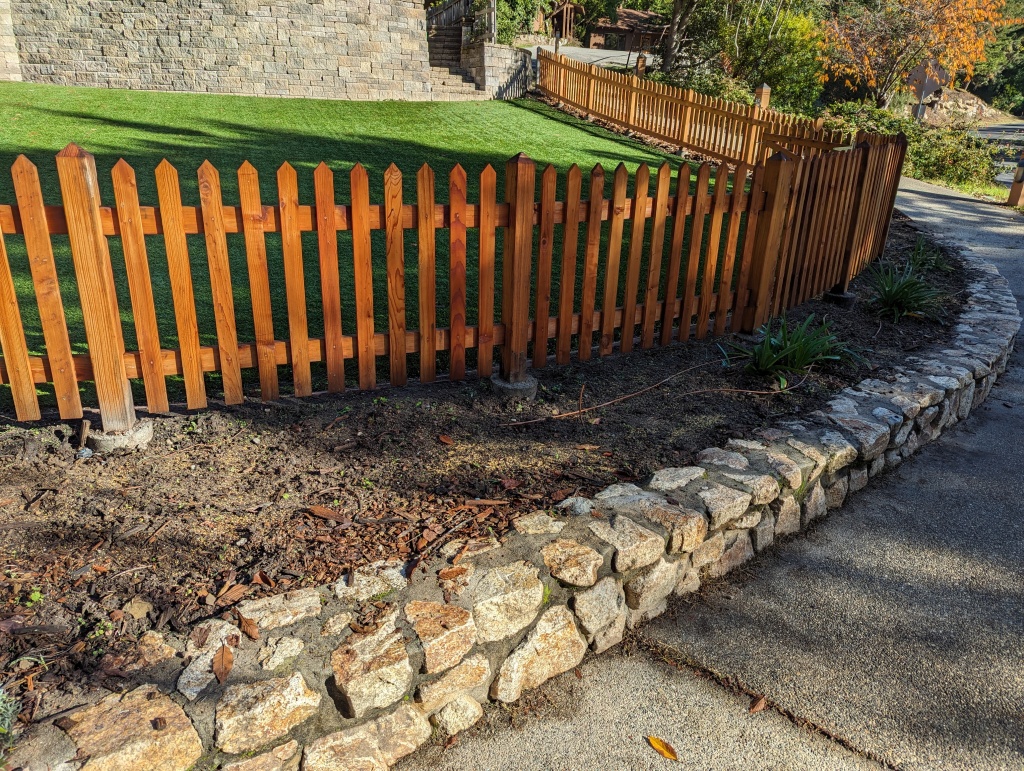
4. Gophers claimed all but a few lily of the Nile that were plugged here last year. I should have taken a picture of their replacements here, even if they are not much to brag about.

5. Oh deer! We are very fortunate that deer avoid the landscapes here. They always have.

6. Sugarcane is growing like a weed. This is one of too many cuttings that I brought from Los Angeles. They were pruning scraps from what I believe to be ‘Pele’s Smoke’. Sweeet!

This is the link for Six on Saturday, for anyone else who would like to participate: https://thepropagatorblog.wordpress.com/2017/09/18/six-on-saturday-a-participant-guide/

Mondo Grass

Of course, it is not actually a grass.

The thick clumps of evergreen grass-like foliage of mondo grass, Ophiopogon japonicas, make a nice lumpy ground cover for small spaces. Because it is rather tolerant of shade, and actually prefers partial shade to full sun, it works nicely under Japanese maples or highly branched overgrown rhododendrons. It gets only about half a foot deep. Narrow stems with small pale purplish blue flowers that bloom in summer are not too abundant, and are generally obscured below the foliage, but can actually get taller. ‘Silver Mist’ is variegated with white.

New plants are easily produced by division of large clumps. Overgrown or tired looking clumps can be shorn down at the end of winter, before new growth begins. Slugs and snails can be problematic.

Wintry Weather Can Damage Trees

(This posted in 2011.)

Wind brings out the worst in trees.

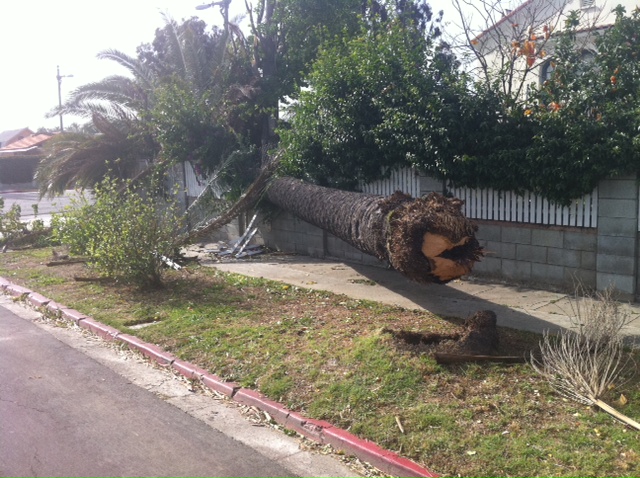
Pasadena sustained the worst of the damage caused by the strongest Santa Ana Winds in three decades. Huge piles of debris from broken trees are much more than can be removed any time soon. Falling debris and trees damaged many roofs, cars and anything else that happened to get in the way.

Other towns and neighborhoods throughout the area, particularly those at the base of mountains, also sustained major damage. At the same time, severe winds ravaged the San Francisco and Monterey Bay Areas as well, particularly in the Santa Cruz Mountains and the hills of the East Bay.

Some of the damage caused by wind in urban areas might have been less disastrous if trees had gotten the respect and attention that they deserve. Some trees develop structural deficiencies that need to be corrected by pruning, either to eliminate the problems, or at least to decrease the strain exerted onto the structurally deficient parts. A few trees that become unstable as they mature may likewise need to be pruned or even removed.

It is not always possible to prune trees to remove all structural deficiencies without damaging the affected trees more, or causing more structural problems to develop. For example, major pruning to remove all parts that may get blown down by wind, such as pollarding or ‘topping’, may seem to be effective for the short term, but actually stimulates the development of vigorous secondary growth or watersprouts that are disproportionately heavy and even more likely to tear off from the older limbs.

Structural pruning more often involves thorough reduction of weight and wind resistance. Weight of foliage and stems directly applies leverage against unions where smaller stems are attached to the larger stems from which they originate. Wind resistance adds more leverage as foliage gets blown about by wind. Thinning obviously removes significant weight, and also decreases wind resistance to allow wind to blow though the affected canopies.

Besides helping to compensate for structural deficiency, structural pruning is also beneficial to potentially unstable trees for the same reasons. However, unstable trees typically need even more reduction of weight and wind resistance. Some of the most unstable trees and those that are deteriorating need to be removed because their instability cannot be accommodated.

During winter, while deciduous trees are bare, evergreen trees are more susceptible to wind damage, obviously because they retain their weight and wind resistance through winter while the weather is the most severe. Unstable trees become even more destabilized as rain softens the soil. Regardless of the potential for susceptibility to wind damage, this would be a good time of year to get any needed tree maintenance done, prior to any more windy and rainy winter weather.

Arborists certified by the International Society of Arboriculture are the most qualified to identify potential structural problems or instability, and to prescribe corrective procedures. A list of certified arborists can be found at the website of the International Society of Arboriculture at http://www.isaarbor.com.

Horridculture – Sniveling

My colleagues are as totally excellent as my career is!

Horridculture is a collection of rants about horrid horticulture. Almost all of such rants are from my own experience and observation within the various horticultural industries. There are more than I can write about. I have been involved with so much more than just production of horticultural commodities on the farm. Horridculture is a bunch of sniveling about the worst of it.

Perhaps I should occasionally say a bit more about the best of it. If I thought it would be more interesting, I could write much more about the best than the worst. Except for the few experiences that I so frequently snivel about, my career has been awesomely RAD!

Therefore, for this week, I will briefly deviate from the typical Horridculture theme.

While we were in school, the professor who taught ‘Orientation to Horticulture’ told us, “If you want to make a lot of money in your career, change your major NOW!”. Of course, we did not. Brent and I both were naturally horticulturists, even if we were not good students. We studied exactly what we wanted to study. We made our careers of what we do naturally. Brent became one of the most renowned landscape designers of the Los Angeles region. I became a nurseryman.

Not only did I work for two legendary nurserymen within my primary career, but I also worked for at least four legendary arborists. I worked with the production of both citrus and rhododendrons with their companion crops. My gardening column was not planned, but has continued for a quarter of a century. Although not as well distributed locally as it had been, it is presently shared with a few publications between San Francisco and Beverly Hills in the Los Angeles region. These few publications sometimes share it with a few others elsewhere.

So, besides all the sniveling, I have been very pleased with my career. The worst of it may not have been as difficult as retirement might be. Fortunately, I do not necessarily need to retire completely, although I should quit sniveling.

flowering maple

Flowering maple should finish bloom soon.

The identities of the many different garden varieties are vague. Most are likely hybrids. A few might be simple species. Some that seem to be hybrids are really cultivars of simple species. Regardless, most flowering maples collectively qualify as Abutilon X hybridum. If all were hybrids, as their name implies, none would generate viable seed, as some do.

Flowering maple can grow somewhat fast, but tends to be lanky if it does so. It should be a bit fuller with slower growth or minor tip pruning. Several cultivars grow no higher than doorknobs, but others reach first floor eaves. Flowering maple demands regular watering and rich soil. It enjoys humid warmth, but may roast in arid heat with harsh sun exposure.

Bloom is sporadic from late spring until frost. The flowers resemble those of hibiscus, but are no more than three inches broad. Most are pastel tints of yellow, orange or pink, with prominently richer veining. Some are red, burgundy red or creamy white. The light green or variegated foliage may get a bit sparse through winter. Foliar lobes are quite variable, or lacking.

Frost Is Simply Too Chill

Some minor frost damage is acceptable.

Chill can be good. Frost can be bad. The difference is thirteen degrees Fahrenheit. Chill is at or less than forty-five degrees. Frost is at or less than thirty-two degrees. Chill helps some flora to maintain its seasonal schedule. Frost causes some flora to freeze. Both are limiting factors of home gardening. Both are weather patterns that are limited by climate.

Many species from climates with more pronounced seasons rely on chill. They know that it occurs only during winter, and that they should bloom afterwards. Duration of such chill is more important than temperature. Any temperature at or less than forty-five degrees is equally sufficient. Within that, different species require different durations, or ‘chill hours’.

This limits the selection of many species, like various fruit trees. Citrus orchards formerly grew within the San Fernando Valley. They require no chill. Stone fruit orchards formerly grew within the Santa Clara Valley. They require a bit of chill. Pomme fruit orchards grow in the Willamette Valley. Many cultivars of pomme fruit perform best with significant chill.

Frost also limits the selection of many species. Pomme fruits do not mind it. However, if it happens late, it can ruin stone fruit bloom or developing fruit. It might damage citrus trees whenever it happens. Some climates here experience frost annually. Some experience it only rarely or mildly. Several coastal climates experience merely minor chill without frost.

Many garden enthusiasts grow a few species that are vulnerable to frost. Of course, such species are safe within frostless climates. Elsewhere, they may need shelter during cold weather. Potted vegetation may benefit from seasonal relocation. Temporary tenting can shelter imobile vegetation in the ground. Some vegetation is too large to shelter, though.

Vegetation that sustains frost damage is unsightly. However, it is best to delay pruning or grooming until subsequent frost is unlikely. Damaged outer growth insulates undamaged inner growth. Besides, pruning stimulates new and more vulnerable growth. Some types of vegetation should want only superficial grooming. Others might require major pruning.

New Mouser

Rodents departed when she arrived.

Darla, the former mouser here, relocated to a more domestic lifestyle in Santa Clara during the unusually stormy weather and flooding last winter. She is getting rather elderly, and has earned a comfortable retirement. Unfortunately though, rodents of all sorts arrived immediately after her retirement.

Mice and rats infested the buildings while gophers and ground squirrels infested exposed ground outside, including the recovery nursery. Rodents of some sort ate the tops off a few of my banana plugs, and chewed the base of my cup of gold vine. Another chewed into a bag of seed for mixed erosion control vegetation, and made a mess of it.

Then, the rodents seemed to leave as suddenly as they arrived. Even tree squirrels became scarce. At about that time, we noticed, on rare occasion, what seemed to be a stray kitty. I thought that the kitty must live nearby, and would eventually return home. It avoided us, but never completely left the area for long.

The kitty appears to be rather grungy because of its color pattern. I recently learned that this particular color pattern is known as tortoiseshell, and that almost all kitties with this tortoiseshell color pattern are female. I hope that she is not offended if my assumption of her gender as female is inaccurate. She is quite small and lean, with a thin tail that is kinked at the end. I intend to get a better picture of her to share with neighbors, just in case someone is missing her.

A bit more than a week ago, this kitty seemed to become a bit more interested in human activity here. For the first time, I offered her a bit of something that she might enjoy. Because there was no kitty food here, I gave her a small can of tuna from the galley. She enjoyed it so much that I got her some real kitty food. She now comes for it to the meeting room daily after the crew leaves. I have been able to get a bit closer to her daily, and petted her briefly for the first time a few days ago. She purrs quite loudly when petted, although she also seemed to be rather nervous. She prefers interaction with Rhody, who now chews her ears. I invited her into the hallway because it gets somewhat cool in the evening, but she does not want to come inside.

Because I believe that her presence here convinced the rodents to relocate, I would prefer her to stay if she has no other home to return to. If she only wants a bit of food from me, this could be a mutually beneficial situation. If so, we should determine what her name is.