Horticulturists are by nature, nonconforming. I happen to find it difficult to conform to what makes us nonconforming. Trends are fleeting. Old technology that has worked for decades or centuries is still best. Although I am not totally against chemicals, I find that almost all are unnecessary for responsible home gardening. Pruning is underappreciated, and fixes many problems.
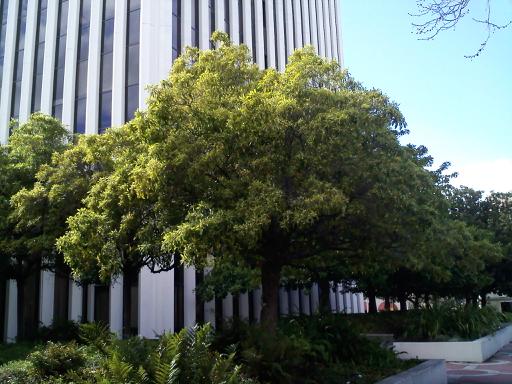
In the right situation, Victorian box, Pittosporum undulatum, is a nice small to mid-sized shade tree with dense foliage, sculptural branch structure and pleasantly fragrant spring bloom. In the wrong situation, it drops enough leaves, flowers and sticky seeds and bits of seed capsules to make quite a mess. This finely textured and sometimes sticky debris is easily absorbed into thick, shade tolerant ground cover like Algerian ivy, but is difficult to rake from pavement and to clean from roof gutters. Besides, even though Victorian box is not a large tree, the roots can eventually become aggressive enough to displace pavement.
Young trees grow rather vigorously to about ten feet tall and wide, and then slow down somewhat as they continue to grow to as much as three times as tall and wide. They are easily contained with occasional selective pruning. The small, clustered flowers are not as impressive as their fragrance, adding only a bit of pale yellowish white color over the exterior of the rounded canopy. Some people, as well as birds, like the greenish olive-sized fruit that turns orange and eventually splits open to reveal sticky orange seeds within. (‘Pittosporum’ translates into ‘sticky seed’.) Leaves are about two or three inches long, or longer, with ‘undulating’ margins.
Many trees get too big for many situations. Trees should be proportionate to their spaces.
Japanese maples are among my least favorite of trees. There; I said it! Even though I can not think of any single species of tree that has so many distinct and fascinating cultivars, I am bothered by how Japanese maples have been denigrated by their own overuse. That which is naturally an understory tree (lives in the partial shade of larger trees), which should be thoughtfully selected for its individual form, texture and color, to function as a focal point specimen tree, has become too common and misused.
Every tree should be thoughtfully selected for its particular application. The ultimate size, shape, shade, potential mess, cultural requirements, root characteristics and foliar characteristics (evergreen or deciduous) all need to be considered. Japanese maples are certainly appropriate for certain applications, but not every application. The same goes for London plane, crape myrtle, Chinese pistache and any overused tree.
Crape myrtles and Japanese maples are popular partly because they do not get too big, and are proportionate to small spaces. However, they do not get big enough for other situations. Although a silver maple will not fit into an atrium as well as a Japanese maple would, it is a much better shade tree for a big lawn. Italian cypress can actually get taller, but its very narrow shape makes a minimal shadow. Monterey cypress gets broader, but the shade is too dark for lawn.
Unfortunately, there is no such thing as a perfect tree. Jacaranda is of moderate size, has a good shape, and makes medium shade, but is quite messy, particularly over pavement. Silk tree is both messy and has aggressive roots that can break pavement, but just like jacaranda, it looks great and is not a problem surrounded by ground cover. Both are deciduous, so allow warming sunshine through in winter. An evergreen tree that would be better to obscure an unwanted view should not get so large that it also blocks a desirable view for a neighbor.
Palm trees are very different from all other trees in that they have no branches, only leaves. As they grow out of reach, they will need to be groomed by professional arborists. Palms only grow upward, and can not be pruned around utility cables. They will need to be removed if their trunks get too close to high voltage cables.
I certainly do not intend to convince anyone to not plant any trees. I merely want people to consider the variables involved with the selection of trees that are appropriate to each particular application. Trees are long term commitments. Problems caused by improper selection can be difficult or impossible to correct later.
Rhody and his Roady, . . . still waiting to leave.
This article is scheduled to post at midnight between March 19 and March 20, which is precisely when we were scheduled to leave for the Pacific Northwest. We were supposed to arrive on the Kitsap Peninsula late in the afternoon, and likely continue to the coast the following morning. Now, we will not leave until midnight between Sunday, March 24 and Monday, March 25. I know that it is only five days later, but it changes the entire schedule. I should still be there in time to prune the apple trees prior to bloom. I do not know when we will return now, but it will likely be about Thursday, April 4.
Then, two and a half weeks later, we leave again for eleven days in Beverly Hills in Los Angeles County, and Buckeye near Phoenix in Arizona. That would involve leaving Wednesday, April 24, and returning on Saturday, May 4. That should be before the weather gets too warm in Arizona to prune the mesquite trees there comfortably. I suppose that the second trip does not necessarily need to be delayed just because the first trip was. We could still leave on Wednesday, April 17 and return on Saturday, April 27 as originally planned, even if that leaves less time between the two trips. Perhaps I should not worry about this until we return from the first trip!
This seems to happen annually. Regardless of how intent I am on leaving on time, we encounter a delay of some sort of another. Ultimately, we leave at about the same time annually, but only after planning to leave about a week earlier, just as we planned for the previous few years. I can not complain, of course, since the delay is justified, but that is another topic for another post.
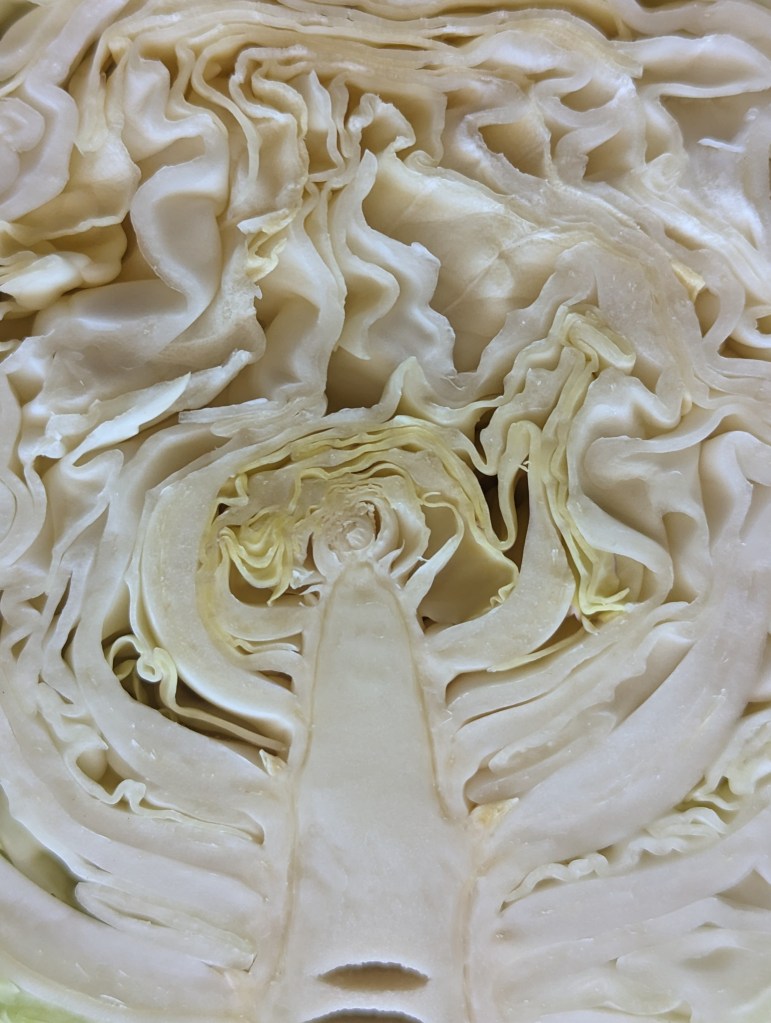
Resemblance to lettuce is merely coincidental. Cabbage, Brassica oleracea, is instead a close relative of very dissimilar vegetables. Brussels sprout, broccoli and cauliflower are different varieties of the same species. So are collard, kale and kohlrabi. All are winter cole crops. (Cabbage comprises the varieties of capitata, tuba, sabauda or acephala.)
Cabbage became seasonable last autumn. Its last phase is now maturing. It grows most easily from cell pack seedlings. Alternatively, it can grow from seed, which starts about a month and half earlier. Cabbage is biennial, so will go to seed if it stays in the garden too late. Warm weather initiates and accelerates the process, which ruins flavor and texture.
Green cabbage is the most popular type. Red cabbage is the second most popular type. Dutch white cabbage often classifies simply as a pale type of green cabbage. A mature cabbage weighs about a pound or two. Its loose outer foliage can be a foot to nearly two feet wide. Within more ideal climates, some varieties grow slower but significantly larger. With rain through winter, irrigation is probably unnecessary. Soil should be organically rich.
Warming spring weather accelerates bloom and growth. Early spring bloom is now much more colorful than the best of winter bloom. Fresh foliage is already replacing defoliated deciduous foliage and faded evergreen foliage. Vegetation will soon be more active than they will be during any other time of year. Such vegetation unfortunately includes weeds.
Weeds are only weeds because they are unwanted. That is their only commonality. Most are exotic, or not native, but a few are native. Most are annuals, but a few are perennials, vines, shrubs or trees. Annuals grow from seed, but several of the others can perpetuate vegetatively. Some are appealing where appropriate, but migrate to where they are not.
Weeds become weeds because they are generally invasive. Many are aggressively so. They grow wherever they can, and compete with any desirable vegetation for resources. The most aggressive annual weeds begin growing before preferable species. They can overwhelm their slower victims. Several have bloomed and are already dispersing seed.
Exotic weeds are here for a variety of reasons. Some arrived inadvertently as seed in fur or digestive systems of livestock. Some were fodder for livestock. Many were originally desirable flowers for home gardens. A few were formerly useful as cover crops or erosion control. Many lack natural pathogens from their native ranges that limit their proliferation.
Regardless of their origins, weeds now necessitate weeding. They grow throughout the year, but most are most active as winter becomes spring. Obviously, they grow like their horticultural designation implies. Those that are not already dispersing seed should not get the opportunity to do so. Less weeding will be necessary later if more happens now.
Besides, weeding is easier while the soil is still evenly damp from winter rain. Roots are more pliable and less dispersed. They toughen and disperse as the season progresses. Rhizomes, stolons and other perennial weed parts are likewise easier to pull or dig now. Tilling might be more efficient for eradication of small but profuse young weed seedlings.
California poppy is the Official State Flower of California. It is native to all but Yuba, Sierra and Imperial Counties within California. It is also native to portions of Oregon, Washington, Nevada, Utah, Arizona, New Mexico, Alaska, Sonora and Baja California.
Although rare elsewhere, a few isolated colonies inhabit several other states and Canada. It naturalizes efficiently in many other regions of other continents.
California poppy naturally blooms almost exclusively orange. Modern varieties that bloom yellow, red, lavender and creamy white were developed relatively recently. Naturally white and lavender California poppies are extremely rare in the wild. To Californian children, they are supposedly good luck, like-four leaf clovers are to Irish children. I remember finding a few of each at the Portola Monument in Montara when I was a kid. I did not see either again until I found a white California poppy at work a few years ago. Of course, modern varieties take the fun out of that tradition.
California poppies are now blooming splendidly. Unfortunately, they are neither as common nor as profuse as they were only a few decades ago. They are displaced by naturalized exotic vegetation, including naturalized forage crops and cover crops. Also, exotic vegetation, including flowers within home gardens and orchard trees, distracts the pollinators that they rely on for pollination. We dispersed California poppy seed at work while the weather was still a bit rainy, so should get more blooming later in spring. Hopefully, they will disperse a bit more seed for the following spring, although I suspect that they would already be naturally established there if it were a good situation for them.
California poppies can get somewhat unkempt within refined landscapes, particularly if they stay long enough to disperse their seed. That is why we want more within unrefined areas.
Ceanothus of all sorts are collectively known as California lilac. A few uncommon species are also known by alternate names that might confuse those who are unfamiliar with them. Most species happen to be native to California, although most are not exclusive to California, and a few are not native to California. The species with the most extensive range is native to the eastern half of America, which does not include California. Incidentally, it is known more familiarly as New Jersey tea.
Ceanothus is not actually related to lilac. It merely blooms within the same season, with tiny flowers in floral trusses that are smaller but sort of shaped like those of lilac. The most traditional lilac bloom with lavender floral color, but a few cultivars bloom with pale blue floral color that sort of resembles that of some of the Ceanothus. Most Ceanothus bloom is richer blue, and some is pale white. The most fragrant of Ceanothus bloom is only mildly fragrant, and only in abundance. Most Ceanothus bloom lacks fragrance or smells rather dusty. Lilac, of course, is famously fragrant.
California lilac is therefore neither notably Californian nor a type of lilac. Nonetheless, during spring, we appreciate its bloom, both within refined landscapes and in the wild. It does not last for long, but it can be impressive, particularly among wild specimens that can grow larger than those within confined landscapes. The blue floral color of the majority of wild specimens and perhaps all cultivated specimens is comparable to that of native lupines, and contrasts splendidly with bright orange California poppies that bloom at about the same time. California lilac that grows wild need no maintenance, and although individual specimens do not last long enough to get old, they reliably replace themselves like so many native species do.
Some of these Six are leftovers from last week. Some might have been late last week, and are a week later now. African daisy and calla bloom somewhat randomly, so technically, may not qualify as late. Likewise, candelabra aloe does not bloom quite as randomly, but is not always punctual either. I should be more observant of bloom schedules. Evergreen clematis and bridal wreath spirea are more likely to be blooming late. I am more certain that flowering quince should have bloomed earlier. Only calla and candelabra aloe were grown here. The others were originally acquired from nurseries many years ago, so I can not gloat about growing them. Incidentally, Rhody and I will leave for Washington early Wednesday morning, so my next two ‘Six on Saturday’ posts should be from there.
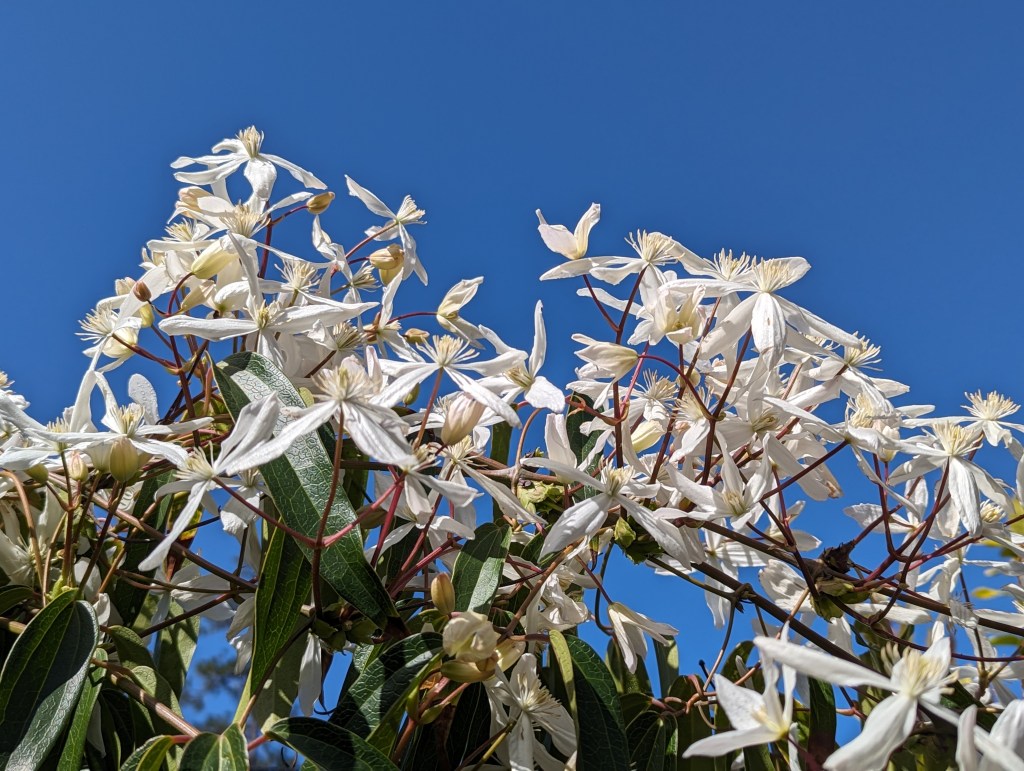
1. Clematis armandii, evergreen clematis bloomed while I was not looking. This picture is from last week. Bloom lasted a bit longer than expected, but is presently deteriorating.
2. Osteospermum ecklonis, African daisy also bloomed last week, but of course, is rarely without bloom. It blooms a bit more profusely in phases between now and late summer.
3. Aloe arborescens, candelabra aloe typically blooms for late winter. These vivid orange flowers are resilient to wintry weather, and contrast splendidly with blue California lilac.
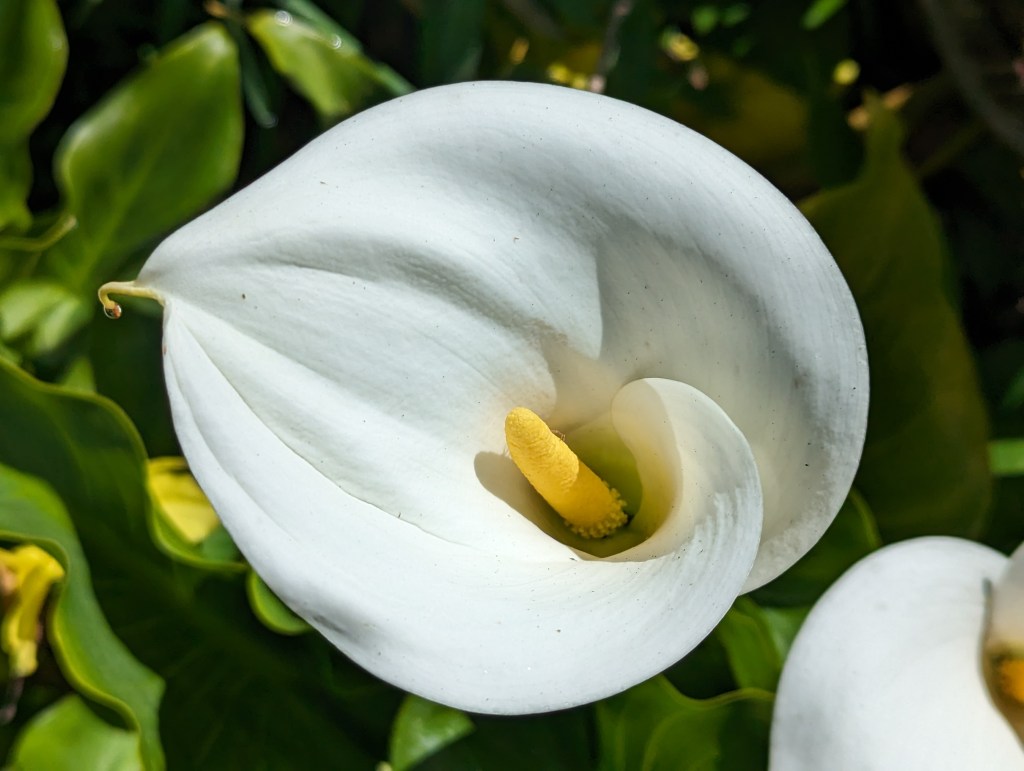
4. Zantedeschia aethiopica, calla grows wild within a portion of one of the landscapes. It could do the same elsewhere if we were to relocate some of it, which is why we rarely do.
5. Spiraea prunifolia, bridal wreath spirea seems to be blooming late. I do not know for certain because I do not remember when it typically blooms. Foliage develops afterward.
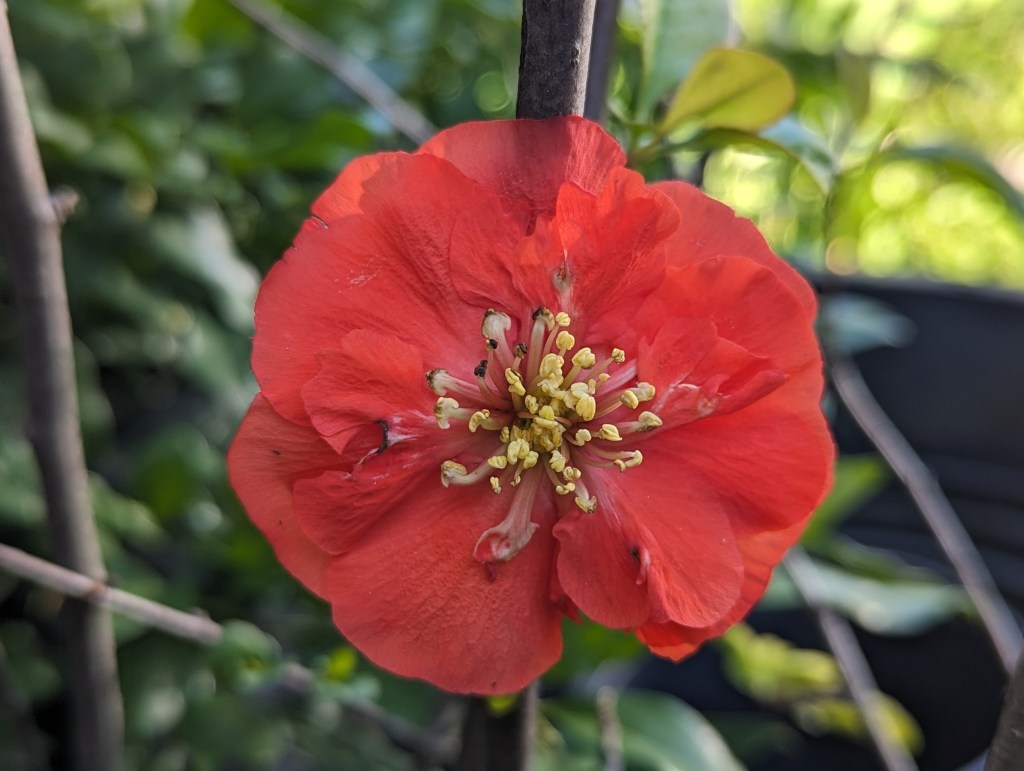
6. Chaenomeles speciosa ‘Double Take Orange’ flowering quince also develops its foliage after bloom. I am more certain that it is blooming late. It typically blooms with forsythia.
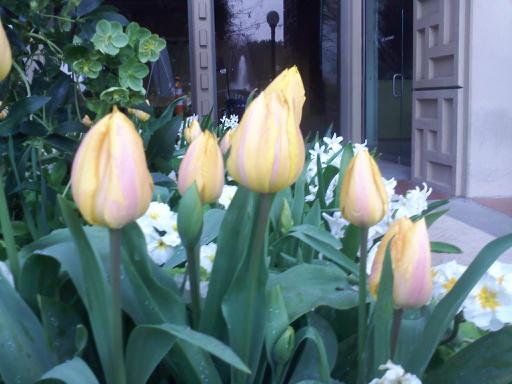
The soft pastel shades of these tulips brighten this somewhat shady landscape.
The mild winters that are so comfortable for us are not so desirable to tulip bulbs, which need to be chilled to perform as perennials. Consequently, they behave as brief season annuals locally. The most popular varieties have simple single flowers in white, yellow, pink, red, purple or pinkish orange. Double tulips are rather ruffled. Parrot tulips are larger and even more ruffled. As the names imply, lily-flowered tulips are shaped like small lilies, with pointy flared petals; and fringed tulips have finely serrate petals. Tulips stand between half a foot to two feet tall. Early types are already finished blooming. Late types, particularly if planted late, may bloom as late as early May.
Daffodil bloom from bulbs that were installed last autumn.
The elegant white callas that are just about to bloom in my garden have their origins in the ‘old country’. I obtained them from the garden of my great grandfather Tomeo in my ancestral homeland; Sunnyvale, near San Jose. I am told that my great grandfather planted them decades ago, and had been trying to get rid of them almost as long. I suppose that means that these callas are easy to grow.
My belladonna lilies that got planted two autumns ago are about as old, since they came from the garden of my mother’s mother in Santa Clara, right near Sunnyvale, and were in her mother’s garden prior to that. These bulbs just keep on growing, blooming and multiplying. Although I do not like their bright pink color much, I can not argue with their reliability.
Bulbs and bulb like plants that can take care of themselves and thrive with minimal or no attention are always welcome in my garden. Bright orange crocosmia is perhaps just as reliable, or should I say ‘persistent’, as callas are, and like callas, should be planted about now. Yellow, red, and orange with red flowering varieties are also available. Pink, red, orange, yellow and salmon cannas are in season too. They are easier to contain, but are likewise prolific.
Some of my other favorites that get planted about now for summer bloom want more attention, but are certainly worth it. Dahlias can naturalize if conditions are right for them, but will more likely do better if dug, divided and replanted in enriched soil at least every few winters. They are remarkably easy to propagate. Asiatic lilies likewise prefer to be dug and replanted as their soil becomes depleted, but are not likely to regenerate year after year if ignored.
Honestly though, some of the other summer blooming bulbs and bulb like plants that get planted about now are rather risky. I like to grow gladiolus because they happen to be among my favorite flowers. However, unless they get well amended soil and fertilizer, they do not perform very well, if at all, after their first year. Liatris is not much more reliable. Tuberous begonia is still a mystery to me, since I have not been able to prevent them from rotting in their first year!
Of the many bulbs and bulb like plants that get planted in autumn that are now blooming, grape hyacinth, snowdrop, watsonia, bearded iris, daffodil and narcissus are the most reliable and likely to naturalize, particularly with rich soil and regular watering. Daffodil and narcissus do not spread as well as the others, but are probably the most resilient. With a bit more effort, freesia and crocus can be persistent. In some situations, freesias have actually been known to naturalize as effectively as grape hyacinth.
Other early bloomers (that get planted in autumn) are more demanding. The anemones that I planted in about 1990 survived neglected in my garden for nearly a decade, but probably produced more flowers in their first year than in all subsequent years combined. Ranunculus and hyacinth may do the same if conditions are not just right for them. Tulips are perhaps the most profusely colorful of spring bulbs, but are sadly grown mostly as annuals, since they rarely do much more than produce foliage after their first year.