Six on Saturday: Springtime

Flowers bloom throughout the year here. I featured bloom this week to avoid the topic of minor frost damage that I should have protected vulnerable foliage from. Frost is minor here, and does not occur every year, but it occurred here prior to some other regions this year. However, this bloom can imply that it is springtime.

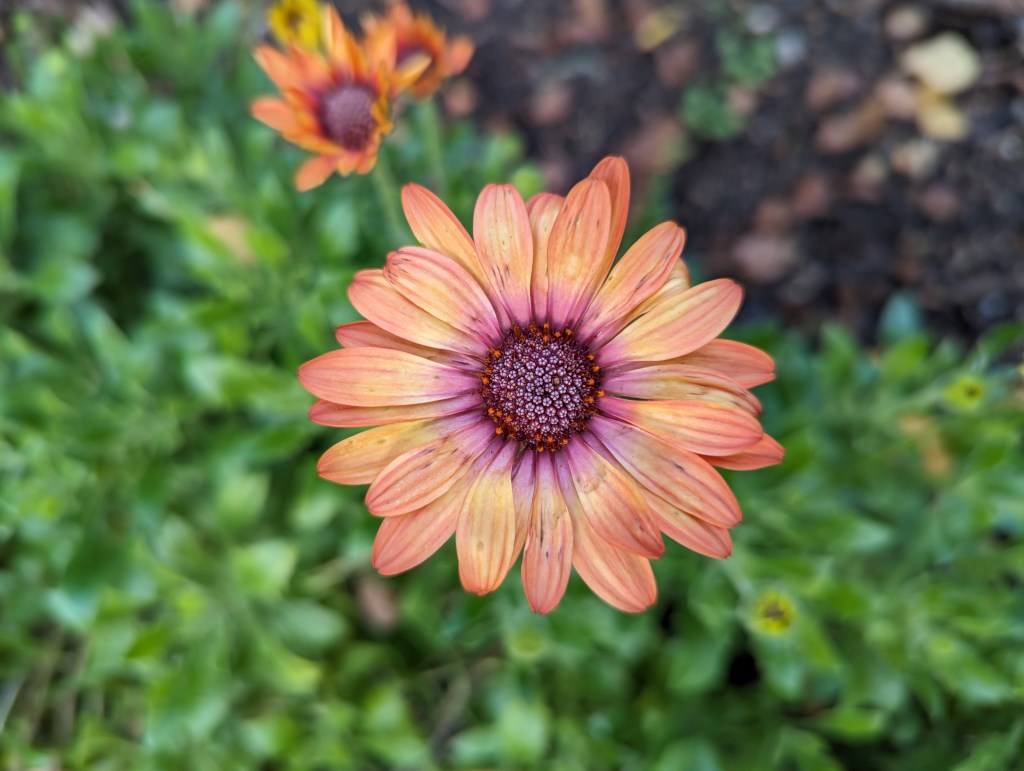
1. Osteospermum X hybrida, African daisy should bloom most for spring, but can bloom randomly whenever it chooses, and often blooms most profusely for summer or autumn.
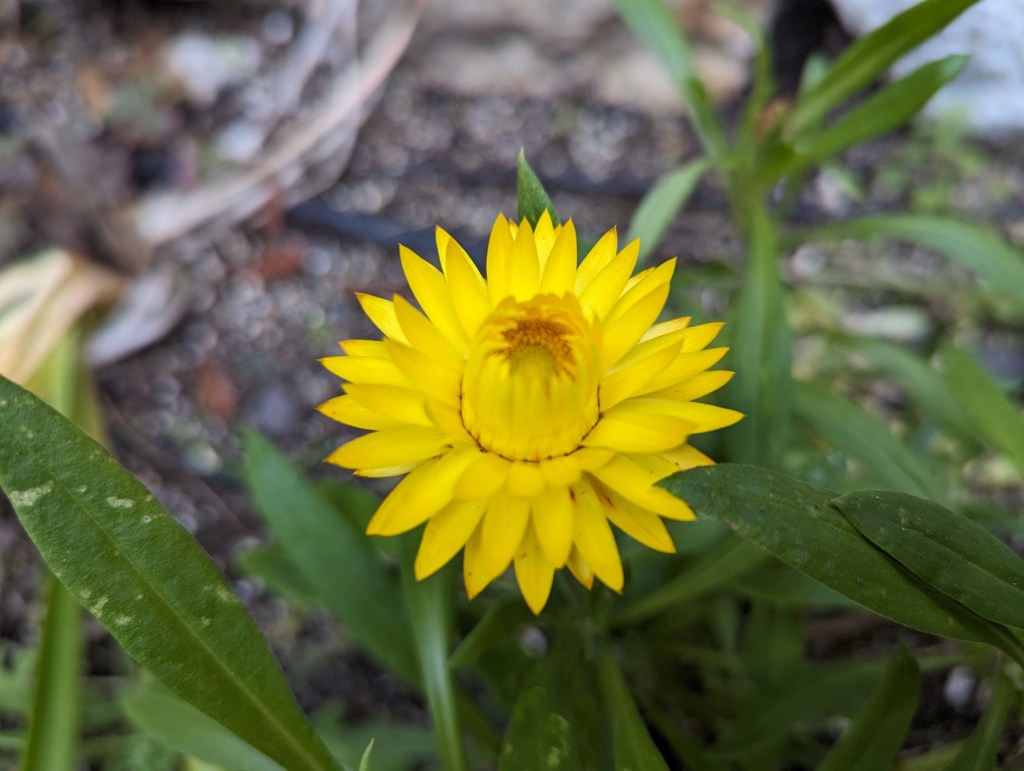
2. Helichrysum bracteatum, strawflower is my favorite of these six because I remember it as the main cut flower crop to the east of my Pa’s home in Montara through the 1980s.
3. Salvia chiapensis, Chiapas sage is a species that I had never met before last year. They grew well through last summer, and even better with more bloom through this summer.

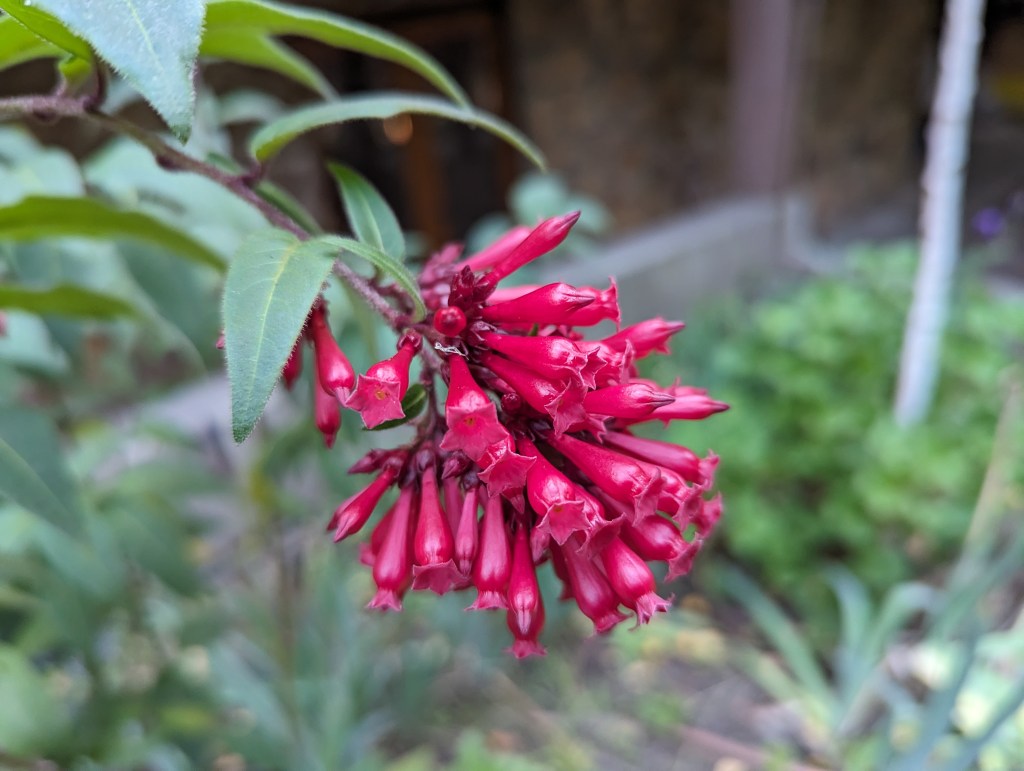
4. Cestrum fasciculatum ‘Newellii’, bastard jasmine has an interesting name. Of course, it is not really jasmine. It recovered slowly from gopher damage, but blooms nicely now.
5. Rosa, carpet rose is my least favorite of these six because it is so cheap and common. I prefer old fashioned and respectable hybrid tea roses that are such excellent cut flowers.

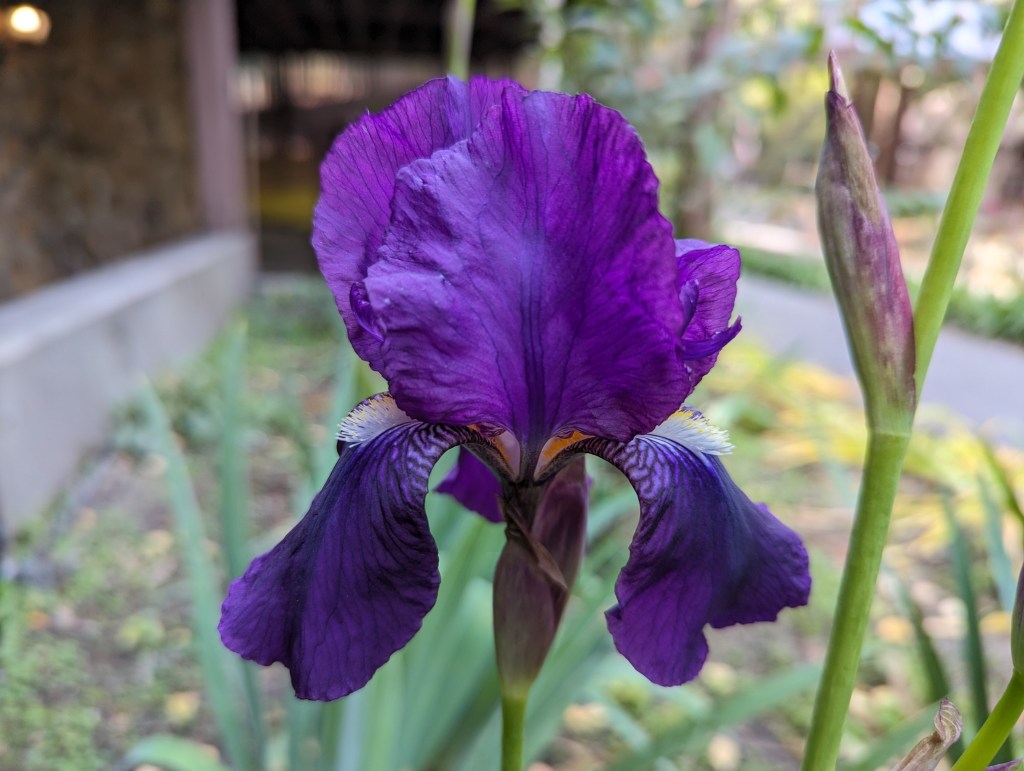
6. Iris X germanica, bearded iris should bloom for spring. Reblooming types also bloom for autumn. I have no idea what this is, but I sort of doubt that it is a reblooming variety. Earlier, it did not bloom much, so now seems to be blooming late for the first phase this year, rather than blooming again for a second phase within the same year. Furthermore, its simple bloom and slim floral stalks suggest that it is not extensively bred. It might be a simple species that is confused about the seasons here, because this climate is so mild.
This is the link for Six on Saturday, for anyone else who would like to participate: https://thepropagatorblog.wordpress.com/2017/09/18/six-on-saturday-a-participant-guide/
Horridculture – Too Many Trees (deferred from Wednesday)

Excess is expensive . . . or profitable.

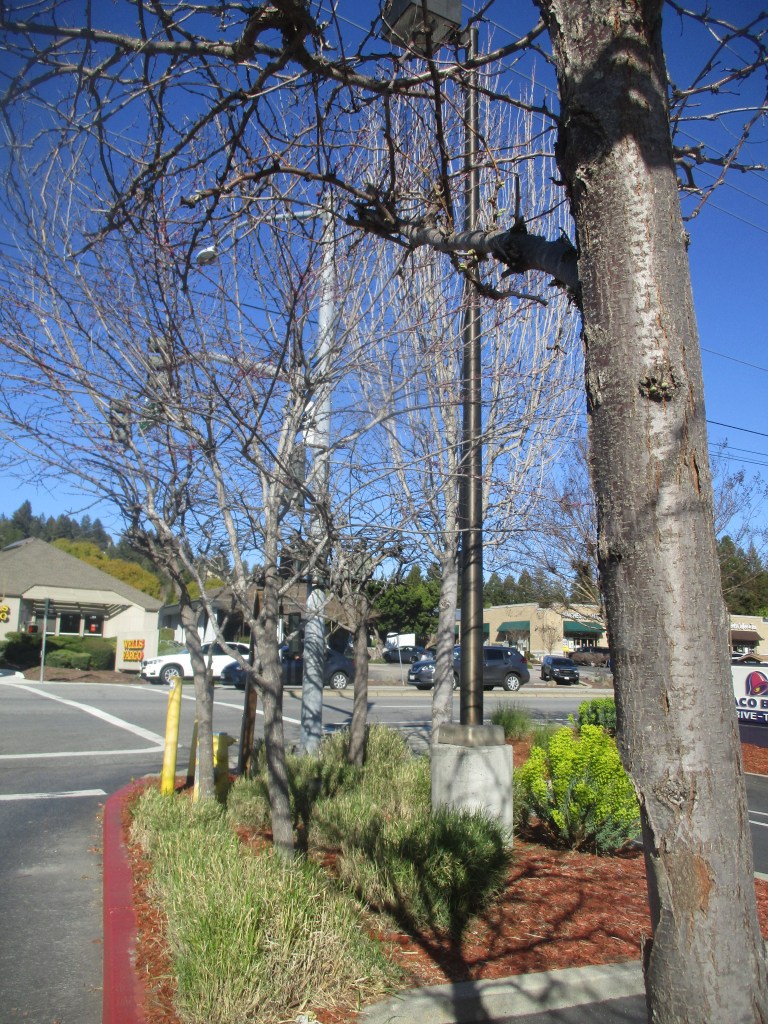
One can not see the forest for the trees here. Actually though, there is no forest, but only too many trees, surrounded by vast pavement. A wide roadway is beyond these trees. A driveway is to the left. A parking lot is to the right. Not much space remains in between for so many trees.

A honeylocust is in the foreground to the right. It mostly obscures a crape myrtle in the background. To their left, and slightly to the right of the center of the picture, there is a red maple. To the left of the center of the picture, there are three Eastern redbuds. That is six trees confined to an area that is about as spacious as three parking spaces. The picture is not of good quality, and because it is a few years old, I can not remember many more details about it.

The honeylocust and the crape myrtle are components of the original landscape of the shopping center that this landscape is associated with. Alone, they are both quite practical for this particular landscape, and would not be too crowded. The red maple and three Eastern redbuds were added for the ‘upgraded’ landscape of the adjacent business establishment. Not only are they much too crowded to grow and develop healthy form, but they also encroach into adjacent traffic signals, and obstruct illumination of their corner of the adjacent parking lot.

Furthermore, they contribute little more than problems to the landscape. Red maple provides nice foliar color for autumn, but is obscured by the other trees. Eastern redbud could bloom nicely for spring, but is too brutally pruned for clearance to do so.

Unfortunately, these crowded trees were more profitable than smaller plant material would have been for the so-called ‘landscape company’ that installed them.

Lantana camara

The foliage is oddly aromatic.

Even as most flowers of summer are finishing, the bright yellow, orange, red, pink and white blooms of Lantana camara continue to brighten gardens until the weather eventually gets too cool and damp for them to perform. This is quite impressive for a species that is endemic to the tropics of Central America, and has a taste for warmth. Blooms are actually one to two inch wide umbels of many small flowers. Individual flowers within each umbel may be different colors at different phases, so that each umbel may have blooms in as many as three different colors.

In the wild, Lantana camara can get almost six feet high and more than six feet broad. Garden varieties are of course much smaller and compact. Since Lantana camara does well in containers, a few cultivars that stay very compact and proportionate to container gardening have been developed, but unfortunately remain somewhat uncommon in nurseries. The potentially objectionably aromatic leaves are about two or three inches long and one or two inches wide, with minor serration and slightly sandy texture. Some dislike the foliar aroma, but many enjoy it.

Lantana camara is not too demanding, wanting only good warm exposure with no more than a bit of shade. Once established, it does not need much water, and can actually rot if watered too frequently, or if soil does not drain adequately. Excessive fertilizer will inhibit bloom. There are not many insects that bother Lantana camara, perhaps because it has an unpleasant flavor. It is actually toxic to animals that may try to eat it. However, butterflies really dig it.

Deciduous Foliage Is Efficient

Maple foliage only seems to be messy because it all falls at once.

(Horridculture will resume on Friday.)

Contrary to popular belief, most deciduous trees, those that drop all their leaves in autumn, are not as messy as most evergreen trees. There are of course a few exception; such as cacti that lack foliage completely, or Italian cypress that drop their finely textured foliage straight down within a very narrow drip-zone, where it decomposes and disappears unnoticed. Very few leaves fall from a big silver maple through winter, spring and summer, so that almost all of the raking is done when almost all the leaves get shed in autumn. However, a big Southern magnolia generally drops leaves throughout the year, so that raking is always necessary.

The problem is that when deciduous trees get to be messy, they are very messy. Also, they get to be messy at the worst time of year, when their leaves mix with rain to clog drains and gutters. Unraked leaves become hazardously slippery when they get wet and start to decompose. It is amazing how something that can be so appealingly colorful through autumn can so quickly become such a nuisance.

Leaves of deciduous trees somehow seem to be better for composting than those of some of the evergreen trees. Anyone with a Southern magnolia knows how slow the foliage is to decompose. Foliage of camphor, bay, carob and various eucalyptus certainly decompose slower than various maple, ash, poplar and birch. Many of us outfitted with green waste bins or curbside collection of green waste prefer to recycle the less desirable evergreen foliage, and compost primarily deciduous foliage. Those of us who do not compost but need to rake under large or many deciduous trees may fill bins for several weeks, or leave very big piles of leaves at the curb.

Small leaves, such as those of most elms, or finely textured compound leaves, such as those of silk tree, jacaranda or locust, may not need to be raked if they fall onto lower shrubbery or ground cover. Small leaves or the small leaflets of disintegrating compound leaves simply sift through the lower plant material to decompose below. However, large elms may produce such an abundance of foliage that some may need to be removed. Maple and other large leaves are not so easy to ignore. They can shade lawns, ground cover or bedding plants, so need to be raked as they fall.

California Black Oak

California black oak defoliates through autumn.

Only a few counties within California lack native California black oak, Quercus kelloggii. Yet, it is not prominent where it is native locally. It generally inhabits mixed forests within the Coastal Ranges. It is rare among home gardens, and rarely available from nurseries. Within the Sierra Nevada, it is common enough to be harvestable as a hardwood timber.

With good exposure, mature California black oaks may get no taller than thirty feet. They can get twice as tall where they must compete with tall trees. The largest trees are higher than a hundred feet. Their elegantly upright trunks are generally less bulky than those of other oaks. Few are more than four feet wide. Gray bark darkens and roughens with age.

The deciduous foliage of California black oak is almost brownish drab green. It becomes brownish yellow prior to defoliation. Cooler weather enhances brighter yellow or orange color, but also accelerates defoliation. Foliage can linger into winter with milder weather. The handsomely lobed leaves are about four inches long, and bigger on vigorous stems. The docile roots are vulnerable to rot with frequent watering.

Dormancy Facilitates Survival Through WInter

Deciduous vegetation defoliates for winter dormancy.

Dormancy is not exclusive to vegetation. Many animals are dormant while they hibernate through cold winter weather. Some animals are dormant while they aestivate through hot and dry weather. Fungi and bacteria can maintain dormancy for many years or centuries. Dormancy is a technique for avoiding unpleasant situations, such as cold or hot weather.

Like some animals, fungi and bacteria, some vegetation is dormant through dry weather. This is evident within local chaparral climates and nearby desert climates. Even within a few coastal forests, buckeye defoliates during summer. Such vegetation resumes activity in response to late autumn rain. However, most vegetation here prefers winter dormancy.

Such winter dormancy is especially evident among deciduous species. Many evergreen species merely halt or decelerate their growth, but without defoliation. Several evergreen species defoliate only partially. A few only shed their old foliage as new foliage replaces it during the following spring. Few species prefer to grow most vigorously through winter.

There are a few advantages to defoliation for winter. Wintry wind blows much more freely through defoliated canopies. Evergreen canopies are therefore more vulnerable to wind. In other harsher climates, defoliated canopies do not accumulate much snow. Evergreen canopies might accumulate more snow than they can support. Some get heavy with rain.

Foliage is not as useful through winter as it is through summer anyway. The sun is lower to the south. Consequently, less sunlight gets through more of the atmosphere. Days are shorter while nights are longer. Furthermore, cooling autumn and winter weather inhibits photosynthesis. For deciduous species, foliage becomes less of an asset than a liability.

Dormancy, whether it involves defoliation or not, facilitates a few horticultural techniques. Bare root stock becomes available at the beginning of winter. Transition from its farms to home gardens is much less stressful during dormancy. So is the aggressive pruning that roses and deciduous fruit trees require. Most pollarding is safest during winter dormancy.

Abutilon

Bloom may become more scarce with cooling weather.

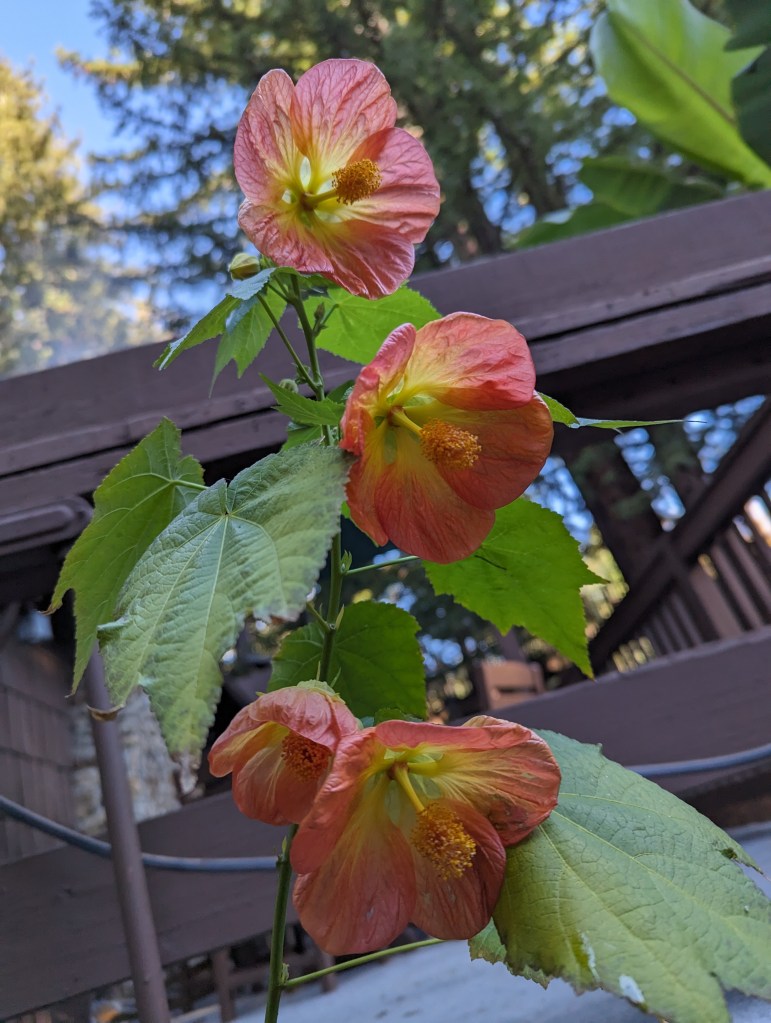
Abutilon X hybridum grows wild from seed within some of our landscapes. Although not prolific enough to be naturalized, dispersion of any viable seed seems odd for hybrids, since most hybrids are sterile. Of course, I do not know for certain if their ancestors were actually Abutilon X hybridum. They could have been other simple species of some sort. Besides, the name seems to apply to any cultivar of unknown parentage, including a few that are not actually hybrids.

Furthermore, even those that are generally sterile hybrids only needed to produce a single viable seed to start the process. Such a seed would likely grow into something that is more genetically stable, and therefore less sterile than its parents. Regardless of their supposed genetic stability, or because of their lack of it, their individual floral color is delightfully variable.

I am no more certain about the common name of this genus, species or group of hybris, which I know simply as flowering maple. Some know it as Chinese lantern. A few may know it as Indian mallow or parlor maple.

I am not so keen on the flowering maple, or whatever it is, for refined landscapes. However, the landscapes here are not so refined, and some are quite rustic. They benefit from the relaxed style, sporadic bloom, and open form of whatever this is.

Bloom is always sporadic, but is a bit more abundant during warm weather. Conversely, it can get scant while the weather is cool through winter. I am impressed by the few flowers that continue to bloom on this particular specimen. So are the hummingbirds. Bloom will likely become more scarce now that the first mild frost occurred last night. Also, foliage may get sparse until warmer weather next spring initiates regeneration to continue the seasonal cycle.

Frost

Before

This elephant ear was happy and healthy as the sun set last night. As the sun rose this morning, it was sagging from frost damage. The picture that was taken prior to damage posted here (at my previous ‘Six on Saturday’ post) at midnight. Frost likely occurred shortly afterward. The picture that was taken after damage was taken only a few hours later.

Frost does not happen frequently enough to get much consideration here. When it does happen, it is not severe. This particular frost was only thirty- two degrees. Nonetheless, I should have sheltered the elephant ear. It would not have taken much effort to do so. I could have simply moved it over a few feet, so that it would have been under an eave. A few other species were likewise worthy of shelter. A few, though, should not even be grown here. The most practical means with which to avoid frost damage is to refrain from growing species that are vulnerable to it.

Fortunately, the elephant ear and all other species that were slightly damaged by frost early this morning should recover efficiently. Elephant ear typically loses its foliage through winter, and regenerates foliage for spring anyway. No more frost is predicted for the next week.

I am glad that I do not need to contend with the sort of frost that kills vulnerable species completely. The possibility of such weather would be much more limiting.

A pair of bougainvillea that I planted last autumn actually succumbed to frost last winter. Although bougainvillea commonly loses foliage and perhaps a few small stems to frost, basal stems should not have succumbed. I wanted to get them into their landscape during autumn, so that they could benefit from cool rain through winter, and be ready to grow in spring. Their replacements will get planted in spring.

After

Six on Saturday: Unidentifiable

Only Australian tree fern is identifiable. Another is just, well, . . . weird.

1. Alocasia odora, taro was installed by a tenant, into a situation that was too dark for it. Now that the tenant is gone, and before another arrives, I brought it back to the nursery for reassignment. The holes in the leaves are from redwood twigs that fell from very high up. I can not identify its cultivar, and am not ever sure if it is an Alocasia or a Colocasia.

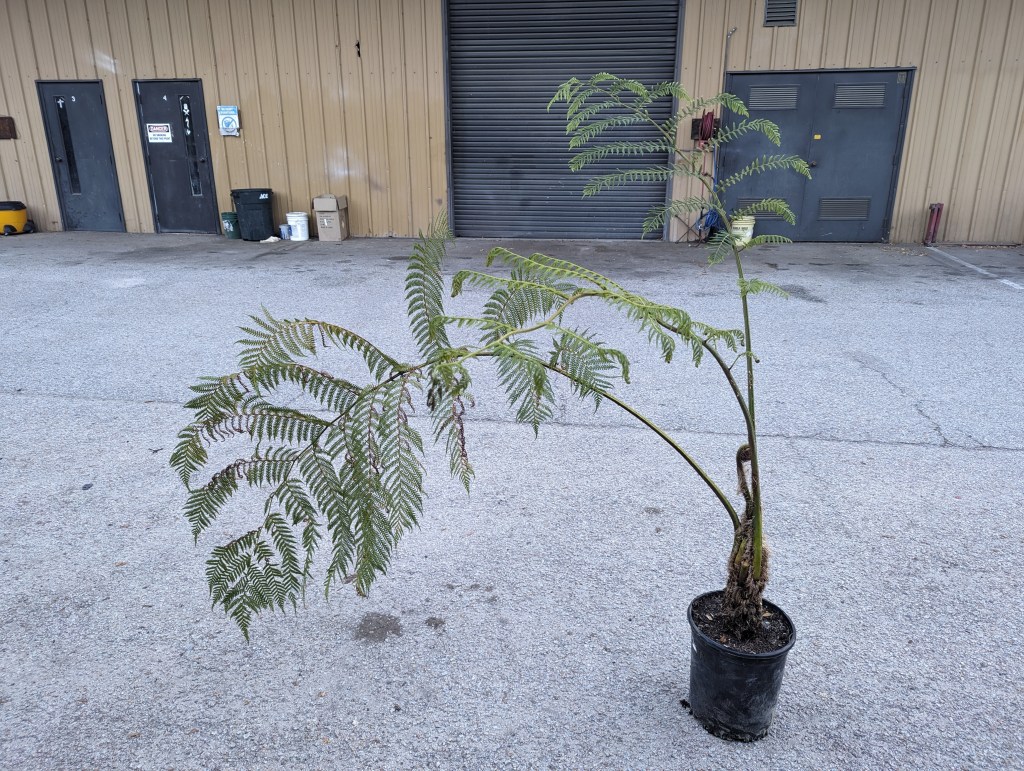
2. Sphaeropteris cooperi, Australian tree fern was next to the taro, so came here with it. Although otherwise healthy, its etiolated leaves were reaching towards limited sunlight.

3. Sphaeropteris cooperi, Australian tree fern that I tried to recycle from the garden of a former neighbor did not survive. It is a saddening loss. It was an excellent tall specimen.

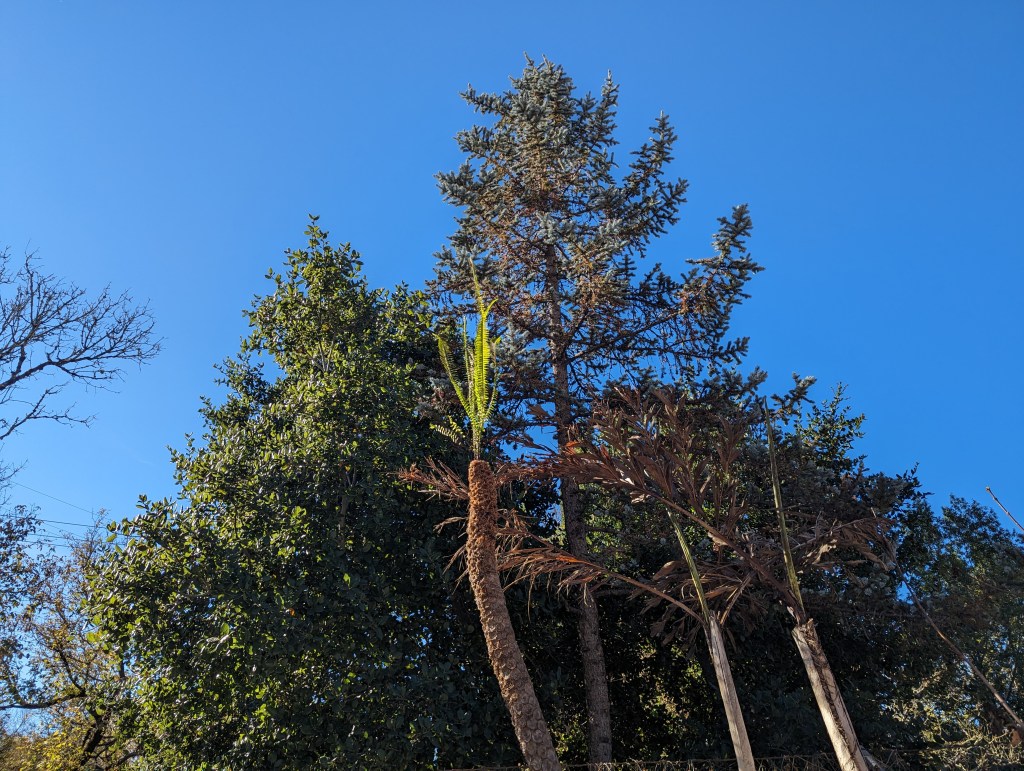
4. Nephrolepis cordifolia, sword fern might make good use of the trunk of this deceased Australian tree fern. Technically, the trunk is not actually a trunk at all; but is merely an accumulation of roots that extended downward through the decayed stem of the original fern. Perhaps the roots of this sword fern can do the same before the dead original roots deteriorate. It seems like a graft, but of course it is not. Nor is it a hybrid. It is just weird.

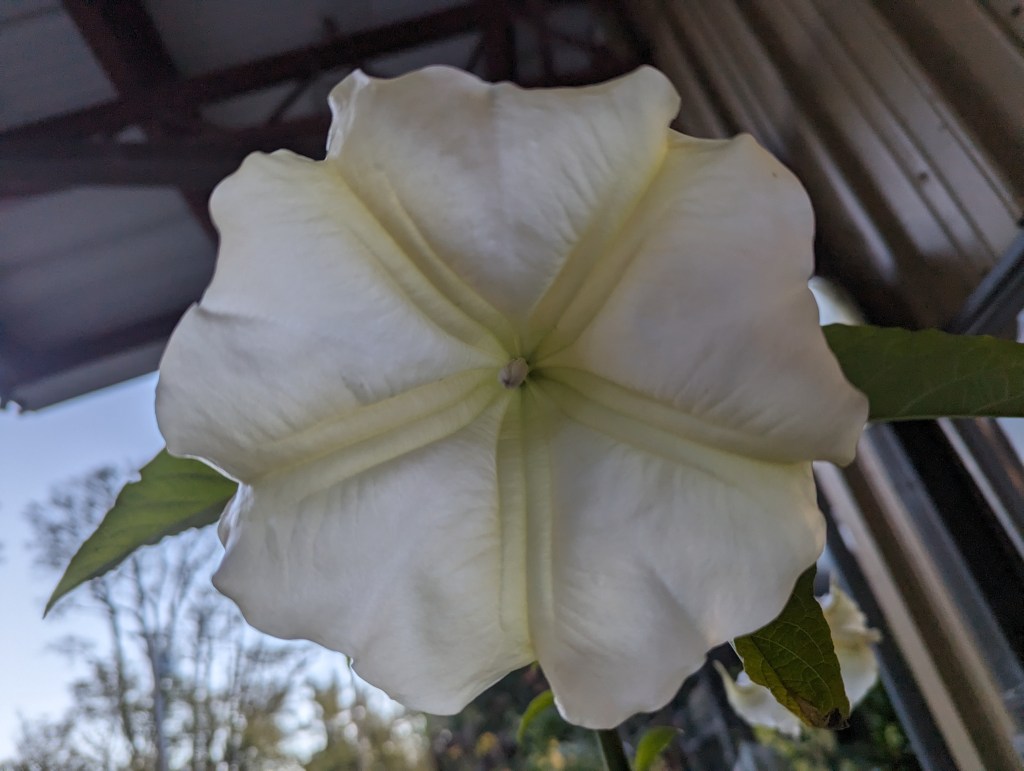
5. Brugmansia, angel’s trumpet of an unidentified cultivar is blooming for the first time. It has been with me for a few years, but dies back each winter. Before it recovers enough to bloom, it dies back again. I got it as a twig from a greenwaste recycle pile in San Jose.

6. Brugmansia, angel’s trumpet should be pastel orange. I took the original twig because I assumed that it was of a specimen that bloomed pastel orange. Does this look orange?!

This is the link for Six on Saturday, for anyone else who would like to participate: https://thepropagatorblog.wordpress.com/2017/09/18/six-on-saturday-a-participant-guide/

Catnip?

Is this actually catnip?

Is this catnip, Nepeta cataria? Again, I am baffled by something that should be very easy to identify. It certainly resembles catnip visually. It almost smells like catnip. If I did not get it from a small curbside garden that Rhody and others of his species leave messages for each other in, I would have confirmed that it tastes like catnip. Perhaps I should be more than adequately convinced that it actually is as I suspect.

Nonetheless, I am not yet convinced. Catnip is rare here. I know of no one who grows it. Those who have tried ultimately found it destroyed by frolicking cats. It really should be grown in hanging pots that cats can not reach. It seems unlikely that it could survive for long within a curbside garden near where a few cats live. It also seems unlikely that it would spontaneously appear where it had not been planted intentionally. Only small succulents were planted below a large camellia within its particular small garden. All the small weeds that grow nearby are common.

Regardless, I could not ignore a branched stem of this questionably identified species that had broken off and was laying limply over undamaged foliage. Obviously, it needed to be removed. Obviously, I obliged. I brought it back and processed it into several small cuttings. I collected the scraps of leaves and internodes for an associate to take to a feline acquaintance of his for possible confirmation of its slightly questionable identity. I await the assessment, although it will be from someone who can not decide to stay inside or go outside after meowing incessantly for someone to open a door. A second or more opinions may be necessary from other members of this innately indecisive species if the first attempt at confirmation is unsuccessful.

The foliage certainly resembles that of catnip.