Thanksgiving

Thanksgiving is a celebration of gratitude. It was created by early American settlers who were grateful for their harvest at a time when the exotic fruits, vegetables and grains that they brought with them from Europe were only beginning to get established in unfamiliar climates and soils. They were also grateful for the generosity of the indigenous people, as well as the native fruits, vegetables and game that they introduced them to. Regardless of how meager their resources now seem to be by modern American standards, early American settlers were very grateful for what they had.

Nowadays, for most Americans, sustenance from all over the World is so reliably available and in such abundance that many neglect to appreciate it. As in the past, those who lack such abundance are more grateful for what is available to them. Perhaps that is why Thanksgiving is still so relevant, and such an excellent Holiday. It is a reminder of the importance of gratitude.

Gardening to grow fruits and vegetables, even on a scale that is very minor relative to how early American settlers did so, facilitates gratitude for the sustenance and any surplus that it generates. Produce from the garden is so much more satisfying than produce from a supermarket. A pantry of canned surplus from the garden is so much more gratifying than a pantry of food that was purchased from a supermarket. Perhaps there should be no difference, since food from a supermarket is purchased with money that is earned from other work, which should be comparatively gratifying.

Realistically, there is so much to be grateful for, and so much gratitude to celebrate. In fact, there is enough to justify a specific Holiday for it. Work and gardening can be resumed tomorrow or later, after this celebration of gratitude, Thanksgiving.

Horridculture – Bay

Umbellularia californica is NOT Laurus nobilis.

Bay grows wild here. It is native. It is also known as bay tree, laurel, bay laurel, spice tree, pepperwood, myrtlewood, Pacific myrtle, Oregon myrtle and California bay. All these different common names demonstrate why simple botanical nomenclature is useful. In that regard, this native bay is Umbellularia californica.

Bay is also native to the Mediterranean region. Of course, it is a different species, Laurus nobilis. Like the bay that is native here, it is also known as bay tree, laurel and bay laurel. Furthermore, it is known as Grecian bay, true laurel and sweet bay, although it is not at all sweet.

Laurus nobilis is a common culinary herb though. Umbellularia californica is not. That does not mean that Umbellularia californica can not be useful as such. It merely means that it is not commonly used as such, and is very different from the bay that genuinely is. Some of us here in California and southwestern Oregon actually do sometimes find culinary applications for it.

Umbellularia california has a much more pungent and stronger flavor than Laurus nobilis. Although it has potential to be useful for similar applications, it is by no means a substitute, and should certainly not be used in comparable proportions. Most of us who use it are aware of the differences, and know how to use it, generally quite sparingly.

The problem is that fresh foliage of Umbellularia californica is sometimes available as culinary bay from supermarkets, and is typically labeled as sweet bay, true laurel or Grecian bay. This is no problem for those of us who recognize it, but we would not purchase it from a market while we can get it for free from the wild. Those who purchase it likely do so because they believe that it is genuine Laurus nobilis.

Variegated Boston Fern

Tiger fern is prettier up close.

Boston fern is merely one of several cultivars of Nephrolepis exaltata. Its cultivar name is ‘Bostoniensis’. Variegated Boston fern, or tiger fern, is reputedly a cultivar of this cultivar. Its cultivar name is either ‘Variegata’ or ‘Tiger’. From a distance, it seems to be a yellower version of the original. Prettily intricate stripes become apparent with closer observation.

Variegated Boston fern is a bit smaller and a bit less vigorous than common Boston fern. Like all variegated cultivars, it works with a bit less chlorophyll. Mature potted specimens might get no wider or higher than three feet. Unvariegated Boston fern can be more than four feet from top to bottom. Both could be larger if their long fronds were less pendulous.

In home gardens, variegated Boston fern can get rather tattered through winter. It is likely to defoliate if exposed to even minor frost. This is why it is more popular as houseplants, usually in hanging pots. Such potted specimens rely on consistent watering. Diffused but bright sunlight is best. Occasional application of fertilizer enhances foliar color and vigor.

Rainy Weather Begins With Autumn

Weather changes with the changing seasons.

Rain is at least as relevant as temperature is to the seasons here. Temperature does not change as much. The warmest of summer weather does not seem to be terribly hot. Low humidity helps. The coolest of winter weather is not too terribly cold. Some local climates lack frost. The difference between dry weather and rainy weather is much more obvious.

After all, rainy weather ends during spring, and does not resume until about now. Almost no rain occurs during the extensively arid summer season. This includes late spring and early autumn. Summer thundershowers are uncommon. Therefore, almost all rain occurs during winter. Some also occurs somewhat variably during late autumn and early spring.

This is quite normal for local chaparral climates. Comparatively to other climates, it might be both an advantage and a disadvantage. It is why most landscapes, particularly lawns, rely on irrigation. It is also why the growing season is so long here. This climate provides more pleasant weather to facilitate more gardening. It also necessitates more gardening.

Recent rainy weather is likely the beginning of the rainy season. If so, it is obviously also the end of the dry season. Transition from one season to the next is not on a very precise schedule, though. Dry weather could potentially resume for a while. Conversely, El Nino has potential to promote rainy weather. This winter could be even rainier than last winter!

Even if rainy weather does not resume for a while, irrigation requires seasonal reduction. This includes frequency and duration of automatic irrigation. Vegetation consumes much less moisture while dormant through winter. Less moisture evaporates from soil while the weather is cool. Rain may provide most of the garden with more moisture than it can use.

Unfortunately though, rain is also potentially messy. It makes soil muddy, and can cause erosion. It dislodges deteriorating deciduous foliage, especially in conjunction with wind. Colorful deciduous foliage is much less appealing on pavement or lawn than in its trees. Raking fallen leaves, and all other gardening, is less pleasurable during rainy weather of autumn.

End of Fire Season

Burned trees are visible on ridge tops within the CZU Fire zone.

Rain is gratifying at the beginning of the rainy season. We all know that it has potential to become excessive later in the season, but we are not yet concerned with flooding or mudslides. After a typically long and dry summer, we enjoy it while we can. A storm that finished earlier yesterday was relatively minor, but was nonetheless the first significant storm of this new rainy season of 2023 and 2024. Only minor drizzle preceded it.

The beginning of the rainy season is also the end of the fire season. Forest fires become less likely as the forests become more saturated through the season. However, rain also sustains growth of vegetation that will become combustible during the following fire season, especially if the weather becomes unusually warm and arid by then. Unfortunately, this is the natural pattern of the climate here. Fire is a major component of local ecosystems.

Three years ago, the CZU Fire was the most destructive forest fire within documented history of this region. Larger fires likely occurred prior to documented history, but burned forests that expect to occasionally burn, without damage to unnatural infrastructure that did not exist at that time. Prehistoric fires were likely less common than modern fires, but involved much larger areas. They also likely burned faster and less violently. Modern forest fires involve more fuel because of regeneration of hardwood species after clear cut redwood harvesting a century ago. That is why so many coastal redwoods that survived several fires during their long lives succumbed to the CZU Fire.

Much of the marginal area of the CZU Fire is regenerating efficiently enough to eliminate evidence that it burned so recently. The scenery of areas that burned more severely remind us why we are grateful for the beginning of the rainy season.

Poke

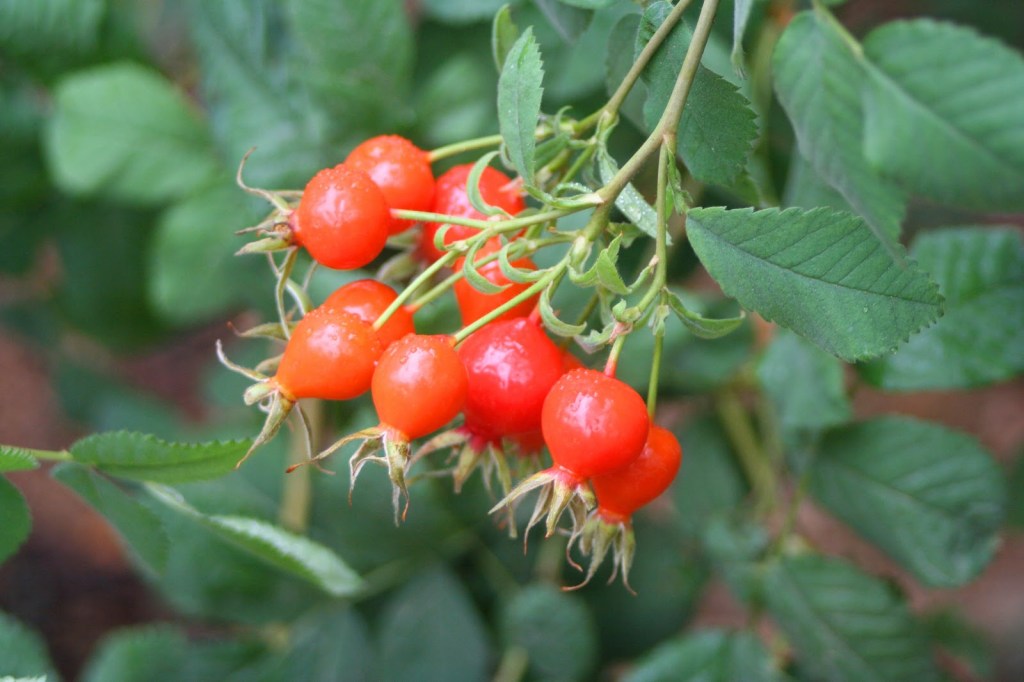
Phytolacca americana; pokeweed, pokeberry, pokebush, pokeroot, poke sallet, poke . . . or inkberry

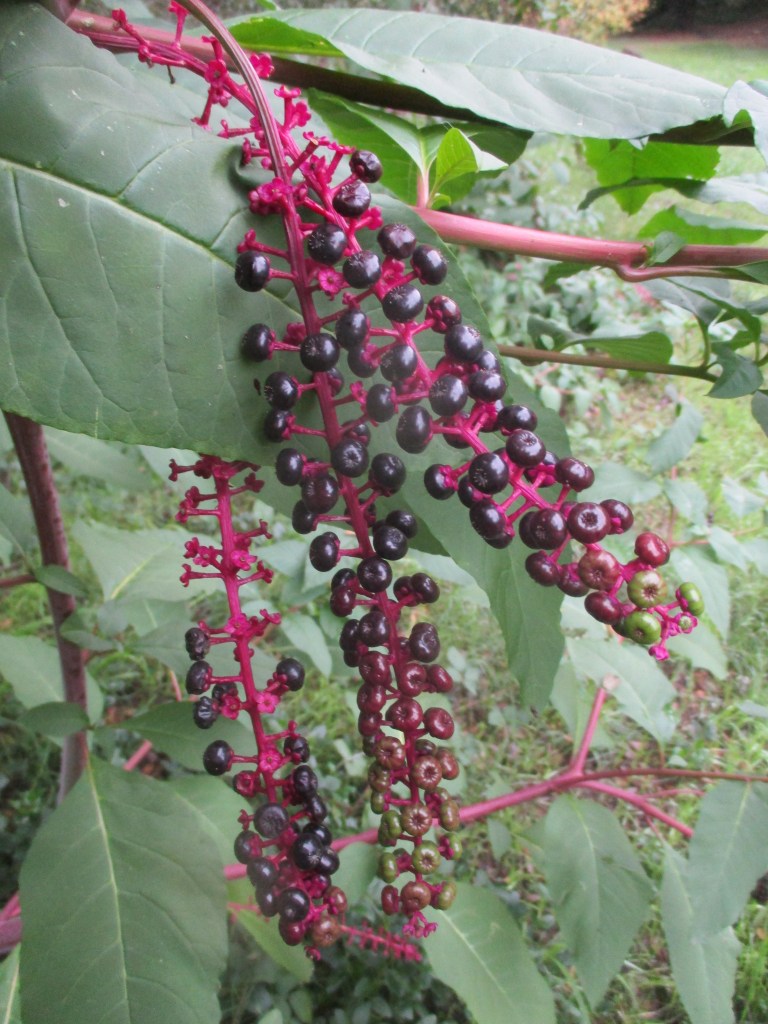
Phytolacca americana is known by several names; pokeweed, pokeberry, pokebush, pokeroot, poke sallet, and simply, poke. I have no idea what poke is, but it is obviously famously associated with this species, which I know instead as inkberry. That is a more sensible name to me, since I made ink from the famously toxic berries. However, within its native range, a species of holly is also known as inkberry.

The ink is initially an obnoxiously bright magenta, but fades to a light brown. Those who prefer the bright magenta color can preserve it somehow. I prefer the faded brown. Because the ink is caustic, it should be used only with disposable quills. Inkberry is also used for dying fabric, either magenta or brown.

Weirdly, inkberry is both extremely poisonous and also edible. Tender young vegetative shoots can be collected as they begin to emerge after winter. They can be boiled and drained a few times to eliminate toxins that might have developed within them by that time. Such growth becomes more toxic as it matures. A few shoots must be left to grow through summer and autumn to sustain tuberous roots below, so that new shoots can grow for the following season. This sustaining growth gets quite large, after providing only a minor volume of edible shoots. In other words, inkberry is a large perennial that needs plenty of space but provides only a small amount of potentially edible but possibly toxic greens. There are plenty of safer and more efficient greens and vegetables to grow in the garden.

Inkberry has become a somewhat invasive exotic species here. We prefer to remove it from public landscapes because its poisonous but pretty berries might be tempting to those who are unfamiliar with it. They certainly look like they would be tasty.

Six on Saturday: Williamsburg II

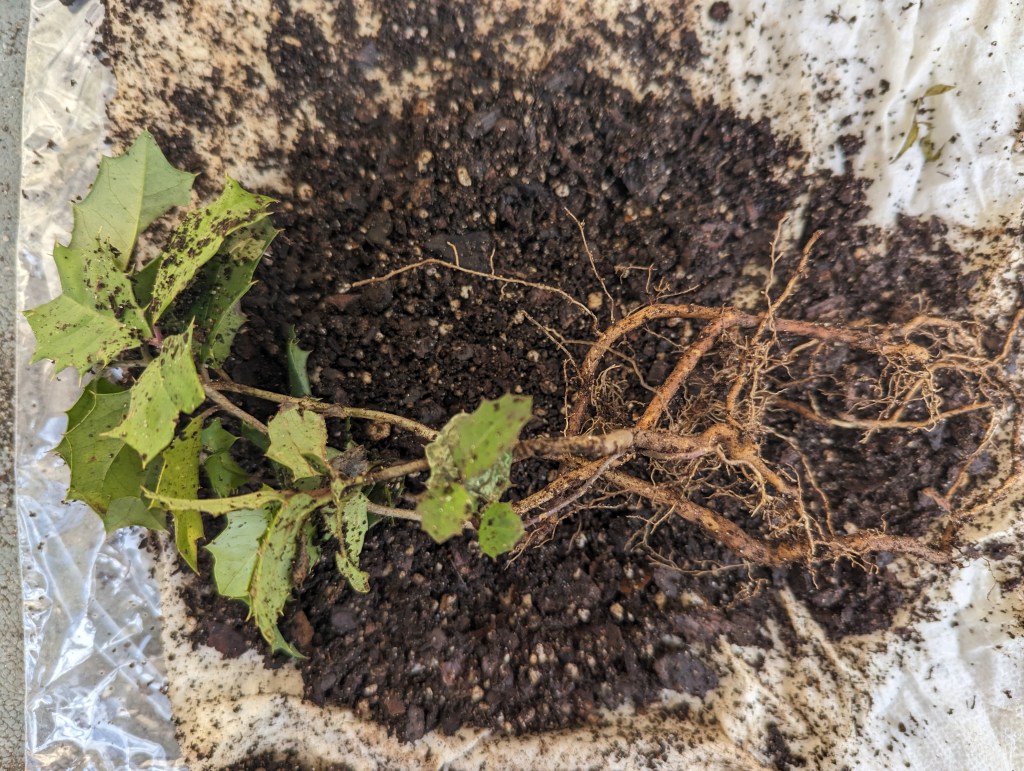
Woodland Gnome of Our Forest Garden awesomely sent me six seedlings of Ilex opaca, American holly from Williamsburg! I had been wanting to get more acquainted with this species since encountering it in school in about 1986, but never justified doing so before. It is unavailable from nurseries here anyway. As with beautyberry, esperanza, poinciana, red elderberry and several other species that I want to get acquainted with, I specifically wanted their wild form, as it grows from seed, rather than cultivars. This is exactly what these seedlings are. I am already very pleased with them, and we are barely acquainted.

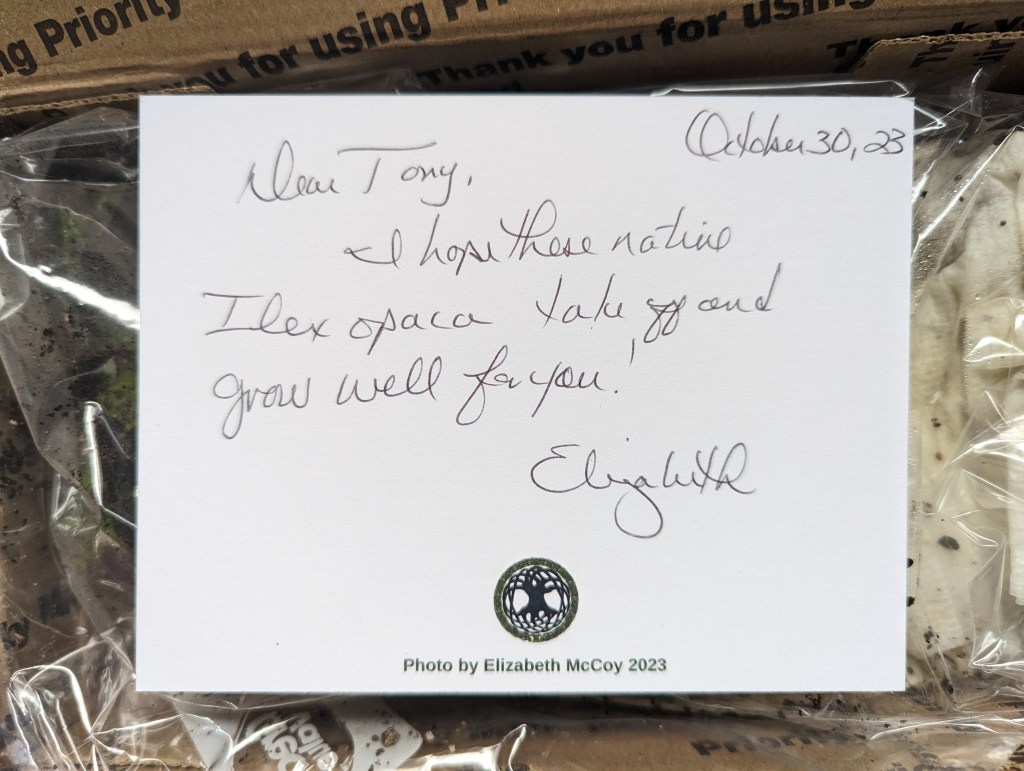
1. Cards and letters written by hand with ink on paper and sent by mail have become an old fashioned courtesy. It is gratifying to know that some still express such graciousness.

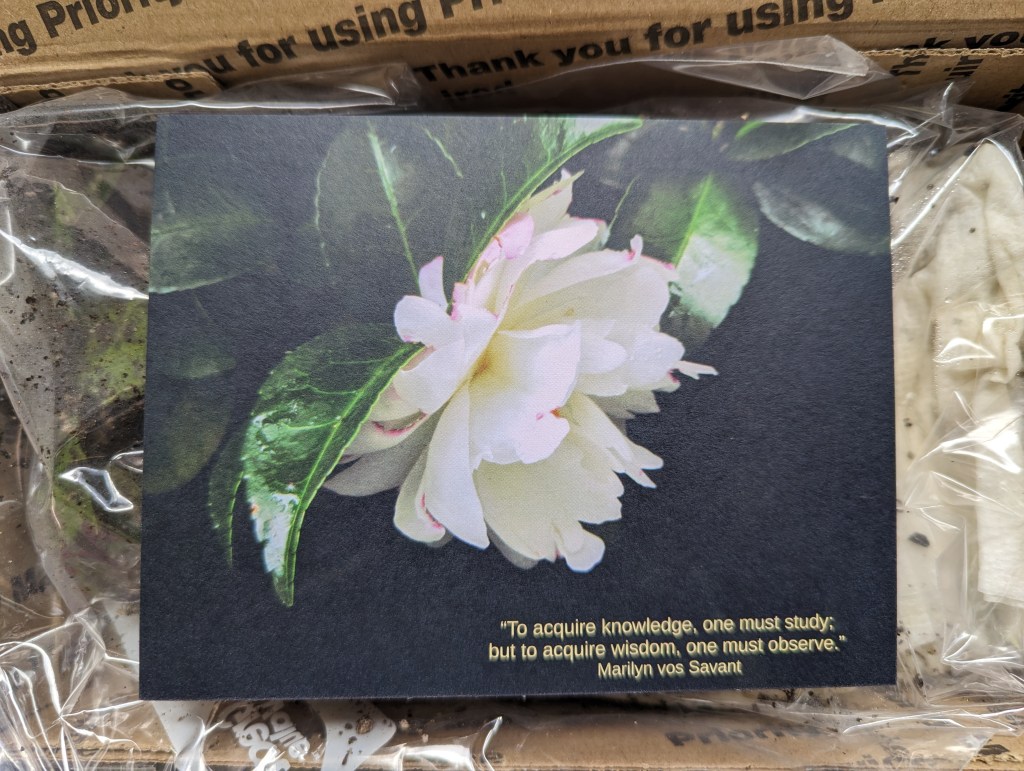
2. Camellia sasanqua, sasanqua camellia is the illustration for the other side of the card. It very likely bloomed where the contents of the parcel originated from in Williamsburg.

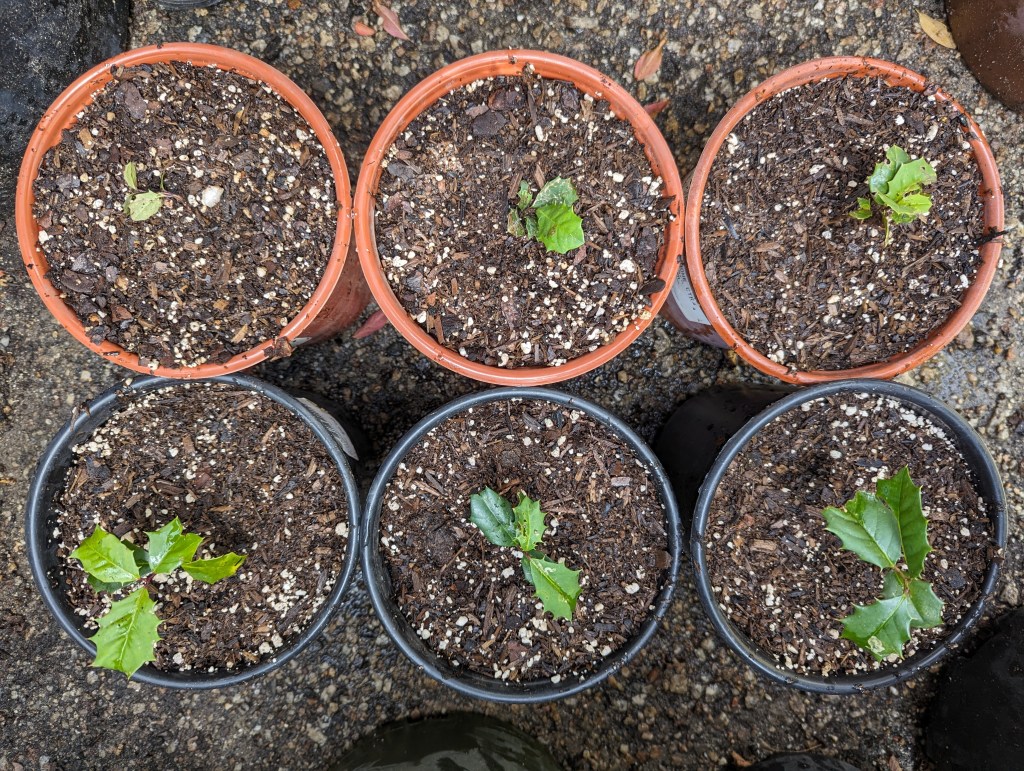
3. Ilex opaca, American holly was the contents of the parcel. There are six seedlings. For me, this is a remarkable acquisition, like beautyberry, red elderberry and Louisiana iris.

4. Ilex opaca, American holly seedlings were canned and happy shortly after arrival here two weeks ago. They can now disperse roots through winter to sustain growth next year.

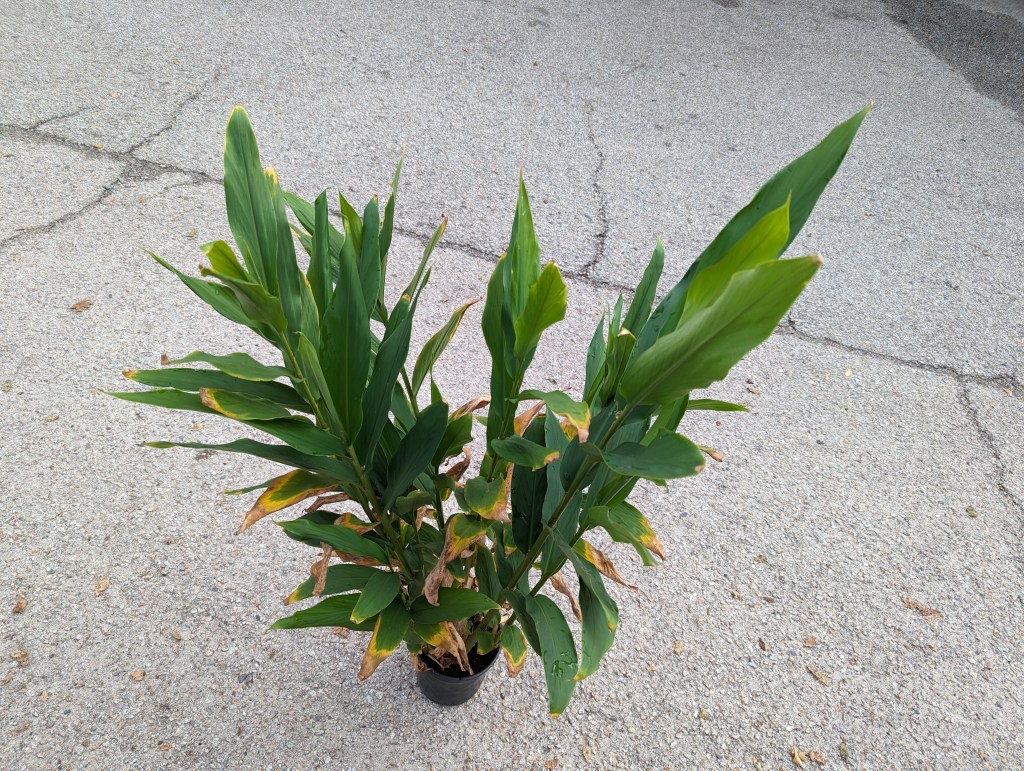
5. Hedychium coronarium, white butterfly ginger came from the same source two years ago. Some was planted at the Chapel. This remaining specimen is higher than three feet. It really wants to be in the ground. The mild warmth last summer likely inhibited bloom.

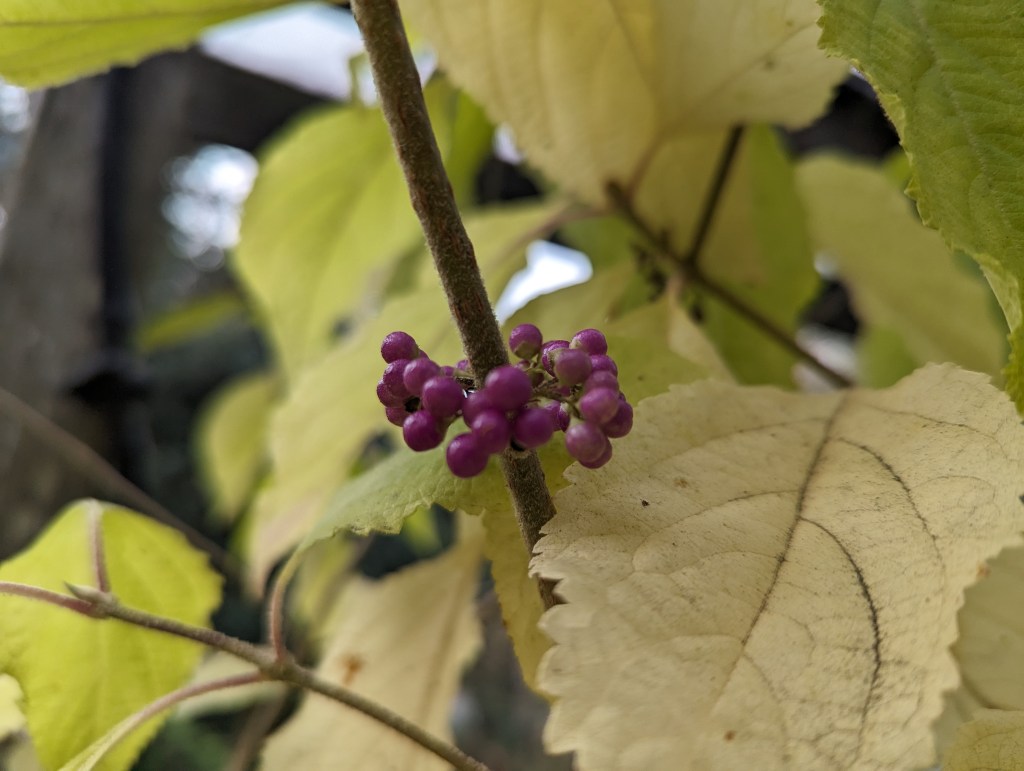
6. Callicarpa americana, American beautyberry was an even more excellent acquisition two years ago. The mild warmth last summer likely inhibited the ripening of the berries. Larger clusters of berries are still green. This yellow foliage will likely be gone after rain.

This is the link for Six on Saturday, for anyone else who would like to participate: https://thepropagatorblog.wordpress.com/2017/09/18/six-on-saturday-a-participant-guide/

Candelabra Tree

Candelabra tree is a big and strikingly weird succulent.

The weirdly sculptural succulent stems of candelabra tree, Euphorbia ingens, dark green but devoid of any real foliage, are striking in the right situation.  These stems resemble those of unrelated cactus, with longitudinal ridges topped with spines. Although botanically interesting, the minute greenish yellow flowers that bloom in autumn and winter on the ridges of the upper portions of the upper segments are not much to look at. Deep red seed capsules that turn purple as they ripen sometimes develop in milder climates after the flowers are gone, but are almost never seen locally.

Good exposure is preferred. Candelabra tree are better structured and more prominent standing alone away from other larger trees and shrubs. Cool winters and occasional frosts limit their height to not much more than fifteen feet; and unusually cold frost can actually kill big specimens back severely. However, in sheltered areas and milder climates, candelabra tree can get twice as tall. Soil should drain very well and get dry between watering. Regular watering can cause rot, particularly in dense or rich soil.

The main problem with candelabra tree is the remarkably caustic latex sap, which can be dangerous to children, chewing dogs or even those who need to prune the stems. Fortunately, candelabra tree needs very little attention, and only needs to be pruned where the stems get in the way or start to lean against fences or roofs. The caustic sap prevents insect problems.

Wise Old Owl (2011)

There is more to cut flowers than flowers.

(This is an old article from 2011, so much of the information within is no longer relevant.)

The sixteen acres of gardens of Filoli are spectacular and horticulturally compelling throughout the year. However, the weather through winter, although more pleasant than other places in the world, is not always quite so compelling or conducive to garden tours. At Filoli though, this is not a problem. More than six hundred volunteers and the Filoli staff merely bring the outdoors indoors, by selecting materials from the garden to adorn the interior of the 36,000 square foot Filoli residence for ‘The Wise Old Owl’, the annual fund raising Holiday Traditions Boutique.

While perusing The Wise Old Owl merchandise, guests can enjoy how so much more than flowers can be brought in from the garden to deck out the home. Bare stems, gnarly limbs, evergreen foliage, pine cones, bark and all sorts of bits and pieces of the autumn and winter garden demonstrate the potential for alternatives to traditional cut flowers that we may not even recognize as useful materials in our own gardens. Of course, there will be no shortage of the less abundant flowers that bloom through the season and decoration that are not out of the garden, as well as live music to enhance the display. Regardless of horticultural interest or boutique merchandise, the grand residence at Filoli is worth visiting even on the least eventful day of the year.

There are too many events within the Event to describe here. Guests can visit http://www.filoli.org to plan ahead and make reservations for buffet lunches and evening bistro dining, as well as an elegant Saturday Evening Dinner Party with dancing in the Ballroom. Children six to twelve years of age can enjoy a Children’s Tea on the finale of The Wise Old Owl on December 3.

The Wise Old Owl begins in only a few days on November 25, and continues through December 3. The hours of operation and admission are variable relative to the various events throughout the main Event. Reservations for specific events can be arranged and more information can be found online

Tickets can be purchased online, by fax or by telephoning Filoli weekdays between 9:00 a.m. and 4:00 p.m. At 650 – 364 8300 X 508. Order forms for fax transactions can be downloaded from the website and sent to 650 – 503 2090. Admission is limited; and tickets get exhausted somewhat early. Tickets are neither refundable nor exchangeable. Filoli is located at 86 Canada Road in Woodside (94062).

Horridculture – New Lawn for Old Trees

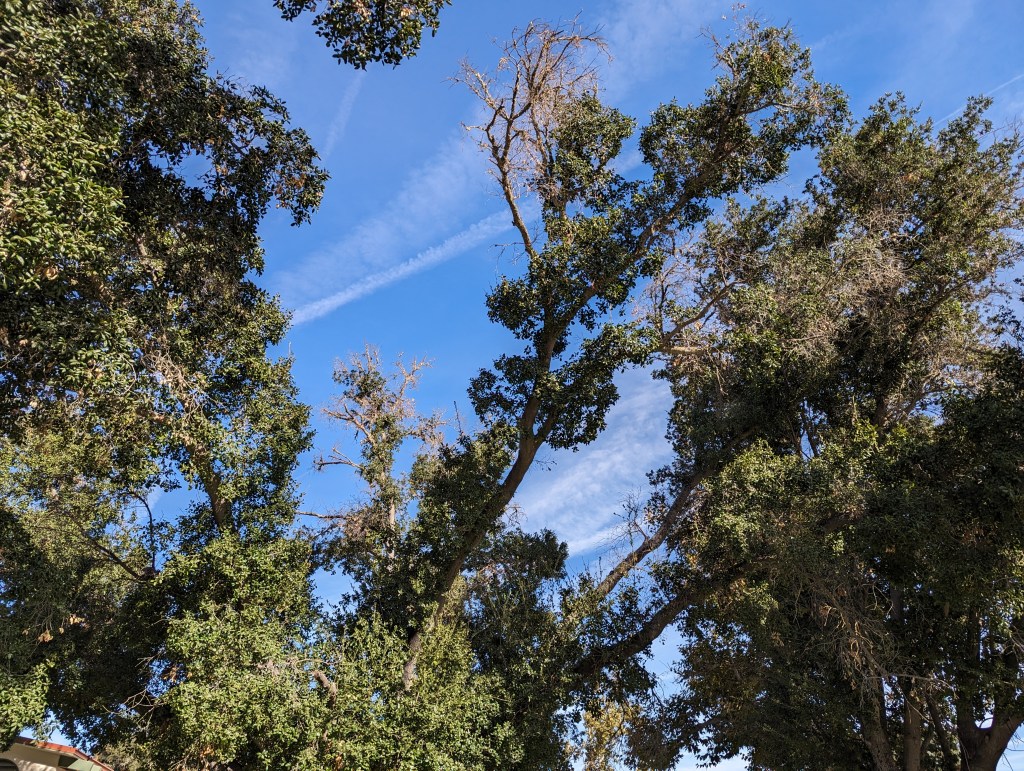
These mature oaks can not adapt to the irrigation that the new lawn requires.

Californian climates are impressively diverse. However, most climates here are chaparral or desert climates, or similar to such climates. That means that almost all rain occurs during the rainy winter season, and that almost no rain occurs during the dry summer season. Vegetation that is native to California is very familiar with the climates here. Therefore, it does not expect rain during summer. This should be obvious.

Some native species can adapt to irrigation during summer. Some may grow faster than they normally would without irrigation, but compromise their natural life span in the process. This is acceptable within some landscapes. Many riparian species are not bothered by irrigation.

However, some species adapt less efficiently. Some do not adapt at all. Some that can adapt while young can not do so while mature. Oaks are a common example of this.

These coast live oaks with a few blue oaks were installed as shade trees within a formerly minimalistic landscape that did not include turf. They were happy with annual rainfall for half a century or so. Then, this generously irrigated lawn was installed around them. They can not adapt to the frequent irritation that the lawn requires. Their roots are succumbing to decay, so will eventually be unable to sustain their foliar canopies. As they deteriorate, decay may eventually compromise their structural integrity and stability. Dieback is already evident within their upper canopies, with lower watersprouts attempting to compensate.

I suspect that the trees will be removed before they deteriorate enough to become hazardous. I also suspect that new trees will systematically replace them prior to their systematic removal. Their eventual demise is likely an acceptable loss, and perhaps expected. Turf with adapted shade trees is likely more important within this particular situation than preservation of these middle aged oaks.

Dieback is evident within the upper canopy. Watersprouts are evident with the lower canopy.