Pecan

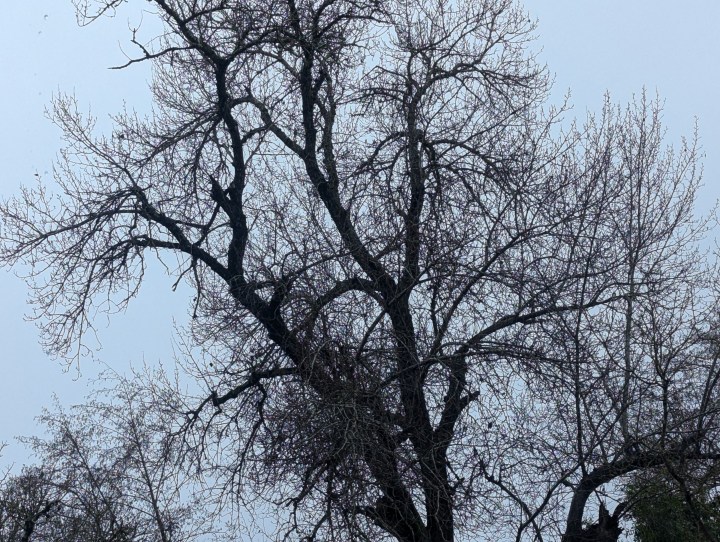
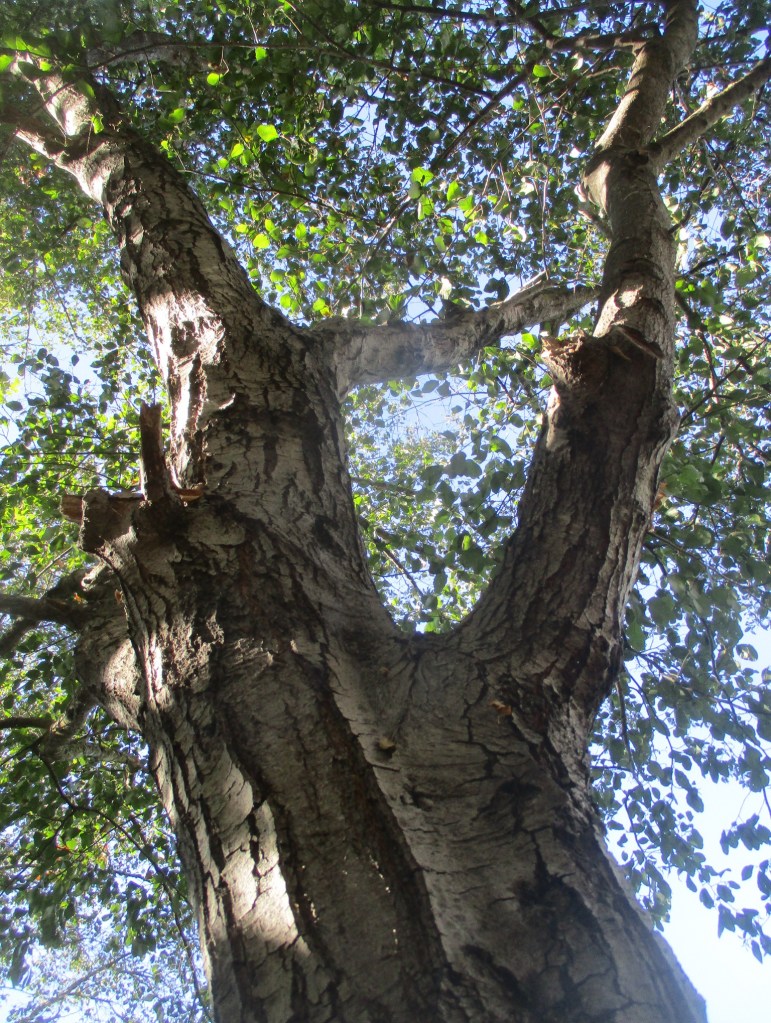
Pecan is the Official State Tree of Texas.

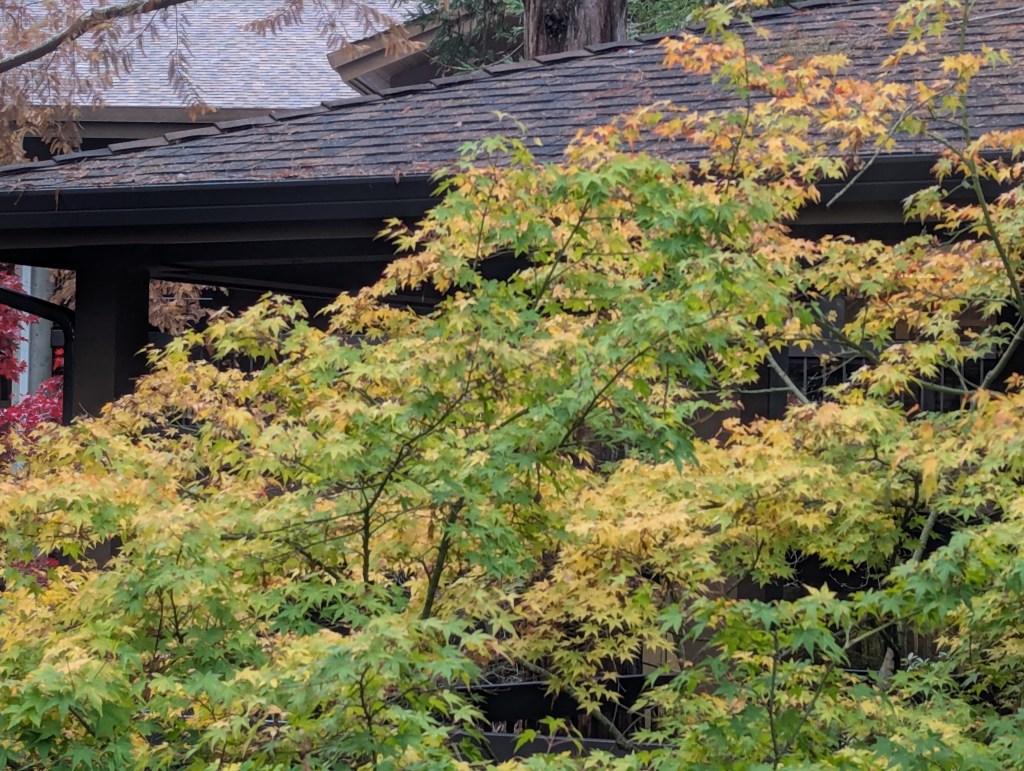
Texas selected a distinctive state tree; the pecan, Carya illinoensis. It is happy in the south and middle mid-west, where naturally grows about seventy feet tall. It can get almost as large here, so is best in big spaces. Summers are a bit too mild for reliable nut production in autumn, but single trees can sometimes make plenty. Two different trees (to pollinate each other) can actually be quite productive, although not quite as well flavored as in warmer climates. The pinnately compound leaves have about eleven individual leaflets that are about five or six inches long. Shade is not too dark.

Firewood

It is not too early to procure firewood.

Despite the pleasant warm weather, it will be autumn soon. This is the time to get ready for cooler weather through autumn and winter. The plants in the garden do that on their own without our help. They somehow seem to know what time it is. We only need to clean up the mess and empty the gutters when deciduous trees start to drop their leaves later. Most of our work involves features that are not plants.

Winters are so mild here that some of our work often gets delayed until it becomes necessary. If needed, we can paint, stain and seal decks, fences, patios and anything else outside anytime the weather allows right through winter. Many of us leave patio furniture outside all year both because the weather is not too harsh on it, and because patios are usable spaces even through winter.

Firewood is also commonly neglected or not even needed, but for different reasons. Many fireplaces were damaged or destroyed by the Loma Prieta Earthquake decades ago, and never repaired or replaced. Modern building codes outlawed the construction of new fireplaces even prior to that; so newer fireplaces are instead pellet stoves. Those of us who still use old fireplaces and stoves have more difficulty obtaining wood now that the orchards are gone and the outskirts of town are so much farther from home.

The advantage of pellet stoves is that fuel (which looks like stove food) is always available so does not need to be accumulated, stored and seasoned. The fuel also burns cleaner. Synthetic logs (made from compressed wood byproducts and fuel) are an expensive alternative for conventional fireplaces and stoves, but also burn cleaner than wood, and are always available. They are lightweight and clean, so can be picked up at the store and brought home in the trunk of a small car whenever a fire is wanted in the fireplace.

Good old fashioned firewood is both more work and stigmatized because of pollution. Those of us who do not have firewood available within our own gardens can purchase it from some tree service companies. It is most commonly obtained already split and seasoned directly from the wood yard where the tree service company stores it. It can be delivered for a price. Some people even like to pay a bit extra to get it  stacked.

Firewood obtained in this manner is typically a mix of random woods from trees found in local landscapes. There is often a preponderance of a particular type of wood. No one ever knows what to expect. The specific type of wood is designated only when a large tree or group of trees needs to be removed, and can be isolated from mixed wood.
Palms and yuccas, known as ‘herbaceous trees’, do not produce effective firewood! A few pieces in a load of firewood should not hurt anything, but palm or yucca ‘wood’ should not be purchased. Mixed wood often contains some resinous wood and eucalyptus, which burns just fine, but produces a bit more soot that needs to be cleaned from chimneys.

Firewood should be obtained annually in quantities that are likely to be used each winter. It is perishable, and can rot if stored several years outside. Even if it does not rot, it can become infested with rodents if it stays idle too long. Besides, excessive firewood simply takes up space that could be used for something else.

Sea Grape

The Shrub Queen sent me seed for sea grape, Coccoloba uvifera. Naturally, it is now very important to me. I wanted to grow it before obtaining the seed. Now, I am obligated to grow it well! Some of the seed germinated readily. The problem is that slugs promptly ate the tops of the seedlings. Only one seedling survived without damage. It now has its first pair of leaves, and looks like a green butterfly. A second seedling that germinated shortly afterward retains one of its first pair of leaves, so could possibly survive. Hopefully, more seed will germinate later. Sea grape is dioecious; so the primary seedling is either male or female, and therefore unable to produce fruit without a mate of the opposite gender. Most sea grape are female; so even if the secondary seedling survives, there is more than a fifty percent probability that both the primary and secondary seedlings are female. If more seedlings germinate in the future, they will increase the probability that at least one will be a gender that is different from the others. Actually though, I would be pleased with only a single fruitless sea grape. The seed was such a generous gift.

Leek

Leeks are a type of onion.

Leek, Allium ampeloprasum, is an old fashioned but traditional cool season vegetable. It is rare among home gardens, but has been in cultivation for thousands of years. It is one of the floral emblems of Wales, in conjunction with daffodil. In cooler climates, leeks may grow through summer for autumn harvest. They are only a cool season vegetable locally.

Leeks grow easily from directly sown seed, but are alternatively conducive to transplant. Therefore, they can start in flats while warm season vegetables are still producing. Then, they can transition to the garden early enough to mature before frost. Later phases which grow through winter are quite tolerant of mild frost. They might even be bigger and better.

Like several cool season vegetables, leeks are in no rush for harvest. Once mature, they can linger in their gardens for weeks without deteriorating or bolting. Like related onions, they prefer somewhat rich and loose soil. Until the winter rainy season begins, they need regular watering. Thrips can be more of a problem in other regions during warm weather.

Successive Planting Increases Vegetable Production

Radishes produce for a limited time.

Cool season vegetables might seem to be a bit early while the weather is still warm. It is technically autumn, though. If the weather is a bit too warm now, it should not be for long. Cool season vegetables may soon enjoy the cool weather they prefer. Their subsequent phases of successive planting can enjoy it even more. Spring is a few months from now.

Successive planting begins early and finishes late. It entails cultivation of relatively small groups of vegetables throughout their seasons. The first groups start as soon as they are seasonable. The last groups should finish at about the end of their season. Each type of vegetable prefers particular seasons. Therefore, some begin or finish earlier than others.

Ideally, each group of each vegetable finishes production as a subsequent group begins. The expected duration of production determines the frequency of phasing. For example, if radishes produce for two weeks, each phase should be two weeks apart. Also, each of the phases should provide enough radishes for two weeks. Scheduling is very important.

Larger vegetables, such as cabbage, broccoli and cauliflower, likely need fewer phases. Successive planting for them may involve only one early group and one late group. Each group may remain in production for a month or longer. Individual vegetable plants within each group mature at different rates. Even when mature there is no rush to harvest them.

Cucumber and pea vines remain in production throughout their seasons. Those that start now might continue production until the middle of winter. Those that start after the middle of winter might continue production until spring warmth. Two such phases are the extent of their successive planting. (Cucumbers and peas are really fruit rather than vegetable.)

Successive planting also prolongs the bloom of spring bulbs that will be available soon. Of course, it is only effective for the first spring after initial planting. Bulbs synchronize for any subsequent bloom if they naturalize. Successive planting is not so effective for bulbs that bloom later in summer or recurrently. Cannas bloom late regardless of planting time. When seasonable, all dahlias should start on time.

Six on Saturday: A Few More Surprises

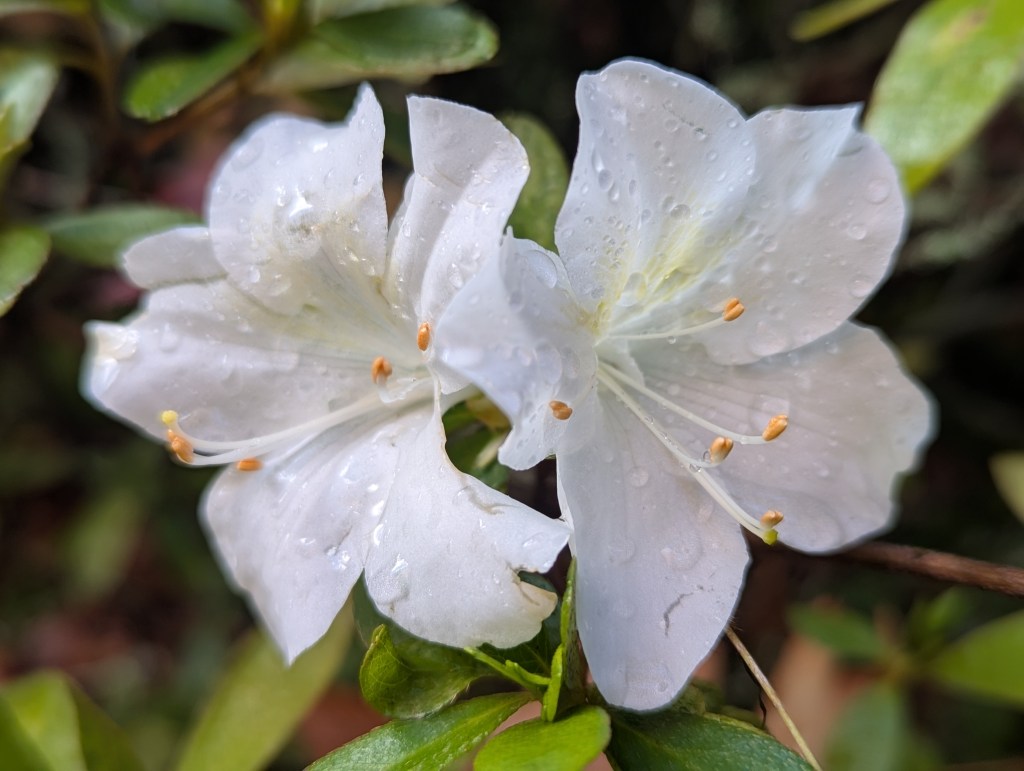
The unseasonably relocated roses that I had been so concerned about for the past month or so continue to surprise with more growth and bloom. So do a few other species. These first three happen to be from Tangly Cottage Gardening. The following two happen to be white. The last happens to not be of horticultural orientation.

1. Canna ‘Stuttgart’, along with a few other fancy potted Canna, unfortunately needed to be relocated from the deck that they inhabited at work. However, it seems to be happier after relocation, and makes larger and more ornate leaves, which is what it is grown for.

2. Persicaria amplexicaulis ‘Firetail’ bloomed lightly but on time for early summer, and then bloomed again before the original bloom faded completely. The secondary bloom is only now fading, with a backdrop of duckweed and watercress. (This is an older picture.)

3. Hesperantha coccinea, crimson river lily was not expected to bloom because it was so dinky when it arrived late last winter. I thought that its bulbs would need to mature for a year or so before they would be mature enough to bloom. Apparently, it wastes no time.

4. Albizia julibrissin, silk tree blooms white instead of pink, although, because it blooms on top of its high canopy, not much of it is visible from the ground. It finished blooming already, but some minor pruning recently revealed a few of these aberrant white flowers.

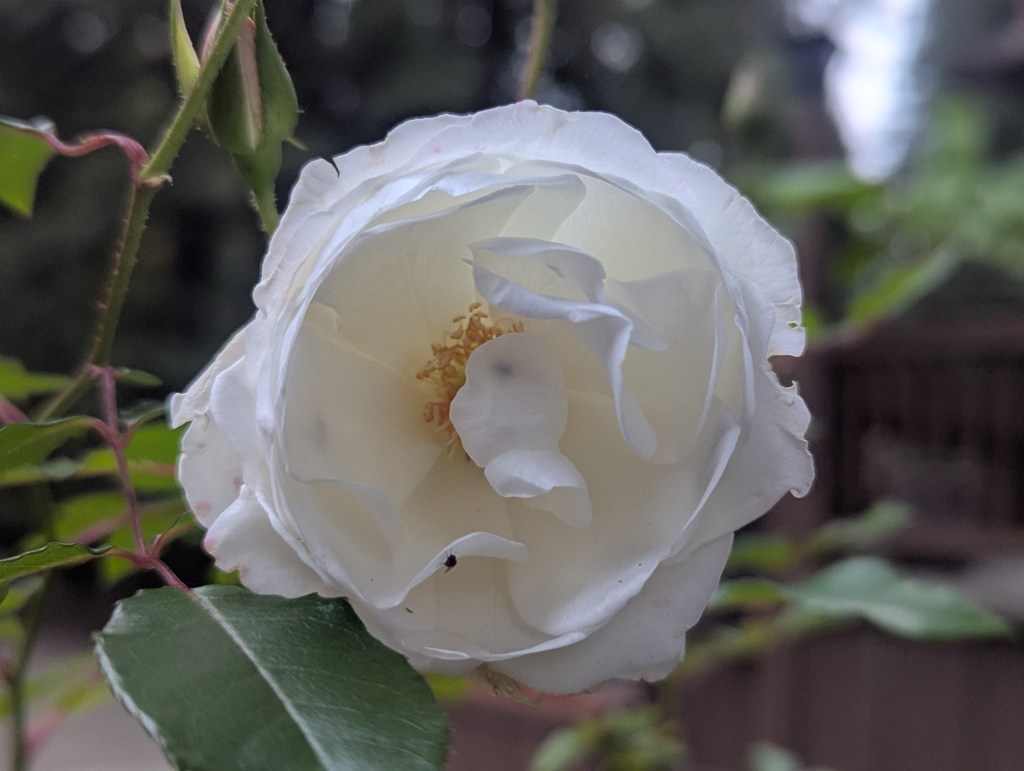
5. Rosa spp., rose is another of the few roses that were not expected to bloom after their unseasonable relocation. It seems to be a climbing type, with long and limber stems, and trusses of small flowers. I am impressed that it not only survived, but is growing so well.

6. Heather fails to be as impressed by these developments that I find to be so surprising.

This is the link for Six on Saturday, for anyone else who would like to participate: https://thepropagatorblog.wordpress.com/2017/09/18/six-on-saturday-a-participant-guide/

Mexican Fan Palm

Mexican fan palm is also known as the skyduster palm.

It does not take long for Mexican fan palm, Washingtonia robusta, to get too big for most of the spaces it so often self sows its abundant seed into. The attractive lush foliage looks innocent enough, although the long petioles (leaf stalks) have nasty teeth. As trees get tall enough to get out of the way, they also get too big to manage, eventually reaching a hundred feet tall on elegantly curving trunks. No matter how tall they get though, their canopies always stay about eight feet wide. The problem is that the maintenance of such tall and aggressive trees can be costly.

Beards of old leaves can be allowed to accumulate on the trunks, but are combustible and can get infested with rats. Old leaves are more often pruned off, leaving a distinctive pattern of petiole bases. Old leaves can alternatively be ‘shaven’ to expose elegant bare trunks.

Cane Berries

Cane berries are certainly not ‘low maintenance’.

Given the opportunity, blackberry and raspberry canes become rampant thickets. The trick is to keep them contained and controlled so that they can produce berries without conquering the garden. Besides, proper pruning promotes production. Properly maintained canes are therefore both better behaved and more productive.

Berry canes are certainly not low maintenance, and should be selectively pruned a few times through the year. The type of pruning needed is determined by the type of growth that the canes exhibit in particular seasons. Spent canes or upper portions of everbearing raspberry canes that produced berries through summer and early autumn will need to be removed by the end of winter while new canes that grew through this year get trained to replace them.

Pruning and thinning of new canes should be delayed until the end of winter; but removal or pruning of spent canes can begin as soon as their fruit gets depleted. Spent canes of traditional summer bearing raspberries like ‘Willamette’, ‘Tulameen’ and ‘Canby’ can be pruned to the ground. ‘September’, ‘Heritage’, ‘Summit’, ‘Fallgold’ and other everbearing raspberry canes should be pruned only as low as their fruit was produced. Lower portions that did not produce fruit should be left to bloom and produce berries next spring.

Just like raspberry canes, new blackberry canes that grew this year do not need to be pruned until late winter. However, the canes that grew last year and are finishing berry production this year can be pruned to the ground as their last berries get taken. There is no rush for this procedure, but getting it done early makes later pruning of new canes for next year a bit easier.

Of course, every different cultivar (cultivated variety) of raspberry and blackberry behaves differently. Some finish producing and are ready to be pruned sooner than others. Their behavior is also affected by climate and environmental conditions, so that the same variety may be earlier or later in different areas, or even different parts of the same garden.

Favorite berry canes are very easy to propagate by division of superfluous new shoots during winter. Alternatively, spent canes that should be removed can be ‘layered’ instead. They simply need to be bent down and partially buried, and can be dug and separated as they develop roots.

The top few inches of cane should extend above the soil. At least a few inches of cane below the top should be buried a few inches below the surface of the soil. The length of cane between the buried portion and the base of the parent plant can remain exposed.

Layering can be done at any time of year if the layer (buried section of cane) gets watered while developing roots. Layering this time of year is easiest though, because layers get plenty of water from rain through winter, and develop roots most efficiently as they come out of dormancy late in winter or early in spring. If layers are buried where new plants are desired, they do not need to be dug and moved next year.

Alaska

Just about everything in my garden has history in someone else’s garden. Almost nothing came from a nursery. I like to say that purchases are against the rules. However, I did purchase ‘Alaska’ Canna from Horn Canna Farm because I want to grow a white canna. I am over the shame already, and am very fond of this first white canna that I have seen since I was very young. As you can see, it is not very white, and is more of a creamy white or vanilla white. Actually, it is very pale yellow. It is presently growing as a houseplant in one of the buildings at work, which might have enhanced the pale yellow color of its bloom. I believe that it would have been whiter out in the weather. It is already growing quite nicely, so will need to move out into a landscape with all the other Canna for next year. I doubt that it will be as popular as the other brightly colored Canna, but a few who see it in bloom might recognize how rare creamy white Canna are now. I think that ‘Alaska’ would contrast splendidly with the dark bronze foliage of ‘Australia’.