Horticulturists are by nature, nonconforming. I happen to find it difficult to conform to what makes us nonconforming. Trends are fleeting. Old technology that has worked for decades or centuries is still best. Although I am not totally against chemicals, I find that almost all are unnecessary for responsible home gardening. Pruning is underappreciated, and fixes many problems.
Bloom continues as long as warm weather continues. Within warm exposures within the mildest of climates, it does not stop for long. Within cooler climates, Lantana camara may already be decelerating its bloom. Although remarkably resilient to arid warmth, it can be vulnerable to frost farther inland. Once established, lantana does not require much water.
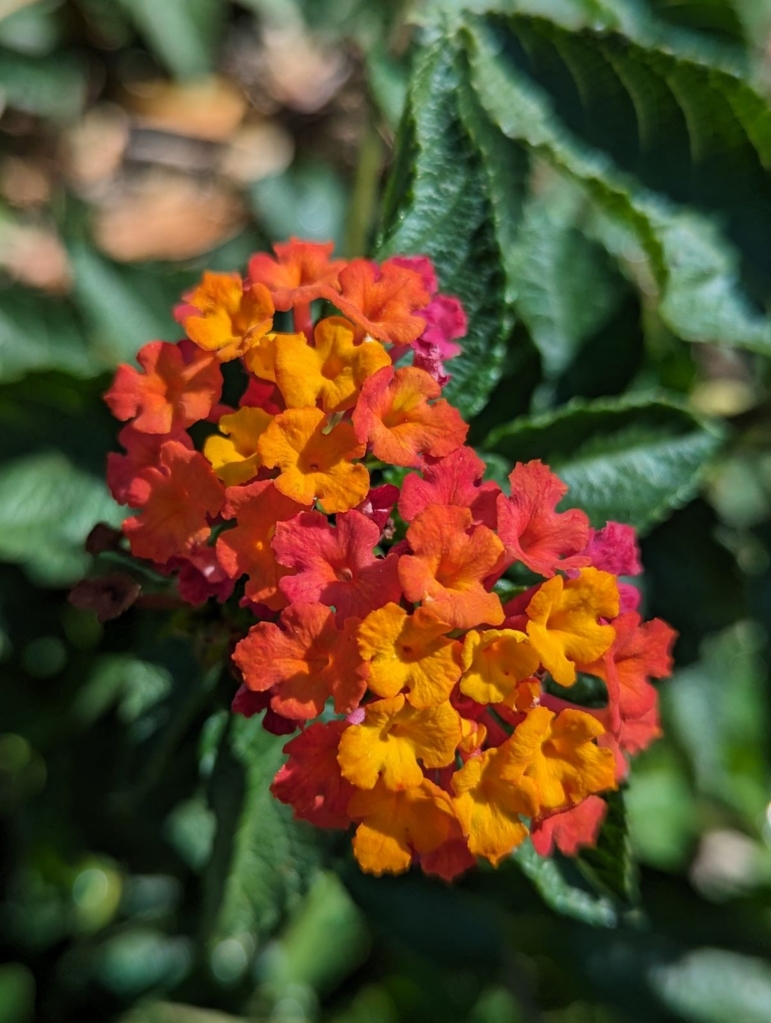
Umbels of several tiny tubular flowers are about an inch and half wide. Individual flowers bloom progressively inward from the edges of their umbels. They are typically yellow, but then fade to orange, red or pink. Blooms therefore develop yellow centers within orange, red or pink edges. One cultivar is uniformly bright yellow. Another fades to creamy white.
Old fashioned lantana can eventually grow six feet tall. Congested old specimens might respond favorably to coppicing after winter. After coppicing, new growth can grow six feet high within its first season. Modern cultivars are generally shorter and relatively compact, and a few sprawl. Their very slightly raspy foliage is pungently aromatic when disturbed.
After their invention in ancient Rome, window boxes became overly prevalent in Venice. They contained herbs and vegetables where space was limited within such urban areas. Their produce was close to kitchens, and more visually appealing than nearby buildings. Several window box herbs produced aromatic foliage for more than culinary application.
The popularity of window boxes preceded the availability of affordable window screens. Mosquitoes were a nuisance within the swampy ecosystems around Venice prior to that. Therefore, besides their obvious usages, window boxes also sustained aromatic foliage. Such foliage, which was mostly also culinary herbs, repelled some troublesome insects.
Just as flowers attract pollinators with fragrance, some foliage repels insects with aroma. Some aromatic foliage intends to repel other large consumers, such as rodents and deer. Any potential consumers know that flavor is likely as objectionable as associated aroma. Ironically, some flavors or aromas that are unappealing to them are appealing to people.
Culinary herbs are perfect examples. Their strongly flavorful and aromatic foliage is quite repellent to insects and wildlife. However, it is an asset both for culinary and horticultural application. Some such herbs have cultivars for either culinary or landscape application. Trailing rosemary is a groundcover that has slightly milder flavor than culinary rosemary.
Several cultivars of lavender are popular for home gardens even if not for home kitchens. Their aromatic foliage is as delightful as their foliar color and bloom. The foliar texture of fennel is as striking as its foliar aroma. Thyme is both an herb and an aromatic, although irregular, ground cover. Mint and oregano are a bit more casual, but likely more aromatic.
Some of the most popular aromatic foliage has no culinary application, though. Its aroma more than justifies its cultivation. Scented geraniums and sages are remarkably diverse. Although most are quite pretty, a few are simply very aromatic. Most aromatic foliage can not disperse its aroma like floral fragrances. It requires some sort of disturbance to do so. Warmth with humidity enhance typical foliar aroma.
Prior to the identification of Hibbertia scandens last week, another mystery arrived. I probably should have mentioned it earlier, but as with the previous mystery, I thought that I would have identified it before I felt compelled to mention it here. Unlike the previous mystery though, I did not recognize it as something that I had encountered in the past.
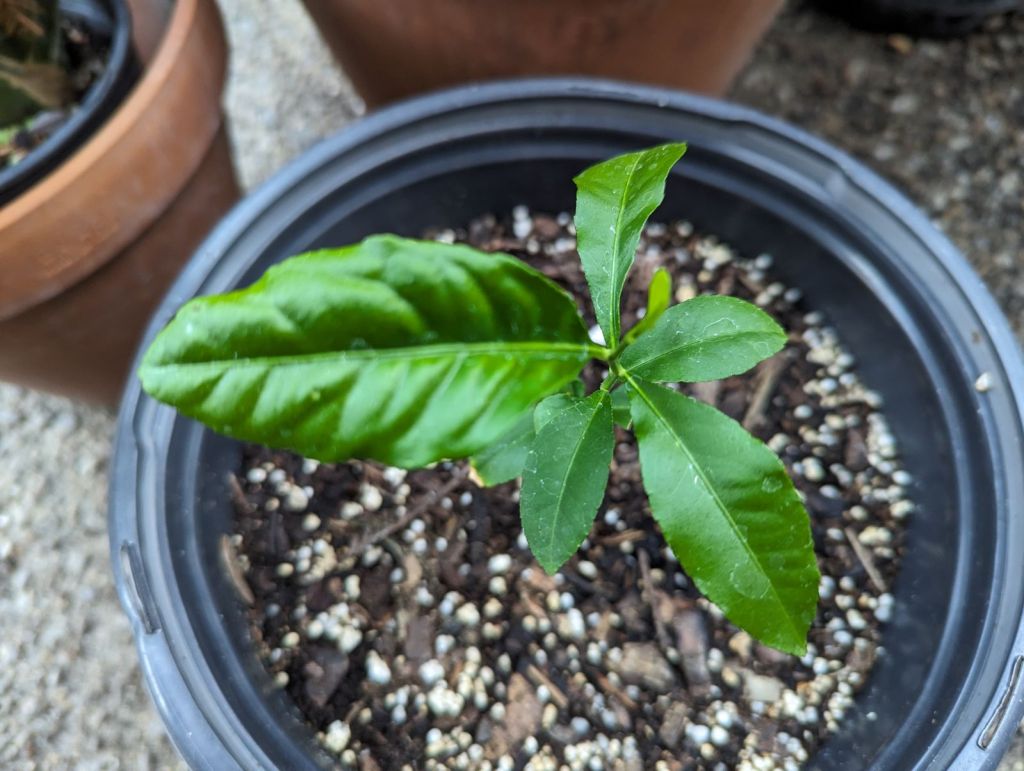
Someone with whom I work, who is not so horticulturally oriented, brought it from one of the homes that he was working at. It had been left by a former tenant. Initially, I thought that it was merely a can of otherwise unused media in which a common bay laurel seed had germinated. However, it is not a bay laurel seedling. Also, contrary to how it appears in the picture, it is remarkably centered within the can, as if intentionally plugged there.
Initially, I thought that it resembled coffee, Coffea arabica. However, coffee exhibits opposite leaf arrangement, and these leaves are alternately arranged. Besides, viable unroasted coffee seed is not exactly common. Now, I sort of suspect that it could be lychee, Litchi chinensis. Although uncommon, seeded lychee fruit are not as rare as unroasted coffee. Although their leaves are so closely paired among mature specimens that they seem to be oppositely arranged, they are technically alternately arranged, and more obviously so among juvenile growth. If this is lychee, it will not produce identifying bloom for a few years.
Realistically, immediate identification of this seedling is unimportant. I could have put less effort into discarding it than I put into writing about it. Therefore, I will merely give it what it needs until it grows enough for identification. I will not mind discarding it if I identify it as something that is useless. Otherwise, I can find it a home.
It is certainly no pear, and its particular cultivar is not overly prickly. Nonetheless, it is commonly known as ‘prickly pear’. It is also known as ‘Indian fig’, but is neither a fig, nor from India. The Mexican Spanish name for its fruit is ‘tuna’, but in American English, that seems fishy.
However, within its proper linguistic context, ‘tuna’ would be the least misleading of the common names of the fruit of ‘nopal’. ‘Nopal’ is the common name of various species of Opuntia, many of which are popularly grown as vegetables. ‘Nopales’ are plural. ‘Nopalitos’ are sliced or otherwise processed as small bits for culinary application.
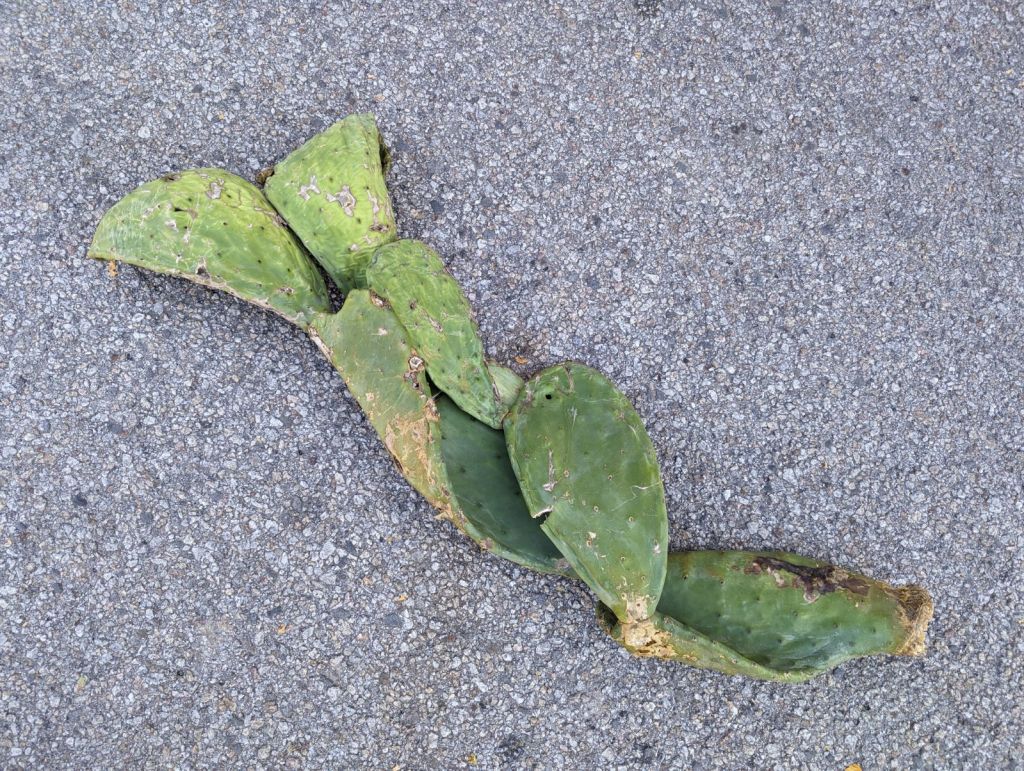
Anyway, this shabby bit of nopal appeared within our big greenwaste pile at work. I find it annoying when neighbors exploit our greenwaste pile for disposal of greenwaste that is obviously not from our landscapes, as if I will not notice. Such debris often includes dirt and other crud or even trash that can not be chipped, and is almost never staged to facilitate efficient chipping.
This was quite a find though. It can be cut into six separate pieces to be plugged in between the five Arizona cypress that I installed as an informal hedge along the outer road. I would not have considered doing so if this had not appeared unwanted on our greenwaste pile. Nopal that I plugged a bit farther out, closer to the road, were shredded by weed whackers on a few occasions until they ultimately succumbed.
I already grow one unidentified cultivar of nopal for its eventual production of rich red tuna. I have no idea what this new acquisition is either, and it could be the same as what is already here, but I sort of hope that it produces yellow or gold tuna with milder flavor.
Indian summer is now doing what it does every few years or so. It was more than ninety degrees for a second day here yesterday, and was even warmer in the Santa Clara Valley. As typical, it happened after cooling weather already started to feel like autumn. It is not a good time to relocate vegetation, which I started to do while the weather was still cool. Also, I must briefly increase irrigation. Not all of these Six are relevant to the weather or any particular theme. Actually, half are irrelevant. The last is open to interpretation. It is not a good picture, but is likely the best.
1. Water from the spigot occasionally gets slightly colorful here. Water from the streams and creek is clearer. It is a consequence of hydrant flushing. It is harmless for irrigation.
2. Unidentified ferns needed to be removed from where an old fence was replaced. I can not simply discard them. I buried them elsewhere so that they can regenerate next year.
3. Unidentified spirea was also in the way. Of course, although I do not expect much of it to survive, I relocated it also. I typically cut this spirea back to the ground during winter.
4. Marah macrocarpa, wild cucumber develops huge tubers that can weigh more than I do. This one is merely about a foot and a half long, so is relatively small, but now what?!
5. Portulaca grandiflora, moss rose is not mine, is not here, and did not give me a good picture. Nevertheless, I feel obligated to share at least some summery floral color today.
6. Rhody did not cooperate for this picture either. I can not explain how he so efficiently hid behind only one yawn. As bad as this picture is, it just might be the best of these Six.
Canary Island date palm is the boldest of the common palms here.
The biggest and boldest of the common palms is the Canary Island date palm, Phoenix canariensis, which can get more than sixty feet tall and nearly forty feet wide, with a full canopy of gracefully arching deep green fronds. A young tree actually spends the first many years as a shrubby plant while the base of the trunk develops. Fronds get longer and spread broader every year until the trunk gets big enough to elongate. Vertical growth then accelerates somewhat, but the canopy gets no broader.
Most trees are female, eventually producing ornately orange but messy clusters of inedible dates. Male trees eventually get a bit taller, but are not quite as graceful and bloom with unimpressive dusty tan flowers.
Old deteriorating fronds need to be pruned away close to the trunk. Petiole bases of the most recently removed fronds are often carved into ‘pineapples’ to leave a bit of support directly below the canopy. Removed fronds leave a distinctive pattern on the trunk.
Mexican fan palm might still be the most common palm here, but is not native.
Only a few of the many different palms that can be grown locally are actually common. The Canary island date palm and the Mexican fan palm, which had historically been the most common palms, have unfortunately given palms a bad reputation. Both get too large for small gardens, and need costly maintenance when they grow out of reach.
Since the late 1980s, the formerly uncommon queen palm has become the most common palm. Although it too eventually grows beyond reach, it is still more proportionate to home gardens while young. It has a relatively narrow trunk that is partially ‘self-cleaning’ (which means that old fronds, or leaves, often fall off or can be easily peeled off).
The windmill palm and the Mediterranean fan palm, although no more common now than a century ago, are two of the better palms for home gardens, since they do not get too large, and are somewhat easy to maintain. The Mediterranean fan palm has several sculptural trunks that curve out randomly from the base. Sharp teeth on their petioles make pruning a challenge, but not impossible.
The windmill palm has a straight solitary trunk that is distinctively hairy where old fronds get pruned away. It eventually grows out of reach, but takes many years to do so. By that time, many people allow beards of old fronds to accumulate on the trunks overhead instead of bothering to keep them pruned.
The desert fan palm, which is the only palm that is native to California, is very similar to the Mexican fan palm, but is about twice as stout and half as tall, with a fluffier canopy. Because it grows slower and stays smaller, it would be a better palm for urban gardens, except that it does not like to be watered regularly when mature. It really prefers warmer and drier climates.
Pindo palm and Mexican blue palm would also be great palms for urban gardens, but grow rather slowly before getting big enough to get noticed. In some climates, pindo palm produces strange and messy, but sweet and tasty fruit. Mexican blue palm is one of the most resilient palms, and blooms with really cool long floral tassels that a can drag on the ground from short trees.
‘Feather’ palms, like Canary Island date palm, queen palm and pindo palm, have pinnate (and generally compound) leaves, with small leaflets arranged on solitary midribs. Their fronds must be removed as they deteriorate.
‘Fan’ palms, like Mexican fan palm, Desert fan palm and windmill palm, have palmate leaves, centered around the distal termini of solitary petioles. These are most often pruned away, leaving distinctive patterns of petiole bases, but can alternatively be left to accumulate into thick beards of thatch.
Mexican fan palms are sometimes ‘shaven’ of their petiole bases to expose elegant lean trunks, although the procedure is intensive and expensive. Desert fan palms and some Mexican fan palms drop their own beards naturally.
Even after mentioning several times that I must discontinue blogging and reblogging, I feel terribly guilty about not posting anything for today. However, for the second time, there is nothing more than a few of the most recent articles to reblog, and nothing new to post. So, here is one of the recent articles. (If this sounds familiar, it is because this is the second time. Yes, I copied and pasted, and changed ‘second’ for ‘first’.)
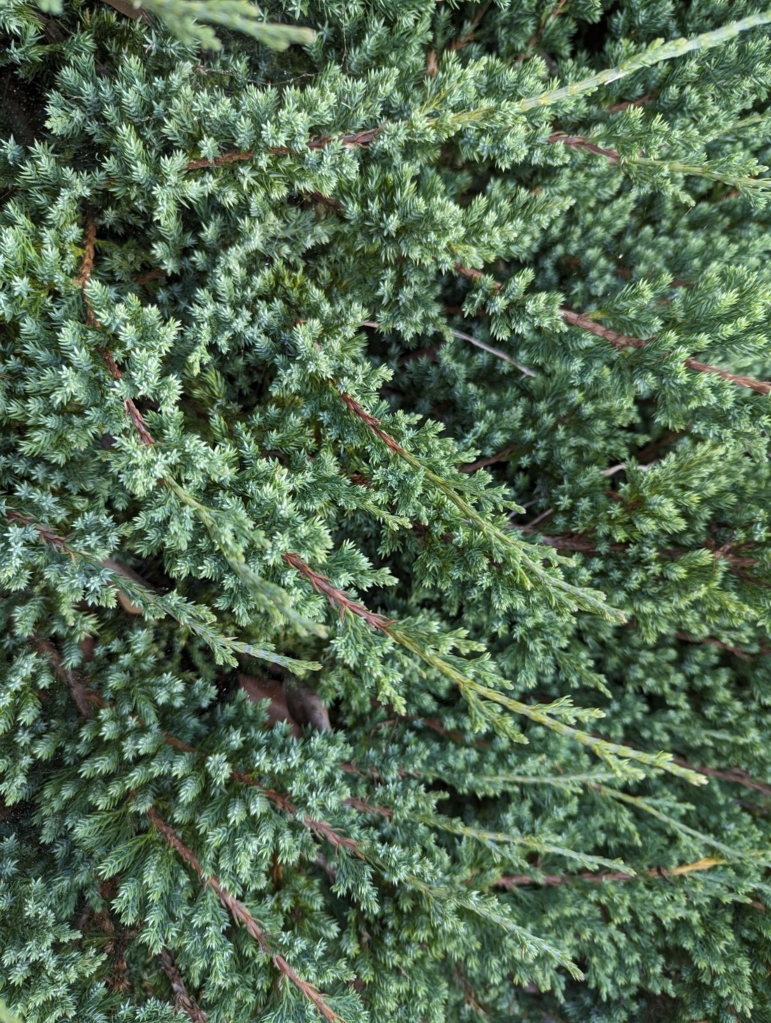
With adequate time, this prostrate juniper slowly evolves from ground cover to shrubbery. Japanese garden juniper, Juniperus procumbens, can sprawl more than ten feet. Without obstruction, it might do so without getting higher than a foot. It grows higher as it depletes space to expand, or reaches its maximum width. It may eventually grow a few feet deep.
The evergreen foliage of Japanese garden juniper is elegantly grayish or bluish green. It contrasts splendidly with deep green junipers or other rich green foliage. The tiny leaves display a visually fine texture, but are actually rigid and prickly. New stems are short and somewhat pointy until they widen with new foliage. Foliar density excludes most weeds.
Like most junipers, Japanese garden juniper is challenging to prune. Because foliage is so dense, it does not extend far below its outer surface. Consequently, there is not much growth to prune back to. Exposed inner stems are unlikely to foliate efficiently. Shearing, although effective, temporarily compromises natural form. Frequent light pruning is best. ‘Nana’ is the more compact cultivar.
Home gardens are components of the homes that they serve. They are the exterior of the interior. They are the environments in which homes exist. Some provide vegetables and fruits. Many provide flowers. Ideally, gardens enhance domestic experiences. Therefore, their design is as relevant as architecture. Accordingly, horticultural form follows function.
Gardens can be single open spaces or, like their associated homes, a few spaces. They benefit from features that function like those that define interior spaces. Lawns are floors. Trees are ceilings. Hedges and shrubbery are walls. Patios, decks and fences are static features. Vegetation, though, requires more discriminating selection for appropriate form.
Lawns seem to be the simplest of such functional vegetation to select. Form is not overly variable. Nevertheless, turf grass must be appropriate to its particular exposure. Some is more tolerant of partial shade than others. Some requires less water than others. Ground cover vegetation is more appropriate for many situations. Artificial turf might be an option.
Trees and shrubbery are much more diverse. Although they are the largest vegetation of a garden, some are quite small. They are evergreen or deciduous, and both have distinct advantages. While palms lack branches, other trees and shrubs develop sculptural form. Consequences for inappropriate selection of such significant vegetation can be serious.
Furthermore, different varieties of the same species can behave very differently. Junipers are practical shrubbery for some situations. However, some are prostrate ground covers. A few grow as small trees. Also, while some rosemaries are shrubbery, some are trailing. Selection of an inappropriate cultivar of an appropriate species is a rather common error.
A few species change form as they mature. With confinement, the trailing juvenile form of English ivy is a practical ground cover. However, as it encounters support, it becomes its vining adult form. This clinging growth ruins paint, and overwhelms trees and shrubbery. Star jasmine evolves from ground cover to twining vines even without changing its form.




 Tony Tomeo