Out of Tune Trumpet

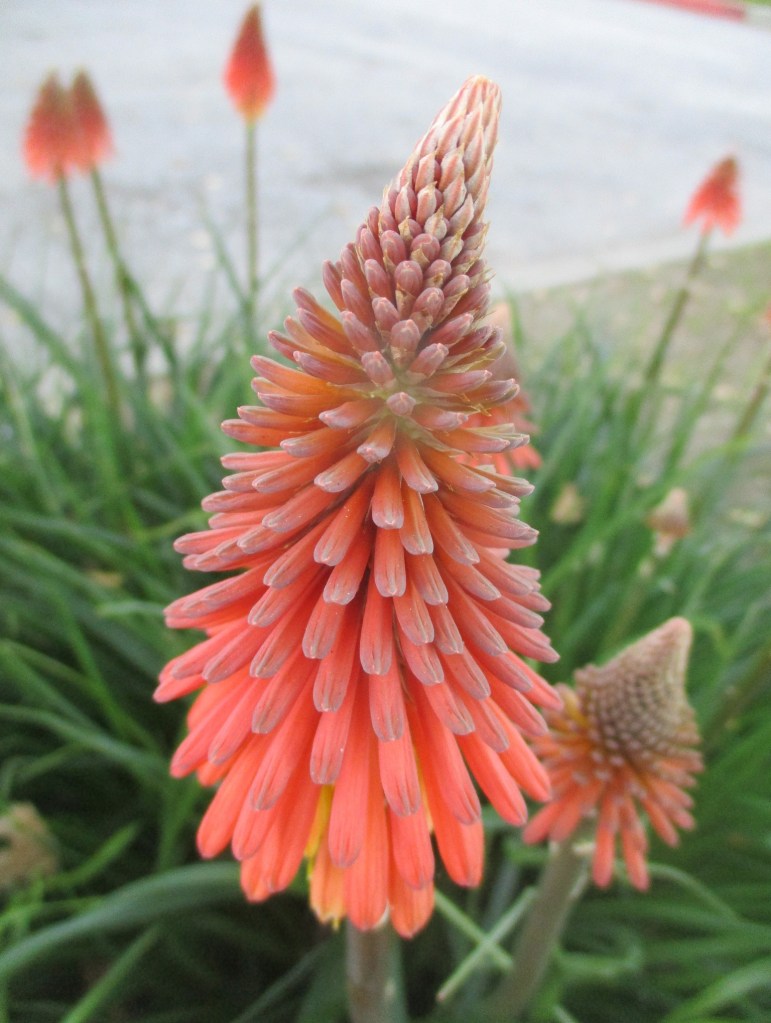
Brugmansia X cubensis ‘Charles Grimaldi’

Summer was mild. Vegetation that enjoys warmth grew relatively slowly through much of it. Then, toward late summer, and without increased warmth, some vegetation seemed to accelerate growth unexpectedly. Banana and heliconia pups grew like they should have earlier in summer. Angel’s trumpet cuttings began to get somewhat weedy. Some that did not bloom earlier began to bloom now!

Brugmansia X cubensis ‘Charles Grimaldi’ is likely the most popular angel’s trumpet. It is the most vigorous, and may be the most fragrant. One cutting that survived the unusually cool frost last winter grew from its roots to more than six feet tall since then. Now that it is time for it to decelerate growth, it is blooming! Such performance is impressive, but not in tune with the seasons. It can not continue for long, before disruption by increasingly cool autumn weather. Unusually vigorous growth that continues to bloom unusually late could be unusually vulnerable to frost next winter.

This is not the only angel’s trumpet that is out of tune with its seasons. A similarly mature specimen of an unidentified cultivar with single white flowers is about to bloom also. Two older specimens of other unidentified cultivars are growing about as vigorously, although without bloom. One blooms with double white flowers. The other blooms with single pale orange flowers.

About nine copies of each of both cultivars that bloom with white flowers are growing like weeds in #1 cans, with more than a dozen more small cuttings of the cultivar that blooms with double flowers in cells. Only the original matured specimen that blooms with double white flowers actually inhabits a landscape, and is incidentally about to bloom, but is not here with these in the nursery. More will go to landscapes after winter, where their bloom can be enjoyed.
What Is This?! II – Hibbertia scandens (sequel from last Saturday)

Hibbertia scandens, Guinea flower

Obviously, it is not cup of gold vine, Carolina jessamine, yellow jasmine, yellow trumpet vine, yellow orchid vine, yellow black eyed Susan vine or any of the vines with yellow flowers that Google suggested as its identity. It is more than obviously not lotus, which incidentally blooms with orange flowers rather than yellow, but was somehow, according to Google, a candidate for vines with yellow flowers. It is amazing what can and can not be found on Google.

Brent recognized this vine just like I did, but also like me, could not remember its identity. We had not seen much of it in many years, but could remember that it was somewhat common in coastal regions while we were in school during the late 1980s. It lived at a doughnut shop that we sometimes went to in Morro Bay, and seemed to smell as if a tom cat had marked his territory on it. I can remember it within old gardens of Carmel and Monterey, as well as Santa Cruz, where I found these cuttings. I also remember encountering it while inspecting median landscapes of some of the major roads of Morgan Hill in the late 2000s, and that it did not perform as well within the somewhat inland climate there. Brent observed that specimens in Santa Monica and Beverly Hills seemed to express the same preference for the more coastal climate of Santa Monica.

Now that I got it, I have no idea of what to do with it. I suppose that, without mentioning the faint but potentially slightly objectionable floral fragrance, I can convince neighbors that they want it in their gardens. Some of our landscapes are big enough for it to be pretty at a distance. At least I know what it is, Guinea flower, Hibbertia scandens.

Six on Saturday: Autumn in the Redwoods

Autumn is not much to brag about here. Not only is the change of the weather mild, but foliar color is limited beyond synthetic landscapes. Redwoods are only a bit messier now because they did not shed as much as typical while summer weather remained atypically mild. Fireplaces at work get a bit more use, but only for ambience. A few autumn flowers bloom between summer flowers and winter flowers.

1. Sequoia sempervirens, coastal redwood is evergreen. Its foliage does not turn colorful for autumn. It certainly sheds though. It sheds mostly while the weather is warmest and driest through summer. However, without such weather, it sheds more as summer ends.

2. Firewood is too mixed for identification of all species that might be involved with this picture. It comes from the various trees that must be removed and pruned here. Because fires at work are more for ambience than heat, the quality of such wood is unimportant.

3. Anemone hupehensis var. japonica, Japanese anemone exhibits why I find ‘Honorine Jobert’ to be so appealing. This is the only anemone here, and it is ghastly pallid, neither pure white nor pinkish. It actually seems to be slightly grayish. Ick! I learned this species as simply Anemone japonica, but now learn that it is supposedly Eriocapitella japonica.

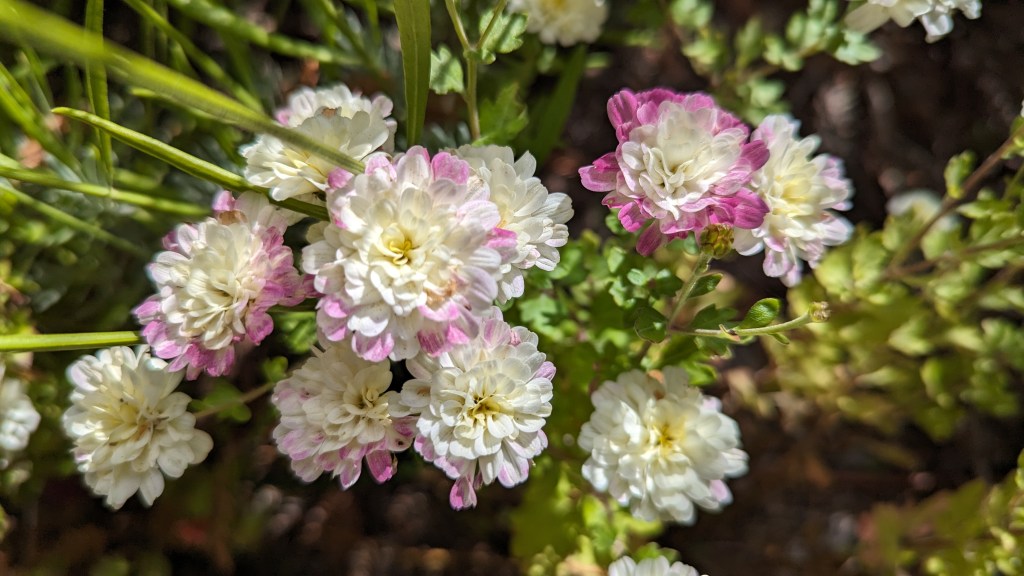
4. Chrysanthemum X morifolium, is more discolored than anemone, but is instead quite pretty. It was likely white when left here after a wedding. It now lives in a garden nearby.

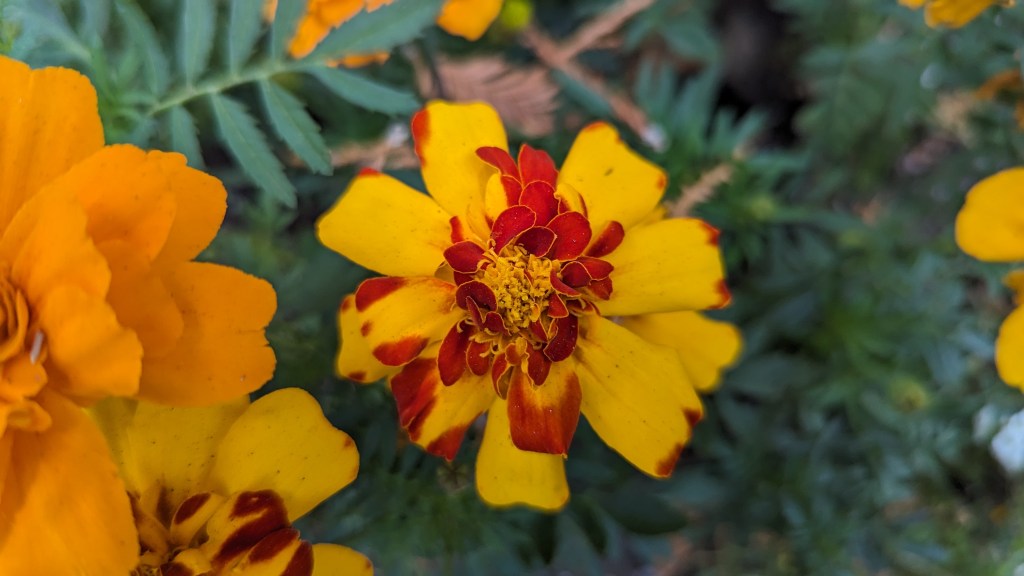
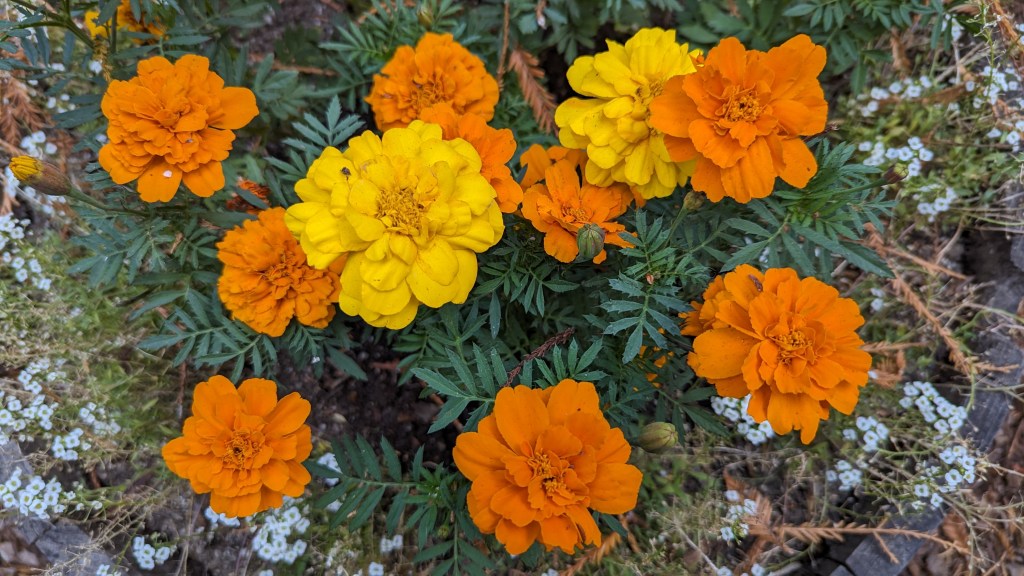
5. Tagetes patula, marigold is as customary for autumn as chrysanthemum is. Its bright yellow and orange are splendid. This one though looks too much like Ronald McDonald.

6. Tagetes patula, marigold should look more like these. Brownish red is traditional too. Marigold is the official flower of Dia de los Muertos of the first and second of November.

This is the link for Six on Saturday, for anyone else who would like to participate: https://thepropagatorblog.wordpress.com/2017/09/18/six-on-saturday-a-participant-guide/

Pecan

It is ‘PEEkan, not ‘piKAHN’!

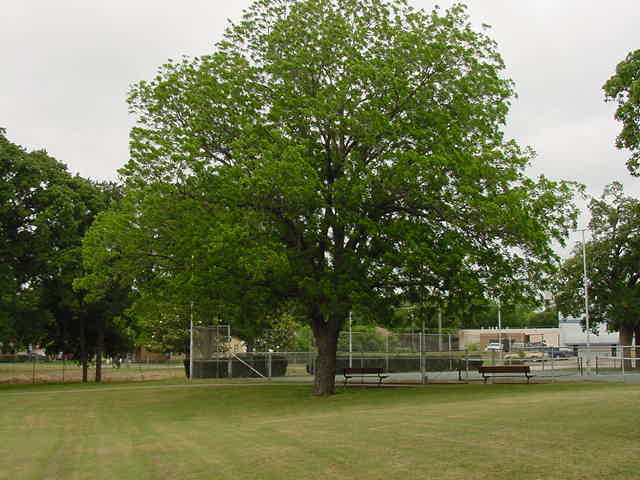
Texas selected a distinctive state tree; the pecan, Carya illinoensis. It is happy in the south and middle mid-west, where naturally grows about seventy feet tall. It can get almost as large here, so is best in big spaces. Summers are a bit too mild for reliable nut production in autumn, but single trees can sometimes make plenty. Two different trees (to pollinate each other) can actually be quite productive, although not quite as well flavored as in warmer climates. The pinnately compound leaves have about eleven individual leaflets that are about five or six inches long. Shade is not too dark.

Firewood Season Begins Before Fireplace Season

Despite the pleasant warm weather, it will be autumn soon. This is the time to get ready for cooler weather through autumn and winter. The plants in the garden do that on their own without our help. They somehow seem to know what time it is. We only need to clean up the mess and empty the gutters when deciduous trees start to drop their leaves later. Most of our work involves features that are not plants.

Winters are so mild here that some of our work often gets delayed until it becomes necessary. If needed, we can paint, stain and seal decks, fences, patios and anything else outside anytime the weather allows right through winter. Many of us leave patio furniture outside all year both because the weather is not too harsh on it, and because patios are usable spaces even through winter.

Firewood is also commonly neglected or not even needed, but for different reasons. Many fireplaces were damaged or destroyed by the Loma Prieta Earthquake decades ago, and never repaired or replaced. Modern building codes outlawed the construction of new fireplaces even prior to that; so newer fireplaces are instead pellet stoves. Those of us who still use old fireplaces and stoves have more difficulty obtaining wood now that the orchards are gone and the outskirts of town are so much farther from home.

The advantage of pellet stoves is that fuel (which looks like stove food) is always available so does not need to be accumulated, stored and seasoned. The fuel also burns cleaner. Synthetic logs (made from compressed wood byproducts and fuel) are an expensive alternative for conventional fireplaces and stoves, but also burn cleaner than wood, and are always available. They are lightweight and clean, so can be picked up at the store and brought home in the trunk of a small car whenever a fire is wanted in the fireplace.

Good old fashioned firewood is both more work and stigmatized because of pollution. Those of us who do not have firewood available within our own gardens can purchase it from some tree service companies. It is most commonly obtained already split and seasoned directly from the wood yard where the tree service company stores it. It can be delivered for a price. Some people even like to pay a bit extra to get it  stacked.

Firewood obtained in this manner is typically a mix of random woods from trees found in local landscapes. There is often a preponderance of a particular type of wood. No one ever knows what to expect. The specific type of wood is designated only when a large tree or group of trees needs to be removed, and can be isolated from mixed wood.
Palms and yuccas, known as ‘herbaceous trees’, do not produce effective firewood! A few pieces in a load of firewood should not hurt anything, but palm or yucca ‘wood’ should not be purchased. Mixed wood often contains some resinous wood and eucalyptus, which burns just fine, but produces a bit more soot that needs to be cleaned from chimneys.

Firewood should be obtained annually in quantities that are likely to be used each winter. It is perishable, and can rot if stored several years outside. Even if it does not rot, it can become infested with rodents if it stays idle too long. Besides, excessive firewood simply takes up space that could be used for something else.

Horridculture – Inappropriateness

Vines and annuals are not shrubbery and ground cover.

Vegetation within a planned landscape should serve a purpose. The form of such vegetation should be appropriate to such purpose. Trees provide shade. Shrubbery defines space and obscures undesirable scenery. Vines climb fences and other infrastructure. Annual bedding plants provide more seasonal color than most other vegetation. Turf grows into useful lawns. It is helpful to plan accordingly for a landscape.

Turf can not do much more than become useful lawn. It can not provide shade, obscure undesirable scenery, climb fences or provide more seasonal color than green. Nor can trees, shrubbery or vines become useful lawn. Again, each form of vegetation should be appropriate to its particular application.

Trellised rocktrumpet is not shrubbery. Rose periwinkle is not permanent ground cover.

There is so much other vegetation that would have been appropriate to this particular situation. Star jasmine, trailing lantana, trailing rosemary or even the dreaded English ivy would have been better and more permanent ground cover. Dwarf oleander, barberry, arborvitae or even dwarf New Zealand tea tree would have been better shrubbery.

Rose periwinkle is an annual bedding plant. Although it is somewhat pretty now, it will not likely survive through winter. Even if it does, it will not migrate far enough to reliably function as a ground cover.

Trellised rocktrumpet is a small but vigorous vine that will always be reliant on trellises for support. As its cheap trellises decay and deteriorate, it will eventually develop into shabby mounds of tangled vine stems, but will never be able to support itself as high as the new trellises are now. It can reach out to cover some of the ground that will be vacated by the rose periwinkle, but can not reliably function as a ground cover for this much area. It will bloom less if shorn for neatness.

Oleander

Most oleander blooms with single flowers.

Since their development, freeways had been prettier with oleander, Nerium oleander. No other comparably resilient and undemanding shrubbery is as colorful. Harsh exposure of medians and interchanges was no problem. Oleander became less common through the 1990s only because of oleander scorch. Big contiguous colonies were most susceptible.

Oleander is as resilient as it has always been. It is less susceptible to oleander scorch if remote from other specimens. It performs best if it can grow wild without pruning. Pruning is not actually harmful, but can disrupt bloom. Frequent shearing eliminates most bloom. However, with pruning to remove lower growth, big shrubs can become nice small trees.

Bloom is white, pink or red. Pink ranges through bright cherry pink to pastel peachy pink. Pale yellow remains quite rare. Single flowers are most common. Double flowers are not rare though. A few cultivars provide mildly fragrant bloom, but also generate seed. Large oleander can grow as tall as fifteen feet. Dwarf cultivars may stay shorter than three feet. Oleander leaves resemble those of native bay laurel. All parts of oleander are notoriously poisonous.

Autumn Bloom Is Remarkably Natural

Some bloom adapts to regional climate.

Most flowers bloom during spring. That seems to be most practical. It maximizes the time for their seed to develop prior to the following winter. It conforms to the schedules of their naturally preferred pollinators. Bloom is less likely to succumb to weather through spring. Deviancy is natural though. Many functional flowers quite naturally prefer autumn bloom.

Deviancy, of course, is as complicated as it is natural. Autumn bloom occurs for a variety of reasons among a variety of species. Many can be delightful assets for home gardens. They provide more options for floral color than the most popular of cool season annuals. Some autumn bloom continues as autumn foliar color develops, and perhaps into winter.

Many flowers bloom randomly as warm weather allows them to do so. They may seem to bloom almost continually here. Cool weather may disrupt their bloom only during winter. As weather fluctuates, bloom might resume before a previously disrupted bloom finishes. African daisies provide autumn bloom because autumn is too mild to disrupt their bloom.

Technically, such flowers do not necessarily prefer to bloom during autumn. They merely bloom whenever they can. Most actually bloom most profusely during spring or summer. Canna produces summer and autumn bloom, as it regenerates from its winter dormancy. Otherwise, within frostless tropical climates, it blooms continuously. It is quite adaptable.

Some flowers that are actually more responsive to seasons simply prefer autumn bloom. Joe Pye weed and goldenrod grow only vegetatively through spring and earlier summer. They only begin to bloom about now. Perhaps their seed prefer to grow through cool and damp winter weather. Their seedlings may be vulnerable to desiccating summer warmth.

Naked lady is more extreme. It maintains dormancy through most of summer to bloom as summer ends. Then it grows through winter until spring warmth initiates dormancy again. It seems to believe that it still inhabits its native range within South Africa. Summer there is winter here. Actually, summer weather there is more severe than winter weather there.

V8

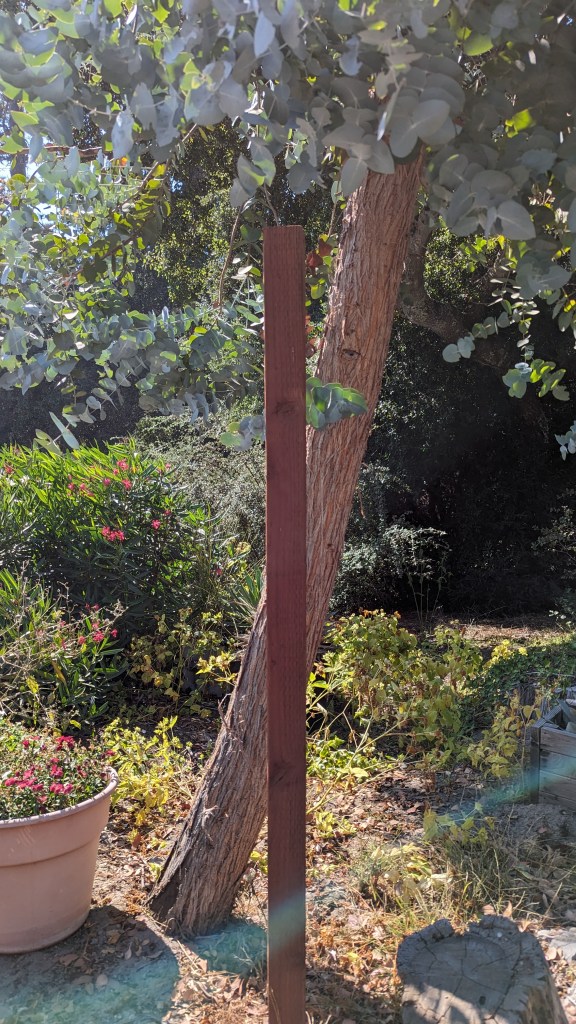
The vertical post demonstrates how much the tree trunk leans.

A few tree species should’ve had a V8. That includes more than a few individual trees. It applies to enough individuals of a species to indicate that the need is almost typical of the particular species.

The need for a V8 is derived from old advertisements for the V8 beverage that depicted those who were deficient in adequate consumption of V8 as leaning prominently. V8 is a juice beverage that is composed of juices of eight vegetables; tomatoes, carrots, celery, beets, parsley, lettuce, watercress and spinach. Hence, V8. It balances a diet so that those who consume it stand upright rather than lean.

In horticultural slang, the need for a V8 refers to a leaning trunk.

Any tree of any species has potential to develop a leaning trunk, and consequently appear to be in need of a V8. Some species innately develop leaning trunks though. No one seems to know why, but specimens of such species with vertical trunks are oddly uncommon or perhaps rare.

For example, so many ginkgo trees lean at such similar angles that, among some groups, their distinctive lean seems to be a normal characteristic of the species. It is variable though. Many individual trees that are isolated from others are quite vertical. So are some groups of street trees. However, many or most specimens of other groups of street trees lean at very similar angles, although in random directions.

Italian stone pines are more likely to lean, also at relatively similar angles, and also in random directions. Locally, vertical trunks are rare among this species. However, within their native range, vertical trunks are typical.

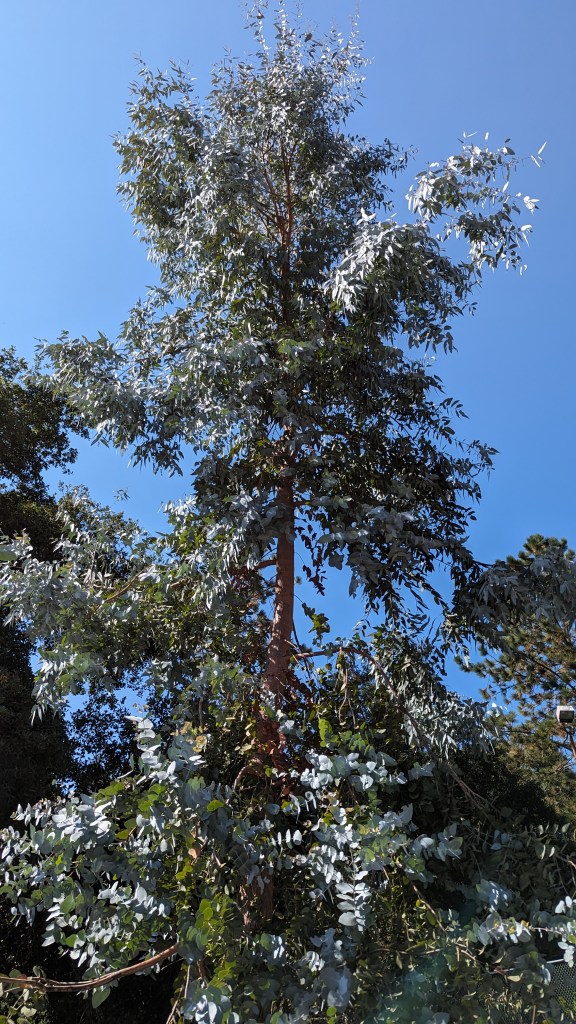
Argyle apple (eucalyptus) is almost comparable to Italian stone pine in regard to its typical need for a v8. I have seen a few with vertical trunks. I was determined for ours to be among them. I bound the trunk to keep it straight as it grew. I installed it with the trunk as vertical as the sign post next to it. When wind caused it to lean slightly while it was smaller than it is now, I pushed it back into position. Actually, I might have done that a few time. However, as it matured, it became more difficult to push back into position. Eventually, it refused to budge from its leaning position. Now, like most of the species, this specimen also seems to be in need of a V8.

After the base of the trunk insisted on leaning, the upper portion of the trunk assumed vertical posture.

What Is This?!

I have no idea what it is, but I intend to grow it.

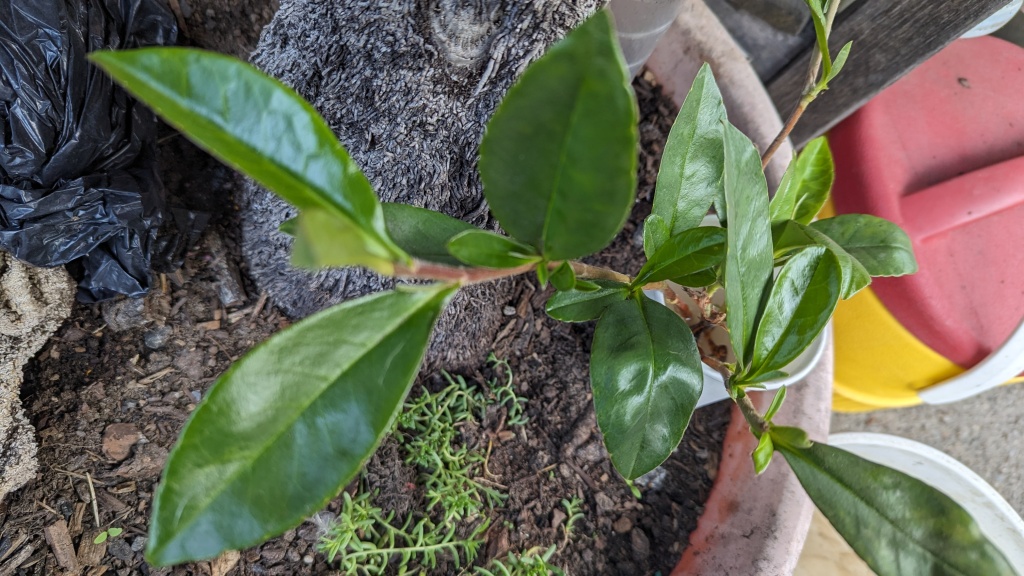
It is an evergreen vine that seems to sprawl over other vegetation rather than actually climb it. It lacks tendrils or other means with which to hold onto its support. It does not even seem to wrap around its support. Nor does it seem to get very high above the ground. It just sort of sprawls.

Its glossy leaves are rather simple, just like in the picture here.

Its bright yellow and staminate flowers, if I remember correctly, seem to resemble those of Saint John’s wort, but are a bit wider.

This vine, again if I remember correctly, seemed to be more popular years ago. I do not notice it much anymore. I can not remember when I last saw it in a nursery, or if I ever saw it a nursery. The few specimens that I am aware of inhabit old landscapes that have not been renovated in decades. I got these bits from where they were regenerating after their earlier removal from an old landscape.

Now that I have these bits, I intend to grow them, in order to get familiar with the species. I hope that I can eventually identify it. It should not be so difficult for something that had formerly been popular, or at least common enough for me to recognize it as something that had formerly been familiar.

I do not often encounter a species that I can not identify, and I even more rarely admit to it. If I do not recognize a species, I can typically recognize the genus, or at least the family, and then key it out. For this seemingly simple vine, I can not identify its family. I asked Brent, which I almost never do. He recognized it about like I did, but also could not remember its name.