Cool Season Vegetables Will Hopefully Do Better Than Warm Season Vegetables Did

Tomatoes were adequate, and perhaps quite good, but not as vigorous as they should have been.

Now that it is half way through September, it is impossible to ignore that tomatoes did not have a good season. Most of us who grow tomatoes were embarrassed by their performance until we realized that everyone else who grows them was also experiencing similar disappointing results. It was not because we did not water them properly. Nor was it because they lacked particular nutrients. They simply wanted warmer weather.

Plants that were put out early before the warm weather last spring did much better at first, but then decelerated as the weather became milder instead of warmer. Cool nights certainly did not help. Mildew, which typically slows a bit as weather becomes drier (less humid) though summer, instead continued to proliferate so that new foliage became infected almost as soon as it developed.

Earlier predictions that the weather would eventually get warm were not accurate enough for many of us who are only now getting enough tomatoes for fresh use, but not an abundance for canning, drying or freezing. There is still some time for most of the tomatoes that are on the vines now to ripen; but many will probably remain green by autumn. Some but not all of the last green tomatoes can ripen off the vine. Perhaps the only good news about all this is that there should be plenty of green tomatoes for pickling.

Sadly, tomatoes were not the only warm season vegetables to be dissatisfied with the weather. Green bean vines and bushes were generally healthy and made good beans, but did not produce very abundantly. Corn was likewise of adequate quality, but on smaller ears and less abundant. Even zucchini, which typically produces too much, was a bit subdued. Marginal vegetables that really prefer warmth, like eggplant and bell pepper, were downright disappointing.

Even if the weather gets warmer in the last days of summer, languishing tomato plants can not ketchup on production. They can be left to make a few more tomatoes, but will eventually need to get out of the way of cool season vegetables. Cabbage, kale, turnip greens, beets, radishes and all the slower growing vegetables that take their time through autumn, winter and early spring will want their space back soon. They will hopefully have a better season.

If possible, cabbage, broccoli, cauliflower and some of the larger cool season vegetable plants can be plugged in amongst the finishing warm season vegetable plants. Then, by the time the finishing warm season vegetable plants need to be removed, the next phase of cool season vegetable plants is already somewhat rooted and has a head start. This process works well in small spaces with good quality soil.

The main problem with this procedure is that it prevents potentially depleted soil from getting amended and well mixed between planting. It can also be a bit awkward to get the spacing of rows, furrows or mounds of the next phase of vegetable plants to match up with the previous phase. Smaller vegetable plants that get sown directly from seed into rows, like turnip greens, carrots, beets and radishes, really prefer customized bed preparation, after the warm season vegetables have been removed.
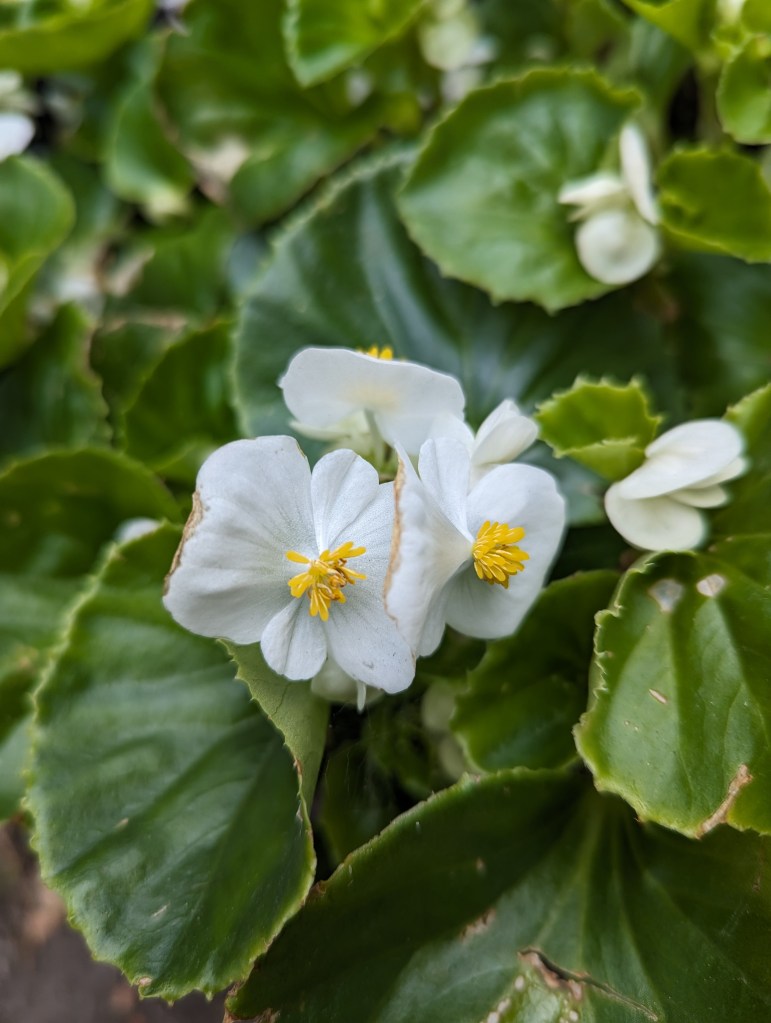
Wax Begonia

Wax begonia is potentially a perennial.

Simplicity is a recurring theme among wax begonia, Begonia X semperflorenscultorum. Floral color is white, pink or red. Foliar color is green, bronze or dark bronze. Each floral color combines with each foliar color. Variation within this simple color range is minimal. So is variation of foliar or floral form. Cultivars with slightly fluffier double bloom are rare.

Perfection eliminated the potential for improvement. Regardless of such simple variation, wax begonia is among the most popular annuals. Technically, it is perennial. Technically, it prefers warm weather. It remains available as cool season color after summer because it blooms until frost. Later, it can recover from minor frost. Without frost, it blooms all year.

Mature wax begonia rarely grows higher or wider than a foot, with densely rounded form. Flowers are small but abundant. Both leaves and stems are succulent and tender, with a waxy sheen. Propagation is remarkably easy by cuttings or division. Consistent watering is very important. Partial shade is tolerable, but if too shady, can inhibit bloom somewhat.

Cool Season Color Returns Seasonally

Pansies and violas like cool weather.

Cool season vegetables are the first clue. Now that they are seasonal, cool season color is also seasonal. Both comply with similar schedules. Their cool season centers around winter, including portions of spring and autumn. Some prefer to start early. Some prefer a later start. They also finish at variable times through spring. Some perform until summer.

Warm season color also complies with distinct schedules. Some might finish a bit earlier than their cool season replacements begin. Conversely, some could continue to perform a bit later than their replacement allows. It is gratifying when color of one season finishes as color of the next season begins. That will become more likely later within the season.

Cool season color has a few designations. Winter commonly replaces cool season. Yet, it includes adjacent portions of autumn and spring. Bedding plants or annuals commonly replaces color. Yet, many are actually perennials, and none are limited to bedding. Large homogenous beds are passe anyway. Some perennials linger after their primary season.

Also, some species behave differently here than within other climates. Wax begonias are warm season color, but may dislike locally arid warmth. They perform better for spring or autumn than for summer here. Actually, they become as popular as summer ends as they are when winter ends. They bloom until frost, or continually and perennially without frost.

Growth is slower during cool weather. Therefore, seed for cool season color should start early. For most, small plants, such as those from cell packs, are more efficient than seed. Cyclamen grow so slowly that they are only available in expensive four inch pots. Some cool season color is better for autumn or spring. This includes marigold and snapdragon.

Pansy and viola are the most popular of cool season color. Pansy are a type of viola with fewer but bigger flowers. Various types of primrose are nearly as popular, and can bloom until summer heat. Iceland poppy can grow a bit later in autumn to bloom through winter. Sweet William is a perennial that blooms now until spring, and can resume next autumn. Ornamental cabbage is bold foliar cool season color.

Early Rain

This could be a sequel to ‘Late Summer’ from yesterday. It happened shortly afterward. It certainly adds another interesting component to this already odd year of weather. Although not impossible, rain at this time of year is rare. Almost all of the rain here occurs between late autumn and early spring.

Weirdly, if rain does occur during summer, it typically does so around the fifteenth of August. Seriously, it is very prompt about that schedule. It typically either begins or ends on that same date.

The first flash of lightning of the storm that started the CZU Fire occurred at 11:59 p.m. on the night of the fifteenth of August of 2020, less than a minute prior to midnight. So, although the storm occurred during the early morning of the sixteenth, it technically began on the night of the fifteenth.

This brief rain shower was minimal, but by local standards, it was surprising. I sort of wanted it to continue long enough to dampen and contain the dust of summer. It might have done so briefly, but could not prevent the dust from becoming dusty again shortly afterward. The aroma of damp asphalt dissipated even before that happened. It was fun while it lasted.

Perhaps this rain shower will be the last of this unusually autumnish weather. Warm and dry summery weather typically resumes immediately after brief rain showers that happen during the middle of August. Technically, for a summer rain shower, it is only half a month late. So far, the forecast does not suggest that pattern, but it has been wrong before, even here. I doubt that there will be any more rain prior to autumn, even if cool autumnish weather resumes until then. But of course, I have been wrong more often than weather forecasts.

Late Summer

Such weather is early this year.

The change of seasons can be boring here. It might seem as if this climate experiences only two seasons. Summer is the primary season, which seems to extend through most of the year, with what seems to be merely a few days of another brief secondary season which is not summer. Perhaps this brief secondary season is autumn, winter and spring, but that is too many letters and big words for such a small season.

That is how those who are familiar with more distinct seasons might perceive seasons of this innately mild climate. Those of us who are familiar with this climate perceive it quite differently. We are aware of the four seasons, regardless of how mundane the transitions between them seem to be. In fact, some might contend that, if autumn seems to be minimal here, it is merely because this climate experiences a fifth season between summer and autumn, which is known as Indian summer.

Indian summer is an extension of summery weather into autumn, and sometimes occurs after summer seems to have begun to succumb to autumn. It does not happen annually, and does not seem to be happening this year, but certainly could. It is sneaky that way.

For now though, autumn seems to be sneaking into the last two weeks of summer, much like Indian summer sometimes sneaks into autumn. Nights have been interestingly cool. Low clouds have been lingering a bit longer after sunrise than they typically do.

However, vegetation that enjoys warmth does not seem to be decelerating for cooler weather. Perhaps such vegetation knows more than the rest of us do about what to expect. Perhaps it is merely more responsive to photoperiod than weather. Regardless, I get the impression that this is how late summer typically is within other climates.

Six on Saturday: Frosty Forecast

Frost is not a problem here. The several species here that are not resilient to frost are the problem. The first of my Six actually has no problem with frost, but does have a problem with starting too late to finish prior to frost next winter. The second also has no problem with frost, but does not want to bloom as weather cools into autumn. The other four are from a frostless region of Los Angeles. I neglected to protect them from the earliest frost last winter because I did not expect it. Their recovery was slow through mild spring and summer weather. They are now growing vigorously rather than decelerating for autumn. This increases their vulnerability to frost next winter.

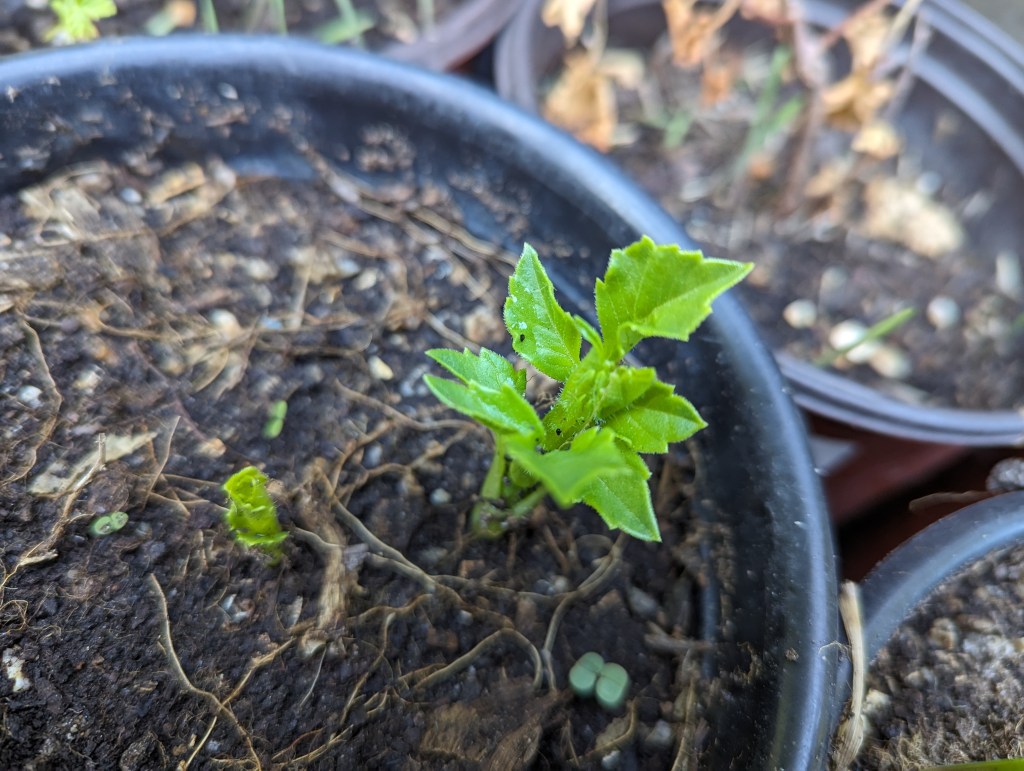
1. Dahlia X pinnata, mixed dinnerplate dahlias are starting to grow, with only a third of their season left. I described the delay last week. Only three of two dozen survived so far.

2. Gardenia jasminoides, gardenia seems to be healthy, and generated a typical number of floral buds, but is now shedding such floral buds, likely in response to cooling nights.

3. Solandra maxima, cup of gold vine was new here when it got frosted last winter, then grew slowly through atypically cool weather last spring, and is now growing like a weed!

4. Platycerium bifurcatum, staghorn fern also waited a bit too long to start growing like this. It could eventually enjoy rain and humidity through winter, but not even mild frost.

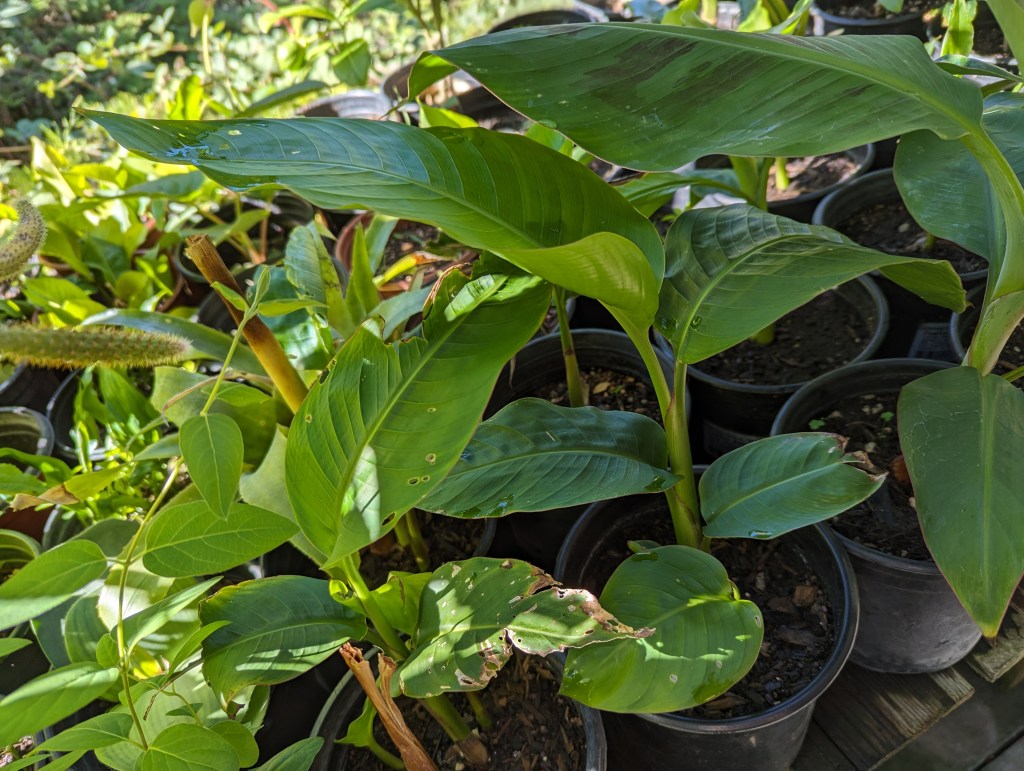
5. Heliconia psittacorum, parakeet flower has done well since last winter. I brought nine rhizomes from Los Angeles. They are still a bit too small to survive average frost though.

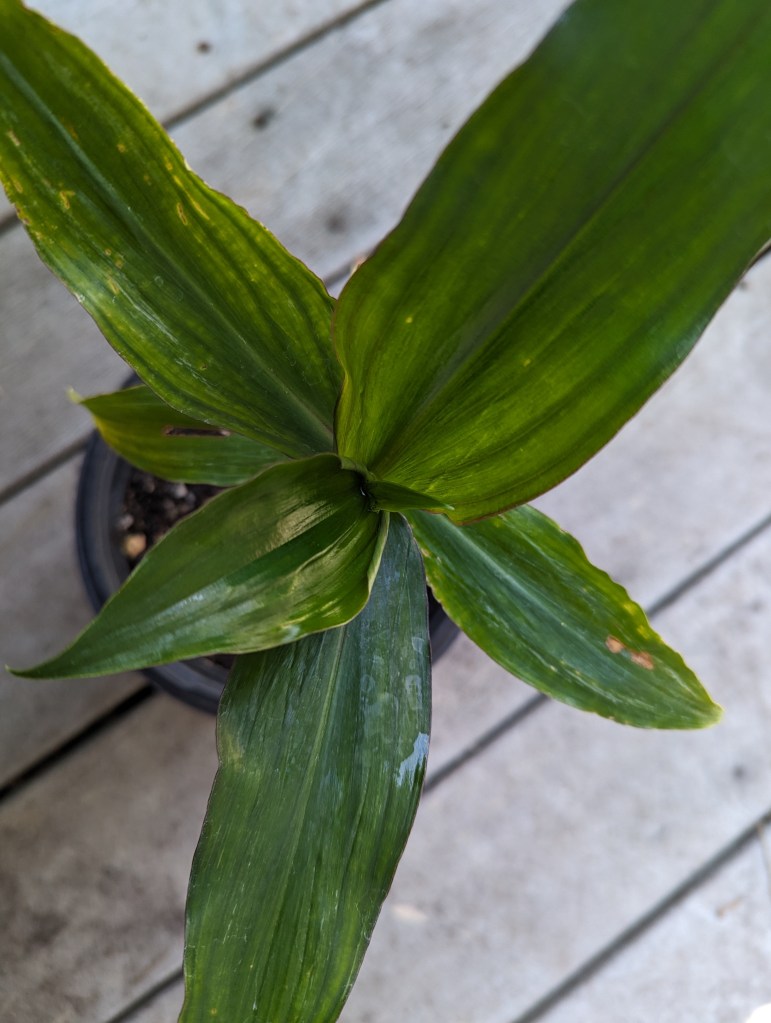
6. Dichorisandra thyrsiflora, blue ginger is likely even more vulnerable to frost. Most of its cuttings did not survive last winter. I am impressed and pleased with the six that did.

This is the link for Six on Saturday, for anyone else who would like to participate: https://thepropagatorblog.wordpress.com/2017/09/18/six-on-saturday-a-participant-guide/

Fiddle Leaf Fig

Fiddle leaf fig starts out as a clinging epiphytic vine.

What a weird tree! Fiddle leaf fig, Ficus lyrata, is an uncommon but familiar large scale houseplant that we might not welcome into our homes if we knew how it behaves where it grows wild in the lower rainforests of Western Africa. Although it can grow upward from the ground like almost all other trees do, it often germinates and begins to grow as an epiphyte, within organic debris that accumulates in the branch unions of other trees. While suspended, it extends roots downward. Once these roots reach the forest floor, they develop into multiple trunks that overwhelm and crush the host tree as they grow.

The bold foliage is typically dark drab green, like the shades of green that were so popular for Buicks in 1970, with prominent pale green veins. Individual leaves are about a foot long and potentially nearly as broad at the distal (outward) ends, often with randomly wavy margins. Like fiddles, they are narrower in the middles, or actually more often narrower at the proximal (inward) ends. When pruning becomes necessary, the caustic sap should be soaked from fresh cuts with paper towels so that it does not drip and stain.

Too Much Mix & Match Gets Sloppy

Conformity has practical application even in casual landscapes.

A combination of modern horticultural apathy and too many choices was probably the demise of conformity in home gardens. Formal hedges or even informal screens of several of the same plants are nearly obsolete. Ironically, long and low barrier hedges and so called ‘orchards’ of identical trees planted in regimented rows or grid patterns have become common in large landscapes in public spaces

Those of us who still crave formal hedges, paired trees or any such symmetry in our home gardens must be more careful with the selection of the plants that need to conform than would have been necessary decades ago when there was less variety to complicate things. It is just too easy to get different varieties of the same plant. Only plants with matching cultivar (cultivated variety) names will necessarily match. (Yet, on rare occasion, even these are inaccurate.) For example, ‘Emerald’ arborvitaes will match other ‘Emerald’ arborvitaes, but will not match ‘Green splendor’ arborvitae, no matter how they resemble each other in the nursery.

Plants that are identified by their characteristics instead of by cultivar name are riskier. Blue lily-of-the-Nile could be any one of many different cultivars with blue flowers. It is therefore best to obtain all lily-of-the-Nile for any matching group from the same group in the same nursery at the same time. What will be available next week may actually be a different variety with a different shade of blue and different foliar characteristics. Nurseries bring stock in from so many different growers.

Adding new plants to replace those that have died within established hedges or streets flanked with the same trees can be particularly difficult, especially if the old varieties are no longer available. The old fashioned yellowish Japanese boxwood that was so common for small hedges in the 1950’s has not been common in nurseries for several decades. Replacement plants are darker green. Some are even compact cultivars or different specie like English boxwood. When lined up and shorn together, they make ‘calico’ hedges.

Horridculture – Nature

Nature is dysfunctional.

Horticulture is unnatural. It involves unnatural manipulation of exotic species that were unnaturally imported from all over the World. It provides unnatural irrigation and unnatural chemical fertilizers and amendments. It involves unnatural containment of many plants within unnatural synthetic media within unnatural plastic cans or other containers. It strives to eliminate much of what is natural, such as pathogens and competition. It is ironic that so many believe that a simple but totally unnatural houseplant brings a bit of nature into their particular environment.

Nature, although quite natural, is dysfunctional. It is messy. It is dirty. It is tragic. It is potentially dangerous. It is overrated. Realistically, it is a hot mess of problems. Somehow though, it seems to be appealing.

That is why so many of us strive to incorporate more nature into our respective lifestyles by very unnatural means. We crave a sort of idealized version of what we believe nature should be. It would likely be easier and more efficient to accept such attempts as unnatural, and exclude what nature might try to contribute.

Some are quite happy to live and work in high rise homes and offices with minimal natural influence. They still breathe natural air, and appreciate natural sunlight and the stabilizing effects of natural gravity, but shelter themselves from what is most bothersome about nature outside, such as weather, wildlife and most insects.

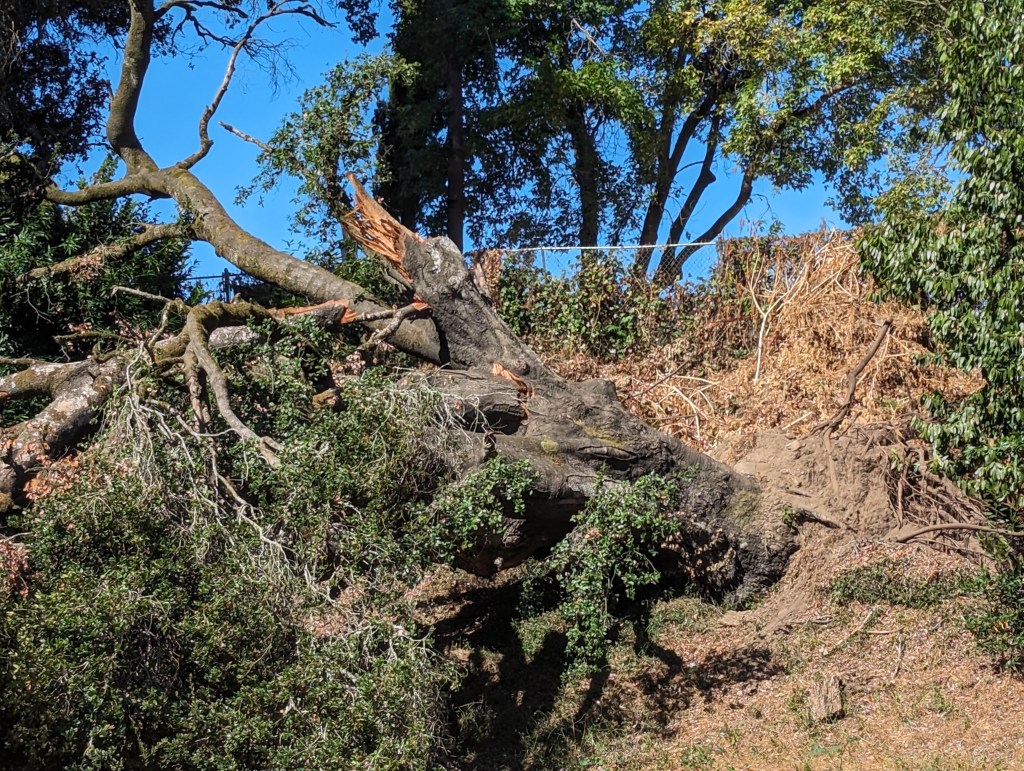
This unfortunate old coast live oak is an exemplary victim of nature. It grew here naturally for two centuries or so. It obtained all that it needed from the natural soil, air and weather. It survived natural insect infestations, and long ago, may have survived natural forest fires. Ultimately though, perhaps in conjunction with a bit of natural wind and natural fungal organisms associated with decay, it succumbed to natural gravity.

This old oak finally succumbed to the same nature that it exploited for centuries.