Frost Protection

For many species, frost damage is not as bad as it looks.

            My colleague in the Los Angeles area still sends me seeds for all sorts of strange plants that I probably should not be growing in my less climactically temperate garden, making it difficult to conform to the primary rule of frost protection: ‘Select plants that are appropriate to the particular climate.’ No matter how often I remind my clients of this rule, I really do not want to abide by it. There are just too many interesting but inappropriate plants.

            So the next option is to grow frost sensitive plants in containers that can be moved to sheltered areas prior to frost. That worked while I had an extra parking space in the carport and some room under the porch for giant bird-of-Paradise, plumeria, philodendrons and such. Eventually though, some of these plants get too large to be contained; and I really do not want to keep pruning them back. Besides, I prefer to grow things in the ground.

            The third option is to put sensitive plants in spots that are naturally warmer, or where they are sheltered below the canopies of large evergreen trees, lath or wide eaves. Just remember that plants under eaves are also sheltered from rain, so may need to be watered occasionally through winter. Steep slopes are not quite as cold because cold air drains off. However, flat areas below slopes get colder as they catch cold air that drains from uphill. South facing exposures are of course warmer than northern exposures.

            I know probably better than most that there are always some plants that are not ‘appropriate to the particular climate’, that I do not want to grow in pots, and that prefer to be out in exposed parts of the garden. For example, bougainvilleas are somewhat tender, have sensitive roots that do not like to be confined, and really want to be out in the open to take advantage of warming sunshine during summer. Such plants in colder areas will either need to be protected, or will get damaged by frost.

            Burlap suspended above the foliage by stakes is typically enough to protect sensitive plants from frost. I have used old towels and linens where my neighbors can not see. Plastic sheeting is also effective, but should be removed before sunlight warms the air too much underneath. Paper grocery bags or cardboard boxes are enough for small plants.

            I actually allow some of my larger plants that would be difficult to cover to get damaged by frost, and then prune out the damage later. If they are too big to cover easily, they are probably big enough to survive frost. Damaged stems should be left until the end of winter both to insulate stems below, and also because early pruning stimulates new growth that is even more sensitive to frost. 

Frost Is Not An Enemy

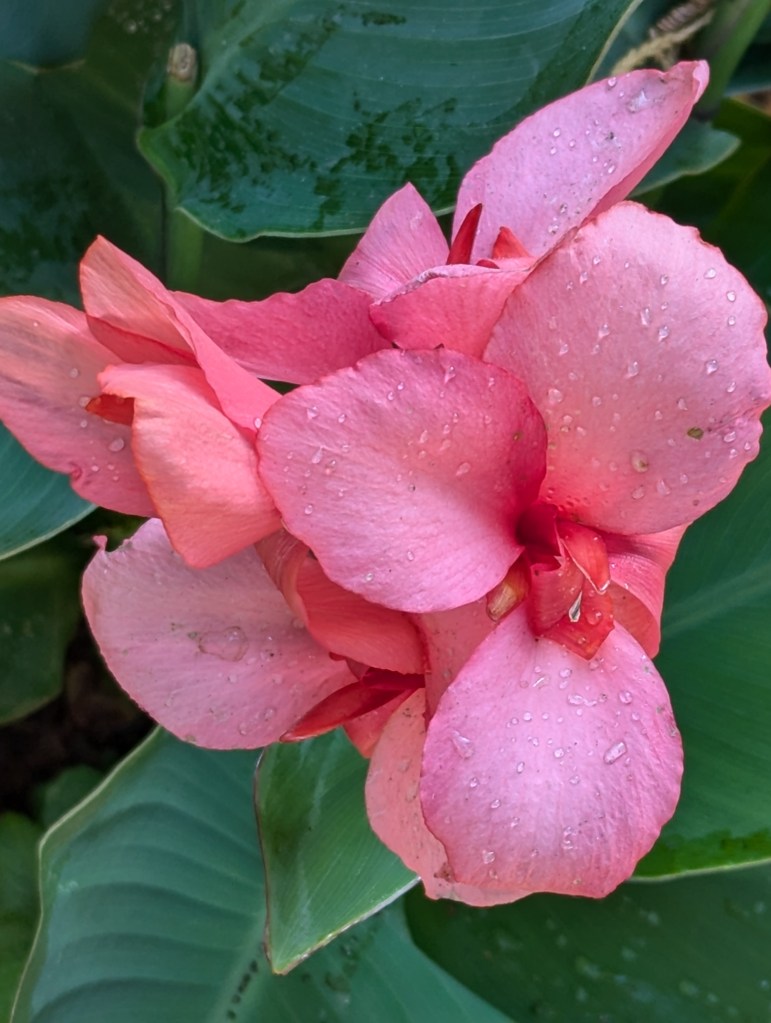
Among canna, frost damage is harmless.

Rain was one clue. Cooler weather is another. It is now so late into autumn that it will be winter soon. Every regional climate experiences some degree of chill. Some, particularly to the north, experience frost. This limits gardening in two ways. Several species prefer a bit less cool weather. Several prefer a bit more. Every species prefers a particular range.

Apple trees, for example, require vernalization, which is a specific duration of chill. Some cultivars require more than others. Without it, they can not distinguish seasons, so do not know when to bloom for spring. Consequently, few cultivars of apple perform adequately within Los Angeles. However, many perform very well in the cooler climates of San Jose.

Banana trees, conversely, need no chill, and are instead set back by frost. Some tolerate a bit more chill than others; but ultimately, they are all tropical species. They produce fruit only within the months between frosts. Consequently, not many banana trees are notably productive within San Jose. However, they perform better in the climates of Los Angeles.

Banana trees stop growing when the weather is cooler than fifty degrees or so. That is a bit too much chill for them. However, frost does not occur until the weather is cooler than thirty-two degrees. Banana foliage can therefore be safely dormant during chilly weather. That is a range of twenty-two degrees. Different tropical species survive different ranges.

The simplest form of frost protection is to not cultivate species that are vulnerable to frost. This is, of course, a bit too restrictive for many who enjoy gardening. Instead, some grow vulnerable species in pots to move to shelter prior to frost. Some simply grow vulnerable species below the shelter of eaves or big trees. Tenting may also be effective protection.

Alternatively, some species can endure frost damage to recover during warmer weather. If possible, outer foliage that succumbs to frost should remain through winter. It insulates inner growth from subsequent damage. Besides, premature grooming can stimulate new growth that is more vulnerable. Many perennials prefer cutting back after winter anyway.

Bare Root Stock

Bare Root Stock may not be much to look at.

Now that nurseries and garden centers are no longer selling Christmas trees, they have plenty of room for bare root stock. All sorts of deciduous fruit trees, a few deciduous shade trees, shrubs and vines, and even a few perennials can now be purchased while dormant and without the cumbersome media (soil) that the roots need at all other times of the year. Not only is bare root stock easier to handle and transport in small cars, but it is also much less expensive than canned stock (that has roots contained in media, which is contained in nursery cans). Bare root stock typically costs about a third of what canned stock costs.

Bare root stock also has the advantage of adapting to new garden easier, since it does not need to leave the comfort zone of the media that it would have grown into (within a can) in order to venture out into unfamiliar soil. Instead, it starts to disperse roots into the new home soil immediately as it emerges from dormancy in late winter. Without cans, bare root stock can not get root bound. Instead of developing branch structure that is appealing to nursery marketing, bare root stock can get an early start on developing branch structure that is most practical and efficient for the gardens that it gets installed into.

It seems that all of the ´stone’ fruit can be found as bare root stock. These include apricot, cherry, plum, prune, peach, nectarine, almond (which is the seed, or ´stone’, of a peach like fruit) and the odd hybrids of these. The pomme fruits, apple, pear and quince, are perhaps the second most popular of bare root stock, although quince is still rather rare. Ornamental trees, shrubs and vines include flowering crabapple, flowering cherry, flowering quince, alder, poplar, willow, lilac, forsythia, wisteria and clematis. Perennials include rhubarb and artichoke.

Bare root stock can be purchased as soon as it becomes available, but does not do much until it starts to grow in spring. It should get planted quickly and soaked in, but will get more water than it needs from rain afterward. It should not need water again until after it blooms or gets new leaves in late winter or early spring. Despite guarantees of fruit in the first year, none should be expected. The few fruit trees that might set fruit will probably produce only useless underdeveloped fruit because new plants are busy producing new roots and growing. Actually though, this apples to canned stock as well, except only for citrus, olives and other evergreen fruit trees.

Berries For Autumn And Winter

Firethorn berries can be impressively prolific.

Cool season annuals are less diverse than warm season annuals for one simple reason. Flowers prefer to bloom while their favorite pollinators are most active. Most of the better pollinators are insects that are most active during warm weather. Therefore, most flowers want to bloom while the weather is warm. Many colorful berries are similarly exploitative.

For dispersion of their seed, colorful berries rely on birds. Therefore, many ripen and are most colorful as many birds migrate during autumn. Birds consume the berries but do not digest their seed. Instead, as they migrate, they disperse the viable seed. It is a mutually beneficial arrangement. Birds eat all they want. Seed benefits from thorough dispersion.

As they ripen, autumn and winter berries develop bright colors that attract birds. Most are bright red. Some are bright orange. A few are bright yellow. They are substantial enough to satisfy the birds that eat them. Yet, they are compact enough for such birds to eat them whole. Some are impressively abundant, at least until any birds that they feed find them.

That can be a dilemma for home gardening. Many garden enthusiasts grow autumn and winter berries for the color. Many grow them to attract birds, though. More grow them both for their color and to attract birds. The latter is least disappointing. Typically, such berries ripen to display their color faster than birds can eat all of them. Every season is different.

Unfortunately, there are not many options for colorful autumn and winter berries. Some of the species that produce the most colorful fruit are unfortunately thorny. Firethorn notably produces the most abundant, most colorful and most familiar berries. It is horridly thorny, though. So is English hawthorn, which is deciduous and defoliates to expose its red fruit.

Toyon and various cotoneasters are thornless alternatives for colorful berries. Toyon is a native species that grows rather large. Although cotoneasters are not as prolific, cultivars stay proportionate to home gardens. Hollies are dioecious, so female specimens need a male nearby for pollination. Because males are rare, females produce only a few berries.

Live Christmas Trees

Most live Christmas trees grow too big for home gardens.

One of the problems with driving my favorite vehicles that were old long before I learned to drive them is that I spend considerable time waiting for a bus or walking. The cool thing about that is that I get to seem so much scenery that I would otherwise drive past. While waiting nearly an hour for a bus at the Cavallero Bus Terminal in Scott’s Valley, I went across the street to see the landscape of the somewhat new Post Office, which has actually been there for many years now.

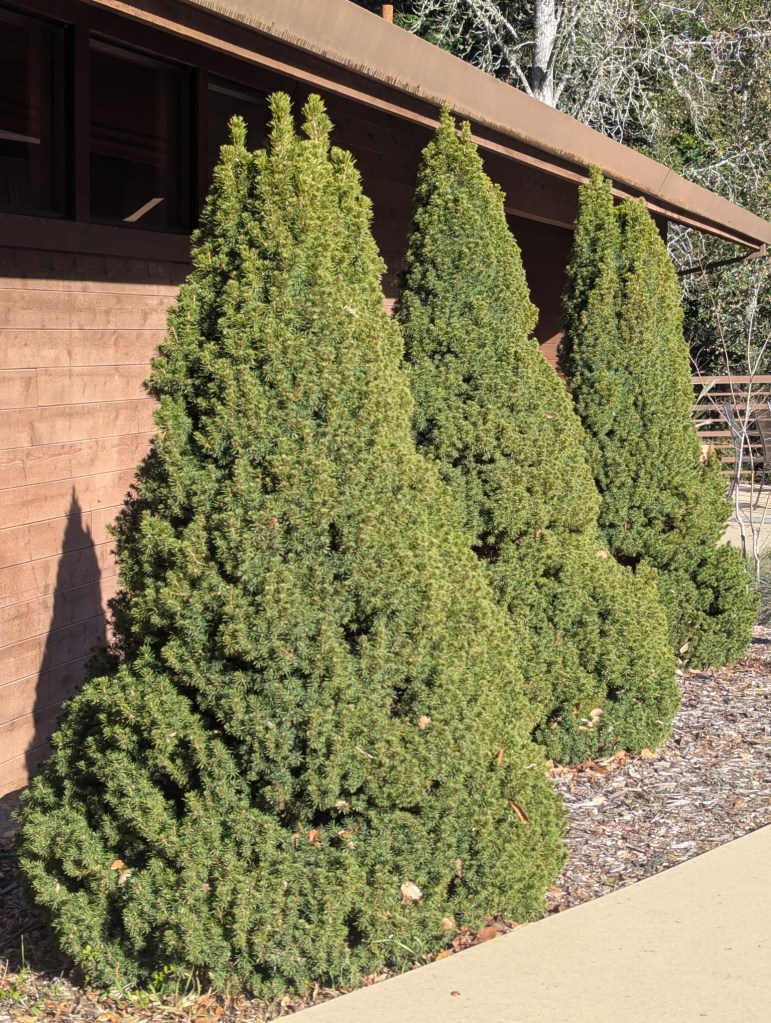
The landscape is a bit sparse in front (I think because of architectural modifications after the landscape was designed), so was outfitted with recycled live Christmas trees. Although none of these particular trees seem happy in the local climate or sandy soil, I had wanted to get better acquainted with them for some time. They are an odd assortment of spruce and fir that are rare here.

The more typical concern with the more common live Christmas trees is not that they are not well suited to local climates and soils, but that they actually do too well and grow much larger than expected. Except for the small rosemary, holly and English ivy ‘trees’, most coniferous evergreen live Christmas trees are young pines that get remarkably large; and some waste no time doing it! The most common live Christmas trees are Italian stone pines, which happen to be the two very large and broad trees in Blaney Plaza in downtown Saratoga!

Canary Island pines, which had been more common than they are now, do not get quite as broad, but do get very tall and messy. Years ago, Aleppo, Eldarica and Monterey pines all took their turns being popular live Christmas trees. Each of them grows large enough to require significant garden space.

This is of course not a problem for the few live Christmas trees that happen to get planted where they have plenty of space. However, those that get planted where they do not have room to grow can cause serious problems. Because they seem so cute and innocent while they are young, and are so often expected to stay cute and innocent, many often get planted dangerously close to houses, where they can displace porches, walkways and even foundations! Large pines, particularly Italian stone pines, are also too messy and potentially combustible (if not pruned and groomed regularly) to be too close to houses.

Sadly, large pines do not like to stay in containers too long. They can be pruned for a few years, but eventually get congested roots. (Bonsai techniques of root pruning can maintain even the largest types of pines in containers indefinitely, but not many of us know these techniques.) Small pines, like Austrian black, Japanese black and Scott’s pine (which has no relation to Scott’s Valley), as well as other small coniferous evergreens, like certain junipers, can stay in containers much longer, but these are the sort that are small enough to get planted in the garden, so do not necessarily need to stay in containers anyway.

If space is not sufficient, pines and other live Christmas trees that eventually get too large really should be given to friends and neighbors who have space to accommodate them. Fortunately, most do not require much attention once they get established after two years or so.

Bark Up The Right Tree

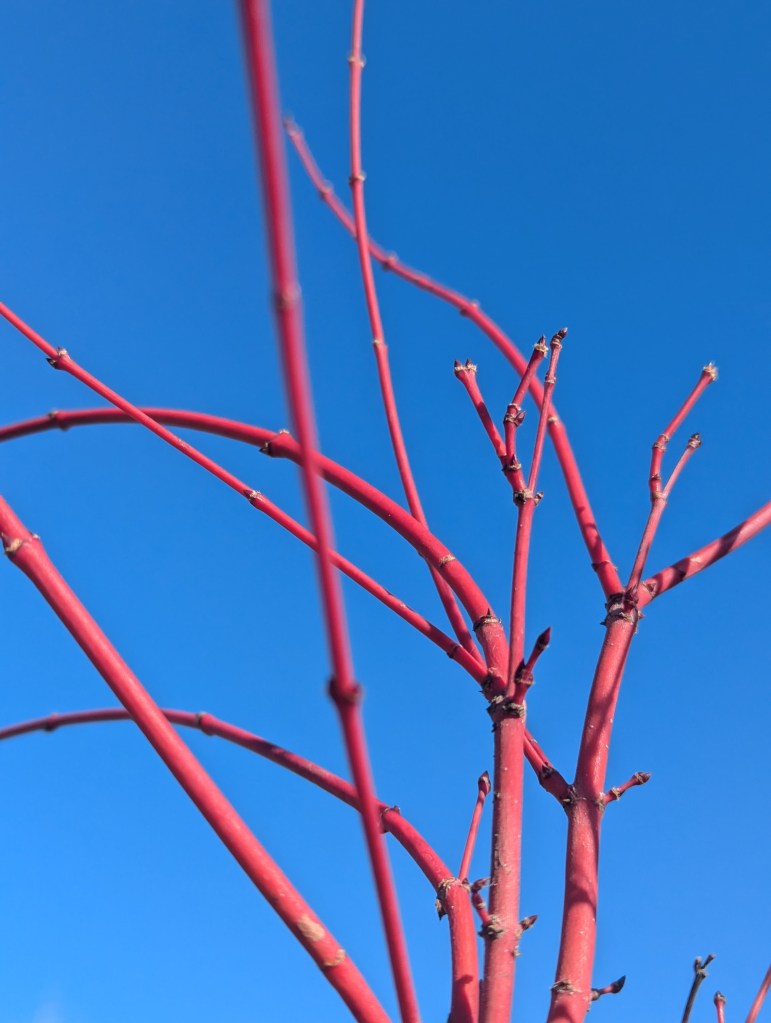
Bark can contribute color and texture.

Autumn foliar color does not seem to last long enough. As it dissipates, though, it reveals silhouettes of bare deciduous trees. Some are delightfully sculptural, with strikingly pale bark on their trunks and stems. Others develop distinctively reddish twigs. Some display interesting bark textures or patterns. Color, texture and patterns are remarkably variable.

Of course, for most species, bark does not change much throughout the year. It becomes more prominent now merely because defoliation increases its exposure. In fact, some of the most distinctive bark belongs to evergreen species. Some belongs to flowering trees, fruiting trees or arboriform shrubbery. The sources are as variable as the characteristics.

European white birch is likely the most familiar tree with white bark. Jacquemontii birch is even whiter. California sycamore is a massive tree with mottled light gray and tan bark. Crape myrtle, which is more proportionate to home gardens, is more mottled. Some elms exhibit elegant tan trunks and limbs. European beech trunks develop metallic gray color.

Melaleucas are evergreen trees with distinctively shaggy trunks. Eucalyptus are likewise evergreen, but generally with pale and smooth trunks. Lemon gum is particularly tall and elegant. However, red ironbark eucalyptus has dark and notably rough trunks and limbs. ‘Marina’ madrone develops smooth trunks and limbs with brown and cinnamon red color.

Coral bark Japanese maple and osier dogwood display colorful bark differently. Theirs is on small twigs rather than trunks and main limbs. Color actually develops in response to autumn chill and defoliation. Coral bark Japanese maple develops, pinkish orange color. Osier dogwood is more brownish red, although some cultivars are orangish or yellowish.

Trees that exhibit distinctive bark are subject to the same constraints as all other trees. In other words, they must be appropriate to their particular landscapes. California sycamore for example, is much too large for compact urban gardens. Osier dogwood can grow as a thicket without intensive maintenance. Any new tree or shrubbery should be sustainable.

The Importance of Proper Arboriculture

Arboriculture is horticulture of trees.

Pasadena sustained the worst of the damage caused by the strongest Santa Ana Winds in three decades. Huge piles of debris from broken trees are much more than can be removed any time soon. Falling debris and trees damaged many roofs, cars and anything else that happened to get in the way.

Other towns and neighborhoods throughout the area, particularly those at the base of mountains, also sustained major damage. At the same time, severe winds ravaged the San Francisco and Monterey Bay Areas as well, particularly in the Santa Cruz Mountains and the hills of the East Bay.

Some of the damage caused by wind in urban areas might have been less disastrous if trees had gotten the respect and attention that they deserve. Some trees develop structural deficiencies that need to be corrected by pruning, either to eliminate the problems, or at least to decrease the strain exerted onto the structurally deficient parts. A few trees that become unstable as they mature may likewise need to be pruned or even removed.

It is not always possible to prune trees to remove all structural deficiencies without damaging the affected trees more, or causing more structural problems to develop. For example, major pruning to remove all parts that may get blown down by wind, such as pollarding or ‘topping’, may seem to be effective for the short term, but actually stimulates the development of vigorous secondary growth or watersprouts that are disproportionately heavy and even more likely to tear off from the older limbs.

Structural pruning more often involves thorough reduction of weight and wind resistance. Weight of foliage and stems directly applies leverage against unions where smaller stems are attached to the larger stems from which they originate. Wind resistance adds more leverage as foliage gets blown about by wind. Thinning obviously removes significant weight, and also decreases wind resistance to allow wind to blow though the affected canopies.

Besides helping to compensate for structural deficiency, structural pruning is also beneficial to potentially unstable trees for the same reasons. However, unstable trees typically need even more reduction of weight and wind resistance. Some of the most unstable trees and those that are deteriorating need to be removed because their instability cannot be accommodated.

During winter, while deciduous trees are bare, evergreen trees are more susceptible to wind damage, obviously because they retain their weight and wind resistance through winter while the weather is the most severe. Unstable trees become even more destabilized as rain softens the soil. Regardless of the potential for susceptibility to wind damage, this would be a good time of year to get any needed tree maintenance done, prior to any more windy and rainy winter weather.

Arborists certified by the International Society of Arboriculture are the most qualified to identify potential structural problems or instability, and to prescribe corrective procedures. A list of certified arborists can be found at the website of the International Society of Arboriculture at http://www.isaarbor.com.

Trees May Benefit From Winterization

Many trees need no winterization pruning.

Arboriculture becomes more of a concern at this time of year. Although winter is a month away, the weather is becoming increasingly stormy. Wind and rain can dislodge limbs or destabilize entire trees. Some trees may benefit from winterization prior to even stormier weather in the future. Some may need the specialized services of professional arborists.

Dormant pruning of deciduous fruit trees is, incidentally, not the same as winterization. It happens later in winter, after the subjects have been dormant for a while longer. Besides, after proper dormant pruning last year, they should not need winterization now. However, if subjects are defoliated, they should not mind early pruning. They are already dormant.

Ironically, the trees that are more likely to require winterization are evergreen. Deciduous species perform almost all of their own winterization naturally. They defoliate to eliminate most of their resistance to wintry winds. In other words, they become more aerodynamic. Defoliation also eliminates most of the surface area to accumulate heavy water from rain.

Evergreen species are generally more resilient to wind than foliated deciduous species. However, as deciduous species defoliate, evergreen species can not. Evergreen foliage therefore becomes less aerodynamic and more vulnerable to wind. Also, it absorbs more heavy rainwater. The added weight of rainwater causes limbs to sag and perhaps break.

Rain does more than cause foliage to become heavier. It also saturates soils, which can potentially compromise root stability. The timing could not be worse, since wind typically accompanies rain. This is also more of a problem for evergreen species than deciduous species. However, some storms arrive early, and some deciduous species defoliate late.

Winterization pruning is as variable as the trees that benefit from it. Large trees will likely need specialized services that only arborists can provide. Japanese maples may require only minor clipping of stems that have extended too far. Many trees require nothing at all. Ultimately, such techniques should help limbs and trees survive eventual wintry weather.

‘The Wise Old Owl’

Filoli

(This article is several years old, so contains outdated information.)

The sixteen acres of gardens of Filoli are spectacular and horticulturally compelling throughout the year. However, the weather through winter, although more pleasant than other places in the world, is not always quite so compelling or conducive to garden tours. At Filoli though, this is not a problem. More than six hundred volunteers and the Filoli staff merely bring the outdoors indoors, by selecting materials from the garden to adorn the interior of the 36,000 square foot Filoli residence for ‘The Wise Old Owl’, the annual fund raising Holiday Traditions Boutique.

While perusing The Wise Old Owl merchandise, guests can enjoy how so much more than flowers can be brought in from the garden to deck out the home. Bare stems, gnarly limbs, evergreen foliage, pine cones, bark and all sorts of bits and pieces of the autumn and winter garden demonstrate the potential for alternatives to traditional cut flowers that we may not even recognize as useful materials in our own gardens. Of course, there will be no shortage of the less abundant flowers that bloom through the season and decoration that are not out of the garden, as well as live music to enhance the display. Regardless of horticultural interest or boutique merchandise, the grand residence at Filoli is worth visiting even on the least eventful day of the year.

There are too many events within the Event to describe here. Guests can visit http://www.filoli.org to plan ahead and make reservations for buffet lunches and evening bistro dining, as well as an elegant Saturday Evening Dinner Party with dancing in the Ballroom. Children six to twelve years of age can enjoy a Children’s Tea on the finale of The Wise Old Owl on December 3.

The Wise Old Owl begins in only a few days on November 25, and continues through December 3. The hours of operation and admission are variable relative to the various events throughout the main Event. Reservations for specific events can be arranged and more information can be found online

Tickets can be purchased online, by fax or by telephoning Filoli weekdays between 9:00 a.m. and 4:00 p.m. At 650 – 364 8300 X 508. Order forms for fax transactions can be downloaded from the website and sent to 650 – 503 2090. Admission is limited; and tickets get exhausted somewhat early. Tickets are neither refundable nor exchangeable. Filoli is located at 86 Canada Road in Woodside (94062).

Rain Will Increase Until Late Winter

The weather is about to change.

Defoliation is the colorful beginning. It indicates that the weather is getting progressively cooler. It then gets messy with the first rain. This is inevitable at this time of year. After all, it is late autumn. Storms will become more frequent as weather simultaneously becomes cooler. So, while gardens are getting wetter, they also take longer to dry between storms.

Ironically, vegetation uses much less moisture while it is so abundant. Deciduous foliage can not perform any evapotranspiration after it defoliates. Evergreen foliage is much less vascularly active while cool. Roots can not utilize all the moisture that autumn and winter rain provides. Soil in some areas might stay moist from now until next spring or summer.

Conversely, summery weather is innately arid and warm. That is how the Mediterranean climate here operates. Moisture is either scarce or abundant. Rain will eventually stop in spring, and then not resume until next autumn. Summer thundershowers are uncommon. Gardening could likely be easier with a bit less rain for winter, and a bit more for summer.

With more rain expected, irrigation needs seasonal adjustment. Such adjustments might need to be incremental, since weather changes incrementally. Manual irrigation might be either less frequent or less voluminous, or both. The same applies to automatic systems, which have a disabling ‘rain’ option. It turns irrigation off without modifying the schedule.

Besides necessitating modification of irrigation, rain can also be messy. It dislodges and accelerates the deterioration of defoliating deciduous foliage. It causes even formerly dry soil to become muddy. A bit too much rain can cause erosion. Cleaning up such mess is less pleasurable while the weather is wet and cool. Then, the weather gets messy again.

Rain can not postpone all gardening. Spring bulbs must get into their garden soil prior to winter chill. Dormant pruning happens later in winter, prior to spring. Fortunately though, gardening is less involved than it is during spring and summer. Maintenance of tools and sorting seed can be indoor tasks for rainy days. So is shopping online for seed, plants or garden tools.