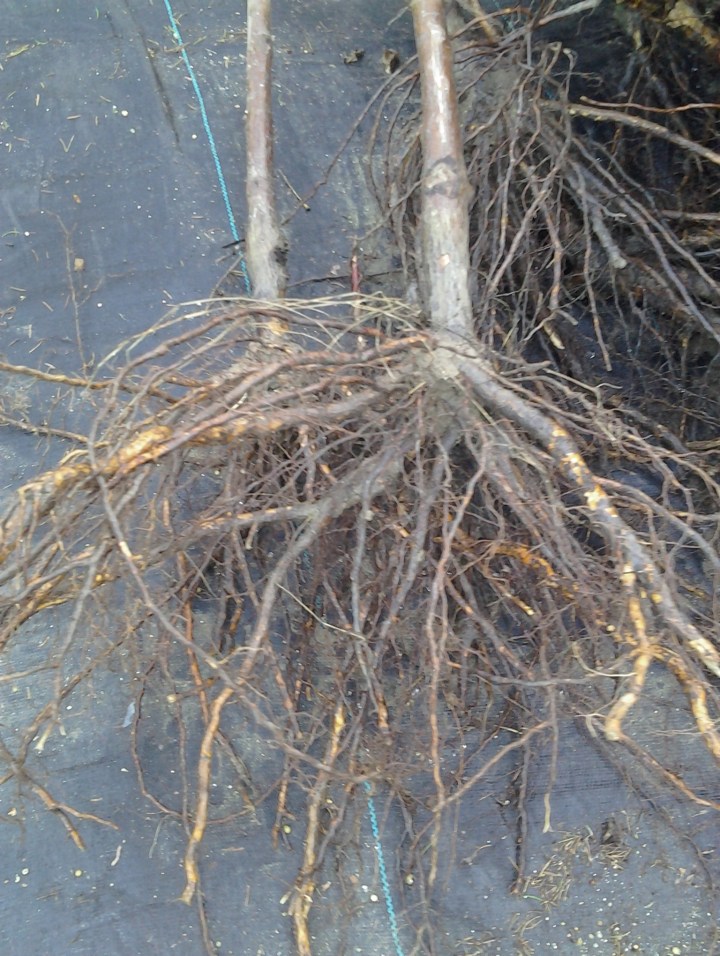
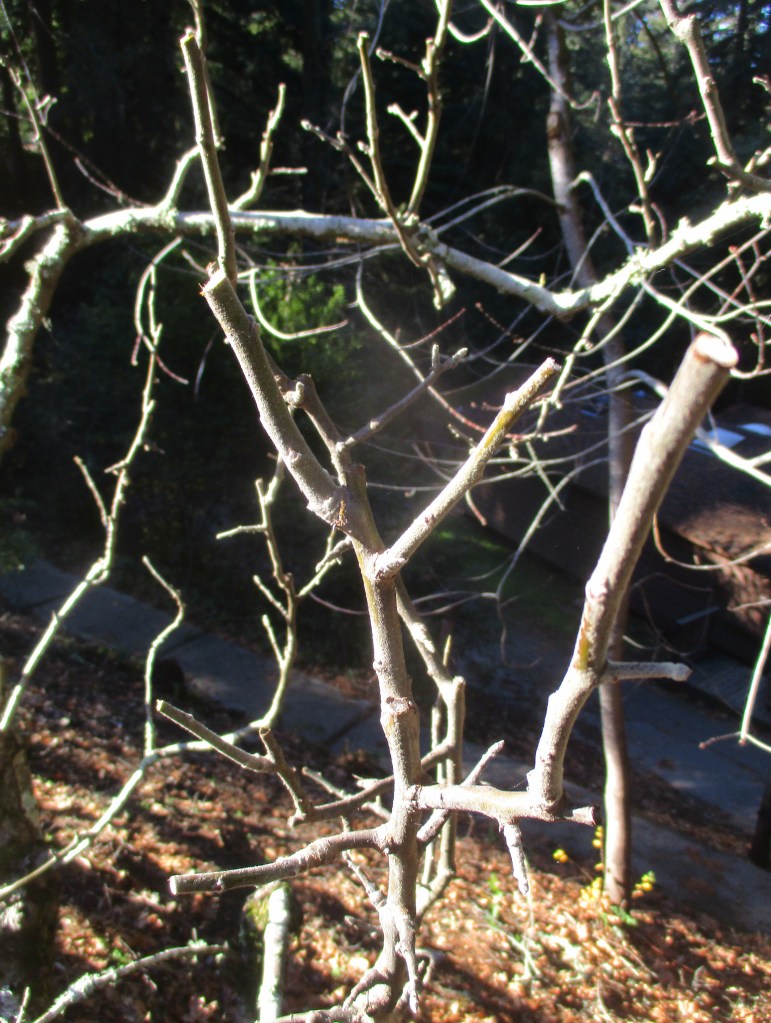
There is some good flowering quince in there, . . . somewhere.
Winter is the time to go wild in the garden, while plants are mostly dormant and not aware of what is going on. This is the time to tend to all the aggressive pruning that fruit trees and roses need annually, and to take care of overgrown deciduous plants that may not need to be pruned every year, but need it now. . . or may have needed it last year. . . or even a few years ago.
Regardless, if they are bare now, they are dormant. By the time their buds start to swell in spring, it will be too late, since they will no longer be dormant, and are likely to be damaged by overly aggressive pruning. Evergreen plants that can be sensitive to frost, like avocadoes and citrus, are the only ones that should not be pruned now, since aggressive pruning may stimulate new growth that is even more sensitive to late frost.
Plants that are too overgrown to be salvaged by tame pruning or typical shearing should be evaluated. Would a particular plant be more desirable if it were tamed? Is removal the only alternative to aggressive pruning? It is sometimes worth taking a chance that an obtrusively overgrown but otherwise desirable plant may actually be killed by aggressive renovation if it is about to removed anyway. For example, overgrown oleanders can be cut down instead of removed. Those that survive will grow into fresh new shrubs by the end of summer.
(The last paragraph of this recycled article is omitted here because the information that it provides about a particular horticultural event is very outdated.)
Citrus trees are not like deciduous fruit trees. They are not marketable as bare root stock. They do not need winter pruning. Actually, winter pruning might initiate premature growth that is vulnerable to frost. Deciduous fruit trees remain dormant so can only dream about fruiting for next summer. Citrus trees are happily evergreen, and fruiting abundantly now.
Citrus somehow seem to be more summery than fruit that actually ripen for summer. Iced lemonade is so traditional for warm summer weather. Oranges for Christmas might seem to be out of season when they really are not. Although Mandarin oranges are perishable, other ripe citrus last for weeks or months. Several ripen sporadically throughout the year.
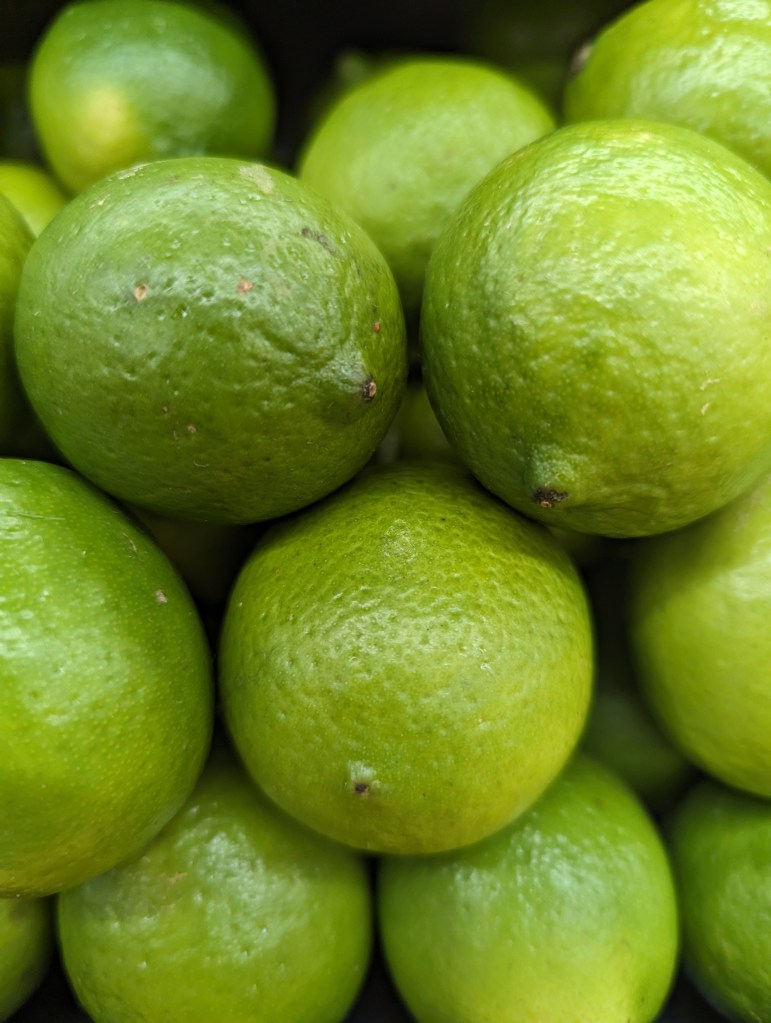
‘Valencia’ oranges, which are the traditional juicing oranges, might last through summer. They may sustain the belief that orange juice is a summery beverage. Several grapefruit cultivars can last about as long. ‘Eureka’ lemon is mostly seasonal, but also generates a few fruits throughout the year. ‘Bearss’ lime may be even more productive out of season.
With only one exception, all species and cultivars of citrus are of the same Citrus genus. Kumquats are of the Fortunella genus, but typically qualify as Citrus for simplicity. Citrus fruit is sweet, sour or bitter. Most familiar oranges are sweet. ‘Seville’ is a sour orange for marmalade. ‘Bouquet de Fleur’ is a bitter orange for infusing with Grand Marnier cognac.
Oranges, lemons, limes, grapefruits, kumquats and Mandarins are all very familiar. All of these fruits are available from grocery markets. Their trees grow in many home gardens. Tangerines are simply Mandarins or Mandarin oranges of the Americas. Pomelos, which are larger ancestors of grapefruits, are still uncommon. So are tiny and tart calamondins.
They are not the most unusual, though. Blood oranges provide tangy red juice. ‘Rangpur’ lime is a sour Mandarin orange that is as acidic as a ‘Eureka’ lemon. Tangelos combines the tartness of grapefruits with the sweetness of Mandarin oranges. Sweet limes lack the acidity of typical limes, so are for eating like oranges. These are merely a few examples.
There is nothing like the flavor of ripe fruit fresh off the tree during summer; whether cherries and then plums, prunes and apricots early, or peaches and nectarines in the middle, or pears and apples at the end of summer. Even though summer is still a few months away, it is already time to get ready for summer fruits, as well as almonds, by pruning the deciduous fruit trees that produce them while they are still dormant in winter.
Because fruit trees have been bred over the past many centuries to produce unnaturally large and abundant fruit, most are unable to support the weight of their own fruit without some sort of unnatural intervention. Trees consequently need to be pruned so that they do not produce so much fruit that their limbs break, destroying the fruit and disfiguring the trees. Pruning also helps to concentrate resources into fruit of superior quality instead of excessive but inferior fruit.
There are as many different techniques for pruning deciduous fruit trees as there are different types of deciduous fruit trees, and certainly too many to write about in a single gardening article. For example, cherries, plums, prunes, apricots, peaches, nectarines and almonds are all ‘stone fruit’ which need varying degrees of similar pruning. Peach trees produce the heaviest fruit, so require the most aggressive pruning. Cherry trees are pruned in a similar manner, but only minimally because they are not so overburdened with fruit. Only evergreen fruit trees like citrus, avocado, guava, olive and tropical fruits do not get some sort of pruning this time of year.
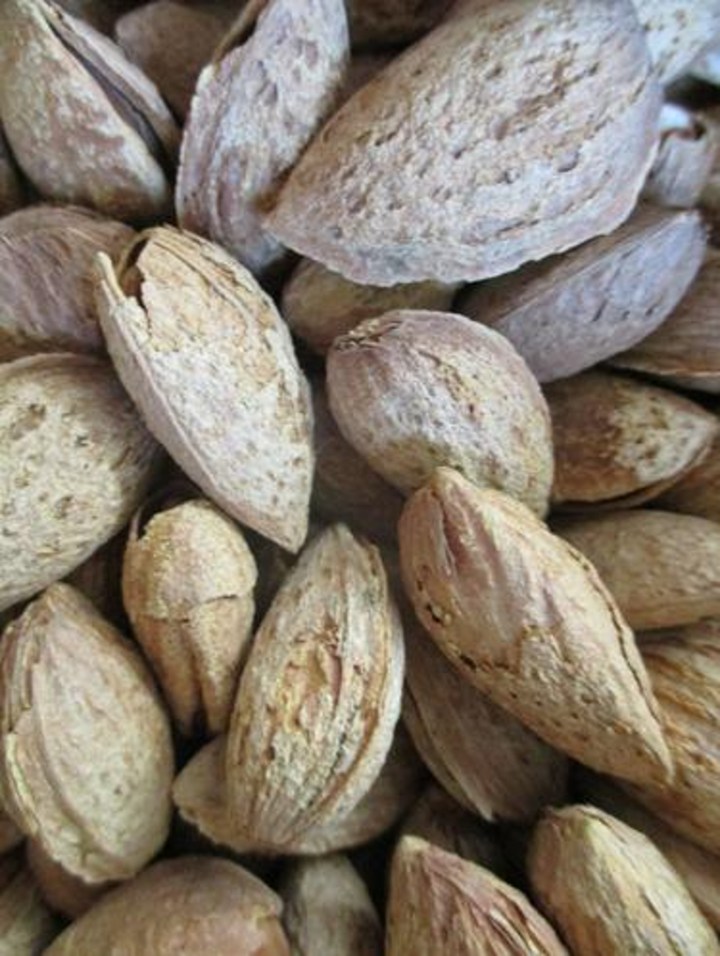
(Stone fruit have substantial seeds which are known as ‘stones’. Almonds are the stones of the fruit that comprises their hulls.)
It is best to become familiar with the pruning requirement of each type of fruit tree before planting them, since some are simply too labor intensive for some people, and most are too involved for almost all maintenance gardeners. It is also easiest to start with young trees and become more familiar and comfortable with pruning them as they grow over the years.
(Because this post is from an old article, outdated information was deleted below.)
Apricot, cherry, prune, almond, walnut, apple, pear, plum, fig and various other trees will be there. The 3.3 acre Historic Orchard was developed in 1994 to include more than 220 of the many types of fruit and nut trees that once made the Santa Clara Valley famous as the Valley of Hearts Delight.
Winter dormancy has advantages. It facilitates acquisition and establishment of bare root stock, and winter dormant pruning. Coppicing and pollarding are the most severe sorts of winter dormant pruning. Although initially ugly, coppiced and pollarded vegetation mostly grow vigorously later. Most species bloom and fruit better. All species foliate more lushly.
There is certainly nothing wrong with proper coppicing and pollarding. Both are common beyond America, particularly within Europe. However, both are very unfortunately vilified as disfigurement here. Not many arborists know how to perform such techniques, or may not admit to it. Yet, some coppiced vegetation is covertly popular in some home gardens.
Coppicing and pollarding are genuinely extreme and harsh techniques. Coppicing is the removal of almost all growth that is above the surface of the ground. For some shrubbery or trees, short stumps may remain. Coppiced vegetation is therefore not much to look at. Pollarding is similar, but retains primary trunks and limbs. Pollarded trees seem hideous.
Hideousness is subjective, though. By European standards, pollarding is an acceptable horticultural technique. European arborists know how to perform it properly during winter dormancy. They do so neatly, without stubs or torn bark, and direct growth as necessary. Coppiced vegetation is not as hideous because not much of it remains to see afterwards.
Because of its vilification, coppicing became more tolerable with different classifications. “Cutting back” perennials, such as African iris, lion’s tail and canna, is the same process. So is cutting back carpet roses or honeysuckle to the ground. The alternate classification is more acceptable. It is just as effective for removal of thicket or deteriorating old growth.
Also, coppiced vegetation regenerates more vigorously for spring than it may otherwise. Elderberries prefer selective grooming, but coppiced plants produce bigger fruit clusters. English Laurel, osmanthus, photinia and red twig dogwood respond nicely to coppicing. However, coral bark Japanese maple is grafted, so is likely to lose its scion if cut too low down.
As soon as any unsold Christmas trees move out of nurseries, bare root plants move in. Like Christmas trees, bare root plants are available within a limited season, while they are dormant through winter. They will all be gone by the time they start blooming and producing new foliage at the end of winter.
Bare root plants of course have ‘bare roots’, without typical media (potting soil) contained within cans or pots. Some get their roots wrapped in lightweight coarse sawdust to keep them moist without too much bulk. Others get their roots heeled into moist sand in nurseries, so that they can simply be dug when purchased.
Because bare root plants need much less space than canned (potted) plants, many more different kinds of deciduous fruit trees, roses, grapes, berries and even a few ornamentals are available. Bare root plants also cost about half as much as typical canned plants.
Since no nursery can stock all of what is available, more varieties are available from mail order catalogues and online. Most of what is available in local nurseries is selected for local climates. Plants purchased from catalogues or online need to be selected accordingly.
A main advantage of bare root plants is that they get established in the garden more efficiently than typical canned (potted) plants do. They get dug, transported and replanted into the garden all while dormant. By the time they wake up in spring, they are already in their new home, where they immediately adapt and start to disperse their roots into relatively uniform soil. Canned plants have confined roots that must disperse into unfamiliar garden soil
Bare root plants should get into the garden as soon as possible. If they do not get planted immediately, plants that were pulled from sand in nurseries should get heeled into damp soil or mulch, and watered to settle the fill. Alternatively, they can wait with their roots in buckets of water for a day to two. Bare root plants that are wrapped in bags of sawdust should be safe for more than a week in the shade outside.
Planting holes should be just large enough to accommodate the roots. If too deep, the loosened soil below is likely to settle and sink. Soil can be mounded into a small cone (known as a ‘volcano’) in the middle of each hole to spread roots over. Graft unions (seen as kinks low on trunks of fruit trees or where rose plants branch) of grafted plants should stand above the surface of the soil. Backfill soil should only be amended lightly, if at all.
Even though dormant plants get more moisture than they need from rain through winter, freshly planted bare root plants should get soaked twice immediately after planting to settle the soil around their roots. Lastly, damaged or superfluous stems can be pruned off. Most bare root fruit trees have much more stems than they should for padding in transportation and to allow more options for pruning.
Specialized dormant pruning improves fruit production.
Bare root season is synchronous with winter for one simple reason. Winter is when bare root stock is dormant. Dormancy similarly justifies winter pruning of deciduous fruit trees. It functions like anesthesia for surgery. While dormant, deciduous fruit trees are unaware of relocation or pruning. They resume growth for spring as if nothing stressful happened.
Winter pruning, or dormant pruning, would be inappropriate at any time other than winter. It is both very specialized for particular deciduous fruit trees, and, for most, very extreme. Some trees that benefit from it could not survive such procedures while vascularly active. Such pruning would involve the removal of most or all foliage if it were not already gone.
Winter pruning is no more unnatural than major breeding that necessitated it. Because of breeding, fruit trees produce unnaturally heavy and abundant fruit. Many can not support the weight of the fruit that they could potentially generate. Major pruning limits production and improves structural integrity of stems. It also confines production to reachable stems.
Production of unnaturally big and abundant fruit consumes substantial resources. Winter pruning concentrates resources into less excessive fruit of better quality. Since fruit is not as congested as it would otherwise be, it is more resilient to pathogens. So are its stems, foliage and precursory bloom. Fruit is easier to harvest from less congested stem growth.
Stone fruit trees and pomme fruit trees are the most common that require winter pruning. Stone fruit include cherry, apricot, plum, prune, peach, nectarine and almond. They need distinct degrees of similar pruning. Large fruit like peach necessitate aggressive pruning. Cherry and almond do not require as much. Pomme fruit include apple, pear and quince.
Deciduous fruit trees are certainly not low maintenance. Their reliance on winter pruning is undeniable. Those who would like to grow such trees should be aware of their cultural requirements. Diligent research of pruning techniques is very helpful. Annual experience is even better. It is an opportunity to observe how trees respond to all earlier procedures.
There should be no stigma associated with cut Christmas trees. They grow on farms, not within natural ecosystems, as some believe. Like cut foliage, cut flowers and vegetables, they are an agricultural commodity. They generate no more greenwaste than an average lawn. Yet, potted Christmas trees are popular as an ‘environmentally responsible’ option.
Potted Christmas trees, however, can be more of an environmental detriment. Only those that perform for a few years consume less resources than cut Christmas trees. Almost all deteriorate too much during their first summer for a second Christmas. Therefore, they do not perform any more perpetually than cut trees. They are, however, costlier and smaller.
The expense of potted Christmas trees is proportionate to the resources which they use. Proportionately, they require more fertilizers, pesticides and infrastructure than cut trees. This is also relevant environmentally. So is their synthetic growing medium, plastic pots, and for some, mylar wrapping. Transportation is more efficient only for the smallest sorts.
Regardless, for many households, potted Christmas trees remain after Christmas. Some of the most expensive sorts are fortunately more likely to be practical sorts. They may be compact types that are conducive to confinement within big pots. If so, they may function as Christmas trees for a few years. Afterward, they might fit nicely into their home garden.
This includes a few cultivars of spruce as well as fir and even pine. Dwarf Alberta spruce is easy to accommodate in both pots and gardens. Large specimens are expensive and rare though, so few need accommodation now. Blue spruce is more practical as a potted Christmas tree, but grows larger. Eastern redcedar can stay in a large pot for a few years.
The most common potted Christmas trees are Italian stone pine and Canary Island pine. These are the small sorts with cheap ornaments and mylar wrapping. They too often lack identification or description of how large they grow. Consequently, those who plant them too often provide inadequate space. Such big trees can be very destructive as they grow.
Some live Christmas trees grow too big for home gardens.
They appear to be so simple and innocent now, shorn strictly into conical form and perhaps adorned with any remnants of their Christmas time employment, but living Christmas trees can potentially become big problems. Italian stone pine, which is one of the most popular living Christmas trees, can get nearly eighty feet tall and sixty feet wide, with massive trunks and limbs! Regardless, they often get planted in small gardens and tight situations after Christmas because they do not seem like they would do any harm.
Most living Christmas trees can eventually become large trees. Canary Island pine, Aleppo pine, Monterey pine and Afghan pine are the most notorious since they are the most common, and also because they are not so easily recognized while they are young Christmas trees. Their juvenile foliage is more softly textured and often lighter colored than their more substantial adult foliage.
These most common living Christmas trees do not like to stay potted for very long, and are not very conducive to subsequent shearing. Consequently, many do not survive through their first summer, and those that do often get planted in the garden without much thought. Until recent years, they were seldom labeled; so few people knew how big they could get.
Coastal redwood, giant redwood, deodar cedar and Arizona cypress as living Christmas trees are neither as common, nor as likely to not get recognized as trees that eventually get quite large. They need their space nonetheless. Fortunately, they are generally somewhat more practical for some spacious gardens than the large pines are.
Scotts pine, Austrian black pine (rare), Japanese black pine, Eastern red cedar (juniper), Rocky Mountain juniper, some arborvitae and the various spruce are some of the best living Christmas trees. They grow somewhat slowly, are more cooperative with pruning and can live in tubs long enough to function as Christmas trees for a few years. When they eventually get too large for their pots, they are not so likely to get too large for the garden.
Whether a Colorado blue spruce being retired after ten years of service or an Italian stone pine being retired after only a single Christmas, a living Christmas tree needs some help with the transition from pot to garden. Any circling roots should be severed when the pot gets removed. Otherwise, roots become constricted as the circling roots grow and expand.
Much of the dense foliar canopy should be thinned out to compensate for confinement of roots. Besides, much of the shorn growth is actually disfigured and will eventually get replaced and shed as new growth develops above the original canopy. Formerly pruned spruce, redwood, deodar cedar and most pines may need minor trimming of the upper new growth to promote a single leader (that will develop into the main trunk).
It is best to plant living Christmas trees rather soon after Christmas so that they can loiter in the garden through winter. Rain and cool temperatures keep them from desiccating as their roots start to disperse before new foliage starts to emerge in spring. Newly planted living Christmas trees should be watered somewhat regularly during their first year because their roots take some time to disperse adequately.
Gardening is dynamic. It must adapt as each season becomes the next. Autumn became winter. Then, suddenly, the Christmas Season became bare root season. Cut Christmas trees that did not sell became green waste. Formerly expensive live Christmas trees that did not sell became bargains. They must relinquish their spaces for fresh bare root stock.
The chronology could not be better. Christmas trees are seasonable while not much else is. Their season abruptly ends precisely as bare root season begins. Bare root season is contingent on the winter dormancy of all associated bare root stock. While dormant, such stock is unaware of what is happening. Otherwise, it would not survive such techniques.
Bare root stock grows in the ground on farms. The roots become bare by separation from their soil during winter dormancy. They should be comfortable within the soil of their new gardens before dormancy ends. They disperse new roots into their new gardens as they resume growth after dormancy. Therefore, transition from farm to garden should be quick.
Some bare root stock arrives by parcel delivery with damply wrapped and bagged roots. More is available from nurseries, with its roots relaxing within damp sand until purchase. Some is available within individual bags of damp sawdust. Most bare root stock benefits from generally minor trimming or grooming. All benefits from prompt and proper planting.
Bare root season is the best time to procure and install several types of plants. Bare root stock is significantly less expensive than canned stock. It is also much less cumbersome to bring home from nurseries. Because bare roots were never confined within cans, they disperse more efficiently. Formerly canned root systems must recover from confinement.
Deciduous fruit trees and roses are the most popular bare root plants. More cultivars are available during bare root season than as canned nursery stock later. Several deciduous but fruitless trees, vines and shrubs are also available. So are a few types of berries and perennials, like rhubarb, asparagus and artichoke. Bare root season finishes with winter.
Evergreen foliage and colorful berries might be more prominent than flowers about now. They should be. Evergreen foliage is, as implied, evergreen. Colorful berries need to be appealing to wildlife that disperses their seed through winter. Not so many winter flowers bloom, though. Most flowers want their bloom season to be favorable for their pollinators.
Flowers that do not rely on pollinators can bloom whenever they choose to. Yet, because they do not rely on pollinators, most waste no resources on floral color. Flowers are, after all, only colorful to attract pollinators. Therefore, if flowers that need no pollinators bloom now, most are easy to ignore. Flowers that are colorful now can probably justify being so.
Most colorful flowers bloom while their pollinators are most active, during warm weather. Some from cooler climates can bloom now simply because they do not know it is winter. Some from milder climates can bloom now because they do not know how cool winter is. Several winter flowers actually bloom now to exploit pollinators who are active in winter.
Winter flowers of some species of Salvia appeal very specifically to hummingbirds. Such species are native to regions where hummingbirds overwinter. Their floral colors are the sort that hummingbirds pursue. Their floral structure and nectar favor the eating habits of hummingbirds. They bloom during winter because that is when they expect their guests.
Camellias of various cultivars are among the most popular and reliable of winter flowers. Different cultivars bloom at slightly different times. Witch hazel cultivars can bloom nicely on bare stems where chill is adequate. Winter jasmine requires less chill and blooms as splendidly, but only with yellow. Oregon grape is also limited to yellow, but is evergreen.
Cool season annuals generally provide the most colorful of winter flowers. Unfortunately, most perform only until warmer spring or summer weather. Pansy, viola and primrose are the most familiar. Primrose becomes popular a bit later, and can continue as a short term perennial. Ornamental kale looks like big winter flowers, but is really big colorful foliage.