Microclimates Are Distinct From Climates

Larger buildings inevitably produce larger microclimates.

Climates and geology are why cinema and television industries are so established here. Cinema evolved in Niles before relocating, with the evolution of television, to Hollywood. The diversity of local climates, geology and associated scenery was the primary appeal. Farmers of all sorts had already been exploiting such climates as well as microclimates.

Climate is a regionally prevalent pattern of weather. Mediterranean or chaparral climates are prominent locally. Coastal, desert and alpine climates occupy other relatively nearby regions of California. Variations of geology influence weather, which determines climate. This comprises mountains, valleys, various altitudes and proximity to the Pacific Ocean.

Microclimates, as their designation suggests, are small climates within big climates. With such a mix of climates here, microclimates might be difficult to distinguish. Some climate zones of steep coastal hillsides are very narrow, for example. Yet, if they are distinct from those for higher and lower elevations, they are climates. Microclimates are even smaller.

For microclimates, exposure is as relevant as endemic climates. Such exposure can not change climate, but modifies its influence. For example, large eaves and warm walls can provide localized shelter from frost. Southern slopes of hilly terrain are likely a bit sunnier and warmer than northern slopes. Buildings and fences shade garden area to their north.

Many microclimates, such as those that involve terrain or forest shade, are natural. They are generally less dynamic than unnatural microclimates. Forest shade changes only as fast as associated trees grow or die. Only major disruption, such as fire or timber harvest, accelerates such slow change. Terrain may not change significantly for millions of years.

Unnatural microclimates are more dynamic and unpredictable. Taller modern homes and fences shade more within adjacent gardens. Skyscrapers can extend their shadows into gardens a few blocks away. Conversely, some can reflect sunlight to adversely increase heat and glare. Expansive and unshaded pavement likewise increases ambient warmth.

Aromatic Foliage Is An Acquired Taste

Foliar aromas and flavors that are useful for culinary application deters many grazing animals.

The infinite variety of colors, fragrances, flavors and even textures that plants use to solicit the help of wildlife is amazing. Flower color, fragrance and sometimes texture are customized to attract very specific pollinators, and guide them to where they are needed. Many flowers direct and reward their pollinators with flavorful nectar. Fruit color, flavor and aroma attract specific animals to take the fruit, and disperse the seeds within. There is no end to what plants will do for their friends. We are merely secondary beneficiaries.

It is ironic that we also enjoy aromas and flavors that are instead designed to be objectionable to plundering herbivores. For example, the appealingly pungent foliage of most herbs is actually intended to repel grazing animals or feeding insects. We not only exploit these herbs for culinary purposes, but also to add their aromas to our gardens.

Lavender, mint, rosemary and the various thymes and sages are the most popular herbs that are attractive both aromatically and visually, whether or not we actually use them in the kitchen. Rosemary is actually a common and practical ground cover for large areas. Thyme is a good ground cover for smaller areas, and stays low enough to be grown around stepping stones where it becomes even more aromatic if stepped on.

Grecian or sweet bay is another herb that actually grows into a sizeable but practical evergreen tree. The native bay laurel is a bit too large to be as practical where space is limited, but is even more pungent. Although generally not useful as herbs, the various cypresses, pines, cedars and eucalypti are appreciated for their aromatic foliage as well. Incense cedar is particularly pungent.

Two of my favorite types of plants, junipers and geraniums, are among the more common aromatic shrubbery. Although actually considered to be perennials, zonal, ivy and of course, scented geraniums, can be used as small shrubbery or small scale ground cover. Junipers of course, range from ground covers to shrubbery to small trees.

Rockrose, breath of Heaven (Coleonema spp.) and myrtle are all quite aromatic. The old fashioned myrtle that gets considerably larger than the modern compact variety is even more aromatic. Lantana is an aromatic ground cover or low mounding shrubbery.

The aromas of aromatic foliage are strongest as fresh new foliage emerges in spring, and particularly after spring rain. Some people like to put aromatic plants where they will be slightly in the way, since foliage relinquishes its aroma more readily when slapped with a gate, bumped, or otherwise disturbed. 

Environmental Factors Silently Influence Bloom

California poppy dramatizes favorable weather conditions.

Superbloom occurs only about once every decade or so. It is very unpredictable though. It can happen for two or even three consecutive springs. Alternatively, it may not happen for two decades. It can be as early as late February, or as late as late May. It can last one or a few weeks. Superbloom is as variable as the environmental factors that influence it.

Actually, all bloom relies on influence from variable environmental factors. That is how it knows how and when to bloom. It is also why many species are so irregular about doing so. Various species prioritize reliance on various environmental factors. Therefore, some may bloom early or late while others adhere to stricter schedules. It can get complicated.

Warmth is undeniably the most significant of environmental factors that influence bloom. Cool weather inhibits bloom, even as growth resumes at the end of winter. Then, warmth accelerates bloom, mostly during spring, but also into summer. Many species continue to bloom as long as the weather stays warm. Very few prefer to bloom during cool weather.

As mentioned, the influence of environmental factors can get complicated. Many species actually require sustained winter chill, or vernalization, to bloom well. It is how they reset their growth seasons to begin in winter. Peony is unreliable here because of inadequate chill. After unusually cool winter weather though, flowering cherry and lilac bloom better.

Humidity is another important environmental factor. Although it does not stimulate bloom for more than a few species, it can prolong bloom. Some flowers, particularly from humid climates, can desiccate with aridity. Conversely, even flowers from desert climates retain hydration better with humidity. Also, rain provides water for areas that lack any irrigation.

Species from mild but not tropical climates might rely more on photoperiod than weather. Poinsettia in the wild does not experience sufficient chill to distinguish winter. It monitors the photoperiod, which is the duration of daylight, instead. It knows to bloom when nights are longer than days. A few species use the same very consistent technique to bloom for other seasons.

Undoing of Fragrance

Extensive breeding can compromise floral fragrance.

As I enjoy good friends and cheap coffee out on the deck, I am also savoring the sweet fragrance of the abundant white bloom of the black locust off in the distance. I know that black locust is a noxious weed that invades riparian environments; but they smell so good on such pleasantly warm spring days. Modern varieties are certainly better behaved and more colorful with their pink to purplish flowers, but their fragrance does not compare so well.

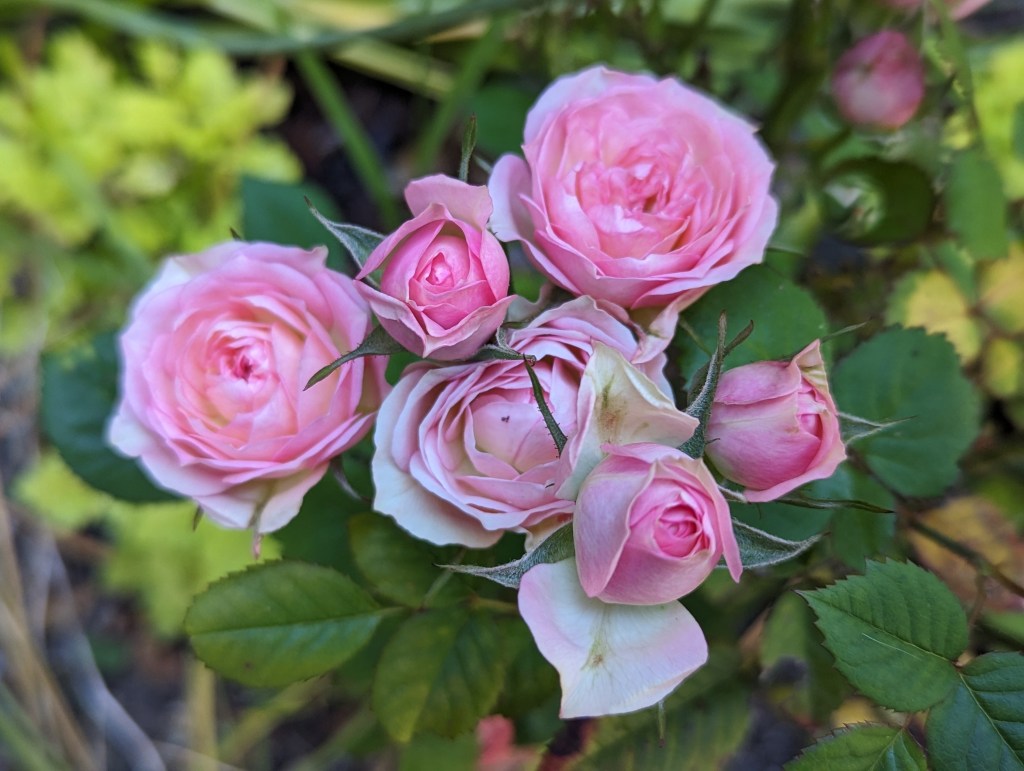
Earlier here on the deck, one of my friends and I discussed how modern Buicks are much safer than old classic Buicks are, but are not quite as elegant and stylish. It made me think of how decades ago, modern roses were developed for flower size, form, color and stem length, but in the process, were deprived of, among other qualities, their fragrance. Perhaps I would have been more attentive to my friend if the coffee were as potent as the fragrance of the black locust.

Modern varieties of many classic flowers are less fragrant than their ancestors were. This is because decades (and centuries) ago, fragrance generally had not been prioritized in breeding as much as were other physical characteristics, such as flower size, form, color and so on. The plants that were consequently used for breeding typically had the most visually appealing flowers, but lacked fragrance. Such disparity is actually quite natural among plants with variable flowers.

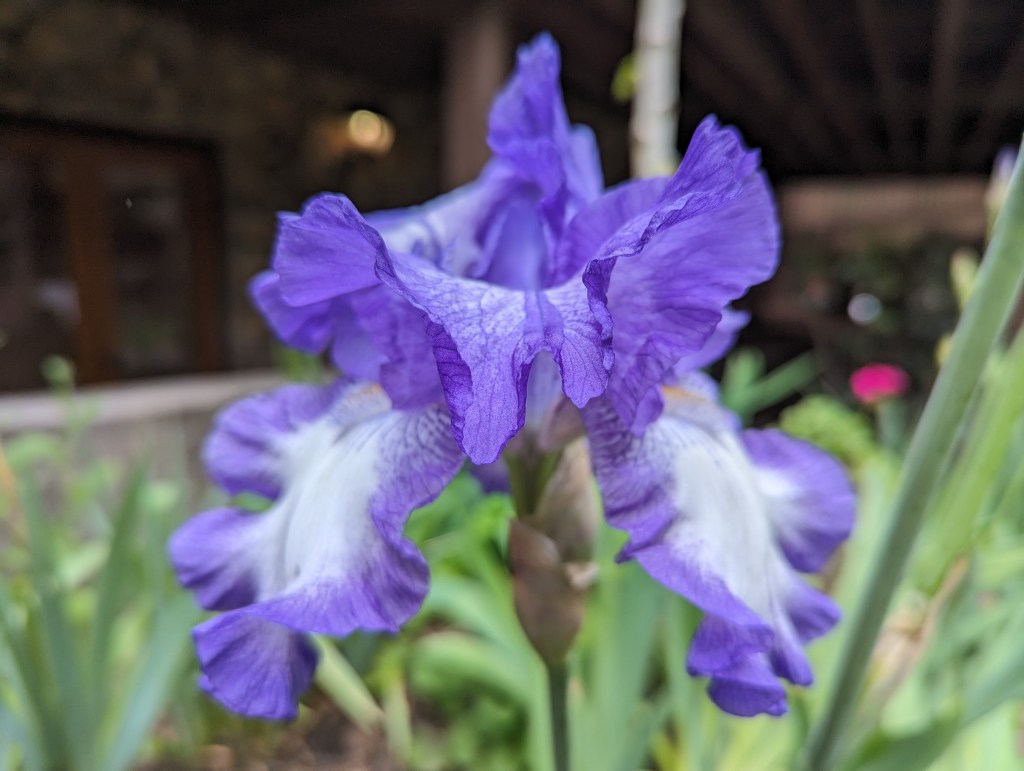
For example, most bearded iris that naturally have the biggest, fanciest and most brightly colored flowers are also the least fragrant. Their progeny that have become the modern varieties are just as flashy, and also, just as deficient of fragrance. Conversely, the relatively small and simple pale purple flowers of my favorite ‘Grandma Sheppard’ bearded iris are remarkably fragrant.

To the iris, this is all quite sensible. Their fragrance is not designed to impress us, but is merely intended to attract pollinators. If they are fragrant enough to entice the insects that bring them pollen, they do not need to waste any more effort on visual appeal. Without fragrance though, they can alternatively use color (including infrared and ultraviolet) to direct insect traffic where they need it to go in order to accomplish pollination. Almost all of the many varieties of iris prefer to specialize in one or the other; either fragrance or visual characteristics, but not both.

So many of the old classics seem to have lost some or most of their fragrance as they have ‘improved’ over the years because visual appeal has been prioritized more than fragrance. Besides flowering locusts, roses and iris, some types of honeysuckle, mock orange, sweet pea, violet, hyacinth, lily and even narcissus are less fragrant than their ancestors were. However, traditional as well as modern fragrant roses and iris seem to be gaining popularity. Fortunately, gardenia, lilac, wisteria, stock and the fragrant types of angel’s trumpet and jasmine are probably as potent as they have ever been because they have not been tampered with as much.

Xeriscape Is Definitely Not Zeroscape

Ocotillo actually prefers more xeric climates.

“Zeroscape” is a neologism that evolved from “xeriscape”. It was a mispronunciation that became a misspelling that became a real word. Ironically, it makes sense. It evolved with the misconception that a xeriscape requires no maintenance. Now, the two are different types of landscapes. A Zeroscape is pavement or gravel that requires zero maintenance.

A xeriscape is a landscape of xeric vegetation. Generally, such a landscape needs less maintenance than conventional landscapes. Nonetheless, some degree of maintenance is necessary. Furthermore, several xeric species require very specialized maintenance. Such specialized requirements may be more demanding than more familiar gardening.

The primary advantage of a xeriscape is that it needs less water than other landscapes. Some xeric species are native to Mediterranean climates. More are native to arid desert climates. Once established, they need minimal irrigation. Many xeric species get all the moisture they need from seasonal rainfall. Some can not tolerate much more than that.

Native species that grow wild can be surprisingly difficult to establish in home gardens. Some xeric species can be even more uncooperative. Cultivation within a garden is very different from natural conditions. In the wild, such species disperse roots proportionately as they grow from seed. In a garden, they begin with detrimentally confined root systems.

Even xeric vegetation within a xeriscape needs moisture while it disperses roots. A few may get enough through winter if they get into a garden early in autumn. Most prefer a bit of irrigation at least through their first year. The difficulty is that some can rot if irrigation is even slightly excessive. They are more susceptible to rot than species that are not xeric.

Maintenance of a xeriscape, is more challenging than demanding. That is because so many xeric species are from harsh desert ecosystems. They innately defend themselves from grazing wildlife. Consequently, cacti, agaves and yuccas are wickedly thorny and spiny. Several are potentially dangerous to handle. So are some euphorbs and acacias. They may not need maintenance often, but when they do, they do not make it at all easy.

Some Exotic Annuals Self Sow

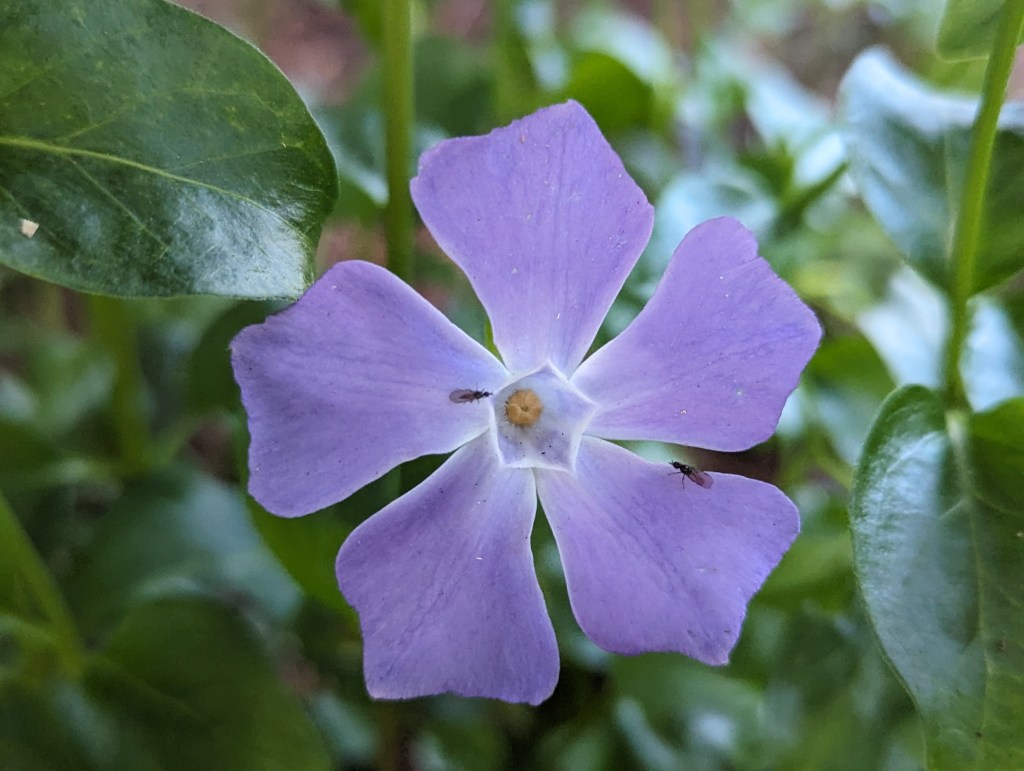
Periwinkle can naturalize a bit too aggressively.

It is impossible to say how long native wildflowers have adorned the natural landscape of California. Various lupines, California poppy and evening primrose had always been the most colorful wildflowers locally until they began to be displaced by exotic (non-native) plants only in the past two centuries or so. Although natives are remarkably resilient to dry summers and occasional wildfires, they are not very competitive with more aggressive and prolific invaders. What the natives and exotics have in common though is that they are so well adapted to local environmental conditions that they are able to perpetuate without much help.

Lupines, poppies and evening primrose, as well as native yarrow, godetia, and fleabane, may unfortunately need a bit of help if exotics want to move into their territory. In areas that are regularly or even only sometimes watered, weeding to remove more aggressive exotic plants helps the natives stay in control. They should otherwise do well on their own. Although without irrigation their growing season is much shorter, natives are slower to be displaced, since so many of the otherwise competitive exotics are not adapted to dry summers.

Many exotic flowering annuals are prolific enough to almost become naturalized, but are not quite aggressive or adaptable enough to get very far from cultivated landscapes. Cosmos, nasturtium, alyssum, catchfly (silene), four o’clock, gaura and foxglove self sow so readily that they are considered by some to be invasive. Some of us instead consider them to be ‘reliable’. They can be useful for unrefined parts of the garden that we do not mind watering, but otherwise do not want to put much effort into.

However, foxglove and even nasturtium can actually become noxious weeds in coastal areas not too far from here. I think that forget-me-not, feverfew, baby tears and English daisy can be problematic anywhere that they get enough water. Also, most annuals eventually revert to more genetically stable forms; which is why all varieties of dwarf nasturtium eventually bloom with the same yellow or orange single flowers. Yet, if we can distinguish between the plants that we can appreciate for their reliability and those that can be too invasive, native and exotic wildflowers and not so wild flowers can make gardening a bit easier.

Mediterranean Climate Is Quite Californian

New Zealand natives perform well here.

“Mediterranean” translates from Latin to “middle of land”. The Mediterranean Sea is in the middle of the land of those who named it. Other regions were either unimportant or unknown to them until the Sixteenth Century. Nowadays, most people of the World are aware of many other regions. A few of such regions also enjoy a Mediterranean climate.

Such climates are obviously not confined to the regions of the Mediterranean Sea. They merely resemble such climates. Some extend eastward into Western Asia. Others are in eastern and southern Africa, southwestern South America and Columbia. Larger regions of such climate are in southern Australia. The closest are here in western North America.

Even these limiting regional designations are debatable. Many horticulturists consider climates of New Zealand to be typical Mediterranean. Such climates are mostly between thirty and forty five degrees north and south. However, some might exist within northern India and southern China. Ultimately, climate is meteorological rather than geographical.

Mediterranean climates receive almost all of their rain during winter. Rain is very minimal through summer. Even if it is twice as abundant in other similar climates, it conforms to a similar schedule. Although winter chill is adequate for many species that need it, frost is mostly minor. Locally, summer weather does not often become too uncomfortably warm.

Native species know what to expect from local climate. So do exotic species from similar climates. Some may prefer more or less winter rain, summer heat or winter chill. Almost all can tolerate warm summers without rain, though. Such weather conditions are normal for them. Therefore, the most adaptable exotic species locally are from similar climates.

This includes species of Eucalyptus, Pittosporum and Callistemon from Australia. Aloe, Agapanthus and Morea are from South Africa. Phormium and Leptospermum are from New Zealand. Oleander and the various species of Lavandula are truly Mediterranean. In the past, a few exotic species adapted too efficiently to become invasively naturalized. Horticulturists are now careful to not import such potentially aggressive species.

Improper Pruning Is More Work Than Proper Pruning

Vine maples should be small trees, not . . . this.

In the short time it took me to run to the back yard to get some big stakes and something to pound them into the ground with, the unfortunate deed had been done. I had come home to find that one of my neighbor’s new Canary Island pine trees had blown down. I also noticed that the gardeners were there; so I wanted to get the tree staked properly before the gardeners got to it. Sadly, as I returned with stakes, ties and a mallet, I found that the gardeners were faster. Instead of standing the small tree up and staking it, they had already shorn the formerly well structured canopy into a globular mound that was about the same size and shape as most other items throughout the landscape, for no other reason than it was within their reach.

This same landscape had egg shaped African iris ‘bushes’ that only rarely bloomed if they happened to get an errant flower stalk out between shearings, and short, round trumpet vine ‘bushes’ in front of hefty  but bare trellises that they were never allowed to climb. Everything that was within reach was shorn, even the underside of an elegant Chinese elm that really should have been pruned properly by an arborist. The landscape was actually well designed, but could not perform as planned because of the shear abuse.

I really do not mind proper shearing of particular shrubbery that is intended to be shorn. I actually like old fashioned privet or boxwood hedges. However, even hedges need to be shorn properly; and realistically, not much else should be shorn as often. If it needs to be shorn regularly, but is not a hedge, it is probably not the right plant material for the job.

Properly selected plant material is proportionate to its particular application. This certainly does not mean that it does not need to be pruned. Most deciduous fruit trees and roses need to be pruned aggressively every winter, and almost all plant material needs to be pruned in some manner at one time or another. The difference is that shearing is indiscriminate pruning of outer growth without regard for foliage, bloom or branch structure. This is fine for hedges, but disfigures many other plants, and deprives them of their blooms and natural foliar textures that they were planted for.

For example, wisteria is an abundantly blooming robust vine that becomes a gnarled shrub that cannot bloom if shorn. Heavenly bamboo (nandina) is grown for its graceful and colorful foliage, but becomes a grungy rigid thicket of tattered leaves and stems with shearing. Although some shrubby junipers can make nice low hedges, frequent shearing deprives them of their feathery texture.   

This is why it is so important to know what the various plants in the garden need. They can only perform as intended with the proper care and maintenance, which includes proper pruning. Hedges may only need to be properly shorn, but almost everything else needs to be selectively pruned, thinned, elevated (raised), divided, groomed, trimmed, trained or even cut back. 

Colorful Foliage Without Colorful Bloom

Barberry can be bronze or gold.

Floral color gets most of the attention within home gardens through spring. It should. It is the most copious and most colorful of color. Though, it is not the only color. A few species that provide floral color, and more that do not, provide colorful foliage. Similar to Olympic Medals, this foliage can be bronze, silver or gold, or variants of such. Some rivals bloom.

Colorful foliage is not the same as foliar color of deciduous foliage as it sheds in autumn. Much is evergreen. Most is most colorful while it grows through warming spring weather. Actually, most fades through summer, and some becomes simpler dark green by autumn. Afterward though, some deciduous colorful foliage also develops foliar color for autumn.

The most popular colorful foliage is variegated. This means it is partly green with stripes, margins, blotches, spots, patterns or blushes. The color range of such variegations is as variable as its pattern range. Some foliage is variegated with a few vividly distinct colors. New Zealand flax, coleus, croton and caladium are some of the more familiar examples.

Of all unvariegated colorful foliage, bronze foliage is the most variable. It includes foliage that is brown as well as reddish, purplish or perhaps dark orangish. Some emerges pink before developing a darker shade. New photinia foliage is reddish bronze only briefly as it matures as dark green. Purple leaf plum and smoke tree are famously purplish bronze.

Silver foliage is the most useful colorful foliage in the wild. At high elevations, where sun exposure is harshly intense, it is selectively reflective. It absorbs sufficient sunlight for its photosynthesis, but not enough to succumb to scald. It is how Arizona cypress and some agaves survive in the high desert. Such foliage may be gray, pallid blue or almost white.

Many species with gold foliage are the same as those with bronze foliage. New Zealand flax, smoke tree, barberry and elderberry can be either bronze or gold. Since gold foliage contains less chlorophyll than green foliage, it is a bit less vigorous. Unlike silver foliage, it serves no natural practical purpose. It survives in landscapes for visual appeal.

Snail Season

Very fresh escargot

The problem with escargot that is too fresh is that it grazes – a lot! Snails, as well as slugs, lurk in our own gardens, waiting for nightfall, or sometimes not, to emerge and devour any tender plant parts that appeal to them. They tear apart large leaves and fresh flowers, and eat seedlings completely. They are particularly problematic this time of year, while the garden is still damp, but the weather is getting warmer, and especially since there is so much fresh new vegetation for them to eat.

The most effective means of controlling these troublesome mollusks is to eliminate their hiding places where they camp out during the day. This involves pulling large weeds and removing any debris that may be laying about the garden. Leave no stone unturned. Of course, this is not so easy in lush gardens with abundant or overgrown foliage, and features like large pots and statuary. In such situations, cunning and diligence are in order.

I have found bare copper wire wrapped around pots, planters and tree trunks to be an effective deterrent. Copper tape sold in nurseries and garden centers is probably better since it is wider. It can be self adhesive, or stapled to wooden containers or shelves. Snails can get past the copper though, on any plant parts than hang over where the snails can reach. Wire should be removed from tree trunks after ‘snail season’, or wrapped in a manner that accommodates for trunk expansion. For example, an ‘S’ shaped curve in the circling wire set flatly against a tree trunk provides enough slack for a bit of expansion.

It is also good to hunt snails as they come out after dark or before they go in for the morning. They are neither elusive nor fast. They are merely objectionable to handle. Laying a piece of cardboard or similar material out for them to hide under, and then surprising them during the day is a sneaky trick, but effective. Putting small puddles of beer out in shallow containers, such as saucers for potted plants, is more work, but not often as effective. It is sneakier though, since it entices the snails to stay out drinking until they die in the sunlight.