Irrigation Technology Can Get Complicated

Modern irrigation does not age well.

Old fashioned irrigation systems were quite thorough, and technically sustainable. They broadcast generous volumes of water over any vegetation that required it. Their systems were too simple to need much adjustment. Their metallic composition was very resilient. That is why so many old systems were in service for so long. Some continue to function.

However, such old fashioned irrigation systems were not perfect. Their consumption was not as sustainable as their plumbing. They wasted water on vegetation that needed less, and pavement. Some of the broadcast water evaporated before reaching any vegetation. Without automation, old irrigation systems operated when convenient for their operators.

Modern irrigation systems are typically more efficient. Automation allows them to operate prior to sunrise to limit evaporation. Most modern systems apply water directly to the soil. This leaves no irrigation water to evaporate from foliar or other surfaces. Also, it prevents evaporation from airborne broadcast irrigation water. Evaporation innately wastes water.

Of course, modern irrigation systems are no more perfect than old systems. Groundcover and lawns still rely on broadcast irrigation. Such systems still waste water on pavement. Automation can actually waste water if not adjusted manually for rain and other weather. Only the most modern automation adapts to weather. No system responds to vegetation.

Consequently, irrigation can become either deficient or excessive as vegetation matures. Many native species need regular irrigation only as they disperse roots after installation. They are likely to rot with the same irrigation as they mature. Many tropical species need more water as they grow. Some vegetation, as it grows, can obstruct broadcast irrigation.

The complexity of modern irrigation systems complicates their maintenance. Automation is merely one component of the infrastructure. Emitters of drip irrigation sometimes need relocation or replacement. They are sometimes difficult to find below healthy vegetation. Because components are plastic, they are not as durable as old fashioned components.

Hydrangeas Perform Better With Proper Pruning

Pruning of one season affects bloom of another.

After decades of breeding, most modern cultivars of hydrangea are much more compact and a bit stockier than old fashioned hydrangeas that had long, limber stems that could bend downward from the weight of their own blooms. They stand up to proudly display their modern, vibrant color, even when their billowy blooms get heavy with rain. Yet, even with all their genetic improvements, they should still be pruned properly and annually to promote continued bloom. Without pruning, even modern cultivars can get floppy and lanky.

Because most hydrangeas bloom on stems that developed during the previous year, they should not be pruned too much while dormant through winter. Instead, solitary (generally unbranched) stems that grew from the base last year and bloomed this year should be pruned back to a pair of buds about a foot high as their blooms deteriorate. Even though some blooms continue to develop late into autumn, most are finishing about now. Therefore, pruning stems back while also removing spent blooms gets the pruning done early enough for the side buds to start to grow into secondary stems.

These secondary stems should not get pruned again, even when they go dormant through winter. They do not grow much before winter, but should be mature enough to bloom during the following spring. Thinning these branched stems through winter by cutting some of the smaller stems to the ground should produce fewer but significantly larger blooms, as well as prolong the blooming season. (However, many modern cultivars naturally bloom sporadically after their primary bloom phase until autumn anyway.)

New canes that develop from the ground to replace older branched stems may not bloom their first year, but can be left unpruned through winter to bloom early the next spring, which starts the process over again. Old stems should be cut to the ground after their third year (second bloom season). Leaving a few spent blooms on the plants long enough to dry (as dried flowers) should not interfere too much with proper pruning.

Fads Influence Contemporary Garden Design

Even boulders can become a fad.

Landscape design and gardening trends change like every other sort of fashion. Several fads of the past were quite practical and justifiable. Many were not. Whether justifiable or not, many merely became old fashioned. Some evolved into a more contemporary style. Others were not so adaptable. Planning for a landscape is easier than planning for fads.

For example, plants seem to be disproportionately small within a new landscape. That is because someone planned for them to have sufficient room to grow. Shade trees should eventually mature to be proportionate to their respective spaces. In fact, all plants should mature accordingly. However, overly trendy queen palms can become passe at any time.

Many home gardens contend with fads from the past that are awkward to accommodate. Strict symmetry that was very common long ago has become more than old fashioned. It is now considered to be unappealing. Relaxed asymmetry is now common and popular. Of course, this is an advantage as aged trees of symmetrical rows begin to die randomly.

Queen palms that became popular in the 1990s are getting more expensive to maintain. Only professional arborists can groom them as they get too tall to reach from the ground. Queen palms at rear fences of backyards were a fad. Sadly, most utility cable easements are above such rear fences. Palms that encroach too closely necessitate costly removal.

Living Christmas trees was another fad that caused serious problems later. Most of such trees were either Italian stone pine or Canary Island pine. Many found permanent homes within confined home gardens after Christmas. They seemed to be so docile while small and potted. The problem was that both species grow too big for compact home gardens.

Sustainability is presently a fad that actually has potential to be beneficial in the future. It only needs proper execution. The results of fads may linger long after the fads are gone. Many trees that are fads now could survive for centuries. No fad demonstrates that more accurately than sustainability. That which is truly sustainable can evolve with future fads.

Blackberries And Raspberries Are Expensive For A Reason.

Cane berries need aggressive pruning, but are no fun to prune.

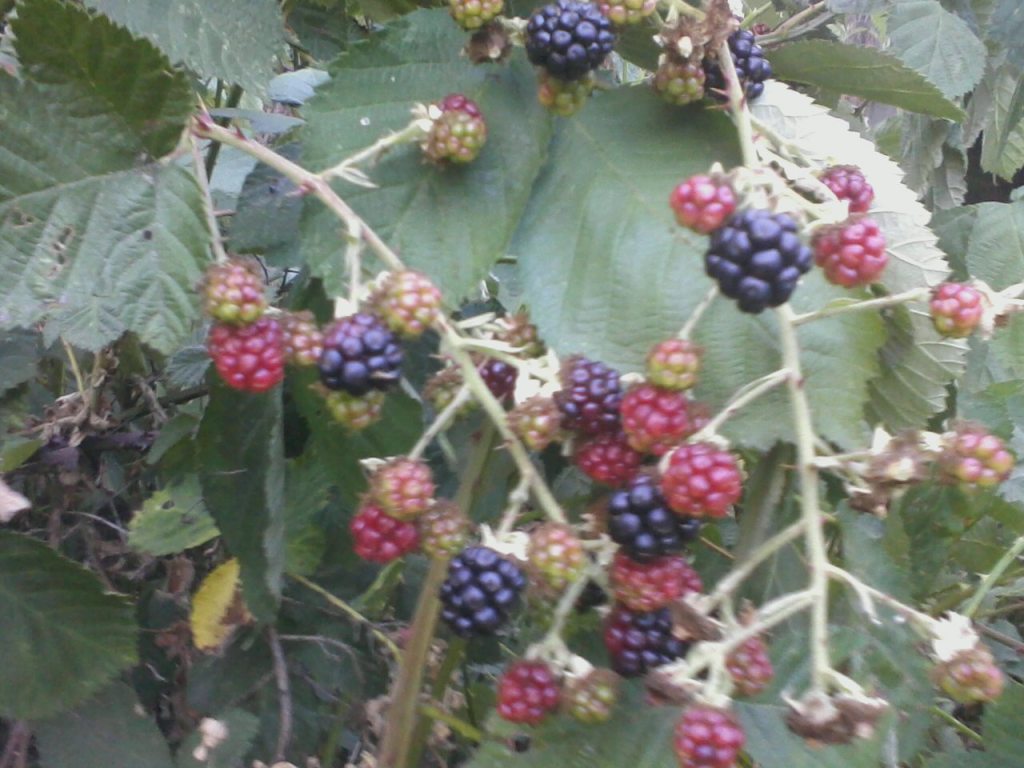
All the raspberries and blackberries that are now ripening do not come without a price. The canes that produce them may grow like weeds, and in many gardens really are weeds, but they need quite a bit of work. Like the deciduous fruit trees that need such meticulous pruning while dormant in winter, berry canes need winter pruning while dormant, as well as summer pruning as the berries finish.

Blackberry canes that have produced fruit should be cut at the ground as the fruit gets depleted. Then, for ‘trailing’ varieties, about a dozen of the new canes that grew since spring should be selected, pruned to about six feet long, and trained onto the same supports that the removed canes used. ‘Semi-erect’ varieties need only about half as many canes, and get cut about a foot shorter. (‘Erect’ varieties that get cut even shorter are not common locally.) All other canes should be cut to the ground. Through the rest of summer, the pruned canes develop side branches which should eventually get pruned to about a foot long in winter to bloom and produce fruit next year; but that part must wait.

Summer bearing raspberries, like ‘Willamette’, ‘Tulameen’ and ‘Canby’, do not need to develop side branches to produce fruit next year, so do not necessarily need to be groomed of spent canes and pruned just yet, and can actually wait until winter. Everbearing raspberries like ‘September’, ‘Heritage’ and ‘Fallgold’, are not nearly so simple, although canes that were selected while young last winter and allowed to grow through summer likewise need no pruning just yet. The top portions of these canes will produce fruit later in autumn, and later in winter, get pruned down as low as fruit developed. However, the lower portions of older canes that fruited the previous year and got their tops pruned down last winter are now finishing their second and last phase of fruit production, so should get pruned out as they finish.

Sustainable Horticulture Should Be Sustainable

Lily of the Nile is sustainable!

There is no doubt about it. Weeds are sustainable. Otherwise, they would not be weeds. By definition, they grow where they are undesirable. Less sustainable vegetation should be less invasive. Also, it should be less resistant to eradication than most familiar weeds are. Unfortunately, also by definition, weeds are undesirable. They can not become fads.

Sustainable horticulture is a fad though. Unlike most fads, it is actually quite sensible. In theory, it is horticulture that requires as minimal intervention as possible. It excludes that which requires intensive or impractical cultivation. For example, native species that grow wild are sustainable. Tropical species that may survive only within greenhouses are not.

A problem with the sustainability fad is its marketability. ‘Sustainable’ and ‘Sustainability’ have become cliche buzzwords. They too often describe merchandise that is contrary to the fad. Realistically, genuine sustainability is unsustainable within profitable marketing. Truly sustainable merchandise would eliminate most of the need to ever purchase more.

Modern cultivars can qualify as ‘new and improved’ as they first become available. They are certainly new. However, their improvements may be questionable. Hybridization and extensive breeding can cause genetic deficiency. Even natural variegation compromises vigor. Seed is not true to type. Most aesthetic improvements are contrary to sustainability.

Native species are technically sustainable. Once established, they might survive without irrigation or other attention. Unfortunately though, some are not very adaptable to refined home gardens. Some are vulnerable to rot if nearby vegetation needs frequent irrigation. Some perform vigorously only for a few years. Several species are innately combustible.

Ironically, several of the most passe and old fashioned species are the most sustainable. That is why some of them became passe. Lily of the Nile can survive indefinitely. If it gets overgrown, it is easy to divide and relocate. It may be available for free from neighbors or friends. African iris, New Zealand flax, bergenia, most aloe and many yucca are similarly sustainable.

Tree Stumps May Put Up A Fight

Some stumps die immediately. Some do not.

Trees of all sorts are among the most important features of most gardens, and are also the most substantial. Yet, in the end, whether they get too big, too crowded, too hazardous or simply succumb to old age, they eventually need to be removed.

Getting rid of the brush (foliage and smaller limbs) of smaller trees is generally not much of a problem, especially where greenwaste can be left at the curb for recycling. Larger limbs and trunks can be cut and split into firewood. The brush and wood of trees that are so large that they need to be removed by professionals typically gets taken away be the same professionals. The most difficult parts to remove though, are the stumps.

Professional tree services typically offer the option of stump grinding. This works well for the most obtrusive stumps that are accessible. Other stumps get left either because they are inaccessible, or because of the expense of grinding.

Stumps that are within ground cover or shrubbery often get obscured by the surrounding vegetation, and are never seen again. Others are not so easy to hide. Many refuse to die for several years, and may even try to grow back as new trees.

Coastal redwoods (but not giant redwoods), poplars, willows, privets, sycamores and camphors are notoriously difficult to kill. Their stumps can continue to sprout for years. Shoots that emerge away from the stump can certainly be left to grow into new trees if they happen to be where they will not soon become problematic. (Shoots that emerge directly from cut stumps will likely lack structural integrity.)

To kill stubborn stumps, shoots must be removed as they appear. Eventually, the stumps and roots below the ground exhaust all resources and die. Of course this sounds simple, but may take years to kill redwood stumps. Leaving shoots to grow prolongs the process by allowing replenishment of resources. A stump from a camphor tree that I cut down in about 1988 but did not regularly remove the shoots from lingered for about twenty years before finally succumbing in about 2008!

Once stumps die, they rot faster if buried or at least covered with other plant material. Less stubborn stumps that are not likely to sprout again, like those of pines, cypresses, cedars, birches and (solitary trunked) palms, can be buried or concealed immediately. Stumps that are not cut low to the ground are not so easy to conceal, but should still rot faster if covered with ivy. I prefer to plant either freshly divided lily-of-the-Nile shoots or geranium cuttings around the bases of stumps, because they obscure the stumps and also promote rot as they get watered and disperse roots into the decaying wood. They can be removed, if desired, as the stumps deteriorate.

Palm Trees Are Specialized Trees

Many palms have palmate leaf form.

A tree is a woody perennial plant with a single tall trunk and branches. Banana trees and tree ferns lack both branches and wood. Arboriform yuccas develop branches but are not woody. Palm trees are no better. Some develop a few trunks but without branches. Doum palms that develop branches are extremely rare in California. No palm is actually woody.

Palms are trees only because of their size and form. In other words, most are big and tall. The most compact of palms are no smaller than Japanese maples, which are also trees. Realistically though, palms are merely large to very large perennials. They are monocots like grass, bamboo or cordyline. Some horticulturists classify them as herbaceous trees.

Only California fan palm is native to California, and only to remote desert oases. All other palms are exotic. Spanish Missionaries imported date palms to produce dates within arid regions. Only a few other palms were similarly utilitarian. The majority are desirable only for their distinctive form, texture and evergreen foliage. They are genuinely ornamentals.

All palms are evergreen. Fan palms produce rounded palmate leaves on sturdy petioles. Feather palms produce elongated pinnately compound leaves on sturdy rachises. Many fan palms also produce wicked teeth on their petioles. Many feather palms also produce dangerously sharp spines on the bases of their rachises. Even lush palms can be mean.

Not many palms get big enough to provide much shade. Many types are shady in groups though. Without branches, palms are not conducive to containment or redirection. Some eventually grow tall enough to shade neighboring gardens instead. Unfortunately, palms that encroach too closely to high voltage cables require removal. They do not go around.

Palm trunks do not widen as their canopies grow higher above. Palms with plump trunks grow at ground level for several years before they can launch. Their single terminal buds must first grow as wide as their mature trunks will ever get. Their foliar canopies likewise grow no broader than they were when they launched. They only grow higher. Most large palms develop distended basal adventitious roots that can get quite wide, though.

Root Of The Problem

Trees need their roots.

Does anyone really know what roots do? We know that they are important parts of almost all plants, that draw nutrients from soil and water, and that they provide structural support so that plants can stand upright. Yet, we really do not know all of what they they could be doing right now, underground, where no one can see them.

Big roots of big trees unfortunately sometimes cause big problems by displacing pavement and other features. They commonly displace pavement because they naturally disperse laterally just below the surface of the soil, and do the same directly below pavement as if it were the thin layer of soil that they require above. Roots of many trees are actually attracted to pavement because it is better insulated than some types of soil, and may even retain moisture better. As roots grow and expand, they displace the pavement above.

They do not displace retaining walls or foundations as commonly because they are not so tempted to go under them. When they do displace such features, it is usually because they disperse against them and displace them laterally.

Although often blamed for such problems, roots only rarely interfere with subterranean utilities like water pipes and sewer pipes. Most pipes are deep enough to avoid the majority of roots. However, very old sewer pipes of unsealed terracotta segments or unsealed iron can leak slightly but enough to attract and become invaded by roots. Also, some types of trees are notorious for invading septic systems.

Various types of root barriers limit lateral dispersion of roots and promote deeper dispersion to protect pavement and features at the surface of the soil. They are somewhat effective for certain types of trees that innately exhibit aggressive roots. Alternatively, trees that innately exhibit complaisant or deeply dispersed roots may be selected for situations in which aggressive roots would be a problem.

Roots that are already causing problems most often need to be severed. Unfortunately, severing substantial roots is very distressful to the affected trees, and can even be destabilizing. Trees with fibrous roots, like redwoods and crape myrtles, recover from minor root damage somewhat efficiently. Many other trees, like oaks and most maples, are very sensitive to such damage. If it becomes necessary to sever major roots or large portions of a root system, an arborist might determine that it would actually be more practical to remove the affected tree than to allow it to be destabilized or to deteriorate slowly before ultimately succumbing to damage.

Soil Is More Than Dirty

Soil amendments improve percolation of moisture.

All weeds are plants. Not all plants are weeds. Weeds are a specifiable subset of plants. Specifically, weeds are plants that grow wildly where they are undesirable. Similarly, dirt is likely soil, although it could be anything that is dirty. Soil is not merely dirt, though. Dirt is soil or a similar matter, where it is undesirable. Plants and weeds know the difference.

Most simply, soil is the loose material on the surfaces of most land. Obviously, looseness is relative. Some is quite dense and hard. It is not solid rock though. All of it consists of a combination of various inorganic aggregates. Most also includes various organic matter. Inorganic aggregates range in size from microscopic clay particles to substantial stones.

Soil provides stability and nutrients for vegetation that inhabits it. Roots disperse through it for structural support of their associated stems and foliage. Roots also absorb nutrients and water, as well as conduct respiration. Soils are naturally quite diverse. Vegetation is naturally more diverse to exploit various soils. Very few soils can not sustain vegetation.

Lawns are the carpets of a garden. Hedges are the walls. Tree canopies are the ceilings. Soils are the foundations. They support all vegetation that is not self-reliant in containers or epiphytically. Some soils are sandy, so drain very efficiently. Some are denser clay, so may drain slowly. Like climate and exposure, soils can limit what grows within a garden.

Most common and popular vegetation is satisfied with most common types of soil. Some, particularly vegetables and annuals, are more demanding. Even within good quality soil, they appreciate amendments such as compost. Amendments improve aeration, drainage and moisture retention. Organic amendments also provide nutrients as they decompose.

The most demanding vegetation also appreciates fertilizers. Most fertilizers are chemical or synthetic fertilizers of very precise formulation. Organic fertilizers are only slightly less precise. All allow application of specific amounts of specific nutrients for specific results. For example, nitrogen enhances foliar growth. Also, phosphorus enhances floral growth, and fruit growth.

Warmth Accelerates Garden Activity.

Spring was mild and started late. Summer if now getting started.

Just like the moon is always either waxing or waning, but is really only full or new for the brief moments in between, the seasons are always flowing from one to the next. Even though it is not yet half way through summer, plants in the garden are already planning for autumn. Summer has been mild, but still warm enough for most plants to do what they need to do by this time of year.

If weeds were not pulled when they should have been in early spring, they really should be pulled now. They have already started to sow their seed for the next generation that will grow at the end of next winter. The ground has dried and hardened since early spring, so pulling weeds will take a bit more effort. That is the punishment for procrastinating.

Weeds that are still somewhat fresh and green may not have dispersed all of their seed yet. If pulled soon enough, their next generation may not be so prolific. Those that have dried have likely dispersed their seed already. Their progeny will be back by next spring.

Pulling out the roots of annual grasses is not as important as getting the roots of perennials like thistles. Heck, they are annuals, so will die at the end of the season anyway. Getting their seed in the priority now. Some people are satisfied with simply pulling the seeded tops off of annual weeds, and leaving the lower portions to die out naturally.

Most fruit trees finish their production sometime during summer. Small fruit like cherries finished some time ago. Larger peaches, although related to cherries, may still be ripening into August. They should be picked as they ripen, not only to get the most use out of them, but also to avoid sharing with unwelcome rodents, birds and other annoying wildlife. The ground under fruit trees should be cleaned of any fallen fruit that might otherwise rot and perpetuate disease. Apples and pears ripen later and into autumn.

Warm season vegetables should be picked as they mature to promote continued production. Leaving extra zucchini on the plants inhibits production of new zucchini, while the old zucchini grow into tough and insipid baseball bats. Leaving extra tomatoes both inhibits new tomatoes and also makes a mess of rotting fruit.