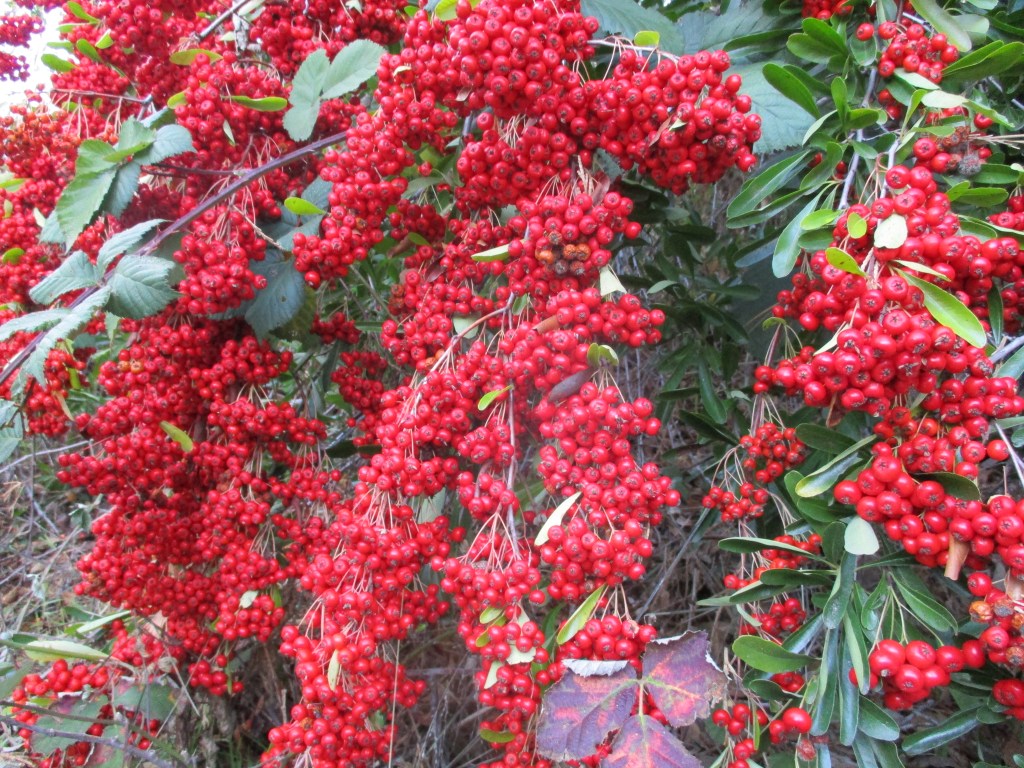
Winter berries provide more color as autumn foliar color finishes.

Pyracantha, although inedible, is likely the most colorful of the winter berries here.

Seasonal color is as variable as the weather. Just as the many different spring flowers bloom differently every spring, and the autumn foliage color is different every autumn, the colorful berries and fruits that linger on many plants through winter respond to the weather. Then, the various birds and other animals that devour them do so at different times, and at different rates every year.

Pyracantha (or firethorn) is probably the most reliable for an abundance of brightly colored red berries. Old varieties with orange or even yellow berries are very rare, perhaps because they are comparably wimpy. Unfortunately, because they are so colorful, and also because they ripen before many of the migratory birds have gone, the berries often get eaten by birds soon after they ripen.

Berries of the various cotoneasters are not quite as colorful, and many ripen slightly later, so they are not so efficiently stripped by birds. Cotoneasters are now more popular than related pyracantha because there are so many varieties with so many different growth habits. Larger types grow into large shrubbery while prostrate types grow as ground cover. Cotoneaster also has the advantage of lacking thorns.

The native toyon can provide large clusters of similar red berries, but only if it is allowed to grow somewhat wildly. It is unable to bloom and subsequently produce berries if regularly shorn. Yet, even in the wild, toyon is unpredictable. Because damp weather can cause berries to rot before they ripen, toyon may be unproductive for many years, and then produce remarkably colorful displays of berries when least expected.

Hollies are the most familiar of colorful winter berries, but are not as colorful as pyracantha or the various cotoneasters because they are almost never provided with male pollinators that they require to develop fruit. Fortunately, their remarkably glossy and prickly foliage is appealing alone.

Flowering crabapples are grown for their impressively colorful pink, white or nearly red spring bloom, but some types also produce sparse and minute red, orange or even yellow crabapples that stay after the foliage turns yellow and falls. English hawthorn lacks the flower color of flowering crabapples, but has more abundant and colorful red or orange berries that linger into early winter after the foliage is gone, or at least until birds find them.

Firewood Is Old Fashioned Technology

Cut firewood needs to be split.

Chimney clearance pruning is easy to overlook nowadays because, for various reasons, chimneys are becoming obsolete. Modern homes lack them completely. Some chimneys of older homes succumbed to earthquakes. Because of simpler and cleaner alternatives for heat, remaining chimneys and their fireplaces, as well as firewood, are almost passe.

Ironically, chimineas and fire pits have become a fad. Most modern fire pits use propane for fuel, but a few use firewood. Although such fire pits and chimineas burn less firewood than fireplaces, they are ridiculously less efficient. Their warmth simply escapes into the atmosphere. Relative to the volume of wood they burn, they generate much more smoke.

Nevertheless, whether for fireplaces, wood stoves, fire pits, or chimineas, firewood is not yet completely obsolete. Some households only rarely use small quantities for ambience fires. Some households still use more significant quantities to supplement home heating. A few households rely on firewood as their primary or exclusive source of home heating.

For unrelated reasons, the availability of firewood has declined with its demand. Orchard trees that were still relinquishing their space decades ago are now gone. Also, wildlands are now farther from large urban regions where most people live. Wood from demolished buildings is more likely to become chipped mulch than to become available as firewood.

Fortunately, most tree services sell firewood that is a byproduct of their work. Such wood is generally a mix of various species, so may include some degree of softwoods, such as pine. Rural tree services are more likely to be able to provide specific types of hardwood, and are also more likely to be able to deliver it. Their softwoods might be less expensive.

Tree services prefer to leave wood where they do tree work, and actually charge a bit for removal. Cut rounds of logs should be firewood length, but need splitting and seasoning. Inadequately seasoned or damp wood generates more smoke than properly dried wood. It should stay sheltered from rain. Palms and yuccas are impractical for use as firewood.

Too Much Water Is A Serious Problem.

Well, . . . this is an exaggeration.

The most common problem with landscapes that are maintained by maintenance gardeners is excessive irrigation. In fact, with very few exceptions, the only lawns that are maintained by gardeners that are not also irrigated excessively are too dry because the irrigation systems are not operational. Excessive irrigation is not only unhealthy for the landscapes, but costly.

Wasted water is obviously expensive, but also causes all sorts of expensive damage. Saturation of soil inhibits deep dispersion of roots, causing shallow roots to displace pavement. Shallowly rooted trees that are easily destabilized by wind can cause expensive damage, and are expensive to remove. Smaller plants that do not cause damage as they succumb to saturation and rot are still expensive to replace. The gardeners who get paid to maintain the landscapes should assume liability for the damages they cause, but instead charge to repair it! If they can not repair the damage, they typically happen to know someone who can.

Fortunately, those of us who maintain our gardens, or are at least involved with the maintenance, are not so generous with water. Although lawns need quite a bit of water, they also need adequate drainage. Besides, we tend to be more aware of the expense of water than gardeners are.

Now that it is autumn, irrigation needs to be decreased for various reasons. Rain will be providing more moisture as the seasons progress. While the weather gets cooler and more humid, and the days get shorter (less sunlight) not so much moisture evaporates. Most plants are either dormant or at least less active, so consume less moisture.

There are unfortunately no accurate formulas for decreasing frequency and duration of irrigation as the weather changes. It must be done by trial and error, by providing enough irrigation during dry spells without keeping conditions too wet. Of course, no irrigation is necessary during rainy weather, except only for plants that are sheltered by eaves. Hanging pots should be monitored because they are both sheltered from rain (if hanging from eaves), but also exposed to drying wind.

Also during autumn and winter, dormant plants need no fertilizer. That can wait until they wake up early in spring. Raking falling leaves from lawns, ground cover and low shrubbery is important though, since such debris shades the plants below while sunlight is already less abundant, and can also promote rot.

Debris Fills Gutters During Autumn

Falling leaves eventually become abundantly messy.

Autumn foliar color certainly is pretty while it lasts. Although less prominent locally than it is where cooler weather begins earlier, it is an asset to many home gardens. It generally appears a bit later within mild climates here, but might also remain suspended a bit later. Ultimately though, with enough wintry wind and rain, it eventually becomes foliar debris.

Evergreen foliage also contributes to the mess. It is likely less abundant than deciduous foliage is during autumn, but only because it sheds through more extensive seasons. For example, Southern magnolia sheds mostly through spring, as new foliage replaces older foliage. It then continues to shed additional debris throughout the year, including autumn.

Regardless of its various origins, foliar debris becomes more of a concern during autumn for two simple reasons. Firstly, and obviously, more of it accumulates during autumn than during any other season. Secondly, since autumn is the beginning of the rainy season, it is the most inconvenient time of year for such debris to accumulate within home gardens.

Roadside gutters, eavestroughs and their downspouts should drain efficiently. However, foliar debris can interfere with their drainage when it becomes most important. Roadside gutters are more accessible, so are easier to observe and clean. Eavestroughs and their downspouts may be beyond reach, but may need more cleaning if defoliation continues.

Foliar debris is unhealthy for turf, groundcover and shrubbery that it accumulates over. It inhibits photosynthesis by obstructing sunlight. It can also promote proliferation of fungal pathogens. This is why prompt raking is very important. Foliar debris can stain pavement and decking, and may be hazardously slippery. Behind chimneys, it can promote decay, and possibly become a fire hazard.

Pumpkins After Halloween

Jack o’ lanterns and pumpkins will soon meet their gory demise now that Halloween is over.

Pumpkins are both the biggest of the common fruits, and also the most wasted. So many of us bring at least one into our homes for Halloween, only to discard them afterward. Not many of us actually bake or make pies from ‘used’ pumpkins. However, those of us who like to can or freeze fruit and vegetables can really take advantage of this tradition by politely collecting jack o’ lanterns from neighbors, or getting unsold pumpkins from markets for very minimal expense. (Pumpkins are ‘low acid’ fruits that need to be canned with a pressure cooker.)

The somewhat small brownish ‘sugar pie’ pumpkins that are sold for pies are of course the best, with the richest flavor and meatiest shells. The common bright orange pumpkins used for jack o’ lanterns are not as meaty and lack flavor, but are certainly worth the price if they are free. White pumpkins can be just plain bland; but with enough sugar and spices, can make decent pie. The deeply furrowed green or gray pumpkins might likewise taste better than they look, but who knows? I certainly have not tried one yet.

Because the jack o’ lantern pumpkins have such thin shells, my neighbor and I prefer to cut them into pieces and steam them before peeling them. It is a messy job, which is why she has me do the peeling part of it. Before steaming, she cuts out any parts with candle wax (on the bottom) or soot (on the top). Once peeled, the pulp is ready to be pureed, and then frozen, canned or baked directly into pies.

Those of us who do not indulge in freezing, canning or baking of ‘recycled’ pumpkins can either give our pumpkins to neighbors who do, or must otherwise dispose of them. On the compost pile, pumpkins should be chopped up and spread out so that they do not mold and rot as much as they would if left intact. Chopping them with a shovel should be adequate. By now, there should be plenty of fresh leaves on the compost pile to spread pumpkin parts out over.

If fireplaces or wood stoves have been used already, the resulting ash can be spread out with chopped pumpkin, to inhibit mold in compost piles. Ash also deters snails. Just be certain that only dead ash gets scattered, without any embers, and that it gets spread thinly enough so that it does not become a mucky mess that actually inhibits composting.

Chimney Clearance Must Be Maintained

Chimneys do not get enough consideration.

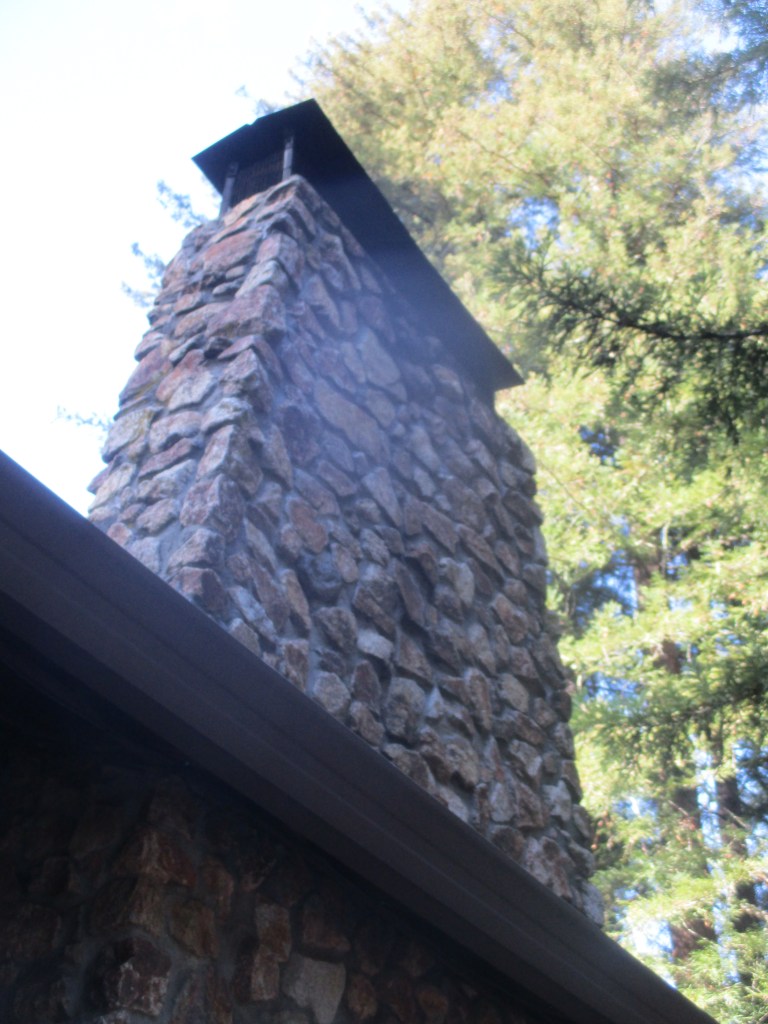
Chimneys are easy to neglect. Some are external to the homes they serve. They occupy visible but minor garden space. Others are internal. Only portions that extend above their respective roofs are visible. Besides the use of accompanying fireplaces or woodstoves, they do not change with the seasons. Nonetheless, chimney clearance is very important.

Trees and vines often extend growth over the tops of chimneys. They grow most actively while chimneys are least active through spring and summer. Such growth is hazardously combustible within the exhaust of chimneys below. Essential chimney clearance pruning eliminates hazardous vegetation prior to the use of associated fireplaces or woodstoves.

Various eucalyptus, cypress, pine, cedar, juniper, fir, spruce, oak and bearded fan palms are very combustible. Deciduous oaks become less combustible as they defoliate during cooling weather though. Other deciduous vegetation is likewise less combustible by the time chimneys are most in use. Vines can accumulate debris directly on top of chimneys.

Vegetation within ten feet of a chimney should generally be two feet below the top of the chimney or fifteen feet above it. More combustible vegetation justifies more clearance or more vigorous grooming. Accumulated dry detritus is more hazardous than fresh foliage. Burning vegetation drops burning debris onto other combustible vegetation and material.

Of course, fireplaces, woodstoves and their associated chimneys are not as common as they were in the past. Most municipalities banned them from new construction during the past many years. Removal of chimneys that incur damage from earthquakes is generally more practical than repair. Chimney clearance becomes unnecessary without chimneys.

Furthermore, few surviving chimneys experience as much use as they did decades ago. Modern heating systems are much more practical and efficient. They generate no smoke to offend neighbors. They are unregulated by ‘no-burn’ alerts. Now that urbanization has replaced orchards and woodlands, firewood might be expensive from local tree services.

Too much in the garden may be going to pot.

Container gardenin is overrated.

The class of 1985 epitomized the ‘Decade of Decadence’ with the raddest of styles in the wildest of colors. My generation is perhaps more familiar than any other with the pursuit of senseless fads and trends. Now that it is about a quarter of a century later, many of us continue such indulgences in our gardens.

Container gardening has become a fad that, despite its practicality for all sorts of applications, has become so common that it actually makes gardening more work than it should be. Modern homes are built with expansive porches and walkways that are designed to accommodate large urns and other planters, instead of more modest and proportionate porches and walkways that leave more space for planting things in the ground around them. Runoff from the planters stains pavement and rots decking. Besides, all the clutter of planters looks like a garage sale.

For balconies, roof gardens or wherever exposed soil is otherwise unavailable, container gardening may be the only option. Containers also help with plants that need to be moved to sheltered spots during frost. However, few plants are as happy in containers as they would be in the ground. Contrary to popular belief, it is better to amend inferior soil in the ground than to grow plants in potting soil within pots.

Where pots or other containers are necessary, they should either be shaded, or otherwise insulated from the heat of the sun. The black vinyl cans that plants arrive from the nursery in are not only unappealing, but can get warm enough in the sun to roast roots. Yet, they are both obscured and shaded simply by getting placed within slightly larger urns or planters.

Other thin plastic pots can transfer heat like black vinyl, but tend to be cooler because they are most often lighter colors that absorb less heat from sunlight. Thicker materials, such as terracotta, are better insulated. Roots prefer the porosity of unglazed pots, although some glazed pots can stay cooler. Plants within containers are often able to provide their own shade by cascading out over the edges, or spreading out above.

Yet, more substantial plants that provide more substantial shade still need to be complaisant to confinement. Plants that need to disperse their roots will never be comfortable in containers. Neither will plants that are not conducive to pruning, but want to grow into large shrubs or trees.

Autumn Foliage In Mild Climates

Minor chill initiates autumn foliar color.

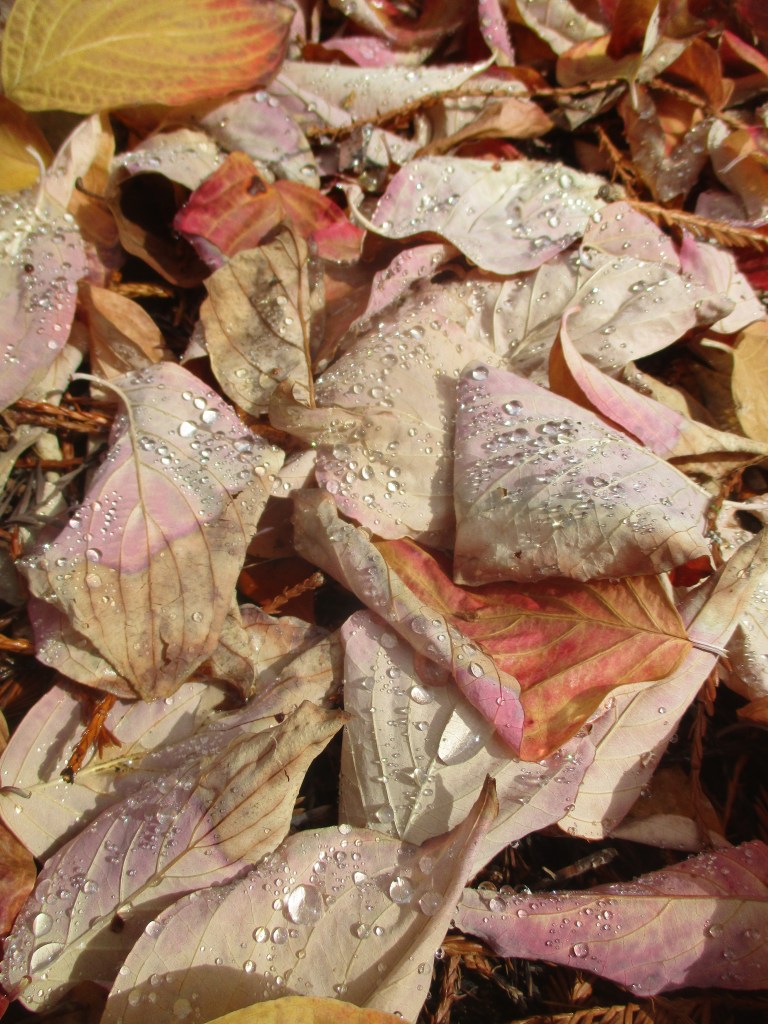
Colorful foliage is always present. After all, green is a color, even without any other color or variegation. Defoliation of deciduous foliage during autumn reveals evergreen foliage beyond, even if fading through winter. Immediately prior to defoliation though, deciduous foliage of quite a few species temporarily becomes spectacularly colorful autumn foliage.

Whether deciduous or evergreen, foliage that is most colorful during spring and summer contains chlorophyll. Regardless of how variegated, reddish, purplish, yellowish or other color it might be, it is also green to some degree. It could not be photosynthetically active otherwise. Colorful autumn foliage exhibits brighter color as its chlorophyll decomposes.

Autumn foliage is most spectacular where it is native, such as New England. Much more of it inhabits forests than home gardens. It is not spectacular within forests here because only a few sparsely dispersed native species produce impressive foliar color for autumn. Its naturally local scarcity likely contributes to its limited popularity within home gardens.

Locally mild weather also limits the popularity as well as the potential of autumn foliage. Many of the most colorful maples of New England merely turn blandly pallid yellow prior to hastily premature defoliation here. However, several other species develop exemplary foliar color in response to minor chill, and seem to be as happy here as in New England.

Chinese pistache, sweetgum, flowering pear and ginkgo are four trees that most reliably provide autumn foliage here. Crape myrtle is a smaller tree that is almost as reliable, and blooms splendidly for summer. Persimmon gets as colorful as Chinese pistache, with an abundance of fruit. Boston ivy is a vine with color that is comparable to that of sweetgum.

Of course, even the most appealing of plants are not perfect. Their innate characteristics are relevant to selection. For examples, trees occupy significant space. Ginkgo becomes bright yellow, but without any other color. Sweetgum produces obnoxiously prickly fruits. Flowering pear is susceptible to fireblight. Boston ivy clings to surfaces and ruins siding, paint and fences.

Vegetation Needs Clearance From Infrastructure

There is a chimney under this overgrown vine.

It may not seem like it is so now, but evergreen trees really are messier than most deciduous trees. They probably do not produce any more debris, but they drop their debris over much longer periods of time, or at various times, or simply ALL the time. Yet, at this time of year, it seems like the deciduous trees that mostly have dropped nothing or very little since last year, are making most of the mess in the garden as they defoliate for winter.

Defoliation is only beginning, and will continue for a while. Ironically, the most impressively colorful deciduous trees happen to be those that hold their foliage for a long time, making their defoliation process linger over a few months. Even the most efficiently neat trees that defoliate in a few days tend to do so during windy or rainy weather, when we are not so motivated to go out into the garden to clean up their mess.

As the rainy season begins in a few weeks or so, the gutters on the eaves should be cleaned of debris that has accumulated since last year. This can sometimes be delayed until all deciduous trees that contribute to the accumulation of debris are completely defoliated. Generally though, homes with many or big trees (or many big trees) may need their gutters cleaned more than once as they continue to collect debris through autumn and perhaps into winter.

Any debris that collects behind chimneys, in valleys (where roof slope changes direction) or anywhere else on the roof, should also be removed. Even without gutters to collect debris, flat roofs collect whatever debris that does not get blown off by wind. Only parapet roofs that are common on so many homes of Spanish architecture collect more debris, since they are sheltered from wind.

Trees and vines should never be allowed to lean onto roofs. Vines and some densely foliated trees tend to accumulate all sorts of debris that rots and then damages the roof below. Trees that touch roofing material are abrasive as they move in any breeze.

Obtrusive trees and vines are also a serious problem for chimneys. Cypress, cedar, pine and the beards (accumulations of dead foliage) of fan palms are particularly combustible. Even after they get soaked by rain, they can quickly dry if heated by the exhaust from a chimney. Maple, ash and other trees with open canopies may not be as combustible, especially while defoliated, but can get roasted by chimney exhaust, and can interfere with ventilation.

Spring Bulbs Begin In Autumn

Spring bulbs are dormant through winter.

Crocus, daffodil, hyacinth, tulip, freesia, anemone and ranunculus will not bloom until the end of winter and early spring. They are spring bulbs or early bulbs. Crocus and daffodil, including the various narcissus, will be among the first to bloom. The others as well as a few types of iris will bloom a bit later. After they finish, summer bulbs will begin to bloom.

Although they will not bloom for a few months, spring bulbs go into the garden now while they are dormant. Visually, they are still unimpressive. They are even more uninteresting when hidden from view by interment. Their planting season appropriately begins prior to Halloween, and continues as long as they remain dormant and available from nurseries.

Spring bulbs generally bloom earlier within their bloom season after early planting within their planting season. Similarly, later planting delays bloom. Therefore, periodic planting of groups of the same bulbs throughout their planting seasons prolongs their subsequent bloom season. They begin to disperse roots and grow as soon as they are in the ground.

However, growth through the cool and rainy weather of winter remains subdued. Foliage should remain safely below the surface of the soil until warmer weather during the end of winter or beginning of spring. Like so many other plants in the garden, bulbs rely on chill to adjust their respective schedules after dormancy, but do not want to be vulnerable to it.

Winter is so mild here though that some spring bulbs do not experience sufficient chill to perform reliably as perennials. Daffodil, for example, can naturalize where it experiences more chill. Here, it may bloom best for its first spring, with less bloom annually afterward. Extensive breeding has also compromised the reliability of many perennial spring bulbs.

Some spring bulbs are actually corms, rhizomes, tubers or tuberous roots, which function much like bulbs. All are specialized storage structures that contain all that they require to survive through dormancy and then start growth for another season. They replenish their resources through subsequent active seasons to repeat the process perhaps indefinitely.