Exotic Weeds Are The Worst

English daisy gets prolific in lawns.

Exotic species are not native. It is that simple. There is nothing fancy about it. They came from elsewhere to live here. They are not necessarily rare, unusual or innately desirable. Most plant species within most refined landscapes and home gardens are exotic. Native species that inhabit unrefined areas, although trendy, remain unpopular for landscaping.

Not only are exotic plant species not necessary rare or desirable, many are too common or undesirable. With few exceptions, the most aggressively invasive of weeds are exotic. For a variety of reasons, they proliferate faster than native species. Some are aggressive because they are endemic to competitive ecosystems. Most lack natural pathogens here. 

A weed is merely any undesirable plant. Some might be desirable in some situations but not others. English ivy, for example, which is a practical ground cover within landscapes, is also an aggressively invasive weed within coastal forests. Most weeds are annuals or biennials, but others are perennials, shrubbery, vines, aquatic plants or substantial trees. 

An unfortunate reality about exotic weeds is that they are not here by mistake. Generally, their importation was justifiable at the time. Most were ornamental plants for gardens and landscapes. Some came as fruits, vegetables, herbs, cover crops or forage for livestock. Some came as timber. Species that escaped cultivation and naturalized became weeds.

Such weeds compete for the same resources that desirable plants utilize, and are mostly visually unappealing. Some enhance the combustibility of landscapes and forests. A few weeds produce seed structures that are hazardous to pets and wildlife. Even if problems are not directly obvious, weeds disperse seed to share their innate problems elsewhere.

This is typically the best time of year to pull or grub out weeds, although more weeds will grow later. Annual weeds are mature enough to get a good grip on. Soil should be damp enough from winter rain for roots to pull out relatively easily. Weeding will likely require a bit more effort this year because of the extended dry and warm weather since December. 

UTILITY CABLES NEED SPACE

With all the cables coming and going, this unfortunate tree does not have much room to grow without causing trouble.

Since I did not make the drive up or down the coast very often, the rare silvery-gray Bismarck palm that I could see slowly climbing into the skyline near the edge of Highway 101 through Santa Barbara seemed to be slightly taller every time I saw it. It grew slowly, but enough to notice since I only saw it less than annually. Then, when I drove by about a month ago, it was gone.

This exemplary specimen had been quite healthy and happy (even though Bismarck palms are not supposed to be happy on the coast). There was only one problem. It was under high voltage utility cables. As it grew, it got too close to the cables, so needed to be removed in order to maintain the minimal clearance required for high voltage.

Unlike other trees, palms have only single terminal buds that grow upward. They can not develop branches to grow around cables, so only die if the single bud needs to be pruned away. Complete removal is therefore the only option when palms begin to grow into high voltage cables.

Sadly, palms often get planted under utility cables. Many Mexican fan palms grow under cables because birds that eat their fruit drop the seed there. Queen palms are popularly planted around the perimeters of back yards, and along the back fence lines that are very often directly below and parallel to high voltage cables.

Trees that are not palms can get disfigured by pruning for clearance around high voltage cables, but generally survive. Trees with central leaders (single trunks) and strict form, such as spruces and redwoods, can get be so disfigured that removal may be more practical than pruning. Trees with more irregular form, like sycamores and elms, are somewhat easier to salvage. Unfortunately, crews hired to maintain clearance are unable to prioritize the health and structure of trees that get too close to high voltage cables.

Lower cables for telephone, television and house-drops (lower voltage cables that extend from utility poles to homes and other buildings) do not often justify pruning for clearance like upper high voltage cables do. However, these lower priority cables can still be damaged if too many limbs sag onto them or become abrasive as they blow in the wind. Really, it is best to avoid problems with utility cables by selecting and planting trees that are not likely to become too obtrusive. Palms, large trees and trees that are likely to be severely disfigured by pruning to maintain clearance should be kept at safe distances.

Frosted Foliage Is Ugly Foliage

Frosted foliage can be removed now.

Weather is variable everywhere. Climates and seasons are imprecisely regulating. They merely define predictable ranges of the elements of weather, such as temperature, wind, humidity, precipitation and cloudiness. As unusual as weather sometimes seems to be, it generally conforms. Winter weather is mild here, but sometimes leave vegetation frosted. 

Frost was sneaky this winter, by occurring during nights between pleasantly warm days. All elements of the weather were within ranges that are normal for local climate, but their chronology was deceptive. Frost seemed unlikely after such springlike daytime weather. Some foliage was frosted only because protection from frost seemed to be unnecessary.

Frost is now unlikely for most local climates so late in the season. Only climates that are at significant elevation or significantly inland might still experience frost. Coastal and low elevation climates are generally past their last frost dates. Some climates experience no frost at all. Except for within the coolest situations, no more vegetation should be frosted.

Therefore, it is generally safe to prune and groom away unsightly frosted vegetation. It is no longer helpful to insulate undamaged vegetation below. Any new growth that pruning of this nature may stimulate or expose should be safe from frost. Within climates that lack frost, vegetation that gets shabby from chill might also appreciate pruning and grooming.

Pruning and grooming of frosted vegetation can be challenging. Many frosted plants are already actively growing in response to warmer weather. Their new growth mingles with their damaged growth that must be removed. Efficient separation of the two requires a bit of effort and persistence. Fresh and tender new growth is innately vulnerable to damage. 

For example, small new shoots of angel’s trumpet break away very easily if bulky frosted stems fall onto or through them in the process of removal. New shoots of several types of canna emerge from the soil among old shoots while it is too early to cut the old shoots to the ground. Grooming is easier where it can happen earlier, or for cannas that grow later. 

FLORAL FRAGRANCE IN THE GARDEN

The most fragrant flowers are generally smaller and less colorful than less fragrant flowers. This angel’s trumpet is an exception.

Attracting pollinators is serious business for flowers that do not rely exclusively on wind for dispersion of their pollen. Many flowers attract pollinators with flashy color. Some reward their pollinators with sweet nectar. Many prefer to use fragrance. Most flowers use a combination of two or more of these tactics.

Fragrances are designed by the flowers that use them to appeal to the discriminating taste of specific pollinators. Most are sweet. Some are more perfumed. A few are even quite objectionable to people because they are tailored to flies. Fortunately, flowers with foul fragrances are rare in gardening.

The most fragrant flowers are often less abundant than flowers that rely on wind for dispersion of their pollen, or less colorful than flowers that rely on visual appeal to attract pollinators. Yet, the fragrant flowers of wisteria vines and lilacs are both profuse and colorful. The surprisingly big and fragrant flowers of ‘Charles Grimaldi’ angel’s trumpet are bright yellow.

Mock orange (Philadelphus spp.) conforms to the stereotype of fragrant flowers a little bit better, with somewhat small white flowers that are incredibly fragrant. The small pale pink flowers of daphne are even less impressive and nearly hidden among their foliage, even though their fragrance can not be ignored. The sweetly fragrant flowers of Japanese honeysuckle vines are abundant but not too colorful. Star jasmine vines likewise bloom fragrantly and abundantly, and their bright white flowers contrast better against their glossy green foliage.

Night blooming jasmine is not appealing enough for prominent placement, and is not even fragrant during the day, but will be unbelievably fragrant on warm summer nights. Just as fragrances appeal to specific pollinators, nocturnally fragrant flowers specifically appeal to insects or bats who are active at night.

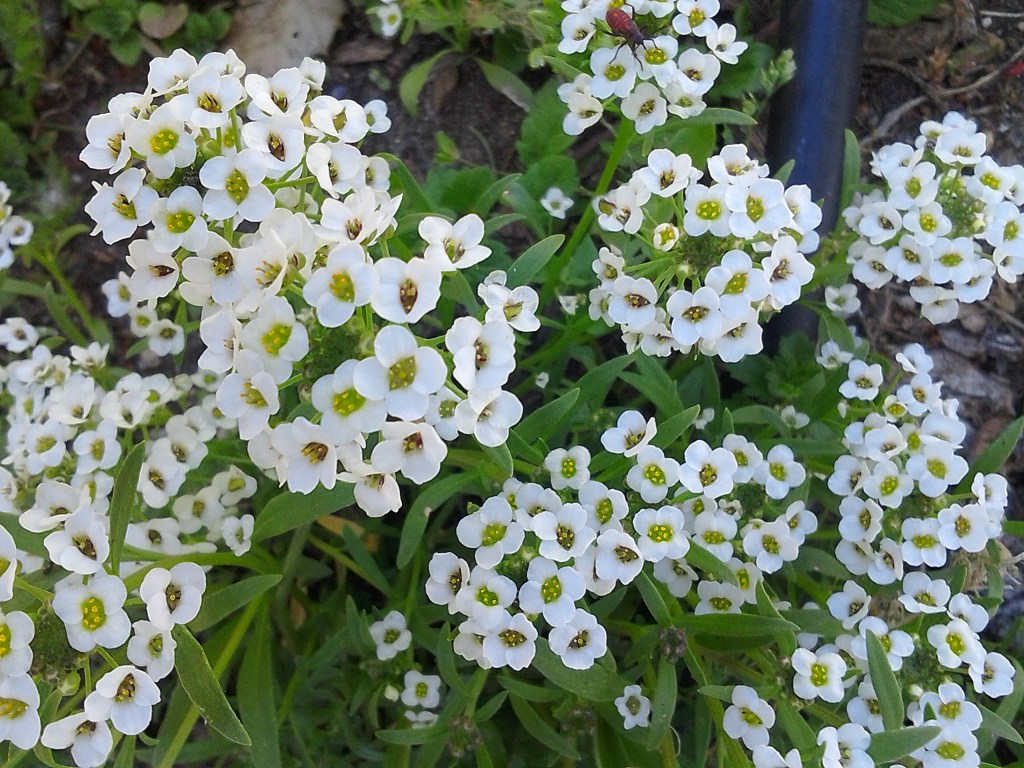
Freesia, hyacinth, lily,narcissus and some types of iris are very fragrant as well as colorful now that they are blooming for early spring. It is unfortunate that their flowers do not last long, and that there are not any comparable flowers later in the year. The same annual sweet peas and stock that bloom about now can be planted again later for autumn bloom. Sweet peas are easiest to grow from seed. Stock is easiest to grow from cell packs, and since it is actually perennial, sheltered plants can survives through warm summer weather to bloom again in autumn. Annual sweet alyssum can bloom anytime while the weather is warm.

Rotation Improves Vegetable Garden Production

Summer squash are consumptive vegetables.

Vegetable plants are mostly unnaturally productive. Extensive breeding compels them to yield fruits and vegetative parts that are bigger, better and more abundant that what their ancestors produced. Increased production increases their reliance on resources. Without crop rotation, some sorts of vegetable plants noticeably deplete some of what they need. 

Rotation, which is the same as crop rotation or garden rotation, is a technique of growing vegetables where different types of vegetables grew previously. In other words, one type of vegetable does not grow in any one place for too long. Some vegetables may produce well in some types of soil for a few years. More consumptive types prefer annual rotation. 

This technique disrupts the depletion of particular nutrients that particular types of plants crave. It also allows for replenishment of depleted nutrients in the absences of plants that cause such depletion. Furthermore, some soil borne pathogens find this active cycling to be disruptive. Eventually, plants that cycled out can cycle back into a particular situation.

Tomato plants are particularly consumptive, so appreciate rotation in many types of soils. Eggplant and pepper are related to tomato, so crave many of the same resources, even if they are less consumptive. Therefore, they should not cycle directly into soil relinquished by tomatoes. Unrelated vegetables, such as squash, corn or bean, are more appropriate. 

Warm season vegetables that are now returning to the garden might appreciate rotation. A bit of research to determine appropriate placement for them may significantly enhance production. It helps to know which vegetables are related, such as mustard, collard, kale, radish and turnip (of Cruciferae Family), or squash and melon (of Cucubitaceae Family).

Because corn is so high, it should grow to the north of a vegetable garden. Unfortunately, rotation may dictate that it grows to the east for a while, or only in portions of the northern edge that it avoided for a while. Pole beans that like to climb wire fences may sometimes need reassignment to different portions of their fence. Peas should follow their example since they are related.

THE LOWDOWN ON GROUND COVER

Most euonymus are upright shrubbery. This one though, stays low enough to be useful as a shallow shrubby ground cover.

Of all the functions that the many and various plants in the garden serve, ground covers have the lowliest job description. Well, maybe it is just the lowest job; covering the ground. It is an important job though. Ground covers fill in the space between other desirable plants to obscure otherwise bare soil. They also control weeds. Some ground covers help to limit erosion. Others help to insulate the soil for plants with sensitive roots.

There certainly are all sorts of ground cover. Lawns are the most familiar. Many other ground covers are perennials like gazanias, African daisies and iceplants. Some, like ivies, honeysuckles and star jasmine, are vines. Others are low growing shrubs like certain coprosmas, cotoneasters and junipers. Some lay about as flat as carpeting. Some get a few feet deep.

Many perennial ground covers as well as some of the vines and low growing shrubbery provide colorful flowers. Japanese honeysuckle and star jasmine are not as colorful, but provide delightful fragrance. Some of the cotoneasters have colorful berries in winter. Although not seen, many ground covers are appreciated more for their network or roots that help to stabilize soil that might otherwise erode. One feature that most ground cover plants have in common though, is their foliage that is dense enough to keep weeds out, as well as to obscure the soil below.

Like all other plants in the landscape, ground cover plants need maintenance. Lawns probably need more maintenance than any other ground cover, since they need to be mowed, weeded, fertilized and watered quite regularly. Vine ground covers need to be pruned so that they do not get into trees and shrubbery. Some ground covers look best if mowed annually (typically at the end of winter) or even more frequently. Some of the deeper ground cover shrubs should be pruned down to stay low. Almost all ground covers need to be edged for confinement.

Ground cover plants must be selected for their appropriateness to particular applications. For example, most low growing shrubbery needs space, so is best for larger areas. Smaller iceplants that may not be aggressive enough for big areas are great for tight spots, or for mixing with other perennials. Tough Algerian ivy that is so useful for freeway embankments may be too aggressive for home gardens. As with all plants in the garden, careful selection helps to get the best ground cover plants for each particular situation where ground covers are needed.

Warm Season Vegetables For Spring

Frequent harvesting promotes continual zucchini production.

Warm season annuals for next spring and summer are already replacing the cool season annuals that bloomed so dutifully since last autumn. As this happens, it is also getting to be about time for warm season vegetables to replace cool season vegetables. Strangely continuous warm daytime weather since December accelerated this process somewhat.

Removal of cool season vegetables that are still productive is as unpleasant as removal of cool season annuals that are still blooming. Fortunately, most cool season vegetables are finished by now, or will be soon. Few linger into warm weather as some cool season annuals might. Regardless, warm season vegetables will need their garden space soon. 

Unlike most cool season vegetables, which actually are vegetative, the majority of warm season vegetables are actually fruits. The plants that produce them generally continue to bloom and produce more fruits throughout their respective seasons. Some, such as bush bean and determinate tomato, exhibit brief seasons. Many produce continually until frost. 

Therefore, indeterminate tomato, pole bean, squash, cucumber, many varieties of pepper and some varieties of eggplant need no replacement within the same season. Cucumber can get tired enough by early summer to justify replacement in midsummer though. Okra, as well as several varieties of eggplant and pepper, produce for relatively brief seasons.

Phasing prolongs production of warm season vegetables that produce only once or only for a brief season. For example, corn that matures so uniformly that it is ready for harvest simultaneously lasts only a few weeks in a garden. Phases for seeding that repeat every two weeks or so develop in two week cycles. As the first phase finishes, the next begins. 

Because so many individual plants are desired, and the seedlings do not transplant well, corn seed prefers direct sowing into the garden. So does seed for bean, root vegetables, and most greens. For tomato, pepper and eggplant, and perhaps cucumber and squash, small plants transplant well, and are not numerous enough in a garden to be expensive. Warm season vegetables grow slowly during cool weather, but accelerate as the weather warms.

Not all weeds are unwelcome.

Unplanned acacias certainly put on a show when they bloom. It is not easy to dislike something so impressively colorful.

Even the best tended gardens get weeds. Most weeds, particularly annual and perennial weeds, meet a quick demise by getting pulled out or sprayed with herbicide. A few shrub and tree weeds though, are sometimes allowed to mature into functional members of the landscape.

Many sneak into the garden by growing within overgrown or otherwise concealing shrubbery, where they can hide long enough to get established. Others are left to grow because they are recognized as desirable plants. The main problems is that many end up in situations where they eventually become problematic.

Mexican fan palms are distinctive trees. Unfortunately, many grow below utility cables, because that is where birds drop the seed as they eat the fruit. Unlike other trees, palms can not be pruned around utility cables, so must be removed when they get too tall.

Silk tree, black locust, tree of Heaven and various oaks, pines, acacias and eucalypti are some of the more common trees that can sneak into gardens. Sometimes, they happen to land in good situations. More often though, they get too close to foundations, eaves, pavement or other features that they damage as they grow. Like Mexican fan palms, they are easier to remove while young, before they become problematic.

Pittosporums, cotoneasters and privets are commonly seeded shrubbery with less potential for problems. The main problem with glossy privet is that it can be too prolific and aggressive, so that it can crowd out more desirable plants. Most pittosporums and cotoneasters that get seeded are from plants that are ‘straight species’ (not cloned cultivars or varieties). Those that happen to be from cultivar or variety plants will not be ‘true to type’, which means that they will be more like the straight species than like their parents.

The few fruit trees that can sometimes grow from seed have the same problem, since only some of the more genetically basic types may resemble their parents. Fancier types and (non-sterile) hybrids probably will not. Fruit trees that grow from root suckers of grafted trees instead of from seed will be nothing like the parents, and may produce useless fruit.

Pampas grass is a prolific and sometimes welcome perennial weed near untended parcels or forested areas where pampas grass has naturalized. Broom is a shrubby weed that is even more prolific, but never welcome.

Algerian and English ivy rarely grow from seed, but can be really nasty weeds if they get where they are not wanted. Bear’s breech (or breaches), Jupiter’s beard, calla, mint and various yuccas that were planted may be very difficult to eradicate if they are no longer desirable, or if they migrate into areas where they become problematic.

Late Pruning For Early Bloomers

Deciduous magnolias get pruned after bloom.

Winter is generally the best season for pruning. Obviously, it is when a majority of plants are dormant, and therefore most complaisant to such potentially invasive procedures. Of course, there are exceptions to this generalization. A few plants are dormant during other seasons. Some simply prefer late pruning to accommodate their bloom or fruiting cycles.

Late pruning is important for some of the same reasons that dormant or winter pruning is important. It controls growth and directs resources. Removal of superfluous or unwanted growth reallocates resources that such growth would otherwise consume, to more useful or productive growth. The primary difference is that late pruning happens after dormancy. 

Flowering cherry trees are very similar to fruiting cherry trees, but generate only copious bloom without fruit. Flowering crabapple trees likewise produce only their unique bloom, but without much fruit. Technically, both would prefer dormant pruning during winter. Yet, late pruning immediately after bloom allows them to first bloom as profusely as they can.

Fortunately, flowering but fruitless counterparts of fruitful trees require pruning that is less severe than what their fruitful relatives require. Comparably severe pruning would be too stressful for them after dormancy. However, flowering peach trees can endure harsh late pruning to stub their bloomed shoots. Stubs generate more shoots for bloom next spring.

Late pruning begins as early as spring blooming trees and shrubs finish bloom. Because of warm weather this winter, many are blooming early. Stems of some types work well as cut flowers, either while in bloom or immediately prior to bloom. Once the first few flower buds begin to show color, most buds on the same stem should continue to bloom inside.

Camellias supposedly prefer pruning during their bloom cycle, since they resume growth immediately afterwards. Because such pruning would ruin some of the bloom that is their primary asset, most camellias must tolerate late pruning after bloom. Dogwood, forsythia, redbud, and flowering quince, as well as flowering cherry and flowering crabapple, are likewise tolerant of these technically untimely techniques.

Vegetable gardening is still cool.

If leafy lettuces are running out, there is still a bit of time to sow some more seed before spring.

Last autumn, it was unpleasant to remove warm season vegetable plants to relinquish space for cool season vegetables, particularly since some still seemed to be productive. Now the cool weather that the cool season vegetables crave will soon be getting warmer. It is still too early for warm season vegetables, but it is time to get ready for them.

If space allows, seed for a quick last phase of certain fast growing cool season vegetables can be sown. Radishes, carrots and beets still have time to mature before the weather gets too warm, although the beets will be the small tender sort. There probably is not enough time to grow big beets for canning. Leafy lettuces can still be sown to replace what might be running out early. Large vegetable plants like broccoli, cauliflower and cabbage grow too slowly to mature before spring weather gets too warm, so will need to wait until next autumn.

Peas are odd vegetables that like to grow in autumn and spring, in between warm and cool (or cool and warm) season vegetables. The first phase of peas can be sown now, and followed by subsequent phases every two weeks or so until the weather gets too warm for them.

Even though it will soon be getting too warm for cool season vegetables, it is not yet warm enough to sow seed for warm season vegetables directly into the garden. Fast growing vegetable plants that get sown directly, such as beans, corn and most squash, will need to wait until the weather is warm enough for them to grow efficiently, and the cool season vegetables finish and get out of their way. However, seed for vegetable plants that can get planted as seedlings, such as tomatoes, peppers and eggplants, can be sown into flats or cell packs in greenhouses or cold frames.

Tomato, pepper and eggplant seed sown directly into the garden when the weather gets warmer will be more likely to get eaten by snails or succumb to rot as they germinate than seedlings that got an early start in a greenhouse or cold frame (although snails and rot are not problems in every garden). For those who do not want to start growing seedlings at home now, seedlings will certainly be available in nurseries when it is time to put them out into the garden. However, the advantage to growing them at home is that there are many more varieties of seed available from catalogs and online than any nursery could stock with seedlings.