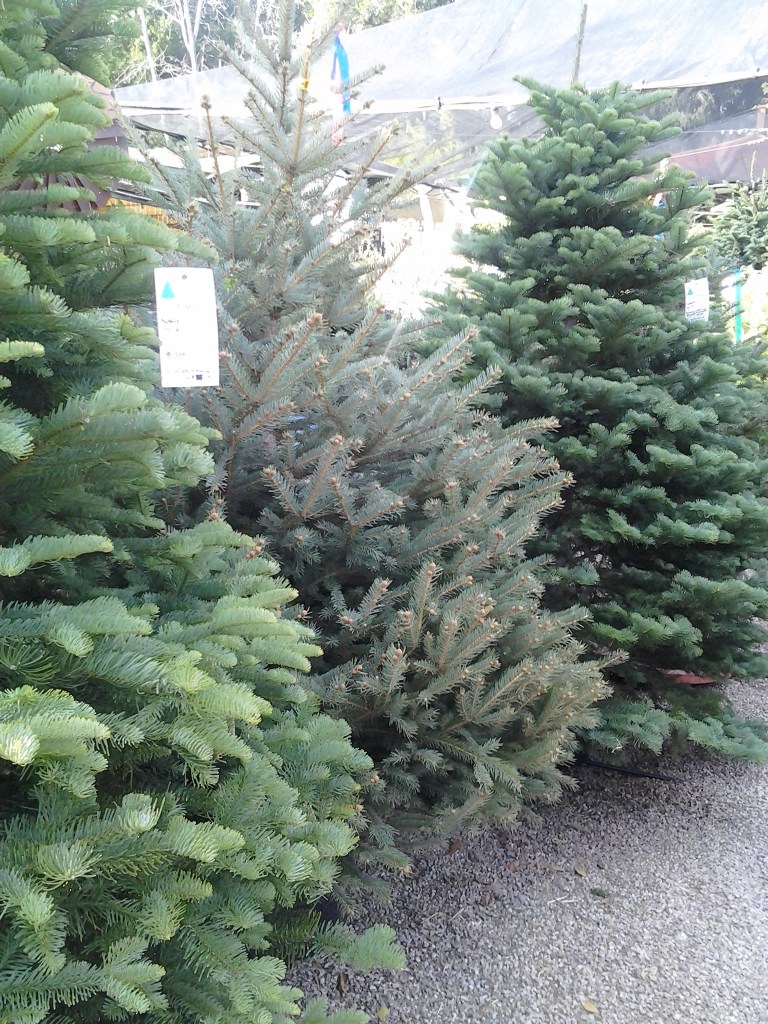
Not So Merry Christmas Trees

Cut Christmas trees are just really big cut foliage, like what comes with cut flowers.

By now most people have already acquired their Christmas trees. Some are live trees in containers. Some are artificial. Most are cut firs, pines, or alternatively, spruces, cedars, cypresses or even junipers. For at least the next two weeks, these trees dutifully maintain their healthy green vigor to brighten our homes with Christmas cheer.

Cut trees should have no problem lasting from the time they were originally cut through Christmas, as long as they get plenty of water. Artificial trees do not have much choice in the matter. Live trees are probably more reliable than cut trees are in regard to freshness, but can be more awkward to accommodate in the home, since they are more likely to leak excess water that can damage floors. If they they get a bit dry, live trees can also be sensitive to relatively dry and warm interior air after spending autumn out in cool and humid garden environments.

The main problem with living Christmas trees though, begins after Christmas. Spruces and other compact evergreens that can work as Christmas trees for several years need to be returned to the garden and maintained until next Christmas. Retired living Christmas trees, including those common, small trees that can be purchased with a few decorations already wired to their stems, eventually need to be planted out into the garden. Circling roots (that grow around the perimeter of a container in search of a way out) need to be severed so that they do not get constricted as they mature.

Unfortunately, with few exceptions, living Christmas trees mature into significant trees when they get the chance to grow. Those common, pre-decorated trees are most commonly juvenile Italian stone pine or Canary Island pine, which become very large trees. Because they seem so innocent as small potted trees, they often get planted in very awkward situations where they do not have enough space to grow without damaging nearby features.

Planting such a tree out in a forest is not practical, since it will not survive through the first year without supplemental watering. Their roots are just too confined to reach out for moisture. Even if such a tree could survive, it would not be an asset to the forest, since it would be an exotic (non-native) species.

Planters Are Overrated But Functional

Some plants should always be confined.

Container gardening is overrated. The endemic soil here is not so bad that nothing will grow in it. What is now suburban gardens was formerly famously productive farmland! Soil amendments make the soil more comfortable to plants with more discriminating taste. Plants that are too discriminating are probably not worth accommodating. With few exceptions, planters are unnecessary.

Plants naturally want to disperse their roots into the soil. Drought tolerant plants disperse their roots even more extensively. That is how they find enough moisture to be drought tolerant. If deprived of such root dispersion, they are always reliant on watering. Plants prefer the insulation of soil too. Many types of planters can get uncomfortably cool in winter, and uncomfortably warm in summer.

Besides, planters clutter landscapes, and occupy space on hardscapes. Decks rot. Patios stain.

The main advantage of planters is their portability. Plants that are sensitive to frost can move to shelter before the weather gets too cool. Plants that are spectacular only while blooming can move for more prominent display during bloom. For those who have not settled into a permanent home, plants in planters are able to relocate. Planters on patios or decks can move about like furniture.

Houseplants obviously grow in planters because not many houses contain enough soil for them to live in. Houseplants can move about just like planters in the garden. That is helpful for those that need a better exposure for winter than they enjoy for the summer. Some might like to go into the garden during mild weather, or for a rinse in light rain. Cascading plants can hang from the ceiling.

Planters can effectively confine invasive plants as well. Montbretia is so invasive that some people will not grow it without containment. (Deadheading to prevent seed dispersion is important too.) Horseradish often grows in tubs for confinement, as well as to facilitate harvest. It is easier to dump the potting media from a planter, and separate the roots out, than to dig roots from the ground.

Potted Plants Need Work Too

Potted plants do not have much soil volume to work with.

Potted plants can be a problem any time of the year. Some want more water than get. Most get too much water or do not drain adequately. Large plants get constricted roots if pots are too small. The roots of some plants get cooked in exposed pots that collect too much heat from sunlight. Besides, too many pots just seem to be in the way in otherwise useful spaces on decks, patios and anywhere else trendsetting landscape designers want to put them.

Now that the weather is getting cool and rainy, potted plants are not as active as they were during warm weather. Many are dormant. Although few demand the attention that they got during warmer weather, plants still need to be tended to appropriately through autumn and winter.

Cool season annuals, which are also known as ‘winter’ annuals, should get groomed as long as they are performing in the garden, just like warm season annuals get groomed through summer. Deteriorating flowers should be plucked from pansy, viola, primrose, Iceland poppy, calendula, dianthus, stock, chrysanthemum and cyclamen because they can mildew and spread mildew to developing flowers and foliage. Unplucked cyclamen and calendula can develop seed which diverts resources from bloom.

Pots that are out in exposed areas will not need to be watered while they get enough water from rain. The problem is that many that do not drain adequately can get too much water from rain and stay saturated. Dormant and defoliated plants do not need much moisture at all. Even evergreen plants do not need as much as they do while active during warm weather, because cool and humid weather inhibits evapotranspiration (evaporation from foliar surfaces).

Potted plants under eaves also need less water while the weather is cool and humid, but need to be watered nonetheless because they are sheltered from rain. Plants in hanging pots typically drain and dry more efficiently, so probably want a bit more water. Even a few sheltered small plants in the ground may occasionally want to be watered during rainy weather if they do not extend enough roots where they can get moisture from rain beyond the sheltered area. Sheltered plants are actually the most likely to be neglected because watering does not seem so important when it is raining.

Evergreens Make A Mess Too

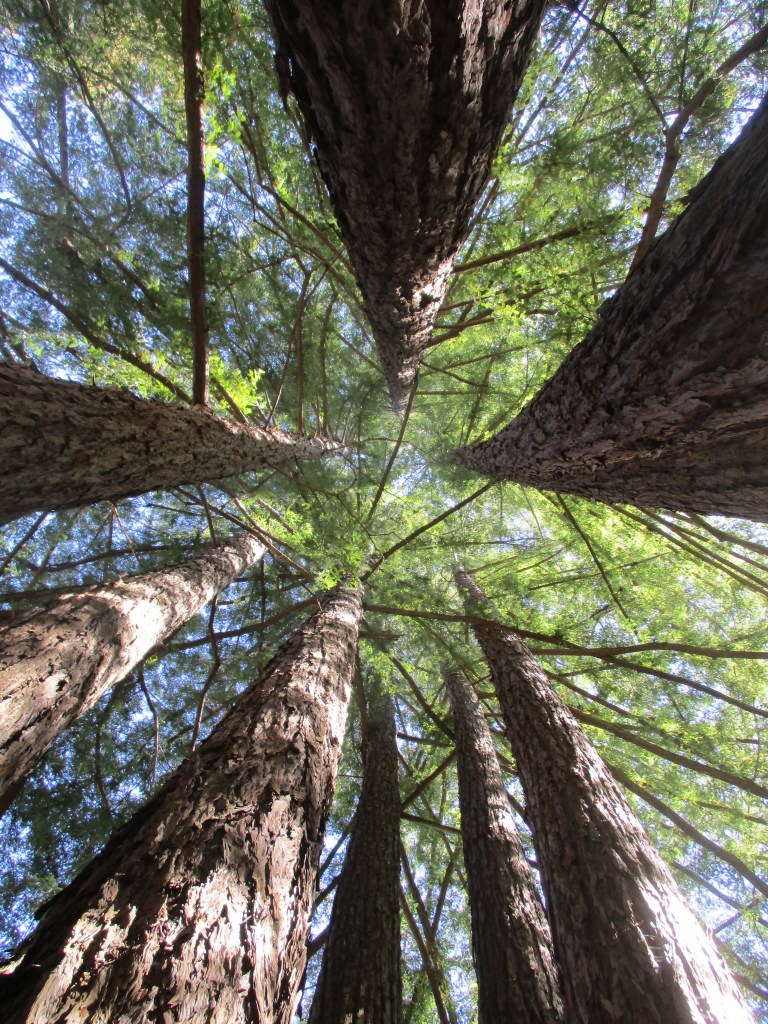
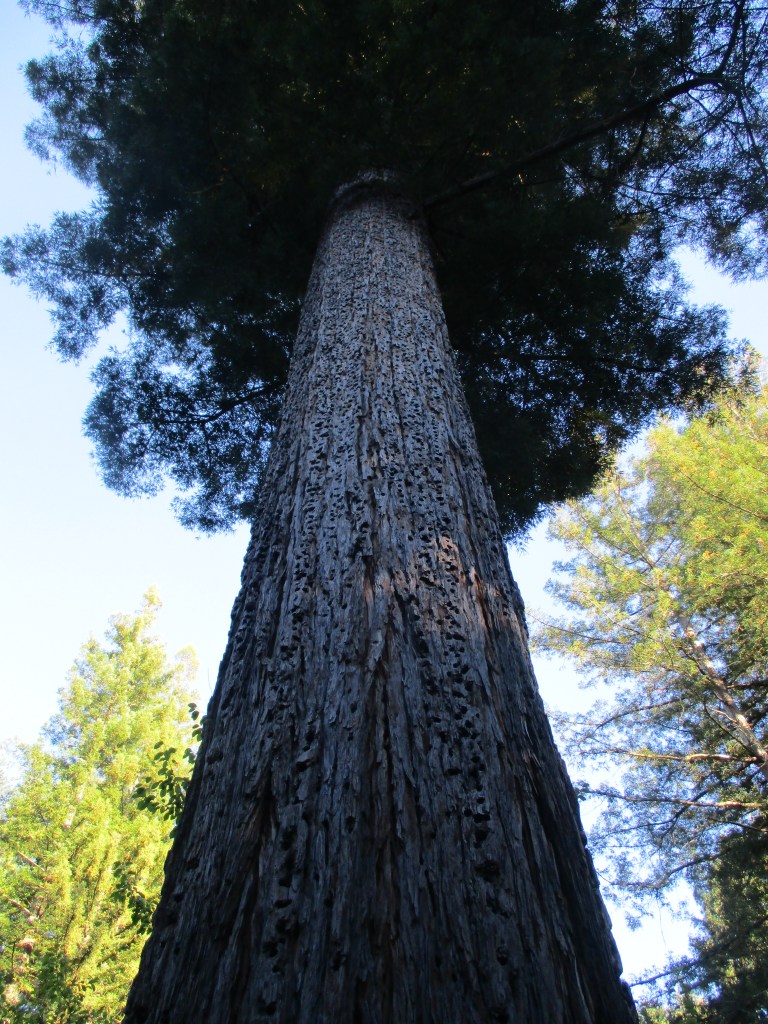
Big evergreen trees make big messes.

Nature is messy. It is that simple. Leaves, flowers, fruits and stems regularly fall from vegetation onto the ground. Animals contribute their mess too. Insects and microorganisms seem to eliminate most of the mess. In reality, they merely accelerate the process of recycling the mess back into more mess. Decomposing organic matter sustains viable vegetation as it perpetuates the process.

Natural mess serves many other purposes as well. It really is an important component of ecology. It retains moisture and insulates the soil. Many plants drop foliage that inhibits the germination of competing plants. Many merely smother competing plants with their mess. Several, particularly locally, produce combustible debris to incinerate their competition in the next convenient forest fire!

Obviously, the sort of mess that is so beneficial in nature is not so desirable in home gardens. Even if weed suppression and moisture retention are appealing, combustibility is not! Neither is any mess that vegetation deposits onto hardscapes, roofs or lawns. Such mess becomes more apparent as deciduous trees defoliate this time of year. Most produced no other mess since last year.

As messy as deciduous trees are, they are generally no messier than evergreen trees. They just happen to defoliate within a very limited season, rather than throughout the year. Some evergreen trees shed more in a particular season, typically as new foliage replaces the old. Otherwise, they shed slowly and persistently throughout the year. The mess seems like less, but is just prolonged.

Both evergreen and deciduous trees serve their respective purposes. Evergreen trees obscure unwanted scenery all year. Deciduous trees provide cooling shade for summer, and allow warming sunlight through for winter. The misconception that deciduous trees are necessarily messier should not exclude them from home gardens. Deciduous trees are often the most appropriate options.

Every species and cultivar of tree is unique. Many deciduous trees actually are messier than some evergreen trees. However, most are not.

Dormancy And Defoliation Are Advantageous

Kahili ginger is finished blooming, and should get cut back once the foliage succumbs to frost.

Many plants are deciduous in autumn and winter, which means that they defoliate or die back, and then refoliate or regenerate in spring. Many others are evergreen, which simply means that they are always foliated through all seasons. What many people do not realize is that evergreen plants replace their foliage just like deciduous plants do. They just do not do it in such distinct phases of defoliation, dormancy and refoliation.

Tropical plants like cannas and some of the various begonias really have no need for formal defoliation, since they are from climates that lack winter. In the wild, they continually and systematically shed old stems as they produce new stems. Locally, they tend to shed more than they grow during late autumn and winter. The large types of begonias tend to keep their canes for so many years that it is not so obvious. Where winters are colder, cannas freeze to the ground, only to regenerate from their thick rhizomes as winter ends.

Zonal geraniums may seem rather tired this time of year for the opposite reason. They expect late autumn weather to include frost that would kill them back to the ground where they would stay relatively dormant until warmer weather after winter. Just because their foliage is instead evergreen through winter does not mean that it should be. It lingers and often becomes infested with mildew and rust (fungal diseases) that proliferate in humid autumn weather.

However, zonal geraniums need not be pruned back just yet. Even if they eventually get damaged by frost, pruning should be delayed so that the already damaged older foliage and stems can shelter the even more sensitive new growth as it emerges below. They can get cut back after frost would be likely.

Evergreen pear can get very spotty once the warm weather runs out because the same damp and cool weather that inhibits its growth also promotes proliferation of the blight that damages and discolors the foliage. The damaged foliage eventually gets replaced as new foliage emerges in spring, but will remain spotty and discolored until then. Photinia does not get as spotty, but holds blighted foliage longer into the following summer. Ivy can be temporarily damaged by a visually similar blight.

Dividing Perennials Equates To Multiplying

Yuccas can get divided after bloom.

This seems like bad algebra. Horticulturally, dividing and multiplying really are the same. Division is the separation of crowded perennials into smaller but more numerous portions. It multiplies the number of individual plants. The smaller portions perform better than they did while crowded. Division is both a method of vegetative (clonal) propagation, and a form of healthy social distancing.

Many perennials are ready for dividing about now. They finished blooming through spring or summer, and are going dormant for winter. Some defoliate. Division is not so disruptive to them while they rest. Cool and damp weather keeps them hydrated. They can disperse roots and resume growth as winter ends, as if nothing ever happened. They should bloom right on schedule next year.

The most popular perennials grow for many years before getting overgrown enough to benefit from division. Some may technically never need dividing. They manage to perform adequately even as dense thicket growth. For some, division is primarily for propagation. Only a few perennials appreciate annual division. Perennials that bloom in autumn or winter prefer division in early spring.

Pigsqueak will bloom later in winter. Dividing it now with other perennials would inhibit and retard the blooming process. It will be ready for dividing before winter ends, so can settle in with the last winter and spring rain. The same applies to Japanese anemone, which might still be blooming now. Dividing these two perennials is typically for propagation or containment, rather than crowding.

Lily of the Nile and African iris do not need dividing often, but when they do, it can be a major chore. For moderate crowding, it is relatively easy to pluck many individual shoots without disturbing remaining shoots. However, it is typically more practical to dig bulky colonies, divide them into individual shoots, and then plant the shoots. African iris shoots work best in groups of five to twelve.

Lily of the Nile, with dividing earlier than later, disperses roots in winter, to bloom for summer.

Dried Flowers Last All Year

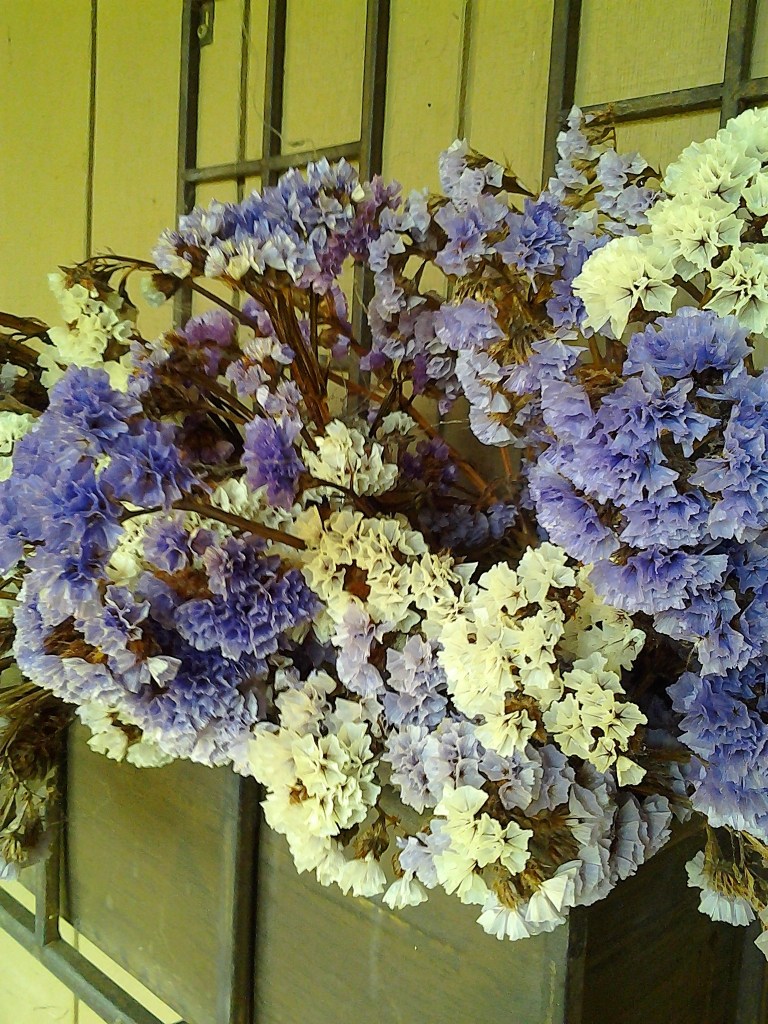
These flowers were cut weeks ago, and will look just as fresh months later.

Statice, strawflower and globe thistle continue to bloom later than most other summer annuals, and hold their flowers longer. Even after bloom, the flowers are so stiff and ‘crispy’ that they remain intact and colorful until they succumb to exposure to weather. If cut and brought in from the weather soon enough, they will last as dried flowers at least until fresh flowers start to bloom in the garden next spring.

Strawflower and larger globe thistle tend to wilt and droop from the weight of the bulky flowers, so should be tied in small bunches and hung upside down to dry. Perennial statice (which has larger blooms than annual statice) tends to flop to the ground, but the stems often bend only at the base so that the rest of the stem length stays somewhat straight. Smaller globe thistle and annual statice often dry standing up while still out in the garden.

Yarrow and English lavender can be dried as well, but lose most of their color. Lavender dries naturally in the garden. Yarrow can likewise be allowed to dry in the garden, but probably keeps a bit more color if cut while still fresh and hung upside down. Because yarrow blooms are so wide, they should be hung individually or in small bundles. Queen Anne’s lace has even wider blooms that curl inward as they dry, so they really should be hung individually.

Old hydrangea flowers that are only beginning to fade can dry surprisingly well if cut and hung individually before they deteriorate too much or start to rot. Some varieties retain color better than others. Some fade almost completely to an appealing brown paper bag.

There are not many roses this time of year, but when they do bloom, even they can be cut and dried while beginning to unfurl. Only a few small and tightly budded roses can be dried when completely open. Because they droop right below the blooms, roses should be hung upside down to dry. Dark colored roses get very dark as they dry. White roses turn tan. Pink and yellow are probably the better colors.

Cat-tails and pampas grass flowers are big, bold and dated cut flowers. Yet, for situations where big flowers fit, they are just as practical now as they were in the 1970s. Because pampas grass flowers shed, and cat-tails can explode (to disperse their seed), they should be sprayed with hair spray or another fixative to keep them contained. Pampas grass foliage has dangerously serrate edges that can give nasty paper cuts, so should be handled carefully, and displayed out of the way.

Tree Surgeons Evolved Into Arborists

Tree surgeons maintain the big trees.

Arborists are very specialized horticulturists. They prefer to work with trees. Of course that is not as simple as it sounds. Some are nurserymen who grow trees. Some select appropriate trees for landscape design. Even some of the orchardists who work with many trees of a similar type have earned this prestigious designation. Decades ago, we still knew many of them as tree surgeons.

Arboriculture, which is the specialized horticulture of trees, has certainly evolved through the decades. Tree surgeons no longer graft fruit trees directly in home gardens. Nurserymen graft trees in production nurseries, to make them available from retail nurseries. However, modern tree surgeons now work with much more diversity of many species that were unknown to their predecessors.

As storms become more frequent through autumn and winter, the need for arboriculture becomes more apparent. More unstable trees fall. More structural deficient limbs break. Many trees prefer to be pruned while dormant through winter. In actuality though, arboriculture is important throughout the year. Some procedures, for some sorts of trees, should happen significantly earlier or later.

Trees are the most substantial features of home gardens. Once they grow beyond reach, they need to be maintained by qualified tree surgeons. Regardless of what most say, very few gardeners are qualified to perform major arboricultural procedures. Many tree surgeons will attest to finding that most damage that trees endure is caused by gardeners with minimal regard for arboriculture.

Tree surgeons who are Certified Arborists of the International Society of Arboriculture, or ‘ISA’, have demonstrated their proficiency with arboriculture. After passing their certification examination, Certified Arborists maintain their credentials by continued involvement with educational seminars, classes and workshops of the ISA. Not many other horticultural professionals are so dedicated.

More information about procuring the services of an ISA certified arborist can be found at www.isa-arbor.com.

Many Perennials Want Seasonal Grooming

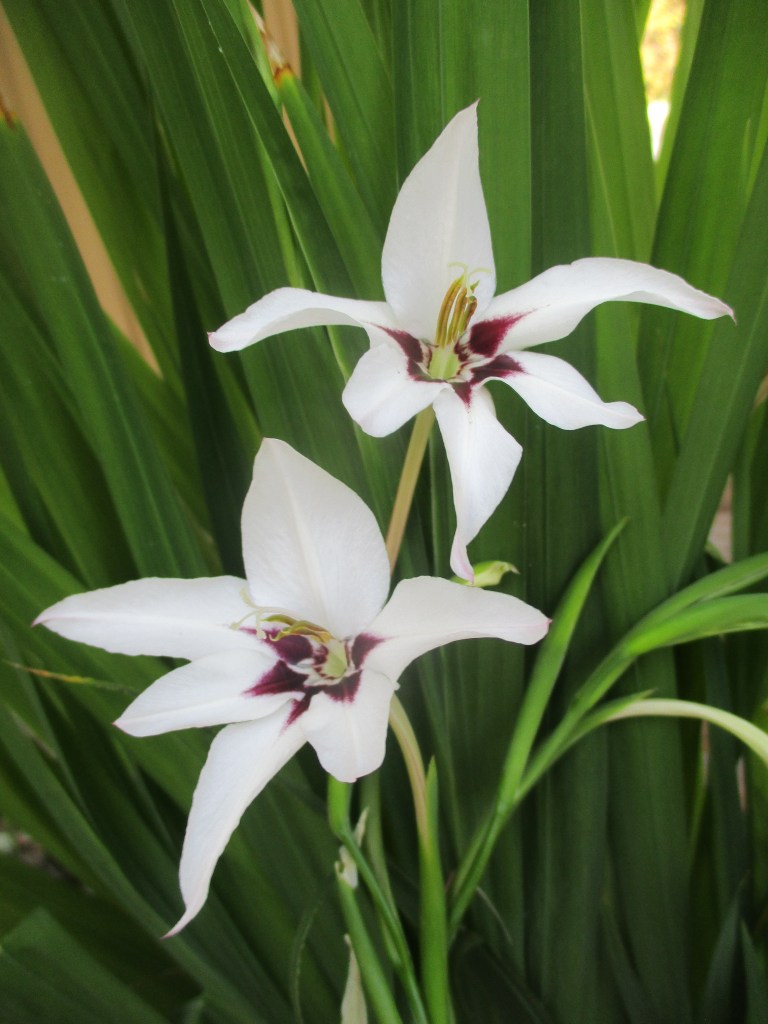
Peacock orchid bloom late, but eventually succumbs to frost and must be groomed.

Here on the west coast, autumn and winter weather is so mild that the native coral bells are already starting to develop new foliage on top of the old foliage from this last year. Technically, they are evergreen, so the old foliage does not need to be shed; but if it is not too much to ask, some types look better with a bit of grooming.

Other perennial plants that are from climates with stronger seasons and colder winters are not quite so evergreen. Many shed all of their foliage and are completely bare for at least part of the winter. Only a few, like cyclamen, are at their best through autumn and winter.

Dried watsonia foliage should be removed now if it has not been removed already. It is not so easy to pluck off like gladiola foliage is, so it should be cut off with shears. Because new foliage for next year develops before the old foliage of this past year is completely brown, it is often necessary to cut the old a few inches above the ground in order to avoid damaging the new.

The so called ‘evergreen’ daylilies can be even messier. New foliage is rather delicate, so it is easily tattered by the removal of old foliage. The ‘deciduous’ types may seem to be less appealing because they are bare for part of autumn and winter, but are so much easier to groom by simply removing all of the deteriorating old foliage as soon as it separates easily from the roots.

Deteriorating flowers can be removed from cannas; but their lush foliage can stay until it starts to deteriorate later in winter. Even if it survives winter, it should eventually be cut to the ground as it gets replaced by new growth in spring.

The many different iris have many different personalities. Most should be groomed sometime between summer and late autumn, although Dutch iris were groomed much earlier. Bearded iris that do not get divided can be groomed simply by plucking off big old leaves to expose smaller new shoots below.

Some dahlias bloom until they get frosted. Most though, are already finished. They do not need to be cut back all at once, but can be cut back in phases as leaves and stems dry and turn brown.

Leaf Litter Is Perfectly Natural

Mulch merely substitutes for leaf litter.

Forests lack gardeners. In the wild, there is no one to rake fallen leaves or blow them away. Foliage falls from trees and onto the ground, where it stays as it decomposes. It is the natural process. Raking and blowing leaf litter away is unnatural. It deprives the soil and organisms that inhabit it of significant organic matter that they crave. It also interferes with insulation and moisture retention.

Of course, there are some natural processes that are not so desirable in home gardens. After all, that is why raking and blowing is standard procedure. It is not practical to leave leaf litter on lawn, ground cover, pavement or roofs. Raking and blowing removes leaf litter from where it is unwanted, or at least moves it to where it is less visible. Leaf litter seems to be so useless and unwanted.

However, other procedures are necessary to compensate for the lack of leaf litter. Mulching insulates soil, retains soil moisture, and inhibits weed growth. Watering adjusts to deficient moisture in exposed soil. Weeding eliminates weeds that germinate and grow where there is nothing to inhibit them from doing so. Herbicide may be more practical. It is all so contrary to natural processes.

It is somewhat obvious why deciduous plants defoliate through autumn and winter. They do not need their foliage as much while days are shorter and sunlight is less intense. Also, they do not want to be battered by winter wind, or collect heavy snow. Yet, their desire to mulch their own soil is not so obvious. Evergreen plants do it also. They just do it slower, and generally throughout the year.

In fact, many evergreen plants are more efficient with their mulch than most deciduous plants are. Leaf litter of eucalypti, camphor, bay and nearly all conifers actually has a preemergent herbicidal effect. It inhibits germination of seed that can reach the soil. It can be a disadvantage for wildflowers, or an advantage for weed control. Incidentally, coniferous leaf litter is likely to be combustible.

Leaf litter, composted or left to its natural processes, is natural.